Sep 18, 2018 | Advocacy, Non-legal submissions
The ICJ today urged the UN Human Rights Council to establish a mechanism to preserve evidence of crimes under international law occurring in Myanmar, with a view to eventual prosecution of those responsible.
The statement, delivered during an interactive dialogue with the UN International Fact Finding Mission, read as follows:
“The International Commission of Jurists (ICJ) has monitored justice and human rights in Myanmar for more than five decades. The ICJ has an established presence in the country supporting justice actors to protect human rights through the rule of law.
With this experience, the ICJ views the Independent International Fact Finding Mission’s conclusions as painting an authoritative picture of the general situation in Myanmar, particularly in its highlighting of the pervasive damage of military impunity upon human rights, rule of law and the nascent democratic process.
The rule of law cannot be established, let alone flourish, without accountability for perpetrators of human rights violations and redress for victims and their families.
The Fact Finding Mission’s findings of crimes under international law, including crimes against humanity in Rakhine, Kachin and Shan states, and the identification of alleged perpetrators, necessitate immediate action.
The Government of Myanmar is unwilling and unable to effectively and genuinely provide justice for crimes, particularly when perpetrated by security forces. International action must not be deterred or delayed by the latest government inquiry, which is incapable of providing accountability or redress and may promote impunity by undermining credible international justice mechanisms.
The ICJ calls for a unified Council resolution at this session to establish an International Impartial and Independent Mechanism. This is urgently required to preserve evidence before its further deterioration, and to demonstrate a commitment to justice. Failing to act now risks further denying justice for victims and emboldening perpetrators.
Violations against Rohingya constitute an egregious yet emblematic example of systematic persecution of minority groups that has persisted in Myanmar for decades.
The ICJ would like to ask the Fact-Finding Mission: how can the Council best ensure accountability for the full range of crimes under international law committed against minorities throughout Myanmar and prevent their continuation and recurrence?”
For more information see:
Myanmar: why an IIIM and Security Council referral are needed despite the ICC ruling relating to Bangladesh
Myanmar: Government’s Commission of Inquiry cannot deliver justice or accountability
Sep 17, 2018 | Events, Multimedia items, News, Video clips
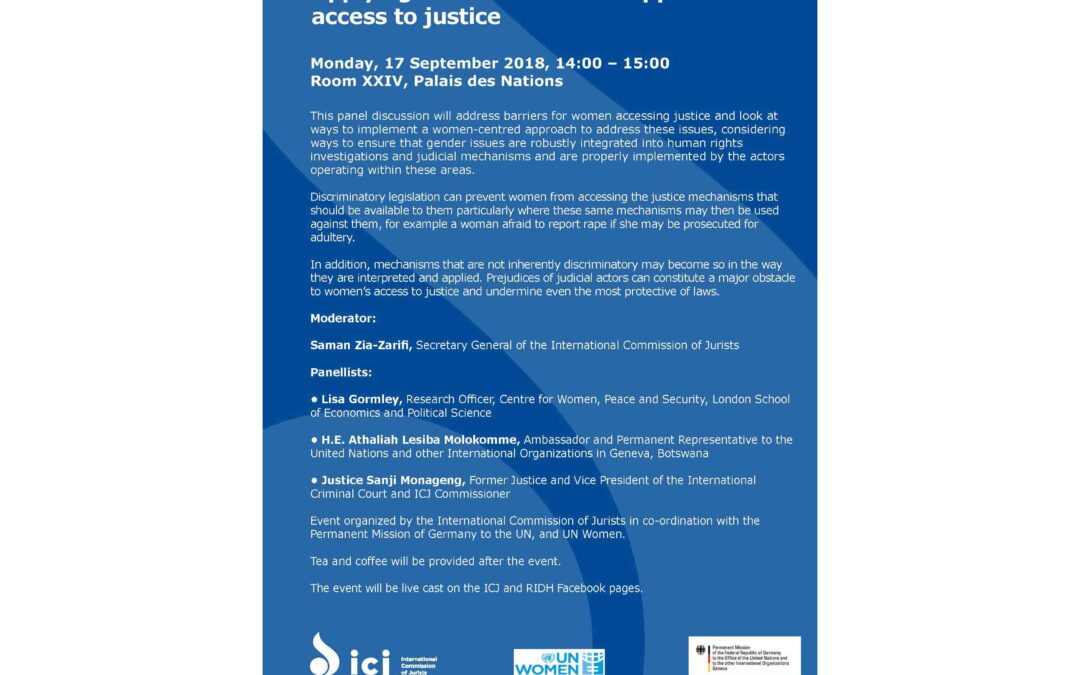
This panel discussion was held today at the Palais des Nations in Geneva.
The event addressed barriers for women accessing justice and look at ways to implement a women-centred approach to address these issues, considering ways to ensure that gender issues are robustly integrated into human rights investigations and judicial mechanisms and are properly implemented by the actors operating within these areas.
Discriminatory legislation can prevent women from accessing the justice mechanisms that should be available to them particularly where these same mechanisms may then be used against them, for example a woman afraid to report rape if she may be prosecuted for adultery.
In addition, mechanisms that are not inherently discriminatory may become so in the way they are interpreted and applied. Prejudices of judicial actors can constitute a major obstacle to women’s access to justice and undermine even the most protective of laws.
Moderator:
Saman Zia-Zarifi, Secretary General of the International Commission of Jurists
Panellists:
• Lisa Gormley, Research Officer, Centre for Women, Peace and Security, London School of Economics and Political Science
• H.E. Athaliah Lesiba Molokomme, Ambassador and Permanent Representative to the United Nations and other International Organizations in Geneva, Botswana
• Justice Sanji Monageng, Former Justice and Vice President of the International Criminal Court and ICJ Commissioner
Event organized by the ICJ in co-ordination with the Permanent Mission of Germany to the UN, and UN Women.
Watch the video:
https://www.facebook.com/ridhglobal/videos/565112000574216/
Side event ICJ WHR (flyer in PDF)
Sep 17, 2018 | Advocacy, Non-legal submissions
Today at the UN Human Rights Council, the ICJ emphasised the importance of effective investigations capable of leading to truth and justice, highlighting recent developments in Manipur, India as an example.
The statement read as follows:
“Justice processes in situations of conflict or transition require fighting impunity and re-establishing public trust.[1] An example is the new prospects for justice in relation to 1528 alleged extrajudicial killings cases in Manipur, India, which would make an important contribution to a transition out of the long-standing conflict.
In July 2016, in response to a petition filed on behalf of the victims, the Indian Supreme Court stated that “there is no concept of absolute immunity from trial…”,[2] opening the door to ending impunity. As of August 2018, the Central Bureau of Investigation has registered 29 complaints against security forces.[3] Recent reports suggest that the Government is also considering amending the Armed Forces Special Powers Act (AFSPA) to remove or restrict existing overbroad authorizations for use of lethal force.[4]
These are welcome developments. However, concerns remain, as the investigation status of the majority of the cases is unknown. Two UN Special Rapporteurs in July 2018 also affirmed that justice must be done in all cases.[5]
The ICJ calls on India to ensure independent, impartial and thorough investigations into all cases in Manipur, amend AFSPA, and to uphold the right to truth of victims and society about acts committed and the identity of perpetrators, in line with its international and national legal obligations, including as a party to the International Covenant on Civil and Political Rights.”
[1] Report of the Special Rapporteur on the promotion of truth, justice, reparation and guarantees of non-recurrence, A/HRC/39/53 (25 July, 2018), http://www.undocs.org/A/HRC/39/53.
[2] Para 163, Extra Judicial Execution Victim Families Association (EEVFAM) & Anr. v. Union of India & Anr. Writ Petition (Criminal) No. 129/2012.
[3] TNN, “Army Major named in FIR for killing 12-yr-old in fake Manipur encounter”, Times of India, August 3, 2018, https://timesofindia.indiatimes.com/city/imphal/army-major-named-in-fir-for-killing-12-yr-old-in-fake-manipur-encounter/articleshow/65252258.cms.
[4] “In AFSPA, Government Considering Crucial Changes”, NDTV, September 13, 2018, available at https://www.ndtv.com/india-news/in-afspa-government-considering-crucial-change-sources-1915706.
[5] Special Rapporteur on extrajudicial, summary or arbitrary executions and Special Rapporteur on the situation of human rights defenders, “India: UN experts call for urgent progress in investigation of hundreds of ‘fake encounter’ killings” (4 July 2018), https://www.ohchr.org/en/NewsEvents/Pages/DisplayNews.aspx?NewsID=23323&LangID=E .
Sep 11, 2018 | Advocacy, Non-legal submissions
The ICJ today addressed the new UN High Commissioner for Human Rights, Michelle Bachelet, highlighting the role of her office in countering global threats to the rule of law and human rights.
The statement was made at the UN Human Rights Council, during general debate on the High Commissioner’s oral update. It read as follows:
“Madam High Commissioner,
The International Commission of Jurists (ICJ) warmly welcomes you to your new mandate – a mandate that the ICJ has, since 1964, fought to create and support.
A multitude of issues and situations urgently call for your attention. However, a dark cloud looms over them all, and casts its shadow across the globe, including in this chamber. From different directions, various political actors driven by authoritarian ideologies and impulses, thirst for power and fraudulent populisms, grow in strength and are joining forces to mount a concerted attack on the rule of law.
They openly scorn the stated aims of the UN Charter, including “faith in fundamental human rights” and the maintenance of “justice and respect for … international law.” They seek to undermine, defame, and destroy global, regional and national institutions built over decades as bulwarks to protect human rights and human dignity. They thrive on silence or passivity by global leaders and populations, as they assault independent judiciaries, media, and civil society.
Madam High Commissioner, you can make a unique impact by speaking forcefully and publicly in defense of human rights and the rule of law, in defense of victims, and against governments and individuals who demonstrate their hostility or indifference to these aims. The ICJ stands ready to support you and your office in the challenges that lie ahead.
Thank you.”
Jul 11, 2018 | Advocacy, Non-legal submissions
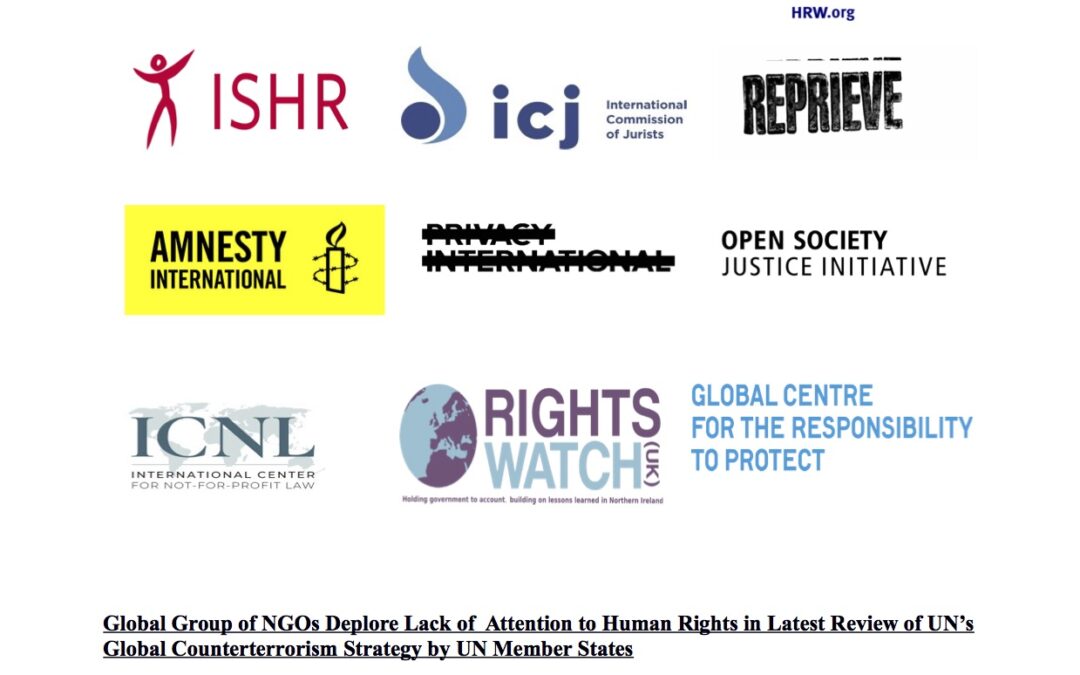
The ICJ today joined other civil society organizations in calling for respect for human rights, and protection of and participation by civil society, to have a greater role in the UN Global Counter-terrorism Strategy.
The joint statement by the organizations followed adoption by the UN General Assembly on June 26th, 2018 of Resolution 72/284, reviewing the United Nations Global Counter-Terrorism Strategy. The UN’s Global Counterterrorism Strategy, first adopted in 2006, sets out a plan of action for the UN and member states at the global, regional, and national level to counter-terrorism.
The organizations emphasise the value of a global counter-terrorism strategy where human rights are an essential component. It notes that the General Assembly resolution importantly reaffirms states’ obligations to comply with international law, including international human rights law, while countering terrorism and that human rights are the “fundamental basis of the fight against terrorism.”
The joint statement expresses concern at States’ failure to adequately address human rights abuses in relation to counter-terrorism measures. It also sets out concerns about member states’ failure to provide an enabling environment for civil society entities, including those relating to women, to be meaningfully engaged in the Strategy review.
The full statement and list of organizations joining it can be downloaded in PDF format here: UN-Advocacy-JointStatement-CounterTerrorismStrategy-2018