Jun 20, 2018 | Advocacy, Non-legal submissions
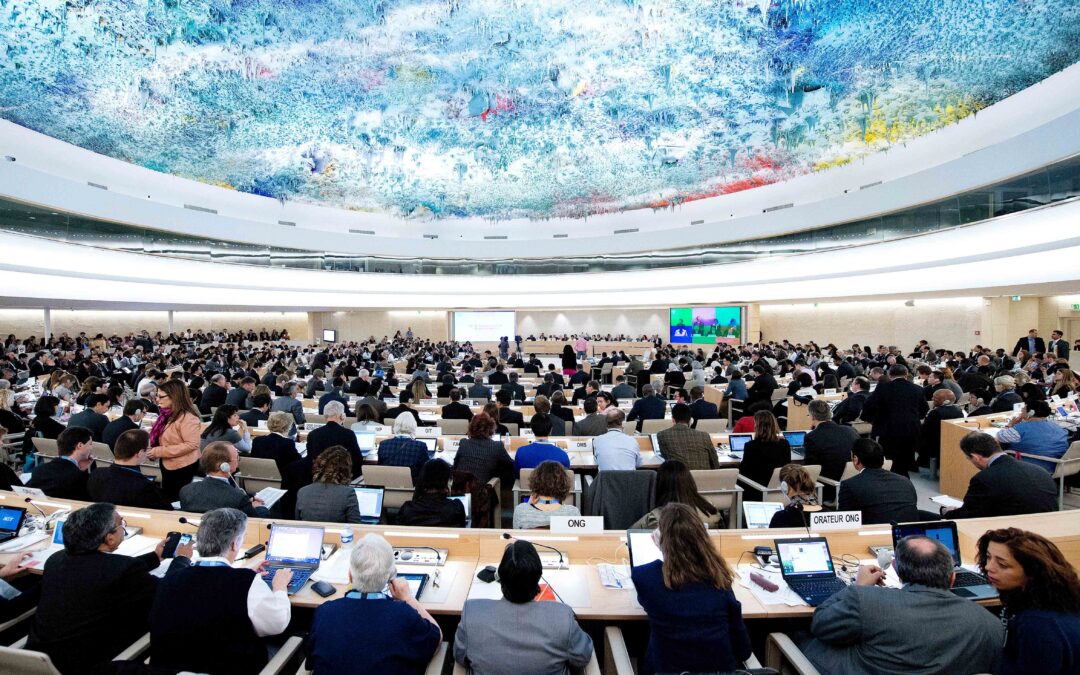
At the UN the ICJ today addressed abuse of laws in Southeast Asia to restrict freedom of expression.The statement was made in an interactive dialogue with the UN Special Rapporteur on Freedom of Expression, at the UN Human Rights Council in Geneva. It read as follows:
“The ICJ welcomes the report of the Special Rapporteur on Freedom of Expression (A/HRC/38/35), on online expression. Such concerns are reflected in the continued weaponization of laws to criminalize and unduly restrict freedom of expression in Southeast Asia. Increasingly, laws are misused to harass and intimidate civil society, journalists, politicians and ordinary individuals.
For example, in Cambodia, three persons were arrested – two charged and detained in May, and one reportedly arrested this past weekend – for sharing content on Facebook in alleged violation of a recent lèse majesté law. Another man was similarly detained, and a woman extradited from Thailand to Cambodia and imprisoned, for Facebook posts deemed critical of the government. An inter-ministerial order signed last month now allows government agencies to monitor and censor information on websites and social media.
Another example is Vietnam, where as well-known bloggers remain in jail, last week lawmakers adopted a cybersecurity law that will compel companies to store users’ data in-country, pass personal data to government authorities, and censor information online when directed to do so by the government.
A further example is Thailand, where this year alone at least 132 people were charged for “illegal assembly” after protesting for elections to be held – 27 were also charged with a sedition-like offence carrying a maximum penalty of seven years’ imprisonment. Last week, arrest warrants were reportedly issued alleging dissemination of false information on Facebook, which may lead to charges under the Computer Crimes Act carrying a maximum penalty of five years’ imprisonment, despite international standards precluding imprisonment as an appropriate penalty.
The ICJ urges all States to implement the recommendations in the report of the Special Rapporteur, and to ensure the right to freedom of expression by revoking or amending all laws, orders, policies or other actions which unjustifiably restrict this fundamental freedom.”
Jun 19, 2018 | Advocacy, Non-legal submissions
The ICJ today joined other NGOs in calling for the UN Human Rights Council to establish an international investigation into extrajudicial killings in the ‘war on drugs’ in the Philippines.The call came in a joint oral statement to the Council, delivered by Franciscans International on behalf of the group of NGOs. The statement, part of the general debate on a global update provided to the Council by the High Commissioner for Human Rights, read as follows:
“Mr President, we welcome the High Commissioner’s update. We are pleased to hear about positive developments that several States have made in granting access to Special Procedures. However, we deeply regret that this is not the case for the Philippines, a member of the Human Rights Council, which has refused access to the Special Rapporteur on extrajudicial executions, in spite of the thousands of killings in the government’s ongoing ‘war on drugs’, and the lack of independent and impartial investigations in the country.
We are further concerned that the lack of cooperation with Special Procedures has been further compounded by the Philippine President’s threats and verbal attacks against several mandate holders and the High Commissioner himself. In the absence of cooperation with Special Procedures, we call on the Council to establish an independent international investigation into extrajudicial killings in the ‘war on drugs’ in the Philippines.
As this was the last update of the High Commissioner to the Council, we would like to express deep appreciation for his hard work and dedication over his four year term, and the attention he has drawn to threats to human rights defenders and their work in the Philippines. We call on the Council to follow up on this work by mandating the OHCHR to monitor the deterioration in the situation of human rights and attacks on democratic institutions, as well as the Philippine government’s moves toward authoritarianism, and ask the OHCHR to report on this to the Human Rights Council.”
In 2016 the ICJ released a briefing paper on investigation of extrajudicial executions in the Philippines, which among other things called for an independent commission of inquiry, after having earlier written directly to President Duterte.
May 30, 2018 | Advocacy, Non-legal submissions
The ICJ today made a submission for an upcoming report by the UN Secretary General on recent developments concerning human rights in the administration of justice.
In 2016, the UN General Assembly requested the Secretary General “to submit to the General Assembly at its seventy-third session a report on the latest developments, challenges and good practices in human rights in the administration of justice, including on efforts to ensure equal access to justice for all through the independent, impartial and effective administration of justice, and on the activities undertaken by the United Nations system as a whole”.
The UN is in the process of preparing the report, which will cover developments during the last two years since the previous report of the Secretary General.
The ICJ’s submission can be downloaded in PDF format here: UN-GA-AdminJustice-2018
May 28, 2018 | Advocacy, Non-legal submissions
Today, the ICJ and 22 other rights organizations submitted a paper to the 30th meeting of Chairs of the human rights treaty bodies (Chairpersons meeting) in New York (28 May-1 June).
This paper is presented to the 30th meeting of Chairs of the human rights treaty bodies (Chairpersons meeting) by non-governmental organizations that contribute to many aspects of the work of the treaty bodies, including by encouraging and supporting national partners in their use of the system.
It focuses on existing good practices in treaty body working methods and makes recommendations for further discussions.
The signing NGOs hope that this submission will provide a basis for an effort by the treaty body Chairpersons to take stock of some of the important changes to working methods that the treaty bodies have undertaken and lead to further discussion on areas where greater alignment of working methods would make a particularly meaningful contribution to NGOs’ efforts to engage with the treaty bodies and promote better implementation by States of their human rights obligations.
Universal-Amnesty-Submission-to-the-30th-meeting-of-chairs-of-the-human-rights-treaty-bodies-Advocacy-non legal submission-May-2018-ENG (Full text in PDF)
May 18, 2018 | Advocacy, Non-legal submissions
Speaking today at a special session of the UN Human Rights Council, the ICJ joined calls for an independent international inquiry into the use lethal and other force by Israeli security forces in Eastern Gaza.
The statement read as follows:
The International Commission of Jurists (ICJ) deplores apparent violations of international law by Israeli security forces during the past six weeks in Eastern Gaza near the border with Israel, in relation to demonstrations by Palestinians.
The ICJ is concerned at the many killings and serious injuries associated with the excessive, unjustified or otherwise unlawful use of force, including the killing of a number of children.
The ICJ recalls that international human rights law permits use of lethal force only when strictly necessary to protect life. The ICJ understands that Israel has taken the position that only the international law of armed conflict, and not international human rights law, was applicable, and that all lethal force used against protestors was justified. The ICJ insists that human rights law – and specifically, standards on the use of force in law enforcement contexts – was indeed applicable, and that the use of lethal force was in the circumstances wholly unjustified.
Excessive force, including lethal force, has apparently been used against unarmed persons who do not pose a threat to life. Irrespective of legal regime, such use of force is manifestly inconsistent with the principles of necessity and proportionality.
The ICJ joins the call for this Council to establish an independent Commission of Inquiry or similar investigation, to ensure accountability for serious violations of international law.
Update: The session concluded with the adoption (29 yes, 2 no, 14 abstained) by the Council of a resolution establishing a Commission of Inquiry.