Feb 12, 2018 | News
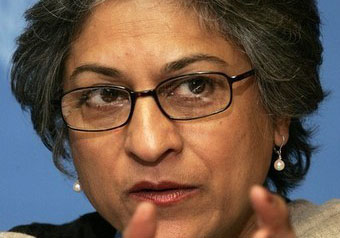
The ICJ mourns the loss of its former Commissioner, Executive Committee Member and Honorary Member, Asma Jahangir, who was at the frontline of the struggle for the rule of law and human rights in Pakistan and around the world.
Ms. Jahangir died of cardiac arrest on Sunday, 11 February, in Lahore, Pakistan. She was 66.
“The ICJ benefited immeasurably from Asma Jahangir’s contribution and leadership. She was a giant of the human rights movement, dedicated to defending the rule of law and fighting for the rights of everyone – including her fiercest detractors,” said Sam Zarifi, ICJ’s Secretary General.
Asma Jahangir was elected to the ICJ in 1998, and went on to serve on the organization’s Executive Committee until the end of her term.
She continued to work closely with the ICJ as an Honorary Member.
Asma Jahangir started her journey as a human rights defender as a petitioner is a case challenging the military dictatorship of Yahya Khan. She was only 19 at the time.
She continued throughout her life to be an outspoken critic of military rule and abuses in Pakistan and at the forefront of the struggle for human rights and the rule of law in the country.
In 1987 she co-founded the Human Rights Commission of Pakistan, which remains one of the oldest and most preeminent human rights organizations in the region.
Asma Jahangir was a senior advocate of the Supreme Court with a legal career spanning nearly forty years.
In 1987, along with other women lawyers, she established the first legal aid cell in the country for free legal representation to women, children, bonded laborers and religious minorities.
She also made lasting contribution to the human rights globally, and served as a UN Special Rapporteur for three different mandates: Extrajudicial, summary or arbitrary executions (1998 to 2004); freedom of religion or belief (2004 to 2010); and the situation of human rights in Iran (2016 – 2018).
In the course of her work as a human rights activist, she was repeatedly threatened, put under house arrest and even imprisoned. However, these attacks did not deter her from her commitment to human rights.
“Asma Jahangir’s brave, powerful voice for human rights and dignity has fallen silent much too soon. We will miss her and strive to live up to her example,” said Zarifi.
Last year, Asma Jahangir participated in ICJ’s Women profiles video series:
Asma Jahangir profile
Jan 31, 2018 | Advocacy, Non-legal submissions
The ICJ submitted a written statement on impunity and transitional justice, ahead of the March 2018 session of the UN Human Rights Council.
The written statement can be downloaded in PDF format below:
In English: UN-HRC37-WrittenStatement-NepalPeruImpunity-EN
In Spanish: UN-HRC37-WrittenStatement-NepalPeruImpunity-ESP
Jan 29, 2018 | Advocacy, Non-legal submissions
Today, the ICJ and Thai Lawyers for Human Rights (TLHR) filed their joint submission to the UN Committee against Torture (Committee).
The Committee will consider it during the adoption of a list of issues prior to reporting (LOIPR) for the examination of the Second Periodic Report of Thailand under Article 19 of the Convention against Torture and Other Cruel, Inhuman or Degrading Treatment or Punishment (CAT).
During its 63rd session, from 23 April to 18 May 2018, the Committee will prepare and adopt a LOIPR on Thailand.
Once adopted, the LOIPR will be transmitted to the State party. Thailand’s formal response to the LOIPR will then constitute its Second Periodic Report under article 19 of the Convention.
Thailand ratified the CAT in 2007. Following its review of Thailand’s initial report under CAT, the Committee adopted its Concluding Observations at its 52nd Session in May 2014.
The ICJ and TLHR’s joint submission to the Committee highlights a number of ongoing concerns with respect to the country’s implementation of and compliance with the provisions of the CAT.
In addition, the joint submissions formulates certain questions and recommends that the Committee should include them in its LOIPR and address them to the Government of Thailand, including on the following pressing issues:
- The fact that, since the coup d’ état of 22 May 2014, the constitutional and legal framework in force in Thailand has increased opportunities for legally-sanctioned impunity;
- The failure to criminalize through the adoption of bespoke domestic legislation the crimes of torture, cruel, inhuman or degrading treatment or punishment and enforced disappearance, consistent with the CAT and other relevant international law;
- The failure to conduct investigations of credible allegations of enforced disappearances, as well as into credible reports of the widespread use of torture and other ill-treatment in a prompt, effective, independent and impartial manner in numerous cases; and
- Threats and reprisals against persons working to bring to light cases of alleged torture, other ill-treatment and enforced disappearance.
Contact
Kingsley Abbott, Senior International Legal Adviser, ICJ Asia Pacific Programme, t: +66 94 470 1345, e: kingley.abbott@icj.org
Thailand-CAT Submission-Advocacy-non-legal submission-2017-ENG (Full submission in PDF)
THAILAND-CAT additional info-Advocacy-2018-ENG (additional information, updated in April 2018)

Dec 8, 2017 | News
US President Donald Trump’s declaration recognizing Jerusalem as Israel’s capital and indicating an intention to move its embassy there, dangerously ignores long-standing international law, the ICJ said today.
Numerous United Nations Security Council’s Resolutions have reiterated the inadmissibility of the acquisition of territory by war, and have urged the withdrawal of Israel armed forces from territories occupied in the 1967 conflict, including East Jerusalem.
Trump’s announcement turns a blind eye on this legal reality and the related 50 years of occupation.
It also implicitly condones Israeli policies and practices that aim at altering the character and status of the Palestinian territory, including through the annexation of East Jerusalem, particularly by failing explicitly to similarly endorse Palestinian claims to East Jerusalem.
“Trump’s declaration cannot form the basis for any alteration of the status of Jerusalem under international law. However, it has the potential of provoking and fuelling a new cycle of violence in the region,” said Said Benarbia, ICJ MENA Director.
Thousands of Palestinians have taken to the streets to protest against Trump’s declaration. Dozens were injured in clashed with Israeli forces.
“The Israeli authorities should guarantee the right to peaceful protest and refrain from any disproportionate use of force against protesters, including the unlawful use of lethal force,” Benarbia added.
Background
The 2016 UN SC Resolution 2334 specifically reiterate that the Security Council “will not recognize any changes to the 4 June 1967 lines, including with regard to Jerusalem, other than those agreed by the parties through negotiations,” and that “the establishment by Israel of settlements in the Palestinian territory occupied since 1967, including East Jerusalem, has no legal validity and constitutes a flagrant violation under international law and a major obstacle to the achievement of the two-State solute on and a just, lasting and comprehensive peace.”
This reaffirms a series of similar resolutions by the Security Council since 1967.
Palestine-Trump Decla-News-2017-ARA (Statement in Arabic, PDF)
Dec 5, 2017 | Advocacy, Non-legal submissions
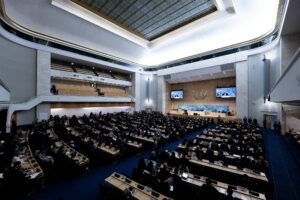
The ICJ today addressed an emergency Special Session of the UN Human Rights Council on Myanmar, outlining key requirements for the protection of the Rohingya minority, including safe and voluntary return of refugees.The Special Session is expected to adopt a resolution to address “The human rights situation of the minority Rohingya Muslim population and other minorities in the Rakhine State of Myanmar.”
The ICJ statement read as follows:
“It is encouraging that the Governments of Bangladesh and Myanmar have recognized the right of displaced Rohingya to return to their places of residence.
However, any provisions for return must comply with international law, including as regards non-refoulement. Effective guarantees that all displaced persons will be able to return to their place of prior residence in a safe, dignified, voluntary and sustainable manner, without discrimination, are essential.
Rohingya refugees must also be provided with alternatives to return, including the option of seeking international protection. Anything short of this would amount to their forcible return and thus violate the non-refoulement principle.
It is of the utmost urgency that the gross and systematic violations that have given rise to the forced displacement are immediately brought to an end and that measures are taken to prevent their recurrence, including by holding perpetrators responsible.
No-one may be forcibly returned to the current circumstances that prevail in Rakhine State, and voluntary returns will only ultimately take place if and when refugees are satisfied they are not returning to further violations in Myanmar.
Any provisions for restrictions on freedom of movement upon return are also of concern, particularly given past experience, with internment camps housing tens of thousands of Muslims displaced in 2012 still in place. Such restrictions elsewhere in Rakhine State contribute to violations of, among other things, the human rights to life, to health, to food, to education and to livelihoods.
To ensure that the rights of refugees are respected and protected, Bangladesh and Myanmar should immediately seek to ensure that UNHCR is involved, and its guidance followed, in any discussion of repatriation processes.
The Government of Myanmar must cooperate with the UN-mandated Fact Finding Mission to independently establish facts and provide a proper foundation for effective responses to human rights violations and humanitarian crises in Rakhine State, as well as in Shan and Kachin States, whose populations also face related patterns of human rights violations by military and security forces.”
The Council adopted a resolution at the end of the session, which reflects many of the concerns raised by the ICJ and others: A_HRC_S_27_L1