Oct 5, 2017 | News
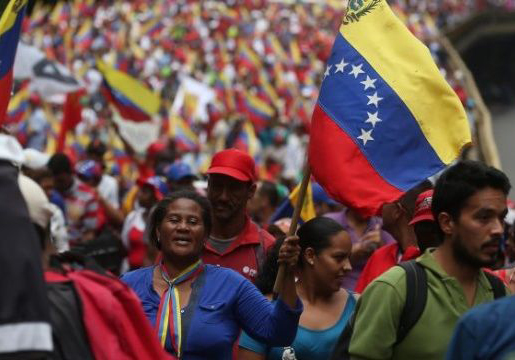
The ICJ calls for Venezuela to accept long-standing requests for country visits by UN Special Procedures whose mandates are most relevant to the rule of law and human rights crisis in the country.
The ICJ takes note of the announcement by the Venezuelan Government that it is inviting the UN Independent Expert on the promotion of a democratic and equitable international order, Mr. Alfred de Zayas, to visit the country.
This announcement, together with a recent invitation to the Special Rapporteur on the right to development is significant. For more than a decade, the Venezuelan Government has denied or left unanswered requests for visits to the country by numerous other of the independent experts (known as “Special Procedures”) of the United Nations. The last mission to Venezuela by a special procedure was the Special Rapporteur on Torture in 1996.
However, the breakdown of the rule of law and the extremely serious human rights situation in Venezuela make visits by other United Nations Special Procedures of urgent relevance.
“In the course of this year, extrajudicial and arbitrary executions, torture and ill-treatment of detainees, arbitrary detention, trial of civilians by military tribunals, and persecutions and attacks against opponents, dissidents and human rights defenders have become systematic and generalized practices in Venezuela, said Federico Andreu Guzman, ICJ South America Representative.
“It is therefore difficult to see why the Government of Venezuela would not respond to long-standing requests from Special Procedure mandates relevant to these violations in favour of proactively inviting other UN experts”, Andreu Guzman added.
The ICJ therefore calls on the Government of Venezuela to invite to visit the country the Working Group on Arbitrary Detention and the Special Rapporteurs on extrajudicial, summary or arbitrary executions; the independence of judges and lawyers; torture and other cruel, inhuman or degrading treatment or punishment; the rights to freedom of peaceful assembly and association; the promotion and protection of the right to freedom of opinion and expression; and on the situation of human rights defenders. All of these UN experts have long-standing requests to visit Venezuela, some for many years, which the Venezuelan Government has failed so far to accept.
“Under the Charter of the United Nations, Member States have the obligation to cooperate with the UN Special Procedures on human rights. This duty is of particular importance when the State is a member of the Human Rights Council, as is the case with Venezuela”, said Andreu Guzman.
The ICJ also calls on the Government of Venezuela to accept the request for a visit to the country that, since 2004, has been repeatedly issued by the Inter-American Commission on Human Rights.
Background
For several years, the following Special Procedures of the UN Human Rights Council have made requests to visit Venezuela: the Special Rapporteur on extrajudicial, summary or arbitrary executions; the Special Rapporteur on the situation of human rights defenders; the Working Group on Arbitrary Detention; the Special Rapporteur on the independence of judges and lawyers; the Special Rapporteur on the rights to freedom of peaceful assembly and association; the Special Rapporteur on violence against women, its causes and consequences; the Special Rapporteur on torture and other cruel, inhuman or degrading punishment; the Special Rapporteur on the promotion and protection of the right to freedom of opinion and expression; the Working Group on the issue of human rights and transnational corporations and other business enterprises; the Special Rapporteur on adequate housing as a component of the right to an adequate standard of living; and the Special Rapporteur on the right to food.
At the regional level, although it denounced the American Convention on Human Rights in September 2012, Venezuela is still a State party to three Inter-American human rights treaties (Inter-American Convention to Prevent and Punish Torture; Inter-American Convention on Forced Disappearance of Persons; and Inter-American Convention on the Prevention, Punishment and Eradication of Violence Against Women). However, Venezuela has systematically ignored recommendations of the Inter-American Commission on Human Rights (IACHR) and has also denied IACHR requests to visit the country, made since 2004.
Contacts
Federico Andreu-Guzmán, ICJ South America Representative, tel: +57 311 481 8094; email: federico.andreu(a)icj.org
Carlos Ayala Corao, ICJ Commissioner (Venezuela), tel: +57 414 243 4872; email: cayala(a)cjlegal.net
Alex Conte, ICJ Global Redress and Accountability Initiative, tel: +22 979 3802; email: alex.conte(a)icj.org
Oct 2, 2017 | Advocacy, Non-legal submissions
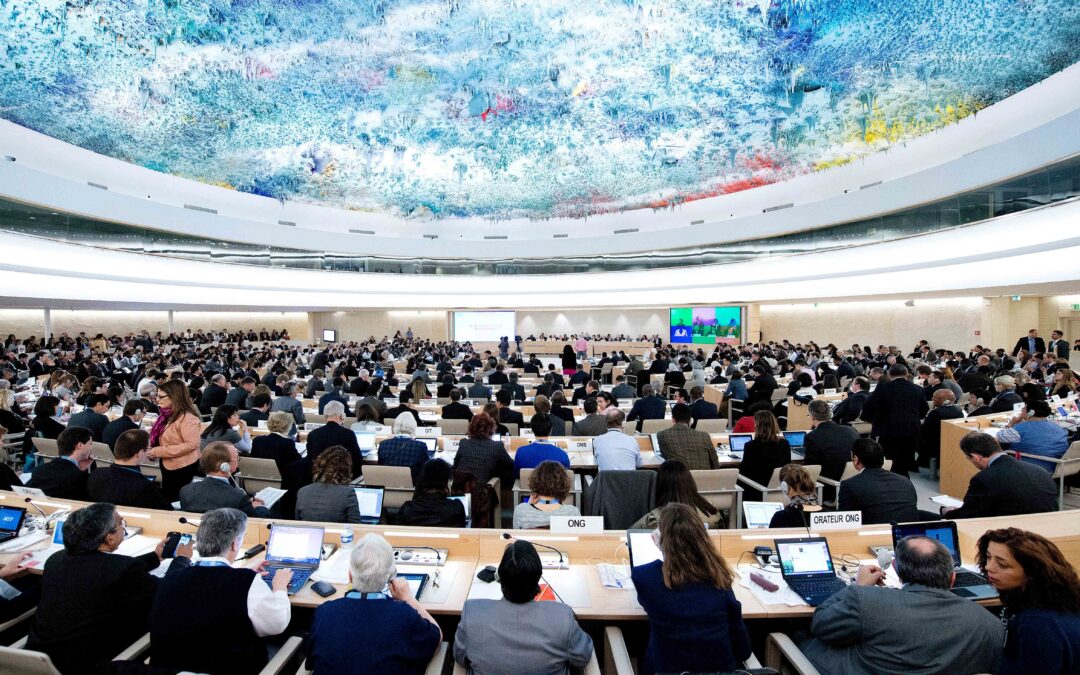
The ICJ has joined other NGOs in welcoming action by the HRC on Yemen, Burundi, and DRC, as well as on reprisals and intimidation against civil society and human rights defenders, and the death penalty, while expressing disappointment about lack of adequate action on other matters.
The full statement is as follows:
Joint statement by International Service for Human Rights on behalf of Amnesty International, Asian Forum on Human Rights and Development (Forum Asia), Cairo Institute for Human Rights Studies (CIHRS), CIVICUS, Human Rights House Foundation, International Commission of Jurists and the International Lesbian, Gay, Bisexual, Trans and Intersex Association (ILGA).
We welcome the adoption of the resolution intended to end acts of intimidation or reprisals. However, we regret that a small group of States – most of them regular perpetrators of acts of intimidation or reprisals – have tried to undermine the Council’s efforts to end reprisals. We thank the majority of the Council members for resisting these efforts.
We are concerned that there were attempts to dilute several resolutions at this Council with the insertion of so-called “sovereignty” clauses. While we welcome the fact that they were ultimately defeated, we are concerned that a significant number members seek to use the concept of Sovereignty to shield themselves and other States from international scrutiny.
We also welcome that the resolution on the death penalty urges States to not impose it as a sanction for specific forms of conduct such as apostasy, blasphemy, adultery and consensual same-sex relations.
We applaud the creation by consensus of an international investigative body on Yemen, and the broad State leadership on this issue. It sends a message that the people of Yemen have not been abandoned, and that accountability for international crimes is urgently required. We call on all parties to the conflict to fully cooperate with this mandate.
On Burundi, we welcome the extension of the mandate of the Commission of Inquiry (COI). This was the only credible response to the CoI’s concerns that crimes against humanity may have been committed, and the persistent non-cooperation of Burundi with both the COI and the OHCHR presence in the country. We urge Burundi to follow through on its promises to start cooperating with the UN system, in line with duties as HRC member, and – failing that – call on the General Assembly to take appropriate action.
On Myanmar, while we welcome the extension of the fact-finding mission’s mandate, we are disappointed that the Council did not do more to address the gravity of the situation on the ground, in particular acknowledging the disproportionate campaign of violence by Myanmar’s security forces in Rakhine State, which have forced around half a million Rohingya to flee to Bangladesh since 25 August. We urge States to use the ongoing UN General Assembly session to address what the High Commissioner for Human Rights described to the Council as a “textbook example of ethnic cleansing.”
On Cambodia, while the Council missed an opportunity for robust scrutiny of the worsening situation, the pre-election reporting in March should put authorities on notice.
On the Democratic Republic of the Congo (DRC), we welcome the Council’s decision to boost scrutiny of the human rights crisis for another year, which shows how horrific the situation has become. The DRC must now cooperate with all Council mechanisms, and the Council needs to keep its eyes on the country until all actors stop committing violations and abuses, and justice for victims has been obtained.
Finally, we regret the increasing effort spent on procedural tricks and manoeuvers by States in an attempt avoid scrutiny – including by abusing the privilege of being a member to seek to avoid scrutiny of their own situation – instead of spending diplomatic time and capital on ending human rights violations, which is the Council’s core mandate. A renewed commitment to addressing situations based on objective criteria is now more urgent than ever.
Oct 2, 2017 | News
The ICJ, APT, OMCT, FIACAT, Redress, Amnesty, IRCT, and Alkarama have constructed a checklist for membership to guide the States parties to the Convention against Torture and Other Cruel, Inhuman or Degrading Treatment or Punishment in selecting five new members later this month.
See Checklist here:
Universal-CriteriaMembership-News-2017-ENG
Sep 28, 2017 | Advocacy, Uncategorized
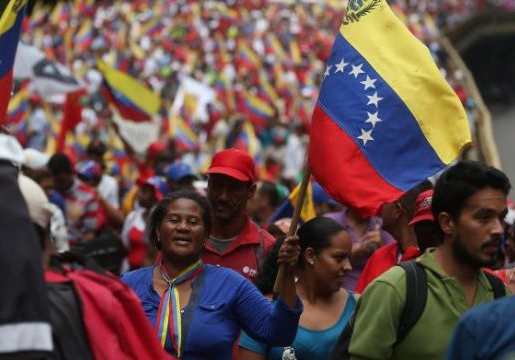
The ICJ today called on the UN Human Rights Committee and a group of UN Special Procedure mandates to take urgent follow up action on Venezuela in light of the grave and ever deteriorating human rights situation in the country.
In a letter to the UN Human Rights Committee, the treaty body responsible for monitoring implementation by States parties to the International Covenant on Civil and Political Rights (ICCPR), the ICJ called for urgent action by the Committee, either through its established follow-up procedure and/or through requesting a special interim report. The Committee’s follow-up procedure was referenced in the Committee’s Concluding Observations on Venezuela’s fourth periodic report under the ICCPR. Special interim reports may be requested by the Committee under Article 40(1)(b) of the ICCPR.
The ICJ also called for urgent action to be taken by the following UN Special Procedure mandates: the Working Group on Arbitrary Detention, the Special Rapporteur on freedom of opinion and expression, the Special Rapporteur on freedom of assembly and of association, the Special Rapporteur on the independence of judges and lawyers and the Special Rapporteur on torture and other cruel, inhuman or degrading treatment. This group of Special Procedure mandates had on 4 August 2017 issued a joint statement on the human rights situation in Venezuela.
The ICJ’s letters draw attention to several critical areas of concern:
- The rapidly deteriorating human rights situation;
- The lack of accountability of perpetrators of human rights violations;
- The lack of effective remedies and reparation for victims of human rights violations;
- The lack of independence of the judiciary;
- The institutional crisis arising from decisions of the Supreme Court of Justice;
- The unconstitutional election of the new National Constituent Assembly;
- The dismissal of the former Attorney General;
- The recent establishment of a ‘Truth Commission’;
- The intended revision of Venezuela’s Constitution; and
- Venezuela’s failure to notify its state of emergency under the ICCPR.
ICJ-Correspondence-VenezuelaFollowUp-HRCttee-2017-09-28 (download letter to the Human Rights Committee, in PDF)
ICJ-Correspondence-VenezuelaFollowUp-SPs-2017-09-28 (download letter to the Special Procedure mandates, in PDF)
ICJ reports:
Venezuela: the Supreme Court of Justice has become an arm of an authoritarian executive
Venezuela: rule of law and impunity crisis deepens
Venezuela: dismissal of Attorney General a further blow to the rule of law and accountability
Venezuela: Human rights and Rule of Law in deep crisis
Strengthening the Rule of Law in Venezuela
Sep 27, 2017 | Advocacy, Non-legal submissions
The ICJ today highlighted a sharp deterioration in the situation for human rights and the rule of law, in a statement to the UN Human Rights Council in Geneva.
The statement was delivered during the interactive dialogue with the Special Rapporteur on the situation of human rights in Cambodia, and read as follows:
“The International Commission of Jurists (ICJ) welcomes the report of the Special Rapporteur (UN Doc A/HRC/36/61) and strongly supports the renewal of her mandate.
Monitoring and action by the international community has seldom been more important for Cambodia since the Paris Peace Accords were signed in 1991.
Civil society, independent media and the political opposition are under sustained attack in what appears to be a carefully orchestrated effort to silence dissenting voices in the lead up to national elections in July 2018. Vague legal provisions in for instance the Law on Associations and Non-Governmental Organizations (LANGO) and the Law on Political Parties, are being weaponized to this end.
Human rights defenders and others, including the “ADHOC 4”, Ny Chakrya, Tep Vanny, Hun Vannak, Doem Kundy, and the President of the opposition party, Kem Sokha, face criminal charges with all the hallmarks of being politically motivated.
Prosecutors and judges lack independence and impartiality, and investigations routinely fall short of international standards, as in the case of the killing of political commentator Kem Ley.
Seeking to justify its actions, Cambodia frequently invokes the principle of the rule of law.
The ICJ, a global organisation of judges and lawyers, has worked for the rule of law for more than sixty years. The rule of law does not simply mean that laws exist and are enforced, but requires among other things: equal application of the law without discrimination, including due to political or other opinion, and ensuring that laws are only adopted and applied consistent with international human rights law.
What is happening in Cambodia today has nothing to do with the rule of law.
The ICJ would therefore ask the Special Rapporteur what further recommendations she has towards seeing the rule of law, as properly understood, truly reign in Cambodia.”
The Human Rights Council is expected to adopt a new resolution on Cambodia later this week. The ICJ and other non-governmental organisations have called for it to include additional monitoring and additional opportunities to discussion the situation at the Human Rights Council, before national elections scheduled for July 2018.