Nov 20, 2017 | Advocacy
The ICJ, with 35 other human rights organizations, today called on members and observers of the UN Human Rights Council to convene a special session on the deteriorating human rights situation in Myanmar.
In open letter to member and observer States of the Human Rights Council, delegations are urged to support holding a special session of the Council against the backdrop of serious reports of human rights violations, including crimes against humanity, committed by Myanmar security forces in northern Rakhine state.
The letter also sets out key elements that should be included in the text of a resolution adopted by the Human Rights Council at such a session, considering action that should be taken by the Government of Myanmar, as well as by neighbouring and other States and by human rights mechanisms.
The ICJ on the same day released a briefing note, entitled Questions & Answers on Human Rights Law in Rakhine State, clarifying national and international law and standards applicable to the crisis.
Myanmar Joint Civil Society Letter 20 November 2017 (download open letter in PDF format)
For a copy of the ICJ’s Q&A briefing, go to ‘Myanmar: rule of law must drive responses to Rohingya crisis’
Nov 10, 2017 | News
As Pakistan is set to undergo its third Universal Periodic Review (UPR) on 13 November, the ICJ has urged Pakistani authorities to meaningfully engage with the process to improve the human rights situation in the country.
“Pakistan’s past engagement with the UPR has been characterized by denial and defensive posturing,” said Frederick Rawski, ICJ’s Asia Director.
“As a recently-elected member of the UN Human Rights Council, it is more important than ever for the Pakistan to show that it takes its human rights obligations seriously by engaging with the upcoming UPR in its true spirit,” he added.
During its second UPR in 2012, Pakistan received 167 recommendations, of which it rejected seven, noted 34, and accepted 126.
The seven recommendations rejected by Pakistan relate to some of the most serious human rights violations in the country, including recommendations to adopt an official moratorium on the death penalty with a view to abolishing capital punishment in law and practice, repeal blasphemy laws, and decriminalize adultery and non-marital consensual sex.
Even accepted recommendations have been largely ignored in the four years since the previous UPR, the ICJ notes.
Enforced disappearances are still not recognized as a distinct, autonomous crime; perpetrators of gross human rights violations continue to escape justice; there has been complete inaction to prevent abuse of so-called blasphemy laws; and freedom of expression is often restricted on vague grounds such as “national security” and “immorality”.
“Pakistan’s human rights situation has in many ways deteriorated since 2012,” Rawski added.
“Yet – as reflected by Pakistan’s national report for the upcoming UPR – the authorities apparently remain in a state of denial about the dire human rights implications of these new measures,” he said.
These measures include the lifting the informal moratorium on the death penalty and carrying out nearly 500 executions in less than three years – among the highest in the world; passing laws allowing military courts to try civilians for certain terrorism-related offences; and a new wave of crackdowns on NGOs, journalists and human rights defenders, including retaliating against NGOs for presenting “a very bleak picture” of the country’s human rights situation to the UN.
“UN member states on Monday should urge Pakistan to end the dangerous downward spiral on rights by ending repression, respecting fundamental freedoms, and holding perpetrators of violations responsible,” Rawski said.
Contact
Frederick Rawski, ICJ Asia Pacific Regional Director, t: +66 64 478 1121, e: frederick.rawski(a)icj.org
Reema Omer, ICJ International Legal Adviser for Pakistan (London), t: +447889565691; e: reema.omer(a)icj.org
Additional information
The UPR is a unique mechanism of the UN Human Rights Council aimed at improving the human rights situation of each of the 193 UN Member States. Under this mechanism, the human rights record of all UN Member States is peer-reviewed every four to five years by the UPR Working Group, consisting of the 47 UN Member States of the Human Rights Council; however, any UN Member State can take part in the discussions and the dialogue during the UPR of the reviewed States. States then make recommendations to the country under review, which has the option of accepting or noting the recommendations.
Oct 16, 2017 | Advocacy
The ICJ, Amnesty International and Human Rights Watch are urging Pakistan to take immediate steps towards meeting “the highest standards in the promotion and protection of human rights,” following the country’s election to the Human Rights Council.
Today, the UN General Assembly selected 15 states to serve as members of the UN Human Rights Council from January 2018 to December 2020.
From the Asia-Pacific region, Nepal, Qatar, Afghanistan and Pakistan were selected out of five candidates.
To secure the UN Human Rights Council membership, Pakistan pledged its commitment to the promotion and protection of human rights.
However, the pledge failed to address directly many of the most serious human rights issues facing Pakistan, including enforced disappearances, the use of the death penalty, blasphemy laws, the country’s use of military courts, women’s rights including the right to education, and threats to the work of human rights defenders, lawyers and journalists.
According to UN General Assembly Resolution 60/251, “members elected to the Council shall uphold the highest standards in the promotion and protection of human rights.” The Resolution also provides that, “when electing members of the Council, Member States shall take into account the contribution of candidates to the promotion and protection of human rights and their voluntary pledges and commitments made thereto.”
Pakistan’s abuses have been highlighted by various national and international human rights organizations, UN treaty-monitoring bodies, and special procedures of the UN Human Rights Council.
Pakistan has affirmed in its election pledge that it is “firmly resolved to uphold, promote and safeguard universal human rights and fundamental freedoms for all.”
Given the pressing human rights issues in the country, the ICJ, Amnesty International, and Human Rights Watch urge Pakistan to take the necessary action to fulfill these responsibilities.
Contact
Frederick Rawski (Bangkok), ICJ Asia Pacific Regional Director, e: frederick.rawski(a)icj.org
Reema Omer (London), ICJ International Legal Adviser, South Asia t: +447889565691; e: reema.omer(a)icj.org
Download
The full statement with additional information: Pakistan-ElectiontoHRC-Advocacy-2017-ENG (in PDF)

Oct 10, 2017 | News
At UN General Assembly First Committee, over 40 organisations from across the world endorsed a statement calling on states to take concerted action to address harm from armed drones and work towards agreement on the limits of the acceptable use of these technologies.
Few states have raised this issue at the First Committee recently, despite the urgent need to address the peace and security implications of armed drones.
Universal-dronesstatement-advocacy-2017-ENG (full pdf)
Oct 6, 2017 | Advocacy, Non-legal submissions
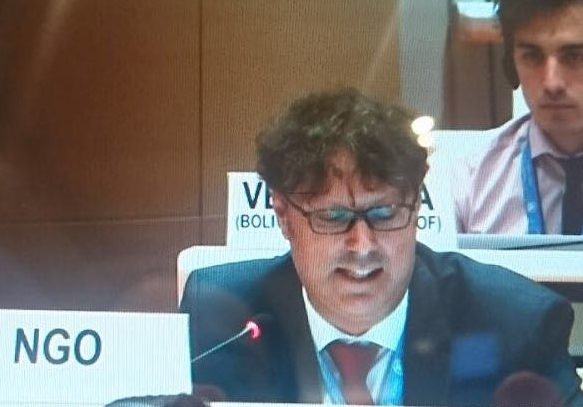
The ICJ today highlighted the role of judges, lawyers, and prosecutors at a UN seminar on prevention of torture in police custody and pre-trial detention.
The ICJ made the interventions during the “Seminar on the implementation of effective safeguards to prevent torture and other cruel, inhuman or degrading treatment or punishment during police custody and pre-trial detention” organized by the Office of the High Commissioner for Human Rights pursuant to a mandate from Human Rights Council resolution 31/31 (2016). A report of the seminar will be delivered and discussed at the March 2017 session of the Council.
The ICJ stated as follows in the first session:
The ICJ’s Commissioners are 60 senior judges and lawyers from all parts of the world. The ICJ works extensively with judges and absolutely agrees that their role is key to prevention of torture and ill-treatment in police custody and pre-trial detention.
Some of the key aspects of the role of judges include:
Judges should rigorously pursue all allegations. They should inquire when there are signs of abuse even if the detainee does not specifically allege abuse. They should demand that detainees be physically brought before them. Judges should be prepared to hold authorities in contempt of court when the authorities do not comply. The ICJ was very interested in what the Panelist Judge Dias Toffoli from Brazil said during the session about developments for custody hearings there, and how the judiciary can take practical systematic measures to fulfil their role even when legislators and other authorities may hesitate to act.
Judges should recognise and balance for evidentiary issues faced by detainees and their lawyers given the control authorities exercise over the place of detention
Judges should ensure that authorities respect rights of access to the outside world (including lawyers, family, friends, doctors, letters, and so on), both as safeguard but also to ensure detainees are not subjected to isolation that in its cumulative impact can itself amount to ill-treatment or even torture. The ICJ was pleased that Special Rapporteur Melzer highlighted the importance of such access.
Judges should ensure that confessions, other information and evidence obtained by torture and similar abuse is not allowed to be part of proceedings before them. The ICJ was interested in what justice Donoso from Chile said about relevant developments there.
In many places, judicial authorities are responsible for supervision of places of pre-trial detention. Where this is the case, judges should visit regularly, and at times without prior notice, such places of detention.
Judges should ensure accountability of perpetrators.
Judges should ensure rigorous constitutional review of relevant laws and practices, and maintain knowledge of and apply in practice international law against torture and ill-treatment. Even non-legally-binding international standards (such as the UN Standard Minimum Rules for the Treatment of Prisoners or “Mandela Rules”, and the UN Body of Principles for the protection of all persons under any form of detention or imprisonment) should be seen by judges as a useful and persuasive source of guidance in interpreting national laws.
To effectively fulfil their role, the judiciary must enjoy all necessary guarantees of independence from other authorities and other powerful interests in society. At the same time, at the ICJ we have also more recently been concerned to ensure accountability of judges when they fail to fulfil their duties to prevent and respond to torture, or are indeed intentionally complicit in mistreatment of prisoners.
Judges acting to protect human rights of criminal detainees are often subject to public criticism, and are often unable for reasons of impartiality and dignity of the court to defend themselves. It is therefore incumbent on members of the Executive, Legislature, legal profession, and others to defend such judges, and certainly not to pile on further unjustified criticism.
Finally, the ICJ would note that recent resolutions of the Human Rights Council on the independence of judges and lawyers, and on the administration of justice, stress the role of continuing professional education of judges on human rights issues (best organised by judicial institutions themselves, but involving other actors). Continuing education on prevention of torture and ill-treatment is a key area needed by all judiciaries in all countries.”
The ICJ continued as follows in the second session:
“A common thread that has already emerged from the first two panels is the role that pressure on police to obtain confessions plays in the incidence of torture and abuse in police custody. Thank you to the Panelists for their insights on this issue.
Values and signales from superiors and political leadership, including for instance in relation to practical aspects like career progression of police officials, is very important. Having clear rules is also very important in this regard. As is the perception of police that they lack alternatives to confessions as form of proof. Training on interviewing techniques, having an adequate number of officers, access to materials like fingerprinting kits and means of assuring chain-of-custody for physical evidence, are all also important.
The Seminar has addressed judges and police already, and will discuss lawyers later; the ICJ would also like to highlight the role of prosecutors in removing incentives on police to focus on obtaining confessions by any means.
The UN Guidelines on the Role of Prosecutors (Article 16) provide that prosecutors shall refuse to use evidence that they believe to have been obtained by torture.
A similar provision is incorporated in the professional standards adopted by the International Association of Prosecutors (which have also been endorsed by the UN Crime Commission). This also is an example of how international and regional professional associations can play an important role with their members in practical measures for prevention of torture and ill-treatment in police custody and pre-trial detention.”
In the third Session, the ICJ expressed its agreement with points made by Ms Miti-Drummond, the representative of the International Bar Association Human Rights Institute regarding the role of the legal profession in the prevention of torture, particularly regarding the importance of access to and presence of a competent and independent lawyer prior to and during any interview.
The ICJ also pointed out that some States have period of delay or even preclusion of access of detainee to the lawyer of his or her choosing, for instance in counter-terrorism, national security or similar cases. Often these are cases where there is a particular risk of abuse, and also may involve delay in bringing the person before a judge. In some places the independent bar association assigns a lawyer who has immediate access, if the access to the person’s lawyer of choice is denied or delayed. The ICJ invited comments or recommendations about this practice or other means to ensure lawyers can effectively prevent torture in such circumstances.