Jun 9, 2016 | News
The ICJ welcomes the landmark decision issued today by the UN Human Rights Committee in the case of Amanda Mellet v. Ireland under the Optional Protocol to the International Covenant on Civil and Political Rights.
The Committee found that, by forcing Amanda Mellet to choose either to carry her foetus to term, despite its fatal fœtal abnormality, or to travel abroad to seek an abortion, Ireland had subjected her to cruel, inhuman or degrading treatment and discrimination, in violation of its obligations under the Covenant.
The ICJ considers that in light of the Committee’s decision Ireland must provide reparation to Amanda Mellet and reform its laws to prevent future violations.
Otherwise, Ireland will be in breach of its legal obligation to provide Amanda Mellet with an effective remedy – including in the terms set out in the Committee’s decision – for the human rights violations she suffered.
Related readings:
Full text of Human Rights Committee’s decision (download in PDF)

May 25, 2016 | Advocacy, Open letters
More than 230 non-governmental organizations (NGO) world wide have called on members of the UN’s Economic and Social Council to reform the practice of the UN Committee on NGOs, and to ensure apolitical, fair and transparent consideration of NGO applications for access to UN processes.
The response has been sparked by the long-term practice of some States to delay or effectively block certain NGOs from participation at the UN, through perpetual questioning and multiple deferrals of applications for accreditation.
In doing so, the Economic and Social Council (ECOSOC) Committee on NGOs has turned what should be largely an administrative role into the obstruction of NGOs working on issues on which States disagree. Human rights organisations are amongst those facing the most obstacles.
The joint open letter may be downloaded in PDF format here: UN-NGOCommittee-OpenLetter-2016
Apr 29, 2016 | Advocacy, Position papers
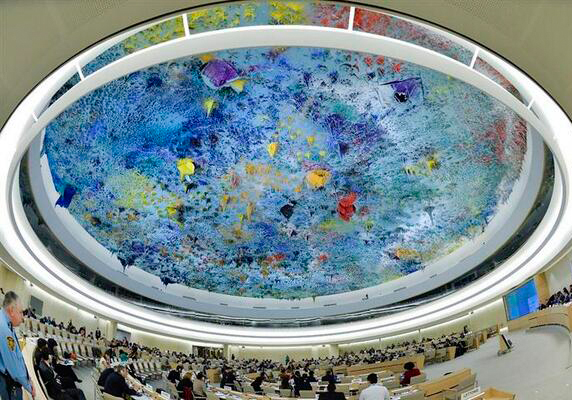
In a joint briefing paper published on the occasion of the anniversary of the Human Rights Council, 20 leading national, regional and international human rights NGOs have outlined a series of concrete steps and proposals that would strengthen the impact of the Council’s work.
The civil society paper outlines a broad vision of a Council that directly guides the actions of State and non-state actors, addresses serious rights violations head on, provides space for civil society, and demands better adherence to basic membership standards.The paper was coordinated by the International Service for Human Rights (ISHR) with the input of global NGOs including the ICJ, as well as organisations from all regions.
The paper can be downloaded here (in PDF): http://www.ishr.ch/HRCat10
Apr 18, 2016 | Advocacy, Non-legal submissions
The ICJ and Thai Lawyers for Human Rights provided a joint submission to the UN Human Rights Committee for its consideration during the adoption of a list of issues for the examination of the Second Periodic Report of Thailand under the International Covenant on Civil and Political Rights.
During its 117th Session, from 30 June to 25 July 2016, the Committee will prepare and adopt a List of Issues on Thailand.
These issues will be put to the Government of Thailand for formal response ahead of the Committee’s full examination of Thailand’s Second Periodic Report during the Committee’s 119th Session, the exact dates of which have yet to be confirmed but which is expected to take place in March 2017.
The ICJ and Thai Lawyers for Human Rights’ joint submission raises matters and suggests concrete questions to be put to the Government of Thailand concerning the following issues:
– Thailand’s derogation under Article 4 of the Covenant;
– Torture and other ill-treatment, enforced disappearances and custodial deaths in disputed circumstances; and
– Thailand’s new institutional and legal framework since the coup d’état, which severely restricts the exercise of Covenant rights within the country and in particular the recent introduction of the National Council for Peace and Order’s (NCPO) Head Order 13/2016, which grants members of the military wide-ranging law enforcement powers to ‘prevent and suppress’ 27 ‘crimes’, together with blanket immunity from prosecution.
THAILAND-JOINT ICJ TLHR HRC LOI SUBMISSION-Advocacy-non legal submission-2016-ENG (full text in PDF)
Mar 24, 2016 | News
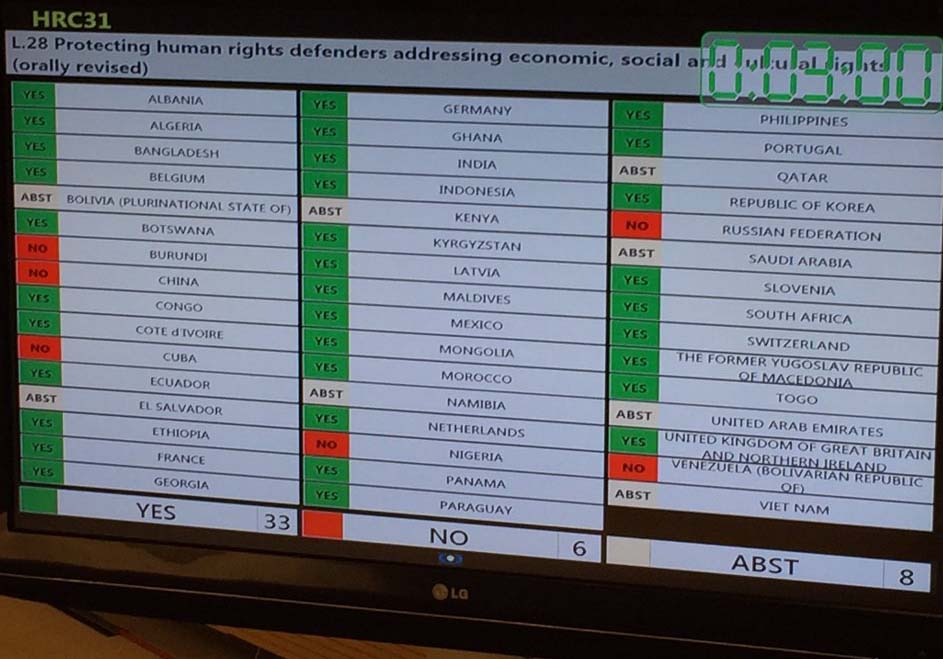
The ICJ welcomes today’s adoption by the UN Human Rights Council of a resolution on human rights defenders addressing economic, social and cultural rights.Negotiation of the resolution was led by Norway, who presented the draft to the Council with co-sponsorship with a large number of states from around the world.
A series of hostile amendments tabled by the Russian Federation, China, Cuba, Egypt and Pakistan, which would have weakened the resolution, were defeated, and the resolution was ultimately adopted by a large majority.
The ICJ had earlier joined advocacy efforts to support the resolution text as presented, and welcomes the strong message the resolution as adopted sends affirming the importance of defenders’ work on economic, social and cultural rights, as well as the need for states to respect, protect and fulfil the human rights of such defenders, including through a range of legislative, policy, and practical measures.
The draft resolution is available in an unofficial version here: 2016 draft resolution HRDs as orally revised.
The voting on the resolution is available here: Result of the vote HRDs