Mar 3, 2015 | Advocacy
Thirteen human rights organizations, including the ICJ, call on the United Arabe Emirates government to release the activists jailed following the UAE 94 trial.
On the second anniversary of the start of the mass “UAE 94” trial that imprisoned dozens of government critics and reform activists in the United Arab Emirates (UAE), including prominent human rights defenders, judges, academics, and student leaders, a coalition of 13 organizations calls on the UAE government to release immediately and unconditionally all those imprisoned solely for peacefully exercising their rights to freedom of expression and association following this grossly unfair trial, as well as those who remain detained or imprisoned for publicizing concerns about it.
The organizations also call on the authorities to ensure that the allegations of torture and other ill-treatment that the individuals were subjected to prior to and following their trial are promptly, independently, impartially and thoroughly investigated, that those responsible are held to account, and that the victims have access to effective remedies and to reparation.
The organizations share the serious concerns raised since 2011 by several UN human rights bodies and human rights organizations regarding the UAE government’s continuing pattern of harassment, secret, arbitrary and prolonged incommunicado detention, torture and other ill-treatment, enforced disappearances, and unfair trials targeting activists and those critical of the authorities, as well as its increasing use of national security as a pretext to clamp down on peaceful activism and to stifle calls for reform.
The space for dissent in the UAE is increasingly shrinking. The repression has been entrenched with the enactment in 2012 of the cybercrimes law, which the government has used to silence social media activists and others who support and defend freedom of expression online, and the enactment of the 2014 counter-terror law.
The vague and overly broad definition of terrorism in the 2014 law, which treats a wide range of activities, including those protected by human rights standards, as amounting to terrorism, may be used to sentence human rights defenders or critics of the government to lengthy prison terms or even death.
The organizations call on the UAE government, which currently is a member of the UN Human Rights Council, to adhere to its obligations to uphold human rights at home, including respecting the rights to freedom of opinion and expression, and to freedom of association and peaceful assembly.
The full statement can be found here in English and Arabic:
United Arab Emirates-Release activists convicted at the UAE94 trial-Advocacy-2015-ENG (full text in PDF)
United Arab Emirates -Release activists convicted at the UAE94 trial-Advocacy-2015-ARA (full text in PDF)
Read also:
UAE: Fear that Anti-Terrorism Law will be used to curtail human rights and target human rights defenders, Gulf Centre for Human Rights, Front Line Defenders, Cairo Institute for Human Rights Studies, Arabic Network for Human Rights Information, 13 December 2014,
Mass convictions following an unfair trial: The UAE 94 case, an ICJ report, October 2013,
United Arab Emirates: ICJ condemns blatant disregard of the right to a fair and public trial, ICJ, 12 March 2013
Mar 2, 2015 | Events
A major side event at the Human Rights Council, featuring current and former UN Special Rapporteurs together with human rights defenders from Swaziland and Zimbabwe, will discuss national security and human rights defenders, on 10 March.
The ICJ joins Article 19, FIDH, ISHR, and OMCT, in supporting the side event.
The panel discussion will feature:
- Michel Forst, UN Special Rapporteur on Human Rights Defenders
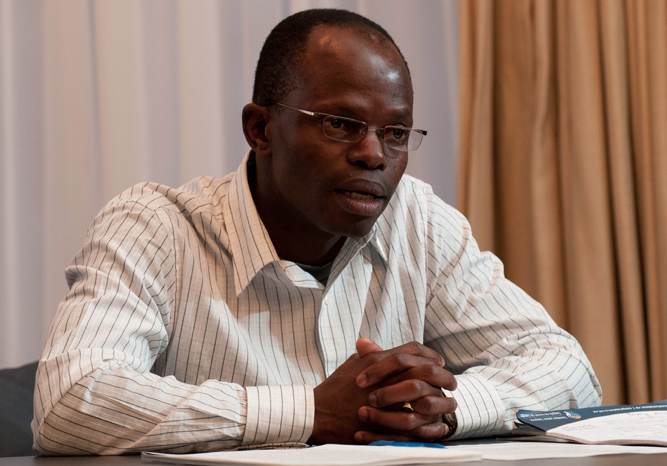
- Tanele Maseko, campaigner for the release of her detained husband, Swaziland lawyer Thulani Maseko (pictured – see recent submission on his case here)
- Jimena Reyes, Director of Americas Desk, FIDH
- Hina Jilani, Pakistani human rights lawyer and former UN Special Representative on Human Rights Defenders (and member of the ICJ Executive Committee)
- Roselyn Hanzi, Zimbabwe Lawyers for Human Rights
- Gerald Staberock, Director, World Organisation against Torture
The side event will take place Tuesday, 10 March, from 15h00 to 16h30, at Palais des Nations, Geneva, Room XI.
Mar 2, 2015 | Advocacy, Open letters
The ICJ today joins with dozens of other NGOs from around the world in an open letter calling for the UN Human Rights Council to establish a Special Rapporteur on Privacy at its current session.
The UN General Assembly, the UN High Commissioner for Human Rights, existing special procedure mandate holders, and many states and civil society organisations have recognized the pressing need to provide continuous, systematic and authoritative guidance on the scope and content of the right to privacy as enshrined in article 12 of UDHR and article 17 of ICCPR. Significantly, all of them have identified the need to assess and monitor the ongoing implementation of this right. The creation of a Special Rapporteur would fill this long-standing gap.
Although the initiative, led by Germany and Brazil, has its origins in concerns about online and telecommunications surveillance, the call is for the creation of a Special Rapporteur with a mandate to look at all aspects of the right to privacy, in all contexts, including issues relating to private sector practices.
HRC28-SRPrivacy-Advocacy-JointLetter-2015
Nov 23, 2014 | Events
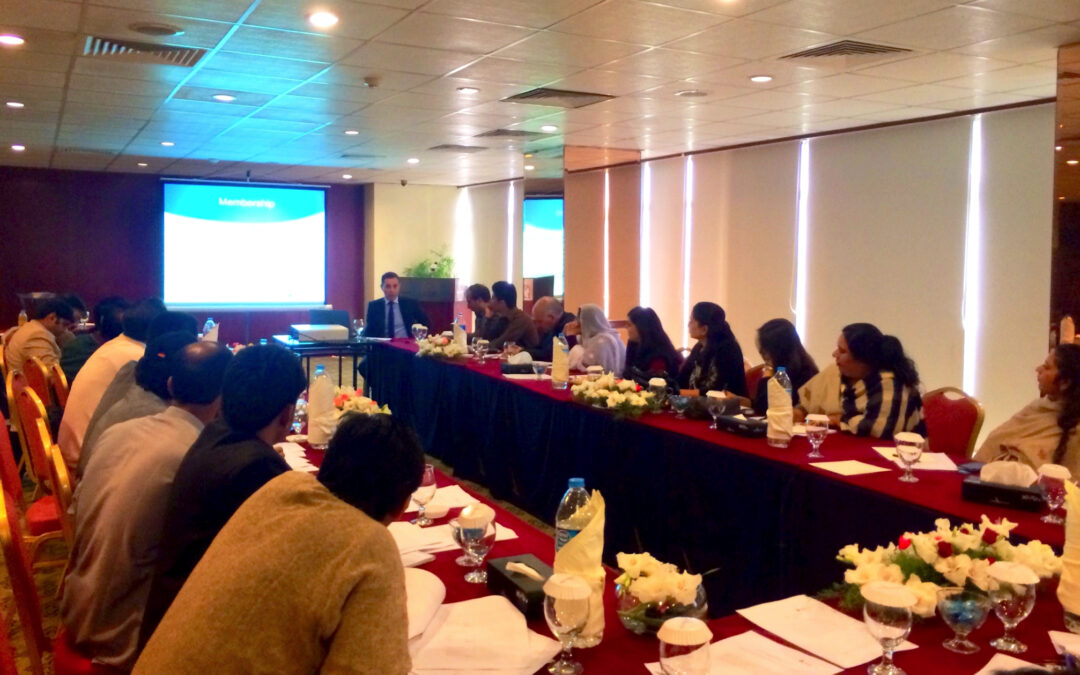
In partnership with the Human Rights Commission of Pakistan (HRCP), the ICJ convened and participated in a one-day workshop on the Universal Periodic Review (UPR) mechanism of the UN Human Rights Council, held in Lahore on 22 November 2014.
The workshop was convened by the ICJ and HRCP as a follow up to, and in response to requests by participants at, training workshops held in Pakistan in February 2014. Now half way between Pakistan’s second and third periodic reviews under the UPR mechanism, the workshop brought together representatives from civil society from throughout Pakistan working on a wide range of human rights issues. It drew from the experience of national and international advocates and human rights lawyers and defenders to discuss:
- The importance of international human rights law at the national level;
- The UPR as a mechanism for human rights protection and how it fits within the broader framework of UN human rights mechanisms;
- Opportunities for NGO engagement in the UPR, especially in the development of a mid-term civil society evaluation report and in preparation for Pakistan’s third cycle UPR in 2017; and
- Weaknesses in Pakistan’s engagement with the UPR.
Oct 30, 2014 | News
The UN Human Rights Committee today emphasized the need for Sri Lanka to take legislative and other measures to address concerns for the independence of the judiciary in the country.