Aug 22, 2013 | Advocacy, Non-legal submissions
With other nongovernmental organizations, the ICJ calls on the Human Rights Council to select candidates for Special Procedure mandates on the basis of technical, professional and other objective requirements.
Ahead of the 24th session of the Human Rights Council (9 to 27 September 2013), several NGOs, including the ICJ, today joined in submitting written statements to the UN concerning the selection of candidates for membership in the Working Group on Arbitrary Detention and the Working Group on Enforced and Involuntary Disappearances and for the mandate-holder of the Special Rapporteur on the situation of human rights defenders. The statements identify a checklist intended as an interpretive aid for the selection of candidates based on qualifications and skills; relevant expertise; established competence; and flexibility and availability of time.
HRC24-JointWrittenStatement-SelectionCriteriaWGAD-NonLegalSubmission-2013 (download full statement concerning selection criteria for the Working Group on Arbitrary Detention)
HRC24-JointWrittenStatement-SelectionCriteriaWGEID-NonLegalSubmission-2013 (download full statement concerning selection criteria for the Working Group on Enforced and Involuntary Disappearances)
HRC24-JointWrittenStatement-SelectionCriteriaSRHRDs-NonLegalSubmission-2013 (download full statement concerning selection criteria for the Special Rapporteur on the situation of human rights defenders)

Jun 10, 2013 | Agendas, Events
On Friday 7 June 2013, the ICJ convened a parallel event during the Human Rights Council’s 23rd regular session held in Geneva.
The event, held in Room IX of the Palais des Nations, addressed key issues concerning past and present challenges to the rule of law in Zimbabwe in the context of the upcoming elections and the need for the international community to remain vigilant about the necessity for free, fair and peaceful elections in the country. The event was chaired by Martin Okumu-Masiga, Deputy Director of the ICJ’s Africa Regional Programme. Panelists were MacDonald Lewanika, Director of Crisis Coalition; Okay Machisa, Director of the Zimbabwe Human Rights Association; and Irene Petras, Executive Director of Zimbabwe Lawyers for Human Rights.
Zimbabwe is scheduled to hold general elections before the end of 2013. Past elections in the country have been marred by violence and attacks on human rights defenders and the rule of law more generally. In the period leading to the 2013 elections, there have been several incidents of crackdown on political dissents and independent voices. The impunity enjoyed by past and current perpetrators electoral violence has continued to exacerbate fears for the integrity, peaceful conduct and fairness of the upcoming elections.
Zimbabwe-HR Council side event on elections in Zimbabwe-event-2013 (event flyer in pdf)
ICJ draws attention to risks of violence in the forthcoming general elections in Zimbabwe

May 29, 2013 | Agendas, Events
On Tuesday 28 May 2013, the ICJ co-sponsored a parallel event with TRIAL and the Missions of Botswana, Costa Rica, Estonia and Switzerland during the Human Rights Council’s 23rd regular session held in Geneva.
The event, held in Room XXV of the Palais des Nations, addressed key issues concerning accountability and human rights. The event was chaired by Professor Paola Gaeta from the Geneva Academy of International Humanitarian Law and Human Rights. Panelists were Tiina Intelmann, President of the Assembly of the States Parties to the ICC Statute; Mothusi Bruce Rabasha Palai, Ambassador of Botswana; Ian Seiderman, Director of the ICJ’s Law and Policy Office; and Gabriella Citroni, Senior Legal Adviser at TRIAL (Swiss association against impunity).
Panelists agreed that accountability is intimately linked to the enjoyment of human rights. It was stated that – under State responsibility – States are, or should be, held responsible for acts involving any violation of international law, including international human rights law and international humanitarian law. Accountability is thus not only about criminal justice, but also about ensuring reparations and guarantees of non-recurrence.
Recommendations made under the Universal Periodic Review (UPR) mechanism were seen as having been partly successful in bridging gaps, although there remains a lack of proper follow-up on the progress of implementation between UPR cycles. Panellists observed that States often fail to refer to standards enunciated by the High Commissioner for Human Rights and by the Special Procedures. Regarding the accountability of non-State actors for conduct involving human rights abuses and violations, the ‘Ruggie Principles’ were referred to as a representing good progress but still failing to be as comprehensive as they should be.
Concerning future steps by Human Rights Council mechanisms, panellists proposed that resolutions, statements and Special Procedures should more directly and frequently refer to accountability. The need for greater political pressure on the International Criminal Court was expressed, with the aim of supporting the domestic capacity of States parties to the Rome Statute. Concerning domestic capacity to strengthen accountability more generally, panellists and participants agreed on the need to improve linkages between the work of persons dealing with development and those working on accountability.
HR Council-Strengthening accountability-event-2013 (event flyer in pdf)

May 7, 2013 | Advocacy, Legal submissions
The ICJ today submitted to the United Nations a written statement concerning corporate complicity in human rights abuses and access to justice for victims of such abuses.
The statement is made ahead of the UN Human Rights Council’s 23rd session (27 May to 14 June 2013) and comments on a report of the Council’s Working Group on human rights and transnational corporations and other business enterprises.
Setting out issues concerning obstacles to justice for victims of human rights abuses by business enterprises, the ICJ calls on the Working Group to take various steps to address such issues, including by:
- Exploring the further development of international standards;
- Raising specific allegations of corporate abuse with relevant State authorities and business enterprises; and
- Addressing more clearly the issue of access to justice in cases of corporate complicity.
HRC23-Item3-WGBHR-WrittenStatement-LegalSubmission-2013 (download statement in PDF)
Apr 29, 2013 | News
The Bahrain authorities must fully cooperate with the UN mechanisms and implement the recommendations of the Bahrain Independent Commission of Inquiry (BICI) set up by the Government of Bahrain in June 2011.
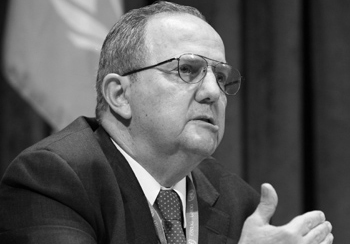
The ICJ further calls on the Bahrain authorities to ensure that the recommendations from the UN Universal Periodic Review process in September 2012 are implemented in full and in good faith and, to this end, immediately extend an invitation with specific dates to the UN Special Rapporteur on torture, Juan E. Méndez (photo).
The statement comes as the authorities in Bahrain effectively cancelled a visit of the Special Rapporteur for the second time, a previous visit in March 2012 also having been postponed at the last minute.
“As a former member of the BICI, I find it extremely disappointing that Bahrain has taken this decision for the second time. It keeps dangling the possibility of a visit when it is under pressure to do something about implementing the BICI recommendations,” said Sir Nigel Rodley, President of the ICJ. “One does not have to be a cynic to infer that once the pressure eases – for example, because the Human Rights Council has concluded its review of Bahrain’s human rights performance or the Formula One race is over – it can then withdraw its invitation. I hope the international community will take account of this pattern, when reacting to positive assurances from the authorities. Promises are no substitute for implementation.”
The report of the BICI, published in November 2011, documented numerous cases of torture and ill-treatment.
It further made crucial recommendations for reform so as to prevent these and other violations in the future, including effective investigations into all cases of torture and ill-treatment by an independent and impartial body; the establishment of a standing independent body to examine all complaints of torture or ill-treatment, excessive use of force or other abuses at the hands of the authorities; and the compensation and provision of remedies for all victims.
“The BICI’s recommendations included ones to address the serious problem of torture in Bahrain, a problem I had identified in the 1990s when I held the mandate Juan Mendez now discharges with consummate professionalism. One may perhaps be pardoned for considering that the only threat posed by the visit to the political situation is the fear of what information would be uncovered by the visit,” Sir Nigel Rodley concluded.
Contact:
Said Benarbia, ICJ Senior Legal Adviser of the Middle East and North Africa Programme, t: +41 22 979 3817, e-mail: said.benarbia(a)icj.org
UN Photo/Rick Bajornas