Oct 23, 2018 | Multimedia items, News, Video clips
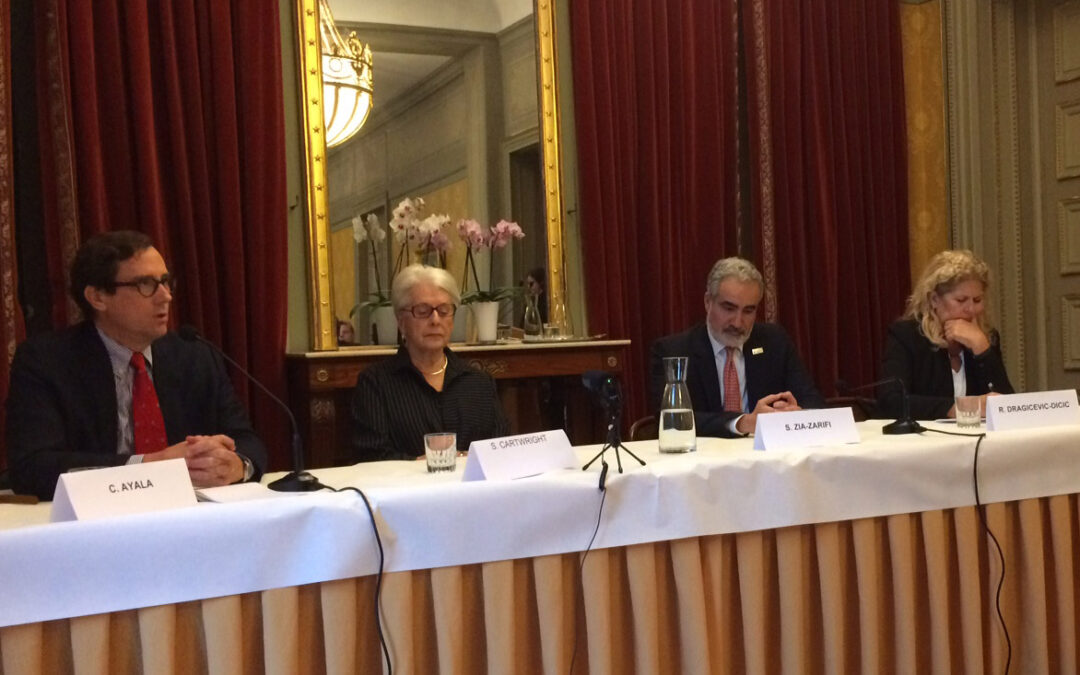
At an event at the city’s Palais Eynard, prominent ICJ Commissioners discussed the supremacy of the Rule of Law and also why it is important to be in Geneva. Watch the video.
The Executive Committee (ExCo), representing the whole Commission of Jurists, participated in the event.
Sam Zarifi, ICJ Secretary General, opened the event by reiterating the importance for the ICJ to be headquartered in Geneva, not only for the UN and international community but also for the city’s and canton’s legal and human rights community.
“It is absolutely clear that we live at a moment in the world when lawyers, judges, jurists are under attack and it is important for the legal community across the world, regardless of borders, regardless of languages, regardless of legal systems, to come together to defend the notion of the rule of law and defend the security and well-being of lawyers and jurists around the world.”
Carlos Ayala, ICJ’s Vice-President, said the ICJ was a unique organization working in the field of the Rule of Law, not as an isolated notion but within the framework of Human Rights and democracy.
He explained how the ICJ is structured and working around the world and insisted on the impact the ICJ is having through its activities.
He said that the organization’s legal outputs were used to have an impact on the overall human rights situations, cases, court decisions, and in training judges, lawyers, prosecutors and others.
Radmila Dragicevic-Dicic, also ICJ’s Vice-President, insisted on how it is important to share experiences about human rights issues and finding solutions to protect different rights.
She gave her personal example of being a judge in former Yugoslavia and Serbia to show how with tenacity and courage one can help establish an independent judiciary even in some of the hardest situations.
She testified how she was helped by the ICJ and Switzerland in her fight for justice.
“If you fight for independence of judges and lawyers in your country, you fight for judges and lawyers everywhere,” she added.
Dame Silvia Cartwright, ICJ Commissioner and ExCo member from New Zealand, was the first woman appointed to the High Court in New Zealand and she was also Governor General of New Zealand.
She said that she was privileged to come from a country that has always promoted and protected the Rule of Law but that unfortunately many recent examples showed that this endorsement could change overnight.
Very active in the fight for women’s rights she said how through her professional work she realized the terrible impact that the Khmer Rouge’s regime in Cambodia and civil war in Sri Lanka had on women.
“Generally speaking I’m quite pessimistic because I think we have reached another stage of the cycle that seems to occur every couple of generations where we are heading towards a more fascist world. So this is the time when human rights must be protected when we must fight to maintain the norms we have struggled for so long,” she said.
Watch the full event here:
https://www.facebook.com/ridhglobal/videos/335212527229422/
Oct 14, 2018 | News
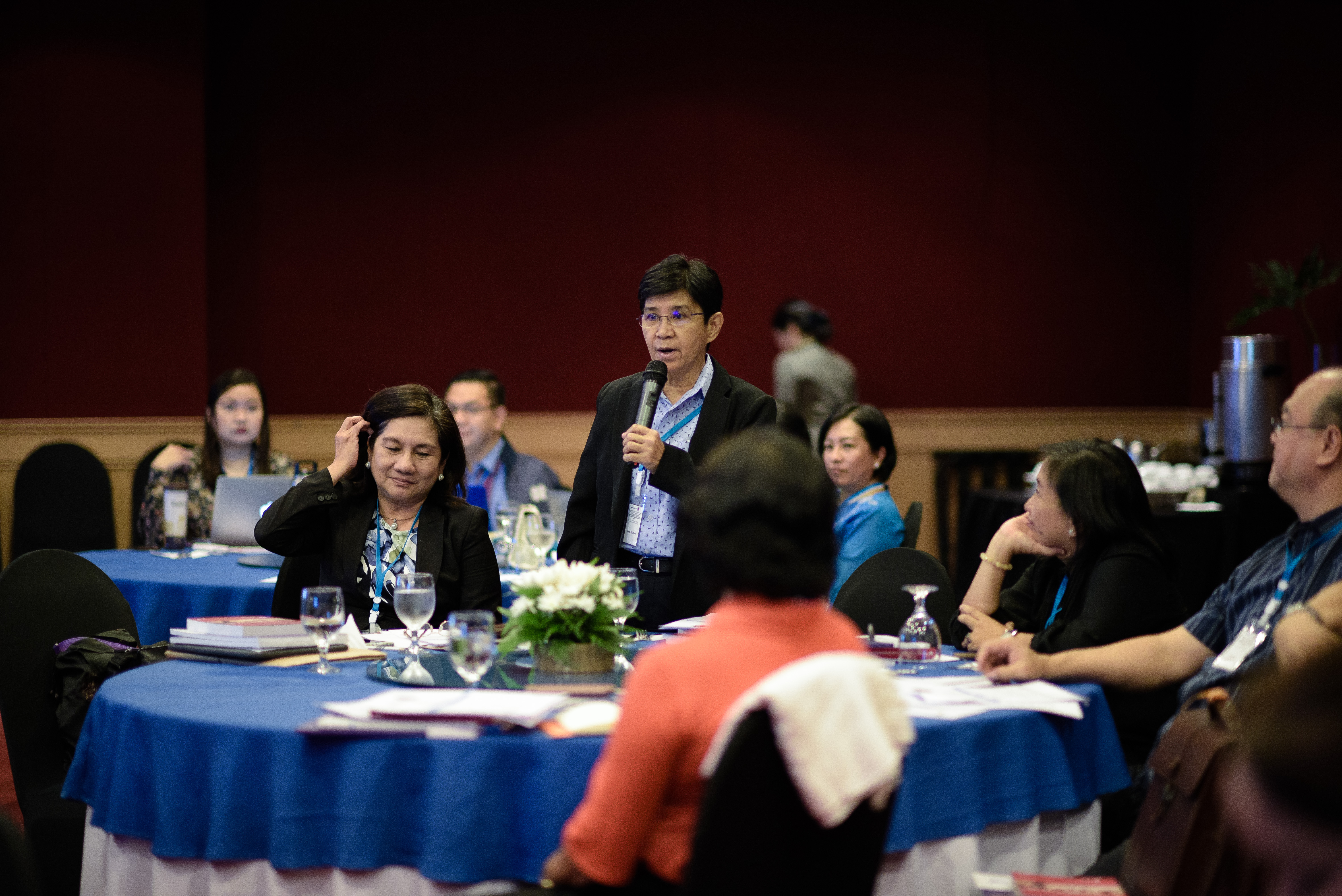
From 12 to 13 October 2018, the ICJ and the Integrated Bar of the Philippines (IBP) held its second national workshop on eliminating gender discriminatory attitudes and behaviours towards women.
Participants at the workshop were members of IBP’s Board of Governors and Committee on Bar Discipline. The workshop was held in Cebu City, Philippines.
Emerlynne Gil, ICJ’s Senior International Legal Adviser opened the workshop by emphasizing that it is crucial for lawyers of all areas of expertise to engage in dialogues such as this in order to further enhance women’s access to justice.
Gil pointed out that gender stereotypes incorporated in laws and perpetuated in the administration of justice impair the capacity of women to exercise their right to access to justice.
She emphasized that lawyers, as frontline formal justice actors, play a key role in eliminating these stereotypes.
Marienne Ibadlit, IBP’s Governor for Western Visayas, spoke about the establishment of the Gender and Development (GAD) Committee as a standing committee of the IBP.
The establishment of the GAD Committee is expected to advance gender and women’s human rights within the IBP.
It is also expected to institutionalize within the IBP efforts to build the capacity of lawyers in the Philippines to assist women in accessing justice.
The participants recognized during the opening session that recourse to gender stereotypes in the practice of law and administration of justice is widespread in the Philippines and that gender stereotypes directly impact women’s access to justice.
A range of stereotypes were identified, including the idea of women being the ‘weaker sex’ and the perception that female lawyers are not suited for litigation of controversial political or criminal cases.
During the workshop, participants discussed how they could maximize their role as lawyers in facilitating women’s access to justice, specifically in the areas of domestic violence, sexual violence, family law, and employment law.
Some of the participants noted that they themselves had been influenced by gender stereotypes and committed to be more consciously gender sensitive in their work and personal life.
While acknowledging that much more must be done to bring about systematic change, it was agreed that incremental measures could be impactful.
Abdiel Dan Fajardo, National President of the IBP, expressed support for more action by lawyers in the Philippines on women’s human rights.
Both the ICJ and IBP reinforced their commitment to joint collaboration in furthering the advancements in women’s access to justice in the country.
Contact
Emerlynne Gil, Senior International Legal Adviser for Southeast Asia, t: +662 619 8477 (ext. 206) ; e: emerlynne.gil(a)icj.org
Oct 5, 2018 | News
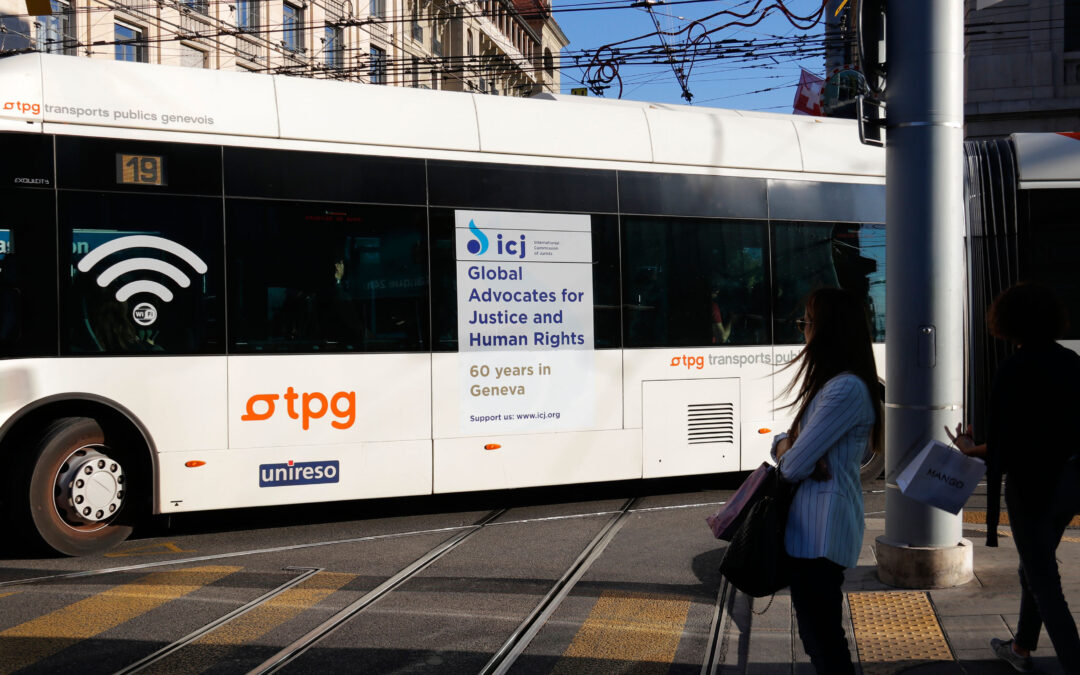
2018 marks the 60th anniversary of the ICJ’s move to Geneva thanks to the great Swiss jurist Jean-Flavien Lalive, who was ICJ’s Secretary General in 1958.
This makes the ICJ one of the earliest international organizations to establish its headquarters in Geneva.
At the 1959 ICJ Congress in New Delhi, Dr. Lalive helped breathe new life into the rule of law and human rights.
The Delhi Declaration is, to date, a fundamental instrument interpreting the rule of law as a living concept, and underscoring the primary role of lawyers in its safeguard and in the advancement of human rights.
The ICJ plays a unique and preeminent role as a non-governmental organization seeking to defend human rights and the rule of law worldwide.
The ICJ will mark this event with two major initiatives:
- A visibility campaign from 26th September to 9th October: the TV screens on the Geneva public transport network and five vehicles will carry the slogan “Global Advocates for Justice and Human Rights – 60 years in Geneva”
- The launch of the “60th Anniversary Appeal” to all lawyers in the Republic and canton of Geneva to support the ICJ and, in turn, their less privileged colleagues, victims of persecution on five continents.
“Geneva can be proud of its image as the world human rights capital. It is a beacon for justice advocates around the world. We must continue to make it shine,” said Sam Zarifi, Secretary General of the ICJ.
“Through its 60-year history, the ICJ has contributed significantly to Geneva’s human rights record: the campaigns that led to the creation of the post of UN High Commissioner for Human Rights in 1993 and the UN Human Rights Council in 2006, as well as the adoption of the United Nations Convention against Torture in 1984 are some emblematic examples,” said Olivier Coutau, Head of La Genève Internationale.
“In the face of repeated attacks on human rights, the world needs, more than ever the ICJ’s competent, rigorous and effective defense of the rule of law,” Sam Zarifi added.
The Republic and canton of Geneva support the ICJ 60th Anniversary Appeal.
Additional information
The international reputation of the ICJ rests on these pillars:
- 60 Commissioners – eminent judges and lawyers – from all regions of the world and all legal systems – with unparalleled knowledge of the law and human rights;
- Cooperating with governments committed to improving their human rights performance;
- Effective balance of diplomacy, constructive criticism, capacity building, and if necessary, ‘naming and shaming’;
- Unmatched direct access to national judiciaries, implementing international standards and improved legislation impacting millions;
- Guiding, training and protecting judges and lawyers worldwide to uphold and implement international standards;
- Working for access to justice for victims, survivors and human rights defenders, in particular from marginalized communities;
- Following a strict result based management in project delivery.
In recognition of this effective approach, the ICJ has been awarded, during its long history, some of the most prestigious international awards: the Council of Europe Human Rights Prize, the United Nations Award for Human Rights, Erasmus Prize, Carnegie Foundation Wateler Peace Prize.
In 2018, the ICJ provided local trainings on five continents to assist 4,300 judges, lawyers and prosecutors strengthen their ability to protect and promote fundamental rights.
The ICJ has consultative status with the United Nations Economic and Social Council, UNESCO, the Council of Europe and the African Union.
Contact :
Michaël W. Sombart, Director Philanthropy & Strategic Partnerships, t: +41 22 979 38 31 ; m: +41 77 965 98 45 ; e: michael.sombart(a)icj.org
Oct 1, 2018 | Advocacy, Non-legal submissions
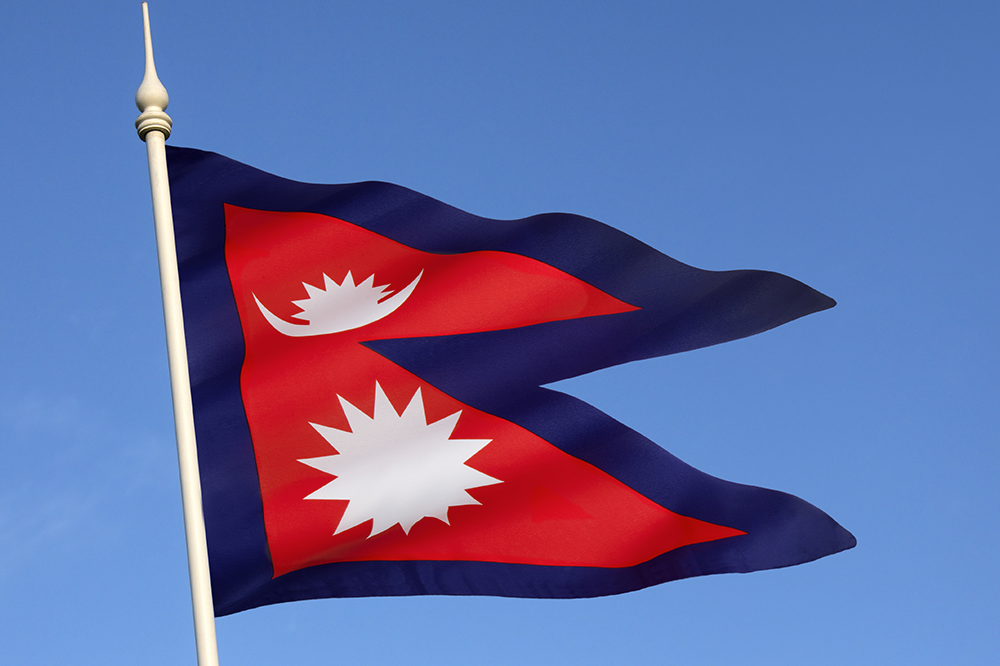
Today, the International Commission of Jurists made a submission to the Committee on the Elimination of Discrimination against Women (CEDAW Committee) in view of its forthcoming review of Nepal’s implementation of and compliance with its obligations under CEDAW in light of the State party’s sixth periodic report under Article 18 of the Convention.
In its submission, the ICJ focused on the transitional justice processes in the country, and noted that the Government of Nepal has failed to effectively address human rights violations experienced by women during the armed conflict that ended in 2006.
The submission highlighted the failure of the authorities to ensure criminal accountability for serious crimes, including rape and other forms of sexual violence during the conflict, and to ensure effective and meaningful participation by women in political and public life.
In its submissions the ICJ urged the authorities of Nepal to implement a number of recommendations with a view to ensuring that the above-mentioned concerns be effectively addressed in a manner that complies with the country’s obligations under the CEDAW and other relevant international human rights law and standards.
The ICJ’s full submission is available here: Nepal-CEDAW Report on Nepal-Advocacy-Non Legal Submission-2018-ENG
Sep 17, 2018 | Events, Multimedia items, News, Video clips
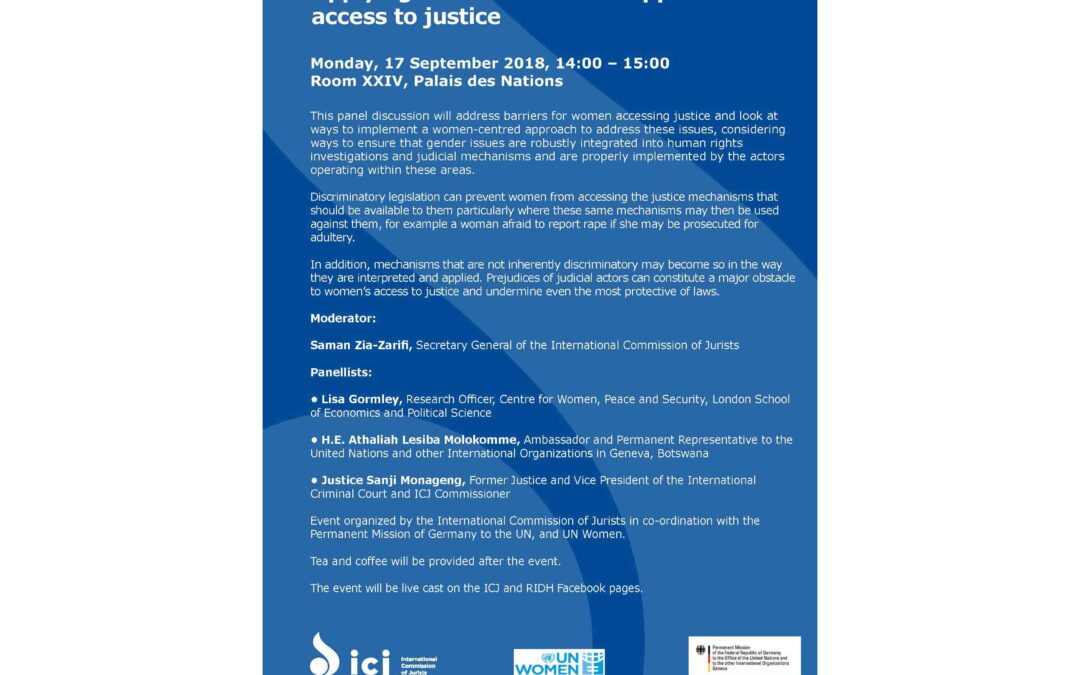
This panel discussion was held today at the Palais des Nations in Geneva.
The event addressed barriers for women accessing justice and look at ways to implement a women-centred approach to address these issues, considering ways to ensure that gender issues are robustly integrated into human rights investigations and judicial mechanisms and are properly implemented by the actors operating within these areas.
Discriminatory legislation can prevent women from accessing the justice mechanisms that should be available to them particularly where these same mechanisms may then be used against them, for example a woman afraid to report rape if she may be prosecuted for adultery.
In addition, mechanisms that are not inherently discriminatory may become so in the way they are interpreted and applied. Prejudices of judicial actors can constitute a major obstacle to women’s access to justice and undermine even the most protective of laws.
Moderator:
Saman Zia-Zarifi, Secretary General of the International Commission of Jurists
Panellists:
• Lisa Gormley, Research Officer, Centre for Women, Peace and Security, London School of Economics and Political Science
• H.E. Athaliah Lesiba Molokomme, Ambassador and Permanent Representative to the United Nations and other International Organizations in Geneva, Botswana
• Justice Sanji Monageng, Former Justice and Vice President of the International Criminal Court and ICJ Commissioner
Event organized by the ICJ in co-ordination with the Permanent Mission of Germany to the UN, and UN Women.
Watch the video:
https://www.facebook.com/ridhglobal/videos/565112000574216/
Side event ICJ WHR (flyer in PDF)