Sep 4, 2018 | News
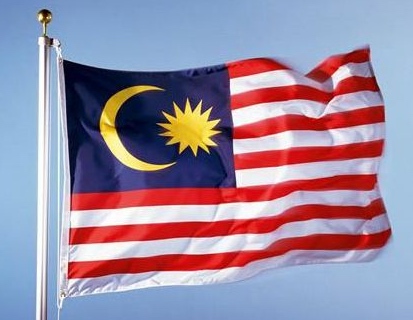
The ICJ today condemned the public caning of two women, a punishment imposed upon them by the Terengganu High Court after conviction on charges of ‘attempting to have sexual intercourse’.
The ICJ called on the Government of Malaysia to immediately abolish the practice of caning as it constitutes a form of cruel, inhuman or degrading punishment prohibited under international human rights law and standards.
Furthermore, it also called on the Government to ensure that its laws, policies and practices at the local, state, and federal levels are in full compliance with its international legal obligations, including under the Convention on the Elimination of all forms of Discrimination against Women (CEDAW).
On 3 September 2018, two women, aged 23 and 33, were publicly caned in front of a hundred people in Terengganu, a coastal state of Malaysia, located northeast of Kuala Lumpur.
The two women were convicted under Section 30 of the Syariah Criminal Offences (Terengganu) Enactment 2001, for the crime of ‘Musahaqah’ (sexual relations between female persons).
“This punishment is a clear violation of Malaysia’s obligations to prevent, prohibit and prosecute all forms of torture and other cruel, inhuman or degrading treatment or punishment. The Government of Malaysia should immediately abolish the practice of corporal punishment, which has been condemned by international authorities such as the UN Human Rights Council’s Special Rapporteur on torture,” said Emerlynne Gil, ICJ’s Senior International Legal Adviser.
“It is equally deplorable that Malaysia continues to criminalize consensual same sex relations. The criminalization of private consensual sexual activities – whatever the sex, gender identity and sexual proclivities of those involved, and whatever the actual sexual practices – violates international human rights law. It also undermines women’s enjoyment of their rights to privacy, personal integrity, and equality,” she added.
The Human Rights Committee has said that criminalizing private sexual acts between consenting adults constitutes an arbitrary interference with privacy and cannot be justified.
It has also observed in a number of Concluding Observations that the criminalization of private consensual sexual activities between adults of the same sex violates the prohibition of discrimination, and the right of equality before the law.
The ICJ also notes that early this year, the CEDAW Committee recommended to Malaysia to “take effective measures to ensure that civil law and Syariah law are in full compliance with the provisions of the Convention at local, state, and federal levels” so as to guarantee the rights of all women throughout the country.
The ICJ calls on the Government of Malaysia to abide by its obligations under international law and follow through with its commitment to human rights, non-discrimination and equality by abolishing the sentence of caning and the criminalization of consensual same sex relations in the country.
Contact
Emerlynne Gil, ICJ Senior International Legal Adviser, t: +66 840923575, e: emerlynne.gil(a)icj.org
Background
On 8 April 2018, religious state authorities arrested the two women who were in a car and accused them of preparing to ‘commit sexual acts’, which is an offense in the State of Terengganu, under the Syariah Criminal Offences (Terengganu) Enactment 2001. The women pleaded guilty to the offence without being represented by a lawyer and did not appeal their case.
On 12 August 2018, the two women pleaded guilty and were sentenced by the Terengganu Shariah to a fine of RM3,300 ($800 USD) and six strokes of caning for attempting to have sexual intercourse.
This is the first case of caning of women for ‘Musahaqah’ (sexual relations between female persons) crime and its attempt in Malaysia and it marks a steady decline in Malaysia’s commitment to protect the rights of its sexual minorities and the members of the LGBTIQA community.
In Malaysia’s Criminal Procedure Code, under Federal law, it states that
“No sentence of whipping shall be executed by installments, and none of the following persons shall be punishable with whipping: (a) females;”
Malaysia’s Federal Constitution provides that Islamic law falls under the matters of State law, with the exception of the Federal States.
It is concerning that the Syariah legal system in Malaysia continues to carry out caning in a manner that is discriminatory against women, and women sexual minorities, as seen in the 2010 case, where three women were found guilty of ‘illicit sex’ by the Kuala Lumpur Syariah Court, as well as the continuing use of Syariah legal enactments to harass, intimidate and prosecute the transgender community in Malaysia.
Jul 30, 2018 | News
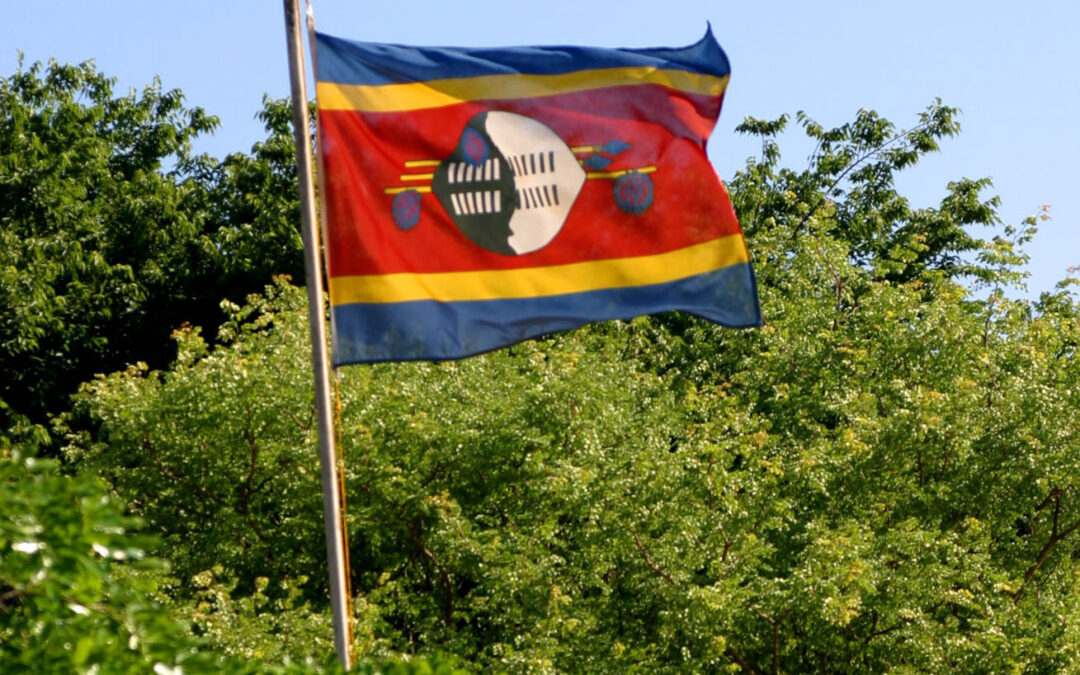
On 25 July 2018, the ICJ facilitated an integrated meeting of governmental stakeholders in the justice chain involved in different aspects of combatting sexual and gender-based violence (SGBV) in the Kingdom of Eswatini (Swaziland), the first meeting of its kind.
The meeting was convened by ICJ Commissioner and Principal Judge of the High Court of Eswatini, Justice Q. M. Mabuza. It followed a meeting held in February 2018 on combating SGBV in Eswatini and an ICJ report on key challenges to achieving justice for gross human rights violations in Eswatini, the latter of which recommended that justice sector stakeholders involved in the investigation, prosecution and sanctioning of, and provision of redress to victims for, acts of SGBV should convene six-monthly meetings so as to develop a common and integrated approach to the effective combating of SGBV.
The integrated meeting involved senior officials from the Office of the Deputy Prime Minister, the Office of the Attorney General, the Office of the Director of Public Prosecutions, the police, correctional services, and the judiciary.
The meeting discussed the fight against SGBV in the context of the Guidelines on Combating Sexual Violence and its Consequences in Africa, and other international standards. It considered the national legal and policy framework on SGBV; practices and challenges in the investigation and prosecution of SGBV; the sanctioning of SGBV offences; and the rehabilitation of sexual and domestic violence offenders by correctional services. Perspectives of the Office of the Deputy Prime Minister, the police and the judiciary were emphasized during discussions.
Stakeholders discussed issues with a view to identifying gaps and challenges in national law, policy and practice when measured against regional and global standards and best practices, as well as with a view to considering potential solutions to those gaps and challenges. The meeting agreed on next steps, including on concrete action that aligns with and/or augments the National Strategy to End Violence. Stakeholders agreed that they should all be involved in the early stages of cases involving SGBV.
Stakeholders also agreed that the recently enacted Sexual Offences and Domestic Violence Act will only be effectively implemented if justice sector stakeholders are well coordinated. Stakeholders agreed that integrated meetings should be held regularly, at intervals of no less than six months including, if possible, before the end of 2018.
Jul 19, 2018 | News
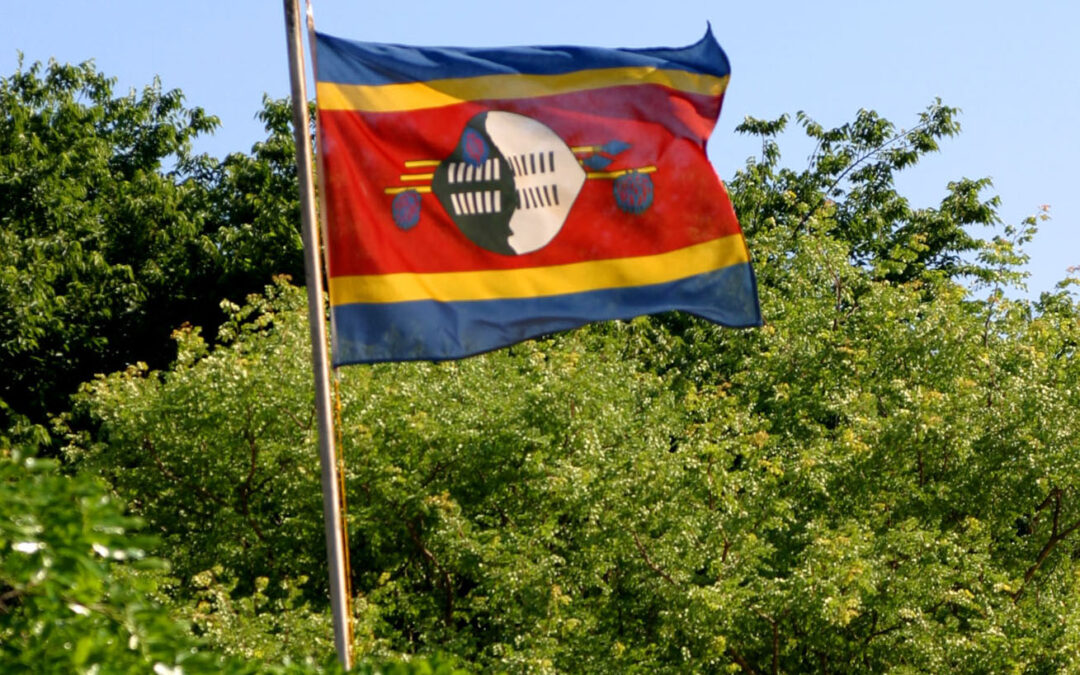
His Majesty King Mswati III of the Kingdom of Eswatini (formerly known as the Kingdom of Swaziland) yesterday gave his royal assent to the Sexual Offences and Domestic Violence Act, a milestone in the fight against sexual and gender-based violence (SGBV) in the country.
In its May 2018 report on key challenges to achieving justice for human rights violations in Swaziland, the ICJ identified the widespread occurrence of SGBV, with discriminatory practices based on customary laws and traditional beliefs undermining equality between men and women and the access by victims of such violence to effective remedies and reparation, as well as the holding to account of perpetrators of such violence.
Eswatini’sNational Strategy to End Violence in Swaziland 2017-2022, produced by the Office of the Deputy Prime Minister in collaboration with the UN Population Fund, itself pointed to an alarming rate of increasing violence in all its forms, noting that its most common form was gender-based violence, disproportionately affecting women and girls.
The new law follows a protracted legislative process, first initiated in 2009; then resumed in 2015. It has also been accompanied by increasing attention and concern by international human rights mechanisms, including the UN Human Rights Committee and the Committee on Elimination of Discrimination against Women.
Building on ICJ initiatives to bring together international, regional and local SGBV experts in 2015, and on sustainable development goals on access to justice and gender equality in 2017, the ICJ with local partners convened a workshop on combatting SGBV in Swaziland in February 2018. In consultations during and around this most recent workshop, interlocutors signaled fears that the Senate of Swaziland was equivocating on passage of the 2015 Bill. Responding to local partners’ requests, the ICJ made a submission to the Senate in March 2018, bringing to its attention to the global and regional obligations of the Kingdom to enact the legislation, as well as the Government’s own commitments to do so. The Senate soon after voted to adopt the legislation.
The new law for the first time criminalizes marital rape and other domestic violence offences; makes provision for Specialised Domestic Violence Courts; creates mechanisms and avenues for reporting of offences; and requires medical examination and treatment of victims. These are issues that had not been previously provided for.
Enactment of the law is significant, incorporating into domestic law a very large part of Eswatini’s international human rights obligations, including those arising from the Africa region, to criminalize and sanction the perpetrators of SGBV. It also discharges commitments made by His Majesty’s Government during the 2016 Universal Periodic Review.
Just as important will be the effective implementation of the new law to combat SGBV by bringing perpetrators to account and providing victims with access to justice.
With a view to enhancing the prospects of an effective and comprehensive approach to that end, the ICJ’s Commissioner, and Principal Judge of the High Court, Justice Qinsile Mabuza, will next week be coordinating a meeting of governmental justice sector stakeholders involved in combatting SGBV in the country. This first coordinated meeting of governmental actors will focus on issues of investigation, prosecution and sanctioning of sexual and gender-based violence crimes, including the role of social and medical services.
The ICJ is also commissioning a report on the access of victims of SGBV to effective remedies and reparation. Focused on case studies, the report will include attention to lack of justice through acquittals that have been prompted by inadequate laws or procedures and/or through lack of prompt or sufficient forensic or medical evidence. This report will feed into discussions at a second meeting of governmental justice sector stakeholders, intended for 2019.
Jul 6, 2018 | Advocacy, News, Non-legal submissions
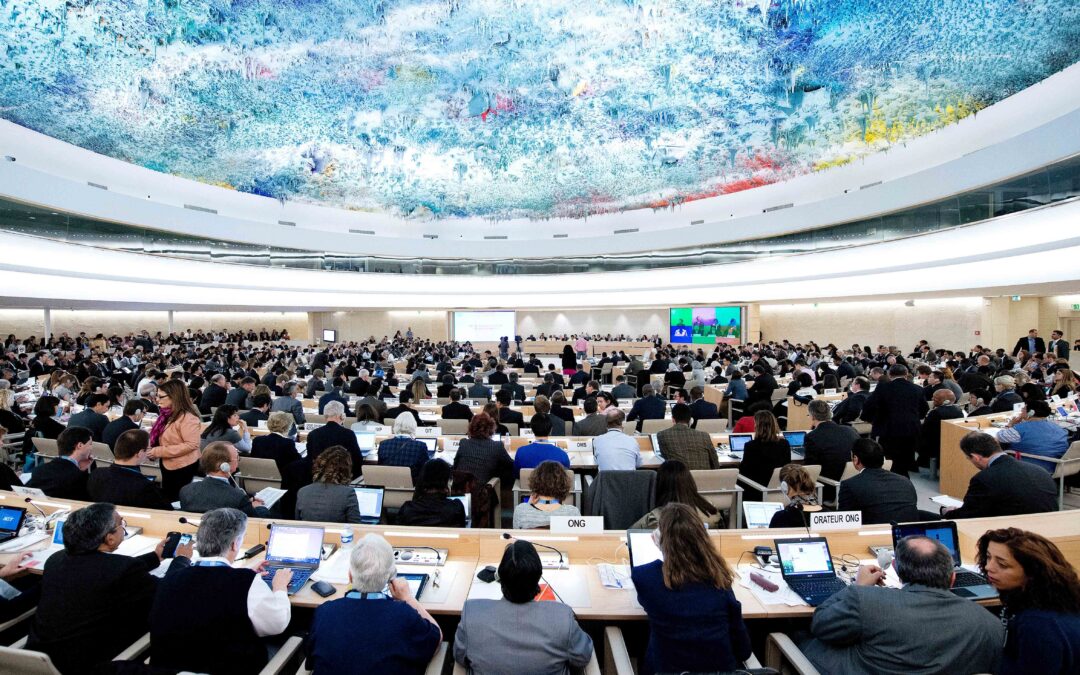
The ICJ today joined other NGOs in highlighting key outcomes of the 38th ordinary session of the UN Human Rights Council.
The statement, delivered by International Service for Human Rights (ISHR) at the end of the session, read as follows (text in italics was not read aloud due to the limited time available):
“Our organisations welcome the adoption of the resolutions on civil society space, peaceful protest, on violence against women and girls and on discrimination against women and girls and the Council’s rejection of attempts to impede progress on protecting civic space, peaceful protest and the rights to sexual and reproductive health.
On civil society space, the resolution recognizes the essential contribution that civil society makes to international and regional organisations and provides guidance to States and organisations on improving their engagement with civil society. On peaceful protest, it sets out in greater detail how international law and standards protect rights related to protests.
On violence against women and on discrimination against women, we consider that ensuring sexual and reproductive health and rights are vital in efforts to combat violence and discrimination against women, online and offline, as well as to ensure targeted and specific remedies to victims. We appreciate that the work of women human rights defenders towards this is recognised.
We consider the adoption of the resolution on the contribution of the Council to the prevention of human rights violations as an important opportunity to advance substantive consideration on strengthening the Council’s ability to deliver on its prevention mandate.
Following challenging negotiations, we welcome the adoption by consensus of the resolution on human rights and the Internet, reaffirming that the same rights that people have offline must also be protected online, and calling on States to tackle digital divides between and within countries, emphasising the importance of tools for anonymity and encryption for the enjoyment of human rights online, in particular for journalists, and condemning once more all measures that prevent or disrupt access to information online.
We welcome continued Council attention to Eritrea‘s abysmal human rights record. This year’s resolution, while streamlined, extends expert monitoring of, and reporting on, the country and outlines a way forward for both engagement and human rights reform. We urge Eritrea to engage in long-overdue meaningful cooperation.
We welcome the renewal of the mandate of the Special Rapporteur on Belarus under item 4 with an increased vote – as it is still the only independent international mechanism to effectively monitor human rights violations in Belarus – while remaining concerned over a narrative to shift the mandate to item 10 in the absence of any systemic change in Belarus.
We welcome the consensus resolution on the DRC, putting in place continued monitoring and follow up on the expert’s recommendations on the Kasais. However, given violations and abuses throughout several regions in the country, occurring against the backdrop of an ongoing political crisis, delayed elections, and the brutal quashing of dissent, we urge the Council to promptly move towards putting in place a country-wide mechanism that can respond to events on the ground as they emerge.
We welcome the strong resolution on Syria, which condemns violations and abuses by all parties, and appropriately addresses concerns raised by the COI about the use of chemical weapons, sexual and gender-based violence, and the need to address situations of detainees and disappearances. The Council cannot stay silent in the face of continued atrocities as the conflict continues unabated into its seventh year.
We welcome the joint statements delivered this session on Cambodia, the Philippines, and Venezuela. We urge Council members and observers to work towards increased collective action to urgently address the dire human rights situations in these countries.
On the Philippines, we emphasise that the Council should establish an independent international investigation into extrajudicial killings in the ‘war on drugs’ and mandate the OHCHR to report on the human rights situation and on moves toward authoritarianism.
The joint statement on Cambodia represents a glimmer of hope after the Council’s failure to take meaningful action against clear sabotage of democratic space ahead of elections. Close scrutiny of the human rights situation before, during and after the elections is paramount and the Council must take immediate action on current and future human rights violations in this regard.
We welcome the joint statement delivered by Luxembourg calling on the HRC President to provide oral updates on cases of alleged intimidation or reprisal, including actions taken, at the start of the Item 5 general debate of each Council session and also provide States concerned with the opportunity to respond.
Finally, the new Council member to replace the United States of America should demonstrate a principled commitment to human rights, to multilateralism and to addressing country situations of concern by applying objective criteria.
Signatories:
- Asian Forum for Human Rights and Development (FORUM-ASIA)
- The Association for Progressive Communications
- The Center for Reproductive Rights (CRR)
- CIVICUS: World Alliance for Citizen Participation
- DefendDefenders (the East and Horn of Africa Human Rights Defenders Project)
- Human Rights House Foundation (HRHF)
- International Commission of Jurists (ICJ)
- The International Lesbian, Gay, Bisexual, Trans and Intersex Association (ILGA)
- International Service for Human Rights (ISHR)
Jun 22, 2018 | Advocacy, Non-legal submissions
The ICJ today issued a statement on online violence against women and girls.
The statement was issued on the occasion of an interactive dialogue at the UN Human Rights Council, with the UN Working Group on discrimination against women. The ICJ was unable to read the statement due to the limited time provided for NGO statements. The statement is as follows:
“International Commission of Jurists (ICJ) welcomes the Report of the Special Rapporteur focusing on online violence against women and girls.
This is timely considering the noted rise in incidents of women being attacked online for expressing their opinions. In many countries, women political dissenters and women human rights defenders, who express their views through social media, face backlash from the subjects of their criticisms and their supporters. They are persecuted and are threatened with sexual and physical violence. Many of the attacks against them clearly embody harmful gender stereotypes.
The ICJ notes that these harmful stereotypes exist in many countries around the world and they hinder women from accessing justice. Unfortunately, technology and social media play a role in spreading and proliferating these harmful gender stereotypes.
The ICJ continues to assist in strengthening the capacities of formal justice actors such as judges to help women access justice and to eliminate gender stereotypes. In 2016, the ICJ engaged with judges from the Philippines, Thailand, Timor Leste, and Indonesia when they developed and adopted the Bangkok General Guidance for Judges in Applying a Gender Perspective.
The ICJ joins the Special Rapporteur’s recommendation for States to provide training for all justice actors, including judges, to ensure their ability to bring perpetrators of cases of online and ICT-facilitated violence to justice. The ICJ offers the General Guidance as a tool for justice actors to consider evidence in these cases without resorting to gender stereotypes and to decide cases based on the principle of equality under international human rights standards.
The ICJ shall persist in its work to enable women to access justice and to eliminate gender-based violence and discrimination.”