Dec 18, 2018 | Multimedia items, News, Video clips
Lawyers from a diverse range of countries, including Egypt, Lebanon, Nepal, the Philippines, Tunisia and Uzbekistan have identified the many barriers that women typically face in accessing justice in their countries.
Common trends and practices identified included socio-economic marginalization, gender stereotypes and patriarchal attitudes.
The observations came during two training workshops held in Geneva in June and September to coincide with sessions of the UN Human Right Council and UN Committee on the Elimination of Discrimination against Women. The workshops were part of a project on enhancing women’s access to justice through UN human rights mechanisms, supported by the Permanent Mission of the Federal Republic of Germany to the UN in Geneva.
A lawyer from Uzbekistan noted that domestic violence flourishes in states where common attitudes hold that this is an internal matter to be resolved within families.
A particular concern raised in respect of Lebanon was discrimination linked to transference of nationality, where Lebanese women married to a foreigner cannot pass their nationality to their children but Lebanese men married to a foreigner can.
Meera Maharjan, lawyer from Nepal, noted the cultural, educational and economic barriers that impede women from being able to take on decision-making roles and the impact this has on the exercise of their rights.
Malaysian lawyer Yvonne Lim explained that the women who are often in need of access to justice tend to be from the lower rungs of the socio-economic strata and lack the resources, support and basic awareness about their human rights and the remedies that may be available to them.
During the September training session the ICJ organized a side event to the 39th session of the Human Rights Council on ‘applying a women-centred approach to access to justice’ to further explore these issues.
Secretary-General Saman Zia-Zarifi moderated the event and panelists included:
• ICJ Commissioner Justice Sanji Monageng, former Vice-President of the International Criminal Court
• Lisa Gormley, Research Officer for the Centre for Women, Peace and Security at the London School of Economics
• Meera Maharjan, Nepalese lawyer and legal officer for Resilience for Sustainable Women Empowerment (RISE)
You can watch a recording of the event, and interviews with two of the workshop participants below.
https://www.facebook.com/ridhglobal/videos/565112000574216/UzpfSTQ3MTQ2NzA4NjIyMTM3MzoyMjEyNTUzNjc1NDQ2MDMw/
Dec 15, 2018 | Events, News
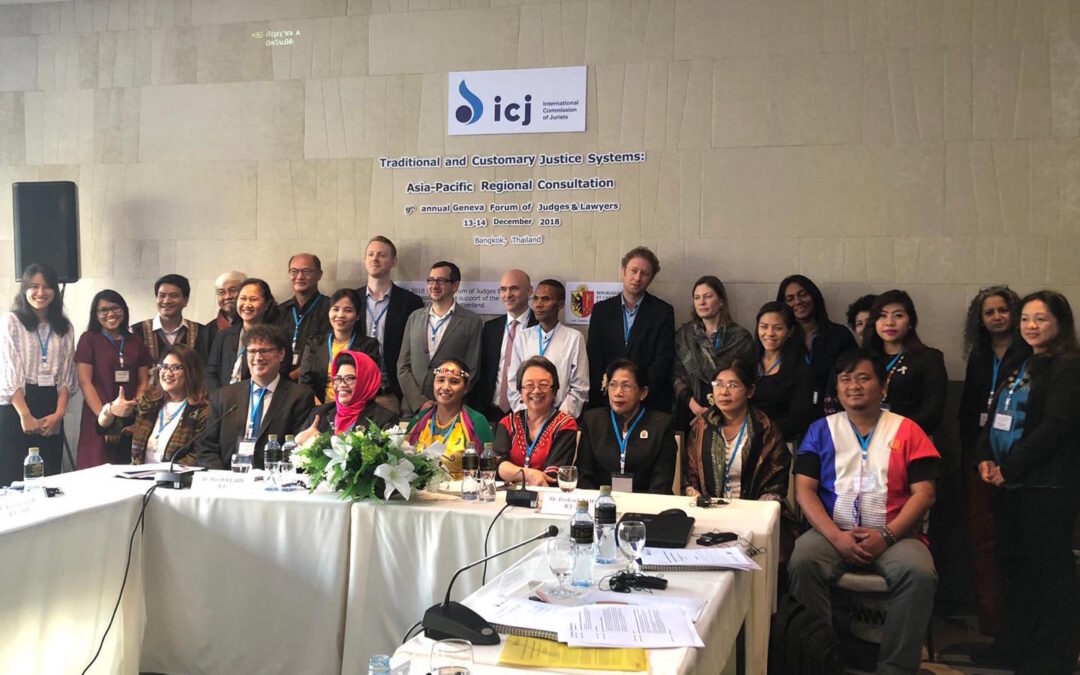
The ICJ convened the 9th annual “Geneva Forum” of Judges and Lawyers in Bangkok, Thailand, 13-14 December 2018, on the topic of indigenous and other traditional or customary justice systems in Asia.
Indigenous and other traditional or customary justice systems play a significant role in many societies around the world, in terms of access to justice for rural communities, indigenous peoples, minorities, and other marginalized populations. At the same time, such systems raise a series of questions in terms of their relationship to international fair trial and rule of law standards, and impacts on human rights including particularly those of women and children.
9th annual Geneva Forum of Judges & Lawyers, 13-14 December 2018, Bangkok, Thailand
Following discussions on these topics at the 2017 ICJ Geneva Forum (an annual global meeting of senior judges, lawyers, prosecutors and other legal and United Nations experts, convened by the ICJ with the support of the Canton and Republic of Geneva (Switzerland) and other partners), the ICJ decided that in order to better engage with customary justice systems, the Geneva Forum would be “on the road” in 2018 and 2019, convening for a regional consultation in the Asia-Pacific in 2018, and in Africa in 2019.
Additional consultations will take place in the Americas. The Forum will return to Geneva for an enlarged session in 2020 to adopt final conclusions and global guidance.
The ninth annual Geneva Forum in Bangkok brought together judges, lawyers, and others engaged with traditional justice systems in the Asia-Pacific region, and practitioners from ordinary justice systems in the region, together with UN Special Rapporteur on the rights of indigenous peoples Ms. Victoria Tauli Corpuz, as well as ICJ and UN representatives from Geneva, to discuss and develop practical recommendations, in a private small-group setting.
Participants came from a number of countries across the region, including: Cambodia, Indonesia, Malaysia, Myanmar, Pakistan, Philippines, Thailand and Timor Leste.
The potential and the risks for equal and effective access to justice and human rights
Many participants re-affirmed that traditional and customary justice systems can make an important contribution to improving access to justice for indigenous, and other rural or otherwise marginalized populations, as a result of such factors as geographic proximity, lower cost, lesser cultural or linguistic barriers, and greater trust by local communities, relative to the official justice system.
Indeed, for these and other reasons, for some marginalized and disadvantaged rural populations, traditional and customary courts may in practical terms be the only form of access they have to any kind of justice.
Furthermore, article 34 of the UN Declaration on the Rights of Indigenous Peoples affirms the right of indigenous peoples “have the right to promote, develop and maintain their institutional structures and their distinctive customs, spirituality, traditions, procedures, practices and, in the cases where they exist, juridical systems or customs, in accordance with international human rights standards”.
Furthermore, official recognition of traditional or customary courts in a country can more generally be a positive reflection of the cultural and other human rights of other ethnic, religious or linguistic minorities.
At the same time, the Forum discussions confirmed that, as with formal justice systems, certain characteristics and processes of some traditional and customary justice systems can conflict with international standards on fair trial and the administration of justice, and human rights, particularly of women and children.
Participants in the 2018 Forum discussed a variety of ways in which the relevant communities, their leaders, and decision-makers in indigenous or other traditional systems, together with government authorities, international actors, development agencies, and civil society, can cooperate and coordinate with a view to seeing both formal and traditional systems operate more consistently with international standards on human rights and the rule of law.
There was a range of views on which forms of engagement or intervention were most appropriate or effective. It was also emphasized that work should continue to build the accessibility and capacity of official justice systems to ensure that individuals seeking justice have a real choice.
The above conclusions were subject to the acknowledgement that traditional and customary justice systems take many different forms across the region, and that they exist in many different contexts.
A full report of the Forum discussions will be published by the ICJ in the first part of 2019.
Development of Guidance by the International Commission of Jurists
The ICJ’s global experience and expertise, together with research and global consultations with judges, lawyers and other relevant experts, including the 2017 Geneva Forum, the 2018 session in Bangkok, and subsequent regional consultations in Africa and the Americas, will provide a foundation for the publication by ICJ in 2020 of legal, policy and practical guidance on the role of traditional and customary justice systems in relation to access to justice, human rights and the rule of law.
The ICJ guidance will focus on the mechanisms and procedures of traditional and customary justice systems, as opposed to tackling all aspects of the substantive law.
The guidance will seek to assist all actors involved in implementation and assessment of relevant targets of Sustainable Development Goal 16 on access to justice for all and effective, accountable and inclusive institutions, as well as Goal 5 on gender equality, including: decision-makers and other participants in traditional and customary justice systems; judges, lawyers and prosecutors operating in official justice systems; other government officials; development agencies; United Nations and other inter-governmental organizations; and civil society.
The guidance will be published and disseminated through activities with ICJ’s regional programmes, and its national sections and affiliates, through a series of regional launch events and workshops, as well as at the global level at the United Nations and in other settings.
The guidance will provide the basis for ICJ strategic advocacy at the national level in the years following the conclusion of this initial phase of this work.
Background Materials
Available for download in PDF format:
A Compilation of selected international sources on traditional and customary courts, is available here.
The Final report of the 2018 Geneva Forum, on traditional and customary justice systems, is available here: Universal-Trad-Custom-Justice-GF-2018-Publications-Thematic-reports-2019-ENG
The Final report of the previous, 2017 Geneva Forum, on traditional and customary justice systems, is available here: Universal-Trad Custom Justice Gva Forum-Publications-Thematic reports-2018-ENG
For more information, please contact matt.pollard(a)icj.org.
Dec 2, 2018 | Events, News
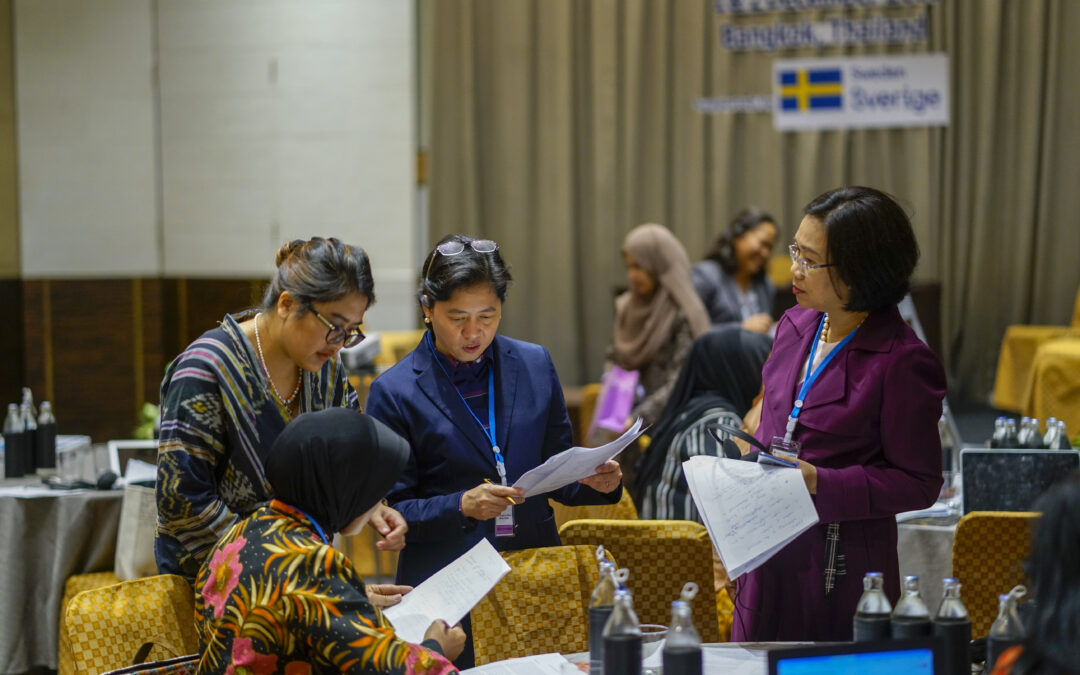
On 1-2 December 2018, the International Commission of Jurists (ICJ) held its 2018 Southeast Asia Regional Judicial Dialogue on enhancing access to justice for women in the region.
Participants included judges from Cambodia, Indonesia, Nepal, Pakistan, Philippines, Sri Lanka and Thailand.
The discussions, held in Bangkok, were focused around resources important for judges to aid in enhancing the capacity of their peers in eliminating gender discriminatory attitudes and behaviours towards women in their work. These resources include a training manual on the use of the Bangkok General Guidance for Judges in Applying a Gender Perspective, and a draft reference manual on women’s human rights and the right to a clean, healthy, safe and sustainable environment.
Frederick Rawski, ICJ’s Director of the Asia and the Pacific Programme, opened the dialogue by emphasizing how important it is for judges to be gender sensitive in their delivery of justice. This could only be done by applying a framework that gives primary attention on ensuring recognition of the applicable human rights, institutional support for the promotion of these rights, and accountability mechanisms for their implementation.
Roberta Clarke, Commissioner of the ICJ and Chair of the organization’s Executive Committee, noted that this judicial dialogue demonstrates the ICJ’s commitment to have a sustainable contribution to the implementation of international human rights standards at the domestic level. She hoped that the judges could contextualize the resources presented and bring these back to their countries for trainings of their peers.
This judicial dialogue is part of a joint project on access to justice for women that ICJ is implementing with UN Women.
Anna Karin Jatfors, UN Women-Asia Pacific’s Interim Regional Director shared that gender stereotypes and social norms which discriminate women are not unique in each country. She pointed out the importance of the ICJ and UN Women collaborating in this project to deconstruct this image to bring better access to justice to women in the region.
Overall, the dialogue was rich and substantive, with the full and active participation from all participating judges who shared their views and experiences on countering gender discrimination in cases before them. At the end of the judicial dialogue, the participating judges expressed strong interest to use the resources for capacity building initiatives of their peers in their own countries.
Contact
Emerlynne Gil, Senior International Legal Adviser, t: +662 619 8477 (ext. 206), email: Emelynne.gil(a)icj.org
Oct 31, 2018 | News
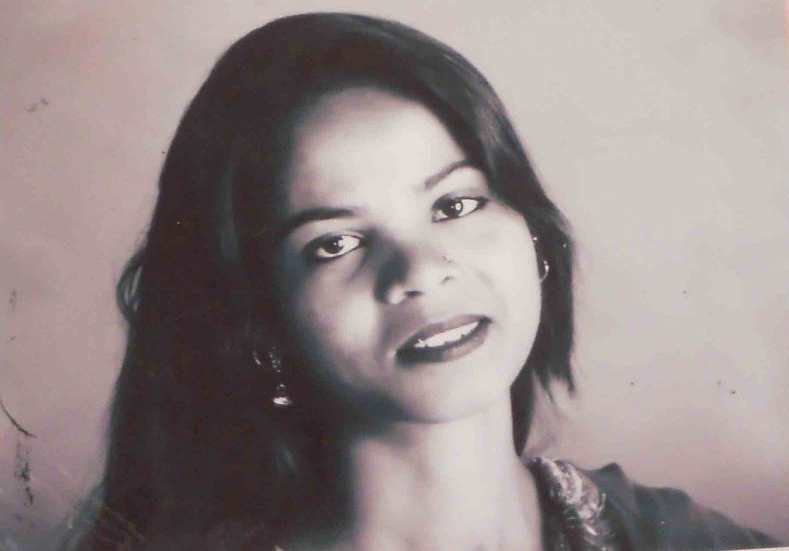
The ICJ today welcomed the Pakistani Supreme Court’s decision to acquit Asia Noreen (Asia Bibi) of blasphemy charges under section 295-C of the Pakistan Penal Code.
Asia bibi had been on death row since 2010, when a trial court convicted her of “defaming the Prophet Muhammad” and sentenced her to death. The Lahore High Court had upheld her conviction and confirmed her death sentence in 2014.
“All eyes were on the Supreme Court to respond to Asia bibi’s final plea for justice and undo the blatant wrongs done to her and her family for eight long years,” said Frederick Rawski, ICJ’s Asia Director.
“It is heartening to see that despite threats and external pressures, the SC fulfilled its role to protect human rights in this case.”
Certain Islamist groups have frequently held demonstrations calling for Asia bibi and other blasphemy accused to be hanged. After the Supreme Court announced its decision to acquit Asia bibi, the Tehreek-e-Labbaik Pakistan took to the streets condemning the decision.
“The Government should take notice of this pattern of threats and reprisals in blasphemy cases and ensure that judges and lawyers are given adequate security to perform their duties independently, impartially and without any external influence,” said Rawski.
Reasons for Asia bibi’s acquittal include an unexplained delay in the registration of the criminal complaint; material inconsistencies in the testimonies of prosecution witnesses; wrongful reliance on Asia bibi’s extra-judicial “confession”; and failure to take into account the circumstances of the blasphemy allegations, including a “quarrel”, possibly about Asia bibi’s faith.
The Supreme Court also noted that the context indicates the charges could have arisen from a “false allegation” of blasphemy, echoing concerns also raised by the ICJ that the blasphemy laws in Pakistan have typcially become an instrument of personal vendettas and malicious motivations.
Asia bibi’s appeal was the first blasphemy case being heard by the Supreme Court since 2002. The Court has so far not upheld any convictions for blasphemy under section 295-C of the Penal Code (defamation of the Prophet Muhammad), though dozens of people have been convicted by trial courts and a number of appeals are pending before various appellate forums.
The ICJ has documented in detail systematic and widespread fair trial violations in proceedings related to blasphemy offences in Pakistan.
Courts in Pakistan have noted on multiple occasions that people accused of blasphemy suffer ‘beyond proportion or repair’ in the absence of adequate safeguards against misapplication or misuse of such blasphemy laws.
The ICJ underscores that laws that criminalize the exercise of freedom of expression are non-compliant with international law, including the International Covenant on Civil and Political Rights, to which Pakistan is a party. This includes the criminalization of expression in relation to religion.
The ICJ opposed the death penalty in all circumstances and considers that it constitutes a violation of the right to life and the right not to be subjected to cruel, inhuman or degrading punishment.
Contact:
Frederick Rawski (Bangkok), ICJ Asia Pacific Regional Director, e: frederick.rawski(a)icj.org
Reema Omer, ICJ International Legal Advisor (South Asia) t: +447889565691; e: reema.omer(a)icj.org
Additional information
In November 2015, the ICJ published a report documenting in detail systematic and widespread violations of the right to a fair trial in proceedings related to blasphemy offences in Pakistan, particularly in trial courts. The report confirmed concerns raised by the Supreme Court of Pakistan that individuals accused of blasphemy ‘suffer beyond proportion or repair’ in the absence of adequate safeguards.
The ICJ also made a number of recommendations to the Pakistani executive, legislative and judicial branches to address violations caused by application of the blasphemy laws, whether due to the legislative provisions themselves or at the investigative, prosecutorial, procedural, administrative and judicial levels highlighted in the report, including to ensure that those accused of blasphemy have a fair chance at defending themselves.
In a briefing paper published in October 2016, the ICJ assessed the fair trial violations in Asia bibi’s trial and appellate hearing. The ICJ found glaring omissions both in the appraisal of evidence as well as the application of laws that brought her conviction into question.
Oct 24, 2018 | News
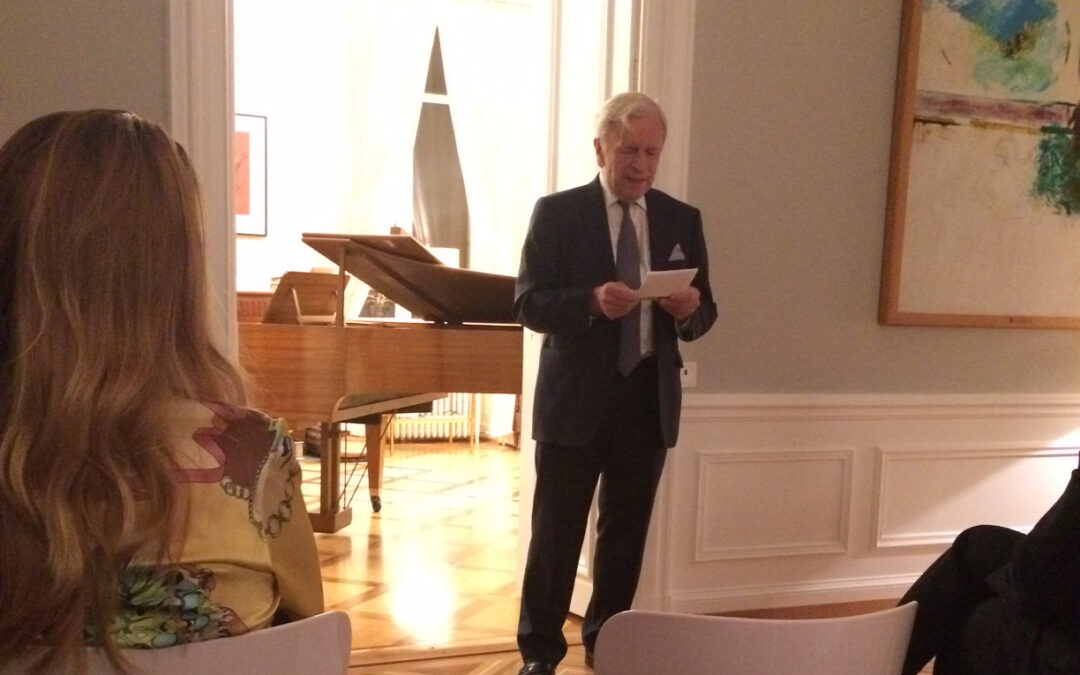
The ICJ started its 60th anniversary in Geneva with an evening gala hosted by Ambassador Julian Braithwaite, at his residence on 18 October 2018. A moving speech by Sir Nicolas Bratza (photo), ICJ Commissioner and Executive Committee member, on the importance of the defence of the rule of law opened the evening.
It was followed by a magnificent concert by Menuhin Academy virtuoso, violinist Vasyl Zatsikha. A magical evening.
The speech of Sir Nicolas Bratza
“I feel very privileged to have been asked to say a few words by way of introduction to the speech of the Secretary General of the ICJ.
May I begin by expressing on behalf of us all the warmest thanks to the British Ambassador for hosting this very special celebration of the 60th anniversary of the ICJ in its home in Geneva.
Anniversaries are always important occasions and never more so than when they mark a milestone in the life of a remarkable organization that has throughout its existence worked tirelessly to safeguard the rule of law and human rights and that has done so, in particular, by protecting and defending the independence of judges and lawyers.
My association with the ICJ has been relatively brief but for many years I have admired its work from afar, as a member of the European Commission of Human Rights for five years and as a judge of the Strasbourg Court, for fourteen.
The Court and the ICJ share the common purpose – to protect the fundamental principles of democracy, the rule of law and human rights.
Without the independent and impartiality of judges, both national and international, those principles would be meaningless and might as well have been written on water.
With the alarming growth of populism in countries across the world, the threats to the independence of the judiciary are regrettably as real today as they have been at any time.
In the international Court of which I was a member, judges are nominated by the States from which they are drawn.
But they are in no sense representatives of those States and are not infrequently faced with having to decide cases, sometimes cases of acute sensitivity, against their own countries.
The pressures on judges of the Court are often intense and there are notorious examples where the courage shown by a judge in maintaining his or her rigorous independence has come at a cost, the judge being punished by not being renominated by the State, by returning to the country at the end of their mandate without employment or means of livelihood, or by being unable to return safely to their home at all.
But if the position of the international judge is difficult enough, that of the national judge in certain States, including member States of the Council of Europe, is far worse, their independence and security, both physical and professional, being under constant threat.
In the 1990s and in the early years of this century, the signs were promising. One was able to witness a slow but steady improvement in adherence to the rule of law on the part of new democracies.
This was in no small measure due to the work of organizations such as the ICJ which, through its writings, seminars and training of judges and lawyers worldwide, did so much to strengthen and support judicial independence and to expose the most flagrant examples of abuse and undermining of that independence.
I regret to say that in more recent years the landscape has become much darker, with open and insidious attacks on members of the judiciary, the arbitrary removal of judges from their posts and measures taken to curtail the powers of judges and courts or to undermine their authority and independence.
In my official visits to member States as President of the Strasbourg Court, I met several judges who voiced their deep concern about the steps being taken both by the legislature and the executive to compromise their independence and to diminish their authority. It is not only in the new democracies that such a phenomenon has become apparent.
There has been a growing trend in many parts of Europe to undermine the standing and authority of the judiciary by outspoken attacks on judges for unpopular decisions, by members of the executive, by parliamentarians and by the media.
It is these challenges to judicial independence and to the rule of law that make the role of the ICJ and the continued support of the diplomatic community not only more relevant but more vital than they have ever been.
It is with pride and pleasure that I wish the ICJ a very happy anniversary on this its first 60 years of life in this great city.
But I combine this with a fervent hope that, with the support of us all, the ICJ is able to continue its extraordinary work for the next 60 years and far beyond. The protection of the rule of law and human rights depend on it.”