Mar 3, 2015 | News
Myanmar’s parliament must reject or extensively revise a series of proposed laws that would entrench already widespread discrimination and risk fuelling further violence against religious minorities, Amnesty International and the ICJ said today.
A package of four laws described as aimed to “protect race and religion” – currently being debated in parliament – include provisions that are deeply discriminatory on religious and gender grounds.
They would force people to seek government approval to convert to a different religion or adopt a new religion and impose a series of discriminatory obligations on non-Buddhist men who marry Buddhist women.
“Myanmar’s parliament must reject these grossly discriminatory laws which should never have been tabled in the first place. They play into harmful stereotypes about women and minorities, in particular Muslims, which are often propagated by extremist nationalist groups,” said Richard Bennett, Amnesty International’s Asia-Pacific Director.
“If these drafts become law, they would not only give the state free rein to further discriminate against women and minorities, but could also ignite further ethnic violence,” he added.
The draft laws have been tabled at a time of a disturbing rise in ethnic and religious tensions, as well as ongoing systematic discrimination against women, in Myanmar.
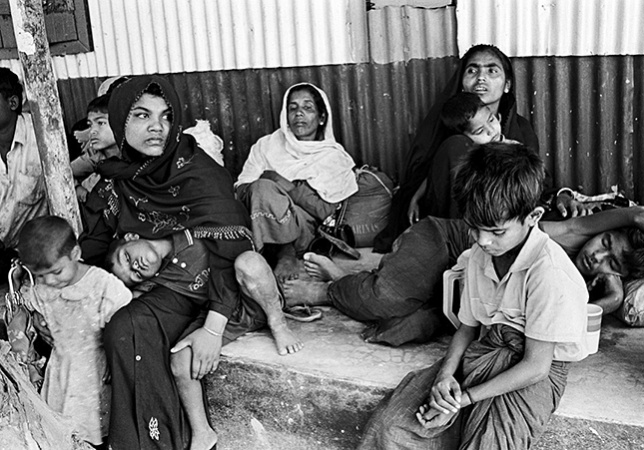
In this context, where minority groups – and in particular the Rohingya (photo) – face severe discrimination in law, policy and practice, the draft laws could be interpreted to target women and specific communities identified on a discriminatory basis.
“The passage of these laws would not only jeopardize the ability of ethnic and religious minorities in Myanmar to exercise their rights, it could be interpreted as signalling government acquiescence, or even assent, to discriminatory actions,” said Sam Zarifi, ICJ’s Asia Director. “The introduction of these discriminatory bills is distracting from the many serious political and economic issues facing Myanmar today.”
Of the four draft laws, two – the Religious Conversion Bill and the Buddhist Women’s Special Marriage Bill – are inherently flawed and should be rejected completely.
The remaining two – the Monogamy Bill and the Population Control Healthcare Bill – need serious revision and the inclusion of adequate safeguards against all forms of discrimination before being considered, let alone adopted.
These bills do not accord with international human rights law and standards, including Myanmar’s legal obligations as a state party to the UN Convention on the Elimination of all Forms of Discrimination against Women and the UN Convention on the Rights of the Child.
Amnesty International and the ICJ have conducted a legal analysis of the four laws and have found that:
- The Religious Conversion Bill stipulates that anyone who wants to convert to a different faith will have to apply through a state-governed body, in clear violation of the right to choose one’s own religion. It would establish local “Registration Boards”, made up of government officials and community members who would “approve” applications for conversion. It is unclear whether and how the bill applies to non-citizens, in particular the Rohingya minority, who are denied citizenship in Myanmar. Given the alarming rise of religious tensions in Myanmar, authorities could abuse this law and further harass minorities
- The Buddhist Women’s Special Marriage Bill explicitly and exclusively targets and regulates the marriage of Buddhist women with men from another religion. It blatantly discriminates on both religious and gender grounds, and feeds into widespread stereotypes that Buddhist women are “vulnerable” and that their non-Buddhist husbands will seek to forcibly convert them. The bill discriminates against Buddhist women as well as against non-Buddhist men who face significantly more burdens than Buddhist men should they marry a Buddhist woman.
- The Population Control Healthcare Bill – ostensibly aimed at improving living standards among poor communities – lacks human rights safeguards. The bill establishes a 36-month “birth spacing” interval for women between child births, though it is unclear whether or how women who violate the law would be punished. The lack of essential safeguards to protect women who have children more frequently potentially creates an environment that could lead to forced reproductive control methods, such as coerced contraception, forced sterilization or abortion.
- The Monogamy Bill introduces new provisions that could constitute arbitrary interference with one’s privacy and family – including by criminalizing extra-marital relations – instead of clarifying or consolidating existing marriage and family laws.
Contact
In Bangkok – Sam Zarifi, ICJ Regional Director for Asia and the Pacific, sam.zarifi(a)icj.org; m +66807819002
In London – Olof Blomqvist, Amnesty International Asia-Pacific Press Officer, olof.blomqvist(a)amnesty.org; t: +44 20 7413 5871, m +44 790 4397 956
An extensive legal analysis of the laws by Amnesty International and the ICJ can be found here:
Myanmar-Reject discriminatory race and religion draft laws-Advocacy-2015-ENG (full text in PDF)
Oct 15, 2014 | News
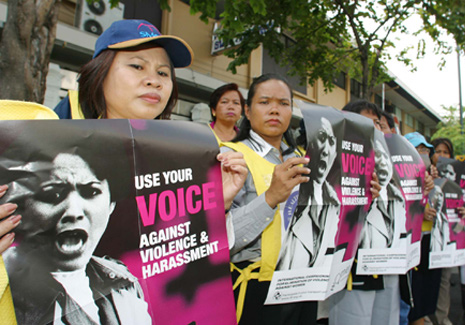
Judges and representatives from judicial institutes from across Southeast Asia are attending a regional workshop to discuss how they can help counter gender-based violence and gender stereotypes.
The workshop, organized by the UN Women Regional Office for Asia and the Pacific, in collaboration with the Office of the Thai Judiciary and the ICJ is held in Bangkok on 15 and 16 October 2014.
This Regional Workshop for Judicial Training Institutions on Good Practices in Promoting Women’s Human Rights Compliant Justice Delivery will focus on using the CEDAW Convention and on eradicating gender stereotypes, especially in cases related to violence against women.
It also aims to improve the progress of the implementation of the CEDAW Convention and strengthen the regional network of judicial training institutions in eight Southeast Asian countries, namely Cambodia, Indonesia, Lao PDR, Myanmar, the Philippines, Thailand, Timor-Leste and Vietnam.
Speakers at the opening session include Hon. Justice Pattarasak Vannasaeng, Secretary-General of the Office of the Thai Judiciary; H.E. Mr. Philip Calvert, Ambassador of Canada for Thailand; Ms. Roberta Clarke, Regional Director of the UN Women Regional Office for Asia and the Pacific; and Sam Zarifi, ICJ’s Regional Director for Asia and the Pacific.
Thailand-Women Judicial training-News-web story-2014-ENG (full text in PDF)

Sep 15, 2014 | Advocacy, Non-legal submissions
The ICJ supports a joint oral statement, delivered by ARC International, in relation to the Panel on “Protection of the Family”, at the UN Human Rights Council today.
The oral statement emphasised the importance of recognising the diversity of forms of families around the world.
It also noted that familes can be sites for transmissions of values, and that this can on the one hand include the promotion of human rights values, or on the other hand values incompatible with respect for human rights.
Finally, the statement highlighted that a human rights-based approach to family policies must recognise that individuals within families have human rights that require protection. Indeed, while families have the potential to help protect the human rights of their members from violations, families also have the potential to conceal abuses of human rights within the family.
The full statement in PDF format may be downloaded here: Universal-ProtectionofFamily-Advocacy-nonlegalsubmission-2014.EN
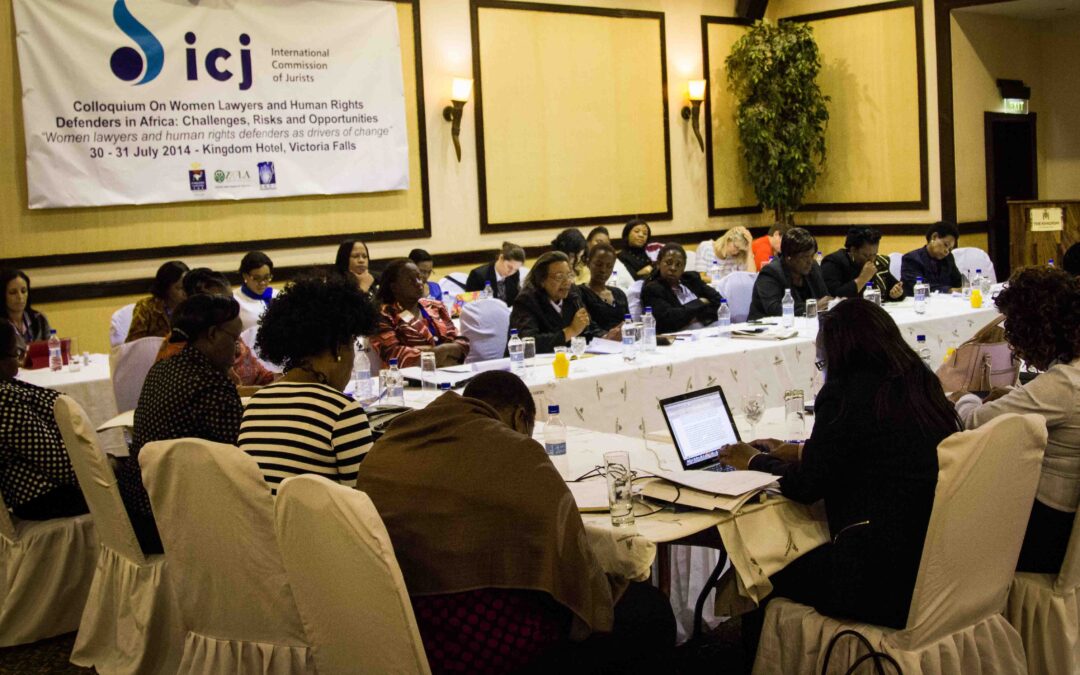
Aug 2, 2014 | Multimedia items, News, Video clips
Women judges, lawyers and human rights defenders from across Africa participated in ICJ Colloquia on “Women Lawyers and Human Rights Defenders: Challenges and Opportunities” on 30 and 31 July in Victoria Falls, Zimbabwe.
The colloquia were hosted in collaboration and partnership with the Gender Committee of the SADC Lawyers Association, the Zimbabwe Women Lawyers Association and Zimbabwe Lawyers for Human Rights.
It enabled over 40 women lawyers, human rights defenders and judges to come together to identify the challenges faced by women lawyers and human rights defenders and elaborate action steps.
Discussions also addressed the role of the judiciary in advancing gender equality, women’s access to justice and protection of women human rights defenders.
The Colloquia are part of an ICJ multi-year initiative on women judges, lawyers and human rights defenders as agents of change.
Interviews:
Justice Martha Koome (Kenya)
Justice Lillian Tibatemwa-Ekirikubinza (Uganda)
Doo Aphane (Swaziland)
Jane Serwanga (Kenya)
Jul 2, 2014 | Advocacy, Position papers
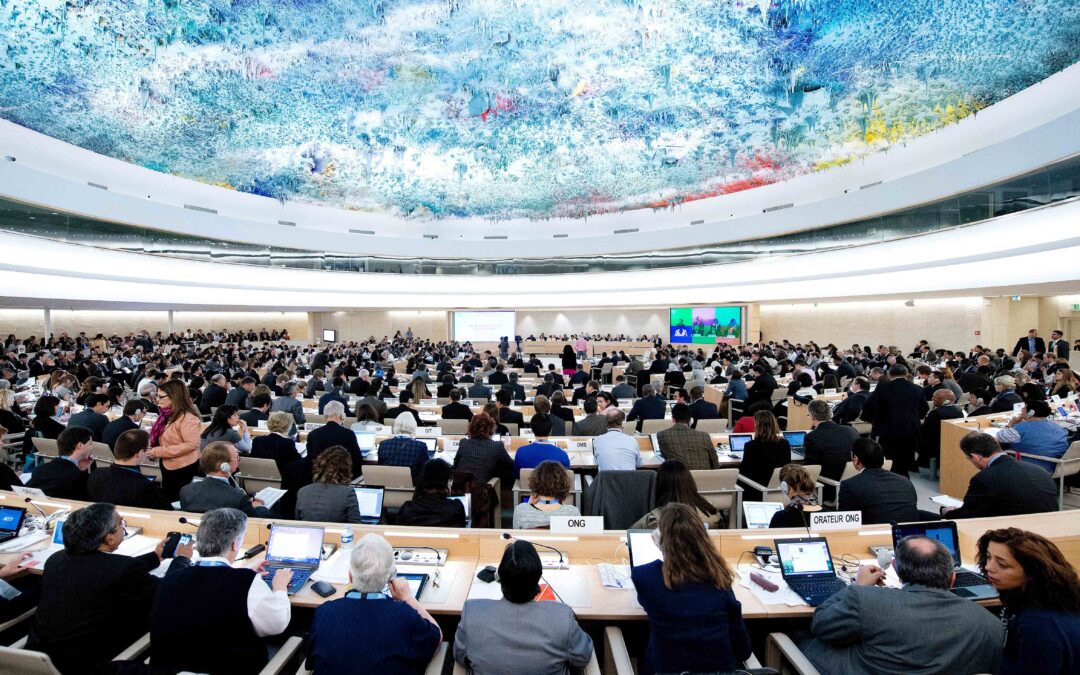
The ICJ and other NGOs have issued a joint statement urging the UN Human Rights Council to ensure that a discussion of “protection of the family” in September will reflect diversity and focus on human rights.
The ICJ is concerned, due to the way the resolution to establish the Panel discussion has been pursued, that some States will seek to exploit it as a vehicle for promoting a narrow, exclusionary and patriarchal concept of “the family” that denies equal protection to the human rights of individuals who belong to the various and diverse forms of family that exist across the globe.
Previous UN resolutions on the family include language, agreed by all States, that recognized that “various forms of the family exist”. The authors of the resolution deliberately omitted this language, despite this issue being consistently raised by other States throughout the negotiations.
A wholly inappropriate procedural tactic was used by some states to block discussion of a proposed amendment that would have restored the “various forms” language.
Efforts to ensure that the resolution clearly acknowledged and addressed the fact that the family is also a setting in which human rights abuses sometimes take place were partially successful.
The Panel topic will be “on the protection of the family and its members to address the implementation of States’ obligations under relevant provisions of international human rights law and to discuss challenges and best practices in this regard” (emphasis added).
The resolution reaffirms “that States have the primary responsibility to promote and protect the human rights and fundamental freedoms of all human beings, including women, children and older persons”. Unfortunately, however, the text of the resolution still does not give enough emphasis to this important aspect.
The organizations affirm that they will continue to insist on recognition that various forms of the family exist, and that individuals should not be discriminated against as a result of the form of family to which they happen to belong.
States should not fail to promote and protect the rights of persons because they belong to particular forms of family.
The organizations will continue to insist that the promotion and protection of the human rights of individuals within all families must be of the paramount importance to the UN Human Rights Council.
The joint statement may be downloaded in PDF here: HRC26-Joint statement family resolution-Advocacy-Position paper-2014