Oct 1, 2018 | News
The Inter-American Commission of Human Rights (IACHR) held a special hearing on the role of the International Commission against Impunity in Guatemala (CICIG) in Boulder, Colarado.
Ramón Cadena, the ICJ Director stated “We regret that the Government of Guatemala requested the IACHR to hold the hearing behind closed doors since all the points discussed were of public interest. The discussions should have been open to the press and the general public. We urge the authorities to ensure there will be no retaliations against the work carried out by human rights organizations and human rights defenders.”
The ICJ welcomed the participation of many NGOs at the event and the frank dialogue that took place on this crucial issue for human rights in that country. The Guatemalan government delegation claimed that the Inter-American System of Human Rights was not competent to consider the matter. However, the IACHR maintained it was competent, according to the American Convention of Human Rights and other regional human rights legislation. As an “external observer”, the IACHR stated it was “surprised” by the latest decisions taken by government authorities at the highest level not to extend the CICIG mandate nor allow the entry of Commissioner Iván Velásquez into the country. It considered these decisions were “excessive” and in no way strengthened the rule of law in Guatemala.
The government delegation further argued that the CICIG acted as a “parallel prosecutor” which affects the internal order of the country. The NGO delegation stated that on the contrary the CICIG acted as a “complementary prosecutor”. The delegation further noted that before the CICIG mandate was approved, the Constitutional Court, in an opinion published in the official gazette on 8 May 2007 (document no 791-2007), considered that the CICIG did not violate the constitutional order nor the rule of law in Guatemala.
The Constitutional Court referred to the CICIG as having “the function of supporting, assisting and strengthening the state institutions responsible for investigating crimes committed by illegal and clandestine security forces .. and does not exclude the possibility of receiving support from other institutions in the collection of evidence, provided that the participation has been established in a legal manner, as in the present case.”
The IACHR considered that the essential question was whether the State of Guatemala already had the judicial independence and strong institutions necessary to fight against corruption in Guatemala without the support of the CICIG. The NGO delegation considered, based on different arguments, that the presence of the CICIG in Guatemala was still necessary.
The IACHR also informed the government delegation that it was in their interest to invite an in-situ visit of the IACHR as soon as possible so as to better understand the human rights situation.
The ICJ Director for Central America Ramón Cadena participated in the hearing at the request of the Central American Institute for Social Democracy Studies (DEMOS), the Committee for Peasant Development (CODECA) and the Network of Community Defenders. The Indigenous Peoples Law Firm had been requested to attend by these organizations but was unable to do so at the last moment.
Oct 1, 2018 | News
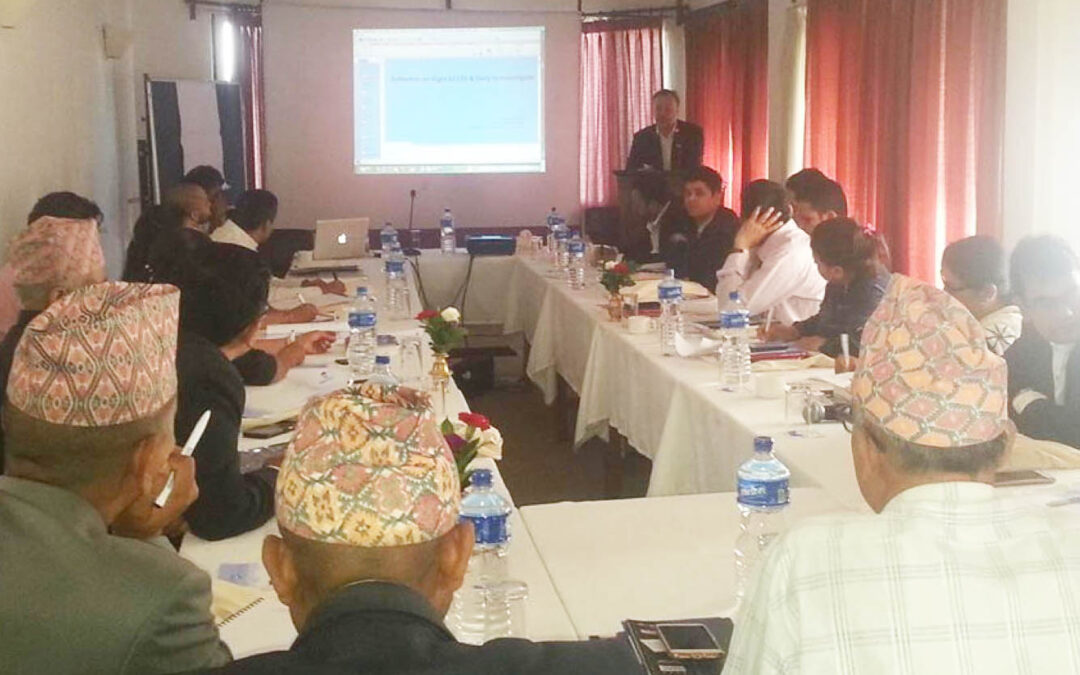
From 29 to 30 September 2018, the ICJ convened a 2nd two-day workshop on application of international law and standards, remarkably focusing on the Minnesota protocol, with special reference to investigation of alleged unlawful killings and enforced disappearances for public prosecutors of Nepal.
The workshop was organized by the ICJ South Asia office and took place as part of the ICJ’s Global Redress and Accountability Initiative, “increasing the knowledge and capacity of lawyers, prosecutors and investigators to deal with challenges of impunity and access to redress.”
The participants of the workshop included 18 public prosecutors working in District Government Office in Kathmandu, Lalitpur, Bhaktapur and Kavrepalanchok, Nepal.
The event started with opening remarks by the Attorney General of Nepal and former minister of Law and Justice, Agni Kharel.
In the opening remarks, Agni Kharel highlighted both commitments made and efforts by the Nepal government in order to protect and promote human rights as well as justice for victims of human rights violations.
Expressing pleasure on the theme of the workshop, he also said the public prosecutors will be benefited as well as be competent to use the knowledge and learning from the workshop in their works.
Senior Legal Consultant of the ICJ Nepal – Govinda Bandi, one of the experts of the workshop and speaker of the opening ceremony, highlighted the objectives of the workshop.
Kingsley Abbott, Senior International Legal Adviser at the ICJ, presented an overview of the relevant international human rights legal framework that applies to the investigation of alleged killing and enforced disappearances.
He further presented an introduction and overview of the revised Minnesota Protocol on the Investigation of Potentially Unlawful Death (2016) and ICJ practitioners Guide no. 9. Both instruments were core materials used at the workshop.
Other speakers included Govinda Bandi, Senior Legal Consultant at the ICJ, who presented on the relevance of the Minnesota protocol in investigating on alleged unlawful killing and enforced disappearances.
Prof. Dr. Hariwar Wasti, Medico-legal expert at the IOM Department of Forensic Medicine of Government of Nepal, presented a power point presentation on the role of forensics in the investigation of gross human rights violations with reference to the Minnesota Protocol.
The workshop focused on investigation techniques of alleged unlawful killings highlighting the significance of public prosecutors in Nepal.
It was also focused on collection and preserving the security of evidences and potential use of the evidences for victims’ right to justice and reparation.
The workshop also covered medico-legal documentation techniques of crime scene and dead wearing tie body, collection of DNA evidence, and drafting of autopsy reports and crime file management.
It was also discussed and outlined some approaches of using the Minnesota protocol in Nepal in the final session of the workshop.
This workshop followed the national workshop the ICJ hosted between 13 to 14 July 2018 in Dhulikhel, Nepal on the investigation of alleged unlawful deaths and enforced disappearances for more than 20 human rights lawyers from diverse regions of Nepal.
Oct 1, 2018 | Comunicados de prensa, Noticias
La CIJ celebra la participación de diferentes Organizaciones No Gubernamentales, en la audiencia que la Comisión Interamericana de Derechos Humanos (CIDH) convocara de oficio, la cual permitió escuchar la posición de ambas delegaciones y llevar a cabo un diálogo franco sobre un tema trascendental para la población guatemalteca y el respeto de los derechos humanos en el país.
La CIJ participó por medio de su Director para Centroamérica, abogado Ramón Cadena, participación solicitada por el Instituto Centroamericano de Estudios para la Democracia Social (DEMOS), del Comité de Desarrollo Campesino (CODECA) y de la Red de Defensores Comunitarios.
El Bufete para Pueblos Indígenas, si bien había sido solicitado por dichas organizaciones para asistir, no pudo hacerlo en un último momento.
Si bien la Delegación Gubernamental alegó falta de competencia por parte del Sistema Interamericano de Derechos Humanos, la Comisión Interamericana no sólo sostuvo que sí era competente, según la Declaración Americana de Derechos Humanos y la Convención Americana de Derechos Humanos y otra legislación regional de Derechos Humanos, sino que además, en su calidad de “observadora externa”, se sintió “sorprendida” por las últimas decisiones tomadas por las autoridades gubernamentales al más alto nivel y advirtió al Estado de Guatemala, que el mensaje que el Estado de Guatemala estaba dando con sus últimos actos y decisiones de no prorrogar el mandato de la CICIG, ni permitir el ingreso del comisionado Iván Velásquez al país, era “excesivo” y que en nada fortalecía al Estado de Derecho de Guatemala.
Otro argumento de la delegación gubernamental fue afirmar que la CICIG actuaba como “fiscalía paralela”, lo cual afectaba el ordenamiento interno.
Al respecto, la delegación de las organizaciones no gubernamentales explicaron a la ilustre Comisión Interamericana de Derechos Humanos, que no se trataba de una fiscalía paralela, sino que de la figura del “querellante adhesivo” y que incluso antes de la aprobación del mandato de la CICIG, la Corte de Constitucionalidad emitió una opinión consultiva el 8 de mayo de 2007 (Expediente 791-2007), debidamente publicada en el Diario Oficial, en la que consideró que la constitución de la CICIG no violaba el ordenamiento constitucional, ni legal del Estado de Guatemala.
Específicamente, la Corte de Constitucionalidad consideró al referirise a la función de la CICIG que “la función de apoyar, coadyuvar y fortalecer a las instituciones estatales encargadas de la investigación en los delitos cometidos con ocasión de la actividad de los cuerpos ilegales de seguridad y aparatos clandestinos de seguridad…no excluye la posibilidad de recibir el apoyo de otras instituciones en la recolección de evidencia, siempre que la participación se haya establecido de manera legal, como sucede en el presente caso.”
La ilustre Comisión Interamericana de Derechos Humanos (CIDH) consideró que la pregunta esencial que había que responder, era si el Estado de Guatemala contaba ya con la fortaleza institucional, con la independencia judicial y con funcionarios e instituciones sólidas, como para poder luchar contra la corrupción en Guatemala, sin el apoyo de la CICIG.
La delegación de las organizaciones no gubernamentales fundamentaron con diferentes argumentos, que aún no se contaba con dicha solidez y que la presencia de la CICIG en el país, seguía siendo necesaria.
La Comisión Interamericana celebró la participación nutrida de la Sociedad Civil de Guatemala y la presencia de representantes del gobierno guatemalteco y manifestó que el haber convocado de oficio a esta audiencia, demostraba el interés de la CIDH en Guatemala.
Informó a la delegación gubernamental, que era su interés realizar una visita “in loco” a la mayor brevedad posible, ya que de esa forma podría conocer en forma más profunda todas las situaciones de derechos humanos que se estaban presentando en el país, para lo cual solicitó el apoyo de la delegación gubernamental.
Ramón Cadena, Director de la CIJ para Centroamérica expresó: “Lamentamos que el Gobierno de Guatemala solicitara a la Comisión Interamericana de Derechos Humanos que la audiencia se llevara a cabo a “puertas cerradas”, ya que todos los puntos discutidos fueron del interés de la ciudadanía en general y de la prensa.
Por ello, en lugar de mantener las discusiones cerradas, deberían abrirse al conocimiento de la prensa y del público en general. Exigimos a las autoridades correspondientes, que no vaya a haber represalias en contra del trabajo que realizan las organizaciones de derechos humanos y las y los defensores de derechos humanos.”
Sep 18, 2018 | Advocacy, Non-legal submissions
The ICJ today urged the UN Human Rights Council to establish a mechanism to preserve evidence of crimes under international law occurring in Myanmar, with a view to eventual prosecution of those responsible.
The statement, delivered during an interactive dialogue with the UN International Fact Finding Mission, read as follows:
“The International Commission of Jurists (ICJ) has monitored justice and human rights in Myanmar for more than five decades. The ICJ has an established presence in the country supporting justice actors to protect human rights through the rule of law.
With this experience, the ICJ views the Independent International Fact Finding Mission’s conclusions as painting an authoritative picture of the general situation in Myanmar, particularly in its highlighting of the pervasive damage of military impunity upon human rights, rule of law and the nascent democratic process.
The rule of law cannot be established, let alone flourish, without accountability for perpetrators of human rights violations and redress for victims and their families.
The Fact Finding Mission’s findings of crimes under international law, including crimes against humanity in Rakhine, Kachin and Shan states, and the identification of alleged perpetrators, necessitate immediate action.
The Government of Myanmar is unwilling and unable to effectively and genuinely provide justice for crimes, particularly when perpetrated by security forces. International action must not be deterred or delayed by the latest government inquiry, which is incapable of providing accountability or redress and may promote impunity by undermining credible international justice mechanisms.
The ICJ calls for a unified Council resolution at this session to establish an International Impartial and Independent Mechanism. This is urgently required to preserve evidence before its further deterioration, and to demonstrate a commitment to justice. Failing to act now risks further denying justice for victims and emboldening perpetrators.
Violations against Rohingya constitute an egregious yet emblematic example of systematic persecution of minority groups that has persisted in Myanmar for decades.
The ICJ would like to ask the Fact-Finding Mission: how can the Council best ensure accountability for the full range of crimes under international law committed against minorities throughout Myanmar and prevent their continuation and recurrence?”
For more information see:
Myanmar: why an IIIM and Security Council referral are needed despite the ICC ruling relating to Bangladesh
Myanmar: Government’s Commission of Inquiry cannot deliver justice or accountability
Sep 11, 2018 | Events, News
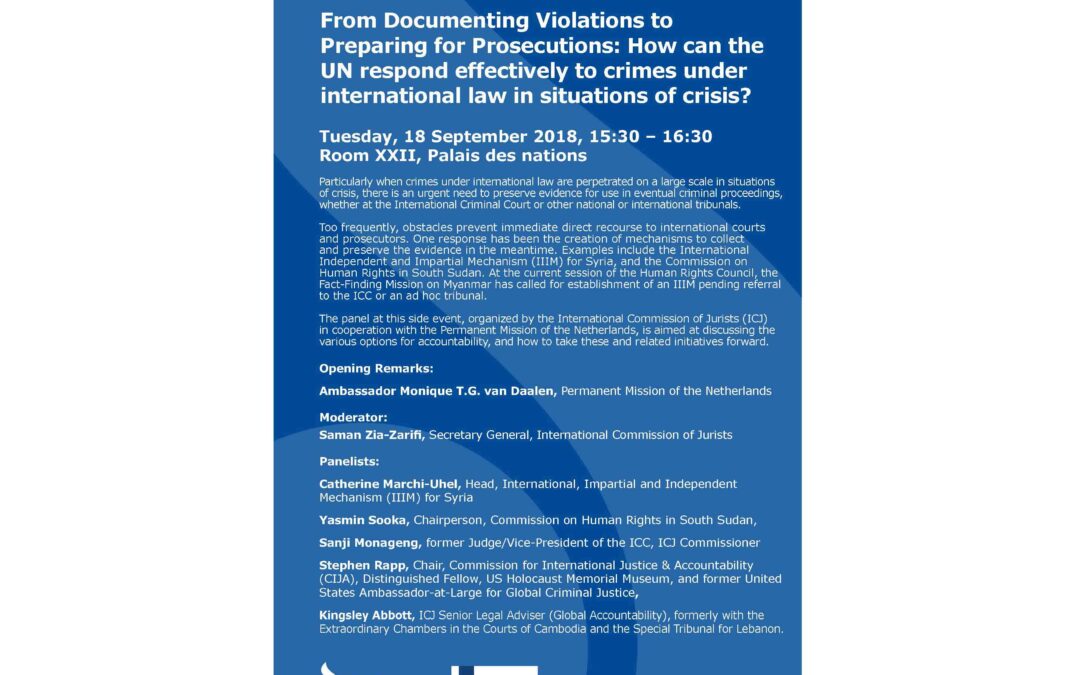
The ICJ will organize this side event, in cooperation with the Permanent Mission of the Netherlands, at the Human Rights Council on Tuesday 18 September 2018 from 15:30 – 16.30 in Room XXII of the Palais des Nations.
Particularly when crimes under international law are perpetrated on a large scale in situations of crisis, there is an urgent need to preserve evidence for use in eventual criminal proceedings, whether at the International Criminal Court or other national or international tribunals
Too frequently, obstacles prevent immediate direct recourse to international courts and prosecutors. One response has been the creation of mechanisms to collect and preserve the evidence in the meantime. Examples include the International Independent and Impartial Mechanism (IIIM) for Syria, and the Commission on Human Rights in South Sudan.
At the current session of the Human Rights Council, the Fact-Finding Mission on Myanmar has called for establishment of an IIIM pending referral to the ICC or an ad hoc tribunal.
The various options for accountability, and how to take these and related initiatives forward will be discussed.
Opening Remarks:
Ambassador Monique T.G. van Daalen, Permanent Mission of the Netherlands
Moderator:
Saman Zia-Zarifi, Secretary General, International Commission of Jurists
Panelists:
- Catherine Marchi-Uhel, Head, International, Impartial and Independent Mechanism (IIIM) for Syria
- Yasmin Sooka, Chairperson, Commission on Human Rights in South Sudan
- Sanji Monageng, former Judge/Vice-President of the ICC, and Commissioner of the ICJ
- Stephen Rapp, Chair, Commission for International Justice & Accountability (CIJA), Distinguished
Fellow, US Holocaust Memorial Museum, and former United States Ambassador-at-Large for Global Criminal Justice
- Kingsley Abbott, ICJ Senior Legal Adviser (Global Accountability), formerly with the Extraordinary Chambers in the Courts of Cambodia and the Special Tribunal for Lebanon
Universal-ICJ-NL-Side event-News-events-2018-ENG (flyer of the event in PDF)