Sep 10, 2018 | Events, News
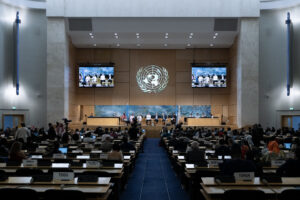
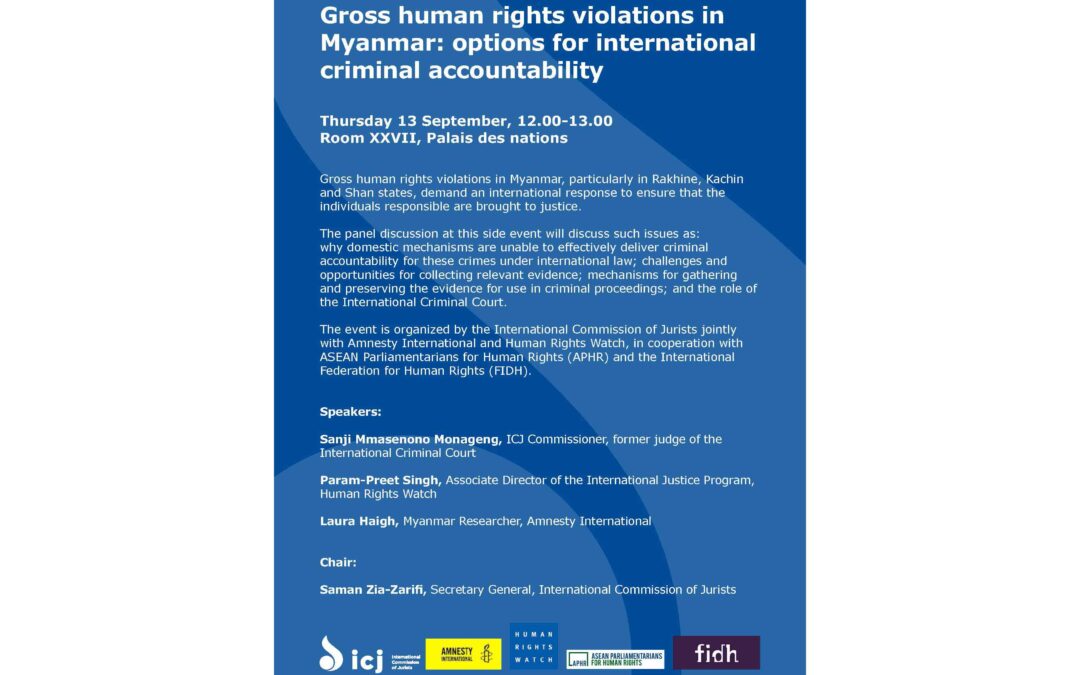
The ICJ will host the side event “Gross human rights violations in Myanmar: options for international criminal accountability” at the Human Rights Council on Thursday 13 September 2018 from 12:00 – 13.00 in Room XXVII of the Palais des Nations.
It is organized by the ICJ, Amnesty International and Human Rights Watch in cooperation with ASEAN Parliamentarians for Human Rights (APHR), the International Federation for Human Rights (FIDH) and Physicians for Human Rights (PHR).
The issues of documenting violations, possible evidence-gathering mechanisms and the role of the International Criminal Court will be discussed.
Speakers:
- Justice Sanji Mmasenono Monageng, Commissioner of the ICJ and former judge of the International Criminal Court
- Param-Preet Singh, Associate Director of the International Justice Program, Human Rights Watch
- Laura Haigh, Myanmar Researchers, Amnesty International
Moderator:
Saman Zia-Zarifi, Secretary General, International Commission of Jurists
Myanmar side event 13 Sept flyer (flyer of the event in PDF)
Sep 7, 2018
On 30 May 2018 the Government of Myanmar announced its latest “International Commission of Enquiry” (ICOE) to investigate human rights violations in Rakhine State.
Its creation follows at least eight other special government inquiries and boards conducted since 2012 in Rakhine State alone.
In a five-page legal briefing, the International Commission of Jurists (ICJ) assesses the inquiry in reference to standards on the conduct of investigations.
The ICJ finds that the ICOE cannot reasonably be seen as having any chance of being independent, impartial, or making an effective contribution to justice or accountability for the crimes under international law. To the contrary, giving any recognition to it is likely to undermine and delay effective international measures for justice and accountability.
On 28 August the spokesperson for the Office of the President stated that:
“We have formed the Independent Commission of Enquiry to response [sic] to false allegations made by the UN Agencies and other international communities.”
Indeed, the Chairperson of the ICOE stated at a press conference, that:
“[T]here will be no blaming of anybody, no finger-pointing of anybody… saying you’re accountable.”
Such prejudicial statements confirm the conclusion of the United Nations Independent International Fact-Finding Mission (IIFFM), that:
“The Government’s recently-created Commission of Inquiry will not and cannot provide a real avenue for accountability, even with some international involvement. The impetus for accountability must come from the international community.”
Crimes against humanity and war crimes have been committed in Myanmar, and an investigation of evidence of the crime of genocide is warranted, according to the summary report of the UN IIFFM, published on 27 August 2018.
Throughout Myanmar the rule of law is severely undermined by a lack of accountability for perpetrators of rights violations; lack of access to remedies and reparation for victims; and persistent challenges to the independence of the justice system.
In current circumstances it is impossible to rely on any national courts, prosecution services, or commissions of inquiry in Myanmar to deliver justice or accountability of security forces in relation to human rights violations constituting crimes under international law.
The UN Security Council should refer the situation to the International Criminal Court or a similarly constituted international tribunal without delay.
The UN Human Rights Council should promptly establish a robust International Impartial and Independent Mechanism (IIIM) or similar mechanism, to collect and analyse evidence for future prosecutions; action should be taken by the Council at its September 2018 session – waiting for or deferring to the UN General Assembly to act would risk further delaying or denying justice for victims, including because key criminal evidence could be irretrievably lost, destroyed, or deteriorate in the meantime.
Contact
Frederick Rawski, Asia and the Pacific Director, frederick.rawski(a)icj.org
Legal briefing
Myanmar-COI cannot deliver justice or accountability-Advocacy-Analysis brief-2018-ENG (full text, PDF)
Myanmar-COI cannot deliver justice or accountability-Advocacy-Analysis brief-2018-BUR (full text in Burmese, PDF)
Sep 5, 2018 | News
The ICJ today signed a joint statement with other international organizations based in Europe that cooperate on Guatemala condemning the decision of Jimmy Morales not to renew the mandate of the International Commission against Impunity in Guatemala (CICIG).
The statement also repudiates the subsequent decision by President Morales to bar the CICIG Commissioner Iván Velásquez from returning back to the country.
The CICIG has made a significant contribution to the work of the Public Prosecutor’s Office, the strengthening of the rule of law and the fight against corruption networks.
The statement expresses grave concern that on 31 August 2018 the government used tanks and heavily armed policemen to intimidate CICIG personnel as well as Guatemalan citizens, while announcing the decision not to renew the mandate of the CICIG. “The image of President Jimmy Morales surrounded by the military and police at the press conference evokes the memory of the coup d’état and the military dictatorships during the dark years of the internal armed conflict,” the statement adds.
The organisations signing the statement call on the European Union and its Member States to demand that the state of Guatemala complies with its international obligations and guarantees the necessary conditions for Commissioner Iván Velásquez and the CICIG to continue their work safely and independently.
The full statement is available here: Guatemala-Statement on decision about CICIG and Velasquez-News-2018-ENG
Sep 5, 2018 | Noticias
Hoy la CIJ firmó una declaración conjuntamente con una docena de otras organizaciones internacionales basadas en Europa que cooperan en Guatemala, condenando la decisión del Presidente Jimmy Morales de no renovar el mandato de la Comisión Internacional Contra la Impunidad en Guatemala (CICIG).
La declaración también repudia la decisión subsecuente del Presidente Morales de impedirle al Comisionado Iván Velásquez (foto) regresar al país.
La CICIG ha realizado contribuciones significativas al trabajo de la Fiscalía, el reforzamiento del estado de derecho y la lucha contra las redes de corrupción.
La declaración expresa una gran preocupación de que, el 31 de agosto del 2018, el gobierno haya recurrido a tanques y policías fuertemente armados afín de intimidar al personal de la CICIG y además a ciudadanos/as guatemaltecos/as, al anunciar la decisión de no renovar el mandato de la CICIJ.
La declaración agrega: “La imagen del Presidente Jimmy Morales rodeado de militares y policías en la conferencia de prensa evoca memorias de golpes de estado y dictaduras militares durante los años negros de conflictos armados internos”.
Las organizaciones firmantes hacen un llamado a la Unión Europea y sus Estados miembros para exigir que el Estado de Guatemala cumpla con sus obligaciones internacionales y que garantice las condiciones necesarias para que el Comisionado Iván Velásquez y la CIGIC puedan continuar su trabajo de manera segura e independiente.
Guatemala-Statement on decision about CICIG and Velasquez-News-2018-SPA (texto completo de la declaración, en pdf)
Aug 13, 2018 | News
From 9-12 August, the ICJ-supported trainings on human rights and the law for lawyers, youths and activists from Kachin and Shan states in Myanmar’s north.
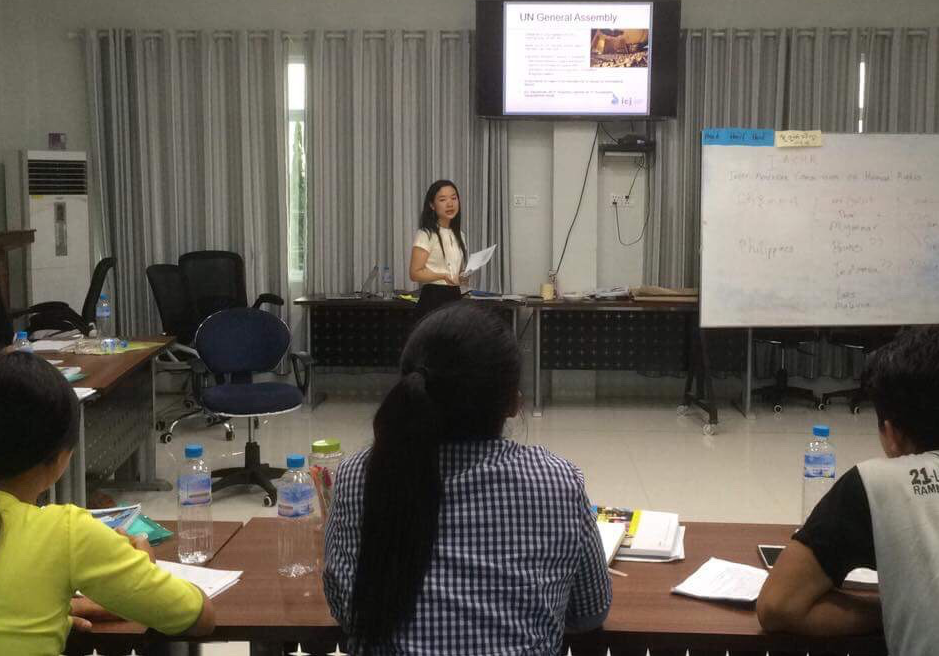
On 9 and 10 August, the ICJ joined a “training of trainers” organized by the Humanity Institute, a civil society organization based in Myitkyina.
This aims to improve the capacity of local youths and activists from Kachin and Northern Shan State on basic human rights concepts and measures to engage with Regional and UN Human Rights mechanisms.
The ICJ’s national legal researcher, Ja Seng Ing, shared information about the advantages and limitations of regional human rights mechanisms, including the Europe Commission of Human Rights and the ASEAN Commission of Human Rights. She provided an overview of the UN human rights framework and human rights mechanisms.
In addition to explaining how these work, she also focused on how human rights defenders can communicate with and participate in UN human rights mechanisms by reporting on human rights violations.
Then on 10 and 11 August, the ICJ facilitated a legal training for senior law students, and junior lawyers hosted by the Kachin Legal Clinic, an independent lawyers network.
The Kachin Legal Clinic seeks to develop a pool of young lawyers and with knowledge on the role of lawyers in the field of domestic and international human rights setting and the independence of the lawyers.
On the first day, a national legal adviser from the ICJ shared experiences of litigating for human rights in Myanmar. She also noted the critical role of independent lawyers in protecting human rights, by representing clients from all communities in different parts of Myanmar.
On the second day, Ja Seng Ing gave an overview of global and local law and standards and issues related to accountability and redress for gross human rights violations.
The ICJ’s international legal adviser, Sean Bain, gave an overview of international laws and standards related to the protection of human rights in times of conflict or crises, sourced from international human rights law as well as international humanitarian law and international criminal law.
These activities are part of the ICJ’s ongoing support to civil society actors in Myanmar, from community to national level.