Sep 2, 2013 | News
The ICJ today called on the Bangladesh authorities to immediately withdraw the contempt of court notice issued against the international human rights organization Human Rights Watch.
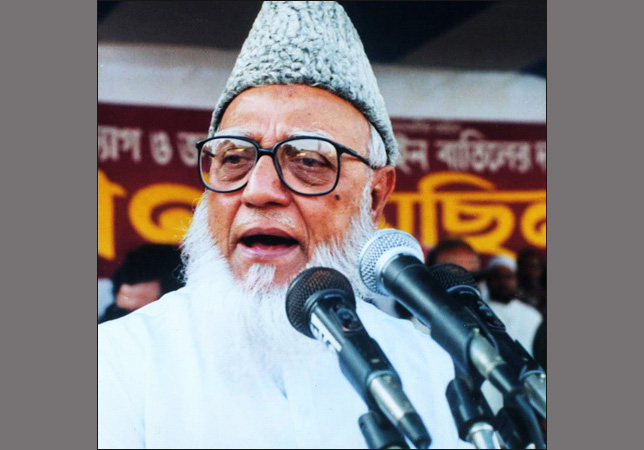
The charges are in response to well documented concerns by Human Rights Watch that the trial of Ghulam Azam (photo), former head of the Islamist group Jamaat-e-Islami Azam’s trial was “deeply flawed” and failed to meet international fair trial standards.
“Silencing voices that highlight the shortcomings of the International Crimes Tribunal impede rather than advance the enormously important task of ensuring that those responsible for committing atrocities during Bangladesh’s war of liberation are brought to justice in a process that complies with international law and standards”, said Alex Conte, Director of the ICJ’s International Law and Protection Programmes.
On 2 September 2013, the International Crimes Tribunal (ICT) in Bangladesh issued a show cause notice asking Human Rights Watch to explain why contempt of court proceedings should not be initiated against it for its allegedly ‘biased’, ‘scandalous’ and ‘inaccurate’ statements about the ICT. Human Rights Watch has to respond within three weeks, or possibly face trial and conviction in absentia.
“Assessing the conduct of administration of justice in judicial proceedings, including where it entails criticism of judicial performance is an important means of ensuring accountability,” said Conte. “Judges and prosecutors should defend the right to freedom of expression, not use their discretionary powers to muzzle criticism”.
Contact:
Alex Conte, Director, International Law & Protection Programmes, t: +41 79 957 2733; email: alex.conte(a)icj.org
Additional information:
The Bangalore Principles on Judicial Conduct clarify that “since judicial independence does not render a judge free from public accountability, and legitimate public criticism of judicial performance is a means of ensuring accountability subject to law, a judge should generally avoid the use of the criminal law and contempt proceedings to restrict such criticism of the courts”.
The Commonwealth (Latimer House) Principles on the Accountability of and the Relationship Between the Three Branches of Government also stress that “criminal law and contempt proceedings should not be used to restrict legitimate criticism of the performance of judicial functions”.
The UN Declaration on Human Rights Defenders underscores that “everyone has the right, individually and in association with others, to promote and to strive for the protection and realization of human rights and fundamental freedoms at the national and international levels”.
The Declaration also highlights that human rights defenders have the right to “freely to publish, impart or disseminate to others views, information and knowledge on all human rights and fundamental freedoms” and to hold opinions and draw public attention to the observance of human rights.

May 29, 2013 | Agendas, Events
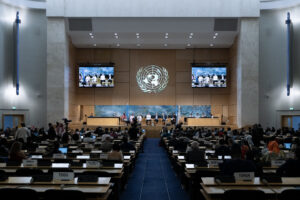
On Tuesday 28 May 2013, the ICJ co-sponsored a parallel event with TRIAL and the Missions of Botswana, Costa Rica, Estonia and Switzerland during the Human Rights Council’s 23rd regular session held in Geneva.
The event, held in Room XXV of the Palais des Nations, addressed key issues concerning accountability and human rights. The event was chaired by Professor Paola Gaeta from the Geneva Academy of International Humanitarian Law and Human Rights. Panelists were Tiina Intelmann, President of the Assembly of the States Parties to the ICC Statute; Mothusi Bruce Rabasha Palai, Ambassador of Botswana; Ian Seiderman, Director of the ICJ’s Law and Policy Office; and Gabriella Citroni, Senior Legal Adviser at TRIAL (Swiss association against impunity).
Panelists agreed that accountability is intimately linked to the enjoyment of human rights. It was stated that – under State responsibility – States are, or should be, held responsible for acts involving any violation of international law, including international human rights law and international humanitarian law. Accountability is thus not only about criminal justice, but also about ensuring reparations and guarantees of non-recurrence.
Recommendations made under the Universal Periodic Review (UPR) mechanism were seen as having been partly successful in bridging gaps, although there remains a lack of proper follow-up on the progress of implementation between UPR cycles. Panellists observed that States often fail to refer to standards enunciated by the High Commissioner for Human Rights and by the Special Procedures. Regarding the accountability of non-State actors for conduct involving human rights abuses and violations, the ‘Ruggie Principles’ were referred to as a representing good progress but still failing to be as comprehensive as they should be.
Concerning future steps by Human Rights Council mechanisms, panellists proposed that resolutions, statements and Special Procedures should more directly and frequently refer to accountability. The need for greater political pressure on the International Criminal Court was expressed, with the aim of supporting the domestic capacity of States parties to the Rome Statute. Concerning domestic capacity to strengthen accountability more generally, panellists and participants agreed on the need to improve linkages between the work of persons dealing with development and those working on accountability.
HR Council-Strengthening accountability-event-2013 (event flyer in pdf)

Apr 25, 2013 | News
The ICJ calls on the Egyptian authorities to take immediate steps to guarantee the rights of victims of human rights violations to an effective remedy and to reparation for the serious harm many have suffered.
The authorities should initiate, as a matter of the highest priority, prompt, thorough, independent and impartial investigations into past and ongoing human rights abuses, including cases of arbitrary detention, torture and ill-treatment, and extrajudicial and other unlawful killings.
The statement comes as the ICJ concludes a high-level mission to address the human rights situation in Egypt and to examine the measures being taken by the authorities to address both the legacy of human rights abuses and to ensure accountability for them.
“The Egyptian authorities should ensure that the pattern of widespread and systematic human rights violations committed under the former regime is not repeated. This will involve the comprehensive reform of State institutions and the revision of the national legal framework with a view to ensuring that the rights of victims are safeguarded in line with international standards,” said Justice Kalthoum Kennou, ICJ Commissioner and member of an ICJ mission to Egypt. “Such reforms should target the police and security forces, the Office of the Public Prosecutor, the Forensic Medicine Office and the judicial system as a whole, including by restricting the jurisdiction of the military justice system to exclude civilians and all cases involving human rights violations.”
The ICJ notes that current reparation programmes, established by the government, have a restricted mandate, which has resulted in the arbitrary exclusion of numerous victims and their families from these programmes. They also do not ensure the accessibility of the range of reparations required under international law. Most importantly, such programmes have failed so far to ensure accountability for past and ongoing human rights violations.
“The very few proceedings against State officials have resulted in acquittals or sentences that are not commensurate with the gravity of the crimes committed. In order to end this cycle of impunity, the Egyptian authorities must hold those responsible for gross human rights violations accountable through criminal prosecutions,” said Alejandro Salinas, a Chilean lawyer and member of the ICJ mission. “They should also establish a transitional justice mechanism with sufficient guarantees of independence and with a comprehensive mandate to address the legacy of past and present human rights abuses, while ensuring that impunity does not become entrenched.”
The delegation was led by ICJ Commissioner, Justice Kalthoum Kennou, and Alejandro Salinas, and was supported by ICJ legal advisers, Alice Goodenough and Marya Farah. The delegation met with the then Minister of Justice, Ahmed Mekki, Justice Adel Omar Sherif of the Supreme Constitutional Court, the President and Secretary-General of the National Council for Human Rights, Hossam Al Gheryani and Abdallah El Ashaal, the Director of the National Council for the Care of the Revolution’s Martyrs, Families and Wounded, Khaled Badwy, the Vice President of the Court of Cassation and Secretary General of the High Judicial Council, Justice Mohamed Mahgoub, Chairman of the Human Rights Committee of the Shura Council, Ehab Kharrat, members of the judiciary, the legal profession and civil society, as well as a number of victims, and the families of victims of human rights violations committed before and after the departure of former President Mubarak.
Contact:
Said Benarbia, ICJ Senior Legal Adviser of the Middle East and North Africa Programme, tel: 41 22 979 38 17, e-mail: said.benarbia(a)icj.org
Egypt-ICJ calls auhorities-Press release-2013-Arabic (full text in PDF)

Mar 11, 2013
The ICJ again called on the Human Rights Council to request the Security Council to immediately refer the situation in Syria to the International Criminal Court and urgently take effective humanitarian measures.
Taking into account the continued and rapidly deteriorating situation in Syria, the ICJ noted the systematic and widespread attacks against the civilian population by Government forces, as well as serious human rights abuses and IHL violations by anti-Government forces.
The statement was delivered today during an interactive dialogue with the Council-mandated Commission of Inquiry on the situation of human rights in the Syrian Arab Republic as part of the Human Rights Council’s 22nd regular session (25 February to 22 March 2013).
Syria-HRC22-Item4-SyriaCOI-LegalSubmission-2013 (download full statement in PDF)

Feb 8, 2013
 The ICJ is concerned that the Government of Nepal has in recent months taken measures promoting impunity for those those responsible for gross human rights violations.
The ICJ says than the Nepalese government should rather have acted to address impunity, accountability and redress instead of ensuring that those responsible for gross human rights violations and serious crimes under international law will escape justice.
Ahead of the 22nd session of the Human Rights Council (25 February to 22 March 2013), the ICJ submitted a written statement and delivered an oral statement to the UN in response to the report of the High Commissioner for Human Rights on democracy and the rule of law.
Pointing to recent measures by the Government of Nepal, the ICJ has called for the Council to urge the Government to:
- Promptly establish a Truth and Reconciliation Commission and a Commission of Inquiry on Disappearance, as agreed in the 2006 Comprehensive Peace Agreement, and in accordance with international standards;
- Implement the recommendations in the October 2012 report of the Office of the High Commissioner for Human Rights;
- Conduct prompt, independent and thorough investigations into alleged cases of past human rights violations; and
- Establish and implement vetting guidelines concerning persons holding public office.
Nepal-HRC22-Item3-Democracy&ROL-Legal Submission-2013 (download written statement in PDF)
Nepal-HRC22-Item3-Democracy&ROL-OralStatement-NonLegalSubmission-2013 (download oral statement in PDF)