Oct 31, 2012
The ICJ has brought to the attention of the UPR mechanism issues concerning Colombia’s responsibility to combat the persistent impunity of perpetrators of gross human rights violations, as well as other key issues to be addressed in the review of Colombia’s compliance with international human rights.
From 22 April to 3 May 2013, the Human Rights Council’s Working Group on the UPR will consider the situation of human rights in Colombia. Ahead of the Working Group’s review, the ICJ has made a submission in which it has made suggested recommendations concerning:
- Combating impunity;
- Reforms affecting access to justice for victims of human rights violations;
- Intimidation of human rights defenders; and
- Colombia’s engagement with international human rights instruments and mechanisms.
Colombia-UPR16-StakeholderSubmission-legal submission (2012) (download full submission in PDF)
Colombia-UPR16-AdvocacyNote-NonLegalSubmission-2013 (download advocacy note in PDF)
IColombia-UPR16-ComparisonChart-NonLegalSubmission-2013 (download comparison with first cycle UPR of Colombia)

Oct 31, 2012
 The ICJ has brought to the attention of the Universal Periodic Review (UPR) mechanism issues concerning the independence and impartiality of the judiciary in Bangladesh, as well as other key issues to be addressed in the review of Bangladesh’s compliance with international human rights.
From 22 April to 3 May 2013, the Human Rights Council’s Working Group on the UPR will consider the situation of human rights in Bangladesh. Ahead of the Working Group’s review of Bangladesh, the ICJ has made a submission in which it has made suggested recommendations concerning:
- Independence and impartiality of the judiciary;
- Lack of transparent appointment procedures for public prosecutors;
- Use of the Presidential pardon in cases concerning allegations of gross human rights violations; and
- Bangladesh’s engagement with international human rights instruments and mechanisms.
Bangladesh-UPR16-StakeholderSubmission-legal submission (2012) (download full submission in PDF)
Bangladesh-UPR16-AdvocacyNote-NonLegalSubmission-2013 (download advocacy note in PDF)
Bangladesh-UPR16-ComparisonChart-NonLegalSubmission-2013 (download comparison with first cycle UPR of Bangladesh)
Oct 29, 2012 | Events
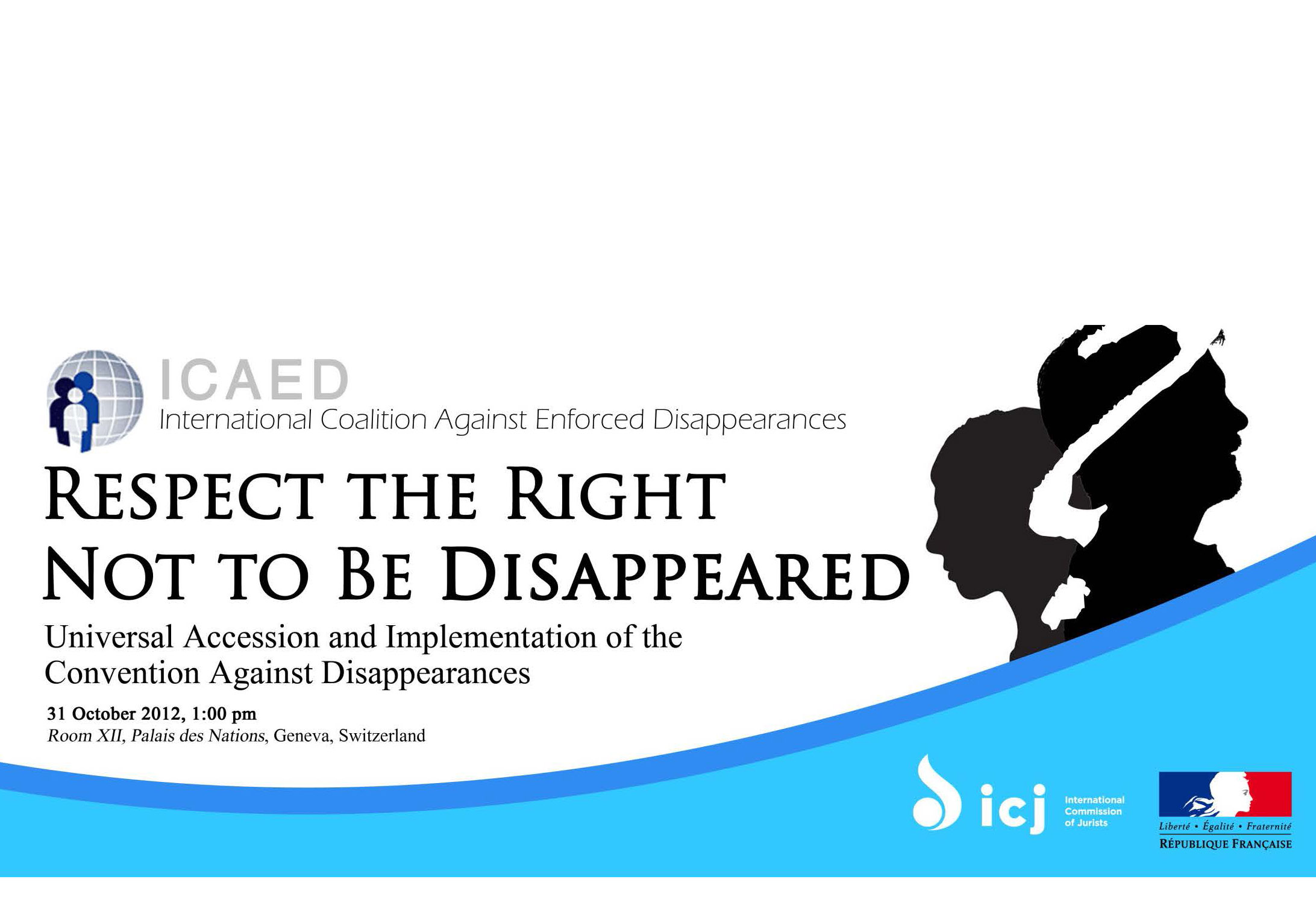 On 31 October the ICJ is co-sponsoring a side event with the Permanent Mission of France on “Respect the right not to be disappeared – Universal accession and implementation of the Convention against disappearances”.
This parallel event to the session of the Committee on Enforced Disappearance and the Working Group on Enforced and Involuntary Disappearances will take place at the Palais des Nations in Geneva, Room XII, from 1 to 3 PM (13.00-15.00).
UN-ICAED enforced disappearances – Event-2012

Oct 6, 2012 | News
The promotion of colonel Raju Basnet is a slap in the face for the victims of Nepal’s protracted civil war, ICJ and other human rights groups said today.
The Nepali cabinet’s decided on October 4, 2012, to promote colonel Raju Basnet to the rank of brigadier general. Human Rights Watch, Amnesty International, and the International Commission of Jurists say the United Nations and the Nepali National Human Rights Commission compiled credible evidence of systematic enforced disappearances and torture at Bhairabnath Battalion headquarters in Kathmandu under the command of the colonel Raju Basnet in 2003.
On the basis of this evidence, in 2007 Nepal’s Supreme Court ordered an independent investigation and prosecution of these human rights violations. That order includes allegations that Basnet personally committed acts of torture.
“Nepal’s cabinet has thrown the entire idea of holding soldiers accountable for abuses out the door,” said Brad Adams, Asia director at Human Rights Watch. “This cynical and reprehensible decision seriously undermines respect for human rights and contradicts Nepal’s assurances to the international community that it would hold those implicated in wartime crimes to account.”
Basnet’s promotion occurred under the leadership of the United Communist Party of Nepal – Maoist (UCPN-M). During the war, the UCPN-M was itself responsible for enforced disappearances, torture, and unlawful killings, and has not had to answer for a single wartime violation, the groups said. Agni Sapkota, a UCPN-M member, was appointed to a cabinet position even as he was under a court-ordered police investigation for his involvement in a 2005 unlawful killing.
“Despite years of promises, the Maoists and the army have shown themselves united in one crucial aspect: contempt for the notion of accountability for criminal acts and victims’ rights to justice, truth, and reparation,” said Polly Truscott, Amnesty International’s South Asia director.
International law applicable in Nepal obligates the government to investigate and prosecute serious violations of international human rights and humanitarian law. Consistent with international legal principles, officials implicated in serious offenses should be removed or suspended pending completion of full investigations, with full respect for their due process rights.
The Nepali Supreme Court in an August decision directed the government to put in place appropriate legislation and guidelines to ensure that security officials are vetted before they are appointed or promoted to high-level positions.
“With the promotion of Basnet, the denial of justice and accountability has essentially turned into government policy,” said Sam Zarifi, Asia director at the International Commission of Jurists. “This decision is basically the current Nepali government saying it does not care about the rule of law, does not care about its own Supreme Court directives, and indeed, does not care about the best interests of its own citizens. This promotion is a signal to all perpetrators that power trumps justice.”
The rights groups called on the international community to urge the Nepali government to revoke its decision.
“Nepali civil society, with support from the UN and the international community, has spent years seeking to promote justice and accountability,” Adams said. “By promoting Col. Basnet, the government has sent a clear signal to the Nepali people and the country’s international supporters that it not committed to these same goals.”
For more information, please contact:
In Kathmandu, for ICJ, Govinda Sharma: +977-985-106-1167
In Bangkok, for ICJ Asia-Pacific, Sam Zarifi: +66-807-819-002