Oct 31, 2019
An opinion editorial by Alejandro Salinas Rivera, ICJ Commissioner (Chile)
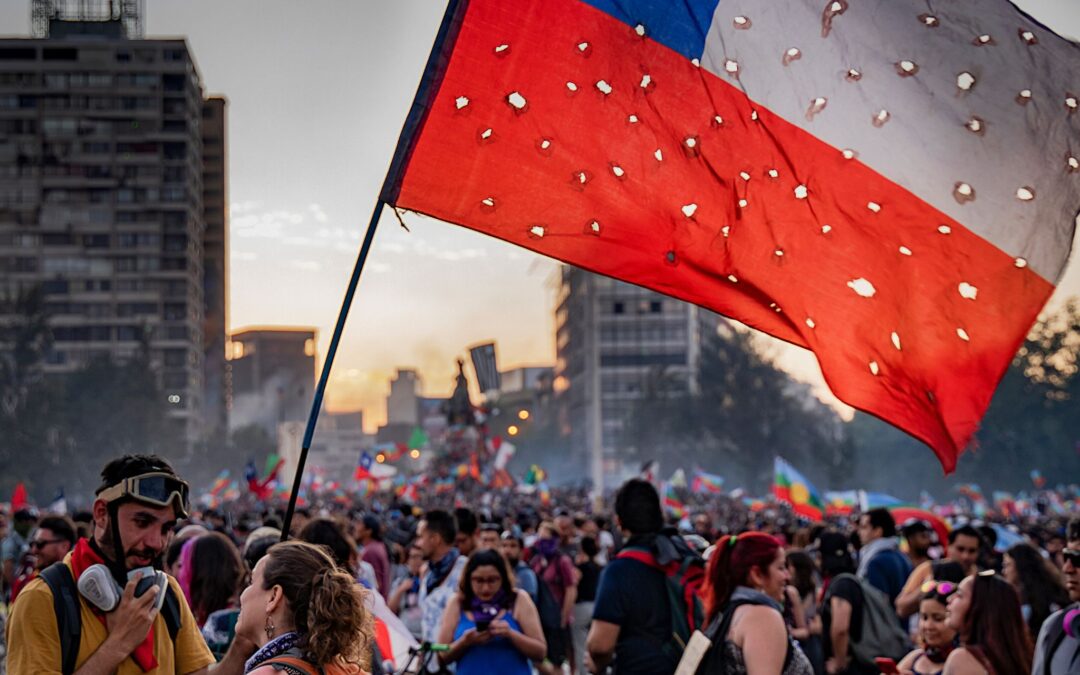
The recent social protests Chile faces have their roots in rampant inequality, social distrust on public institutions, and lack of guarantees of economic and social rights for the population.
The origins of the protests date back several years. They express three structural problems which question the foundations of the political and social model of Chilean democracy.
Those problems are continued inequality despite the country’s economic and social success, social distrust in public institutions, and insufficient State capacity in realizing economic and social rights.
The country faces frustrations that remain from the earlier dictatorship and problems that are evident during democracy due to this pervasive inequality.
Rights are not guaranteed evenly for everyone. For example, some people access health services similar to those provided in more fully developed countries, and others have access to poor quality of health services.
Education rights are also guaranteed unequally: public education is not cheap and, for example, university fees are very high for Chileans.
Also, municipalities in Chile are classified as rich and poor; the infrastructure and quality of the roads change depending on the neighbourhood. Is all this fair? No.
So why are there so many inequalities between the people of Chile?
Citizens have stopped believing and respecting that public institutions will help them guarantee their rights, and hopelessness has permeated the souls of many Chileans.
Current social protests: what now?
There have been numerous protests in recent days. The immediate trigger was the Chilean government’s announcement of rising the metro prices in Santiago on 6 October, but they are related to the profound inequity and the institutional distrust the country faces.
After 6 October, some people, mainly students, began a mass action involving the evading paying metro fares in Santiago, and because this practice continued, police forces (Carabineros) were sent to stop it.
The protests expanded beyond these actions and on the night of the 18 October several protests arose in different cities.
The initial response of President Sebastián Piñera was to decree a state of emergency, and a curfew in many municipalities and to deploy military forces into some of the streets.
Protesters increased and were expanded to other regions of the country.
There were serious allegations regarding excessive use of force by police forces and possible arbitrary detentions committed by them, which requires proper and effective investigation and, where the evidence warrants, prosecution according to international standards.
While most of the protests have been peaceful, some protesters have committed violent acts. This does not delegitimate the acts of all protesters, but it is necessary that any such violence be condemned.
After more than 13 days of continuous protests, the government has not been able to section the conditions to fulfil a political and social pact that includes other political forces, and the opposition has also not been flexible enough to bring positions closer.
Also, civil society has been lacking in proposal to address the crisis.
There has to be a political solution to address the social grievances that underlie the protests. Chilean politicians need to truly acknowledge this social discontent and they need to rise to the challenge despite their political differences.
They need to converge towards a social and political arrangement that answers, urgently, the social demands regarding equity, justice, solidarity and trustworthy institutions.
Furthermore, Chilean politicians and public institutions must ensure and guarantee economic and social rights of the population, by adopting the legal reforms needed to that end and by providing public policies that allow the country to overcome inequity.
Oct 22, 2019 | Advocacy, News
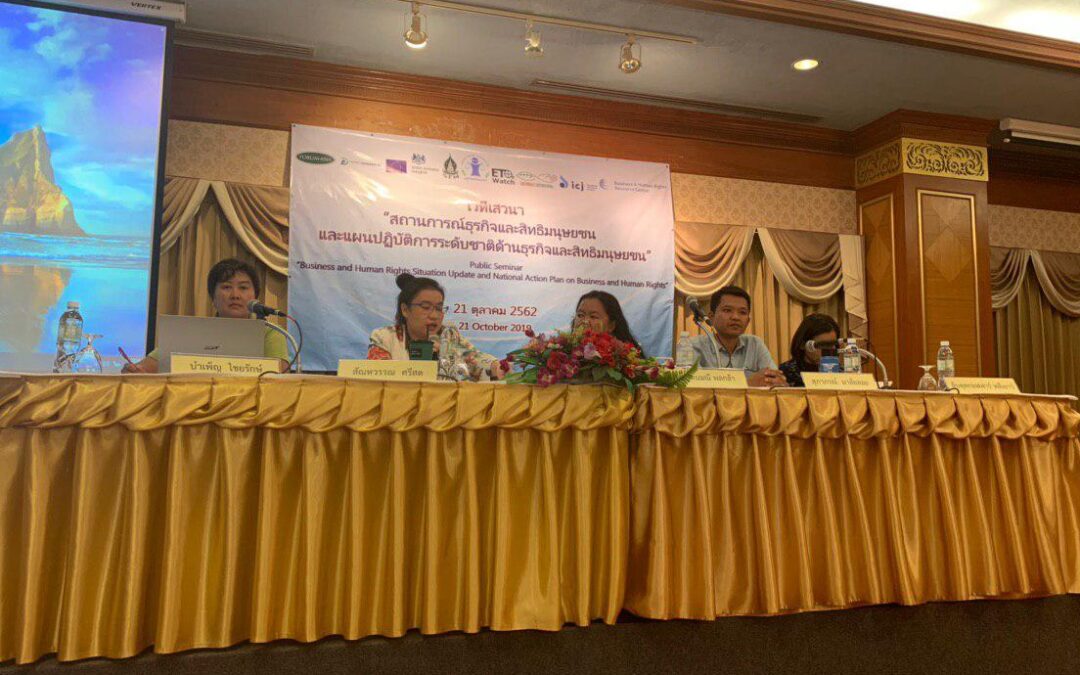
On 21 October 2019, the ICJ co-hosted an event on “Business and Human Rights and Thailand’s National Action Plan on Business and Human Rights” at Mido Hotel in Bangkok.
The discussion surrounded the evolution of business and human rights in Thailand and concerns arising with respect to the National Action Plan on Business and Human Rights (‘NAP’)’s key priority issues.
Notably, on the same day of this event, the NAP was being considered by the Cabinet for approval.
Participants included 37 individuals representing affected populations from all regions of Thailand, members of civil society organizations, and representatives from international organizations.
Sanhawan Srisod, ICJ’s Legal Adviser, spoke at a panel on ‘Land, Environment and Natural Resources’, addressing key concerns arising with respect to environmental laws in Thailand. These included the lack of adequate consultations with affected stakeholders before implementing development projects, inadequate assessment of environmental impacts prior to policy determination, inadequate protections under relevant laws on the environment, problems arising from Environmental Impact Assessment (EIA) and Environmental and Health Impact Assessment (EHIA) processes, and obstacles in accessing remedy for environment-related cases. She also facilitated another panel on judicial harassment of human rights defenders.
Saovanee Kaewjullakarn, ICJ’s Legal Consultant, facilitated a panel on Thai outbound investment and challenges with respect to access to justice for victims of human rights abuses committed by Thai corporations in the context of their business activities abroad.
The event was co-hosted with the Community Resource Centre Foundation (CRC), Spirit in Education Movement (SEM), Thai Extra-Territorial Obligations Working Group (Thai ETOs Watch), EarthRights International (ERI), Asian Forum for Human Rights and Development (FORUM-ASIA), Business and Human Rights Resource Center (BHRRC) and the British Embassy in Thailand.
Background
After the event, on 29 October 2019, the Cabinet approved and adopted the First National Action Plan on Business and Human Rights (2019-2022), making Thailand the first country in Asia to adopt the stand-alone NAP.
The NAP sets out plans to be followed by several public and private stakeholders in order to ensure the state’s and business’s duty to protect and respect human rights, and the general obligation of the State and businesses to provide for access to remedy in the case of business-related human rights violations and abuses. NAP has determined four key priority issues, including (1) Labor; (2) Land, environment and natural resources; (3) Human rights defenders; and (4) Cross border investment and multi-national enterprises.
Subject to these four key priority issues, the NAP emphasizes the duties of the relevant State agencies to, inter alia, review and amend certain laws, regulations and orders that are not in compliance with human rights laws and standards and ensure their full implementation, ensure mechanisms for redress and accountability for damage done to affected communities and individuals, overcome the barriers to meaningful participation of communities and key affected populations, and strengthen the role of businesses to “respect” human rights on a variety of key priority issues.
Its effectiveness in term of implementation is yet to be assessed because the NAP does not have the status of a law, but is merely a resolution from the executive branch. Under Thai law, a Cabinet Resolution is considered a “by-law” in accordance with section 3 of the Act on Establishment of Administrative Courts and Administrative Court Procedure, B.E. 2542 (1999).
In March 2019, the ICJ and Human Rights Lawyers’ Association (HRLA) had also submitted recommendations to the Ministry of Justice on Thailand’s draft NAP and expressed concern on the removal of a commitment that had been included in earlier versions of the NAP to “push for an Anti- Strategic Litigation against Public Participation (SLAPP) law”.
Further reading:
Thailand: ICJ hosts discussion on human rights consequences of Special Investment Zones
Thailand’s Legal Frameworks on Corporate Accountability for Outbound Investments
Thailand: ICJ and HRLA express concern about inadequate protections for human rights defenders in draft National Action Plan on Business and Human Rights

Oct 14, 2019 | Events, News
This side event will take place on Wednesday, 16 October 2019 at 13h00-15h00 in room XXIV of Palais des Nations, Geneva.
The ICJ and FRIEDRICH EBERT STIFTUNG invite you to a discussion about the article 6 of the Revised draft of a legally binding instrument on TNCs and other business enterprises to assess its content and coverage. The discussion will have a focus on whether its various paragraphs adequately address issues such as parent company and lead buyer liability in relation to harm caused by their subsidiaries or suppliers to human rights and labor rights.
The panel will feature:
- Doug Cassel (by video), University of Notre Dame
- Makbule Sahan, International Trade Union Confederation
- Markus Krajewski, Friedrich-Alexander-Universität Erlangen-Nürnberg
- Olivier de schutter, University of Louvain
Moderator
- Ian Seiderman, ICJ Legal and Policy Director
Side event Legal liability (flyer of the event, in PDF)
Sep 21, 2019 | Advocacy
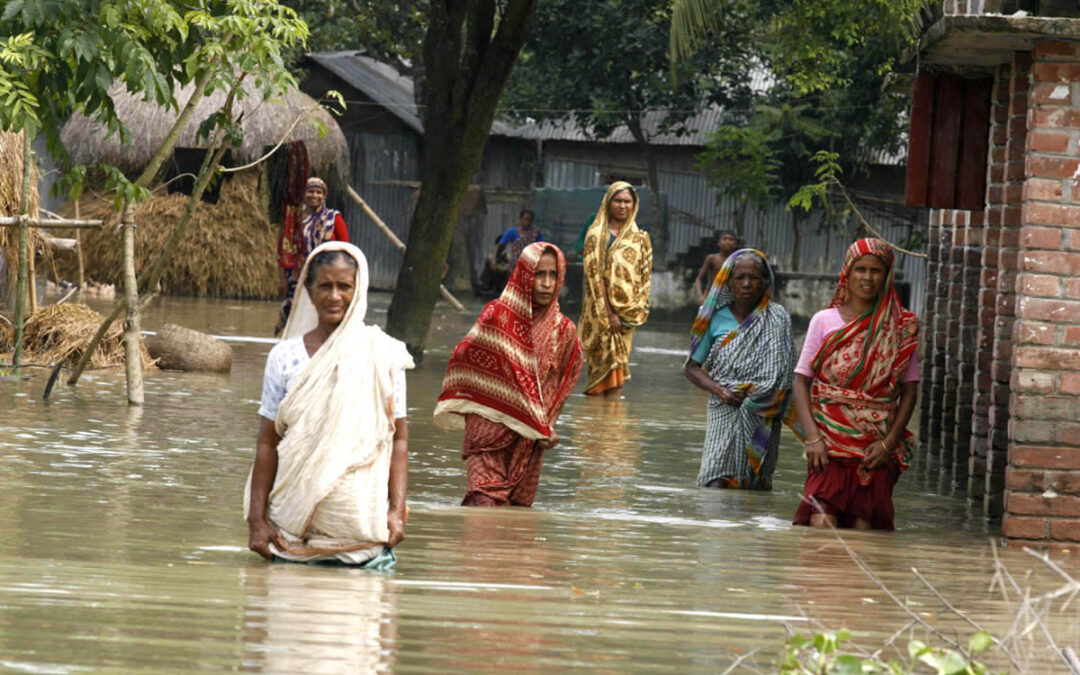
The ICJ has joined several hundred organizations working to defend human rights, the environment, and climate justice in a bold declaration setting out a vision and objectives for addressing the climate crisis and the devastating human rights and environmental impact of catastrophic climate change.
The Declaration was adopted at a gathering of the the Peoples’ Summit on Climate, Rights and Human Survival in New York on 18-19 September, which brought together some 200 representatives of Indigenous Peoples, workers, academia, environmental and human rights groups, including the ICJ.
The Declaration warns that “the climate emergency threatens human survival, the environment and the enjoyment of all human rights, for present and future generations.”
It emphasizes that governments and corporations bear the primary responsibility for acting to address and reverse the drivers of climate change.
The signatories to the Declaration agreed to 10 types of actions, including, among others, placing human rights at the core of climate activism, demanding effective access to justice for individuals and communities whose rights are impacted by the climate crisis, and support for environmental human rights defenders.
Download
Universal-Peoples Summit Declaration CC-Advocacy-2019-ENG (full declaration in PDF)
Sep 18, 2019 | Events, News
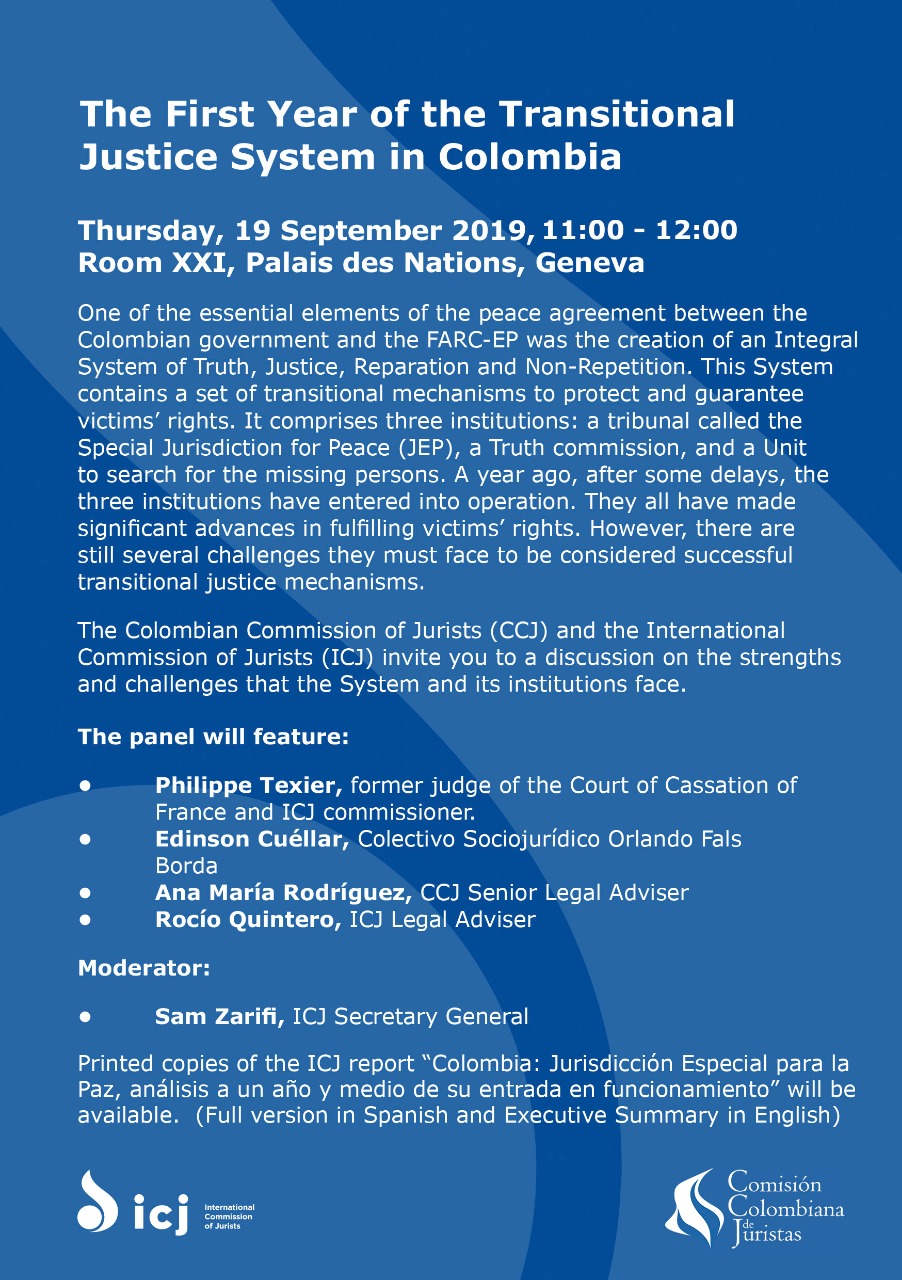
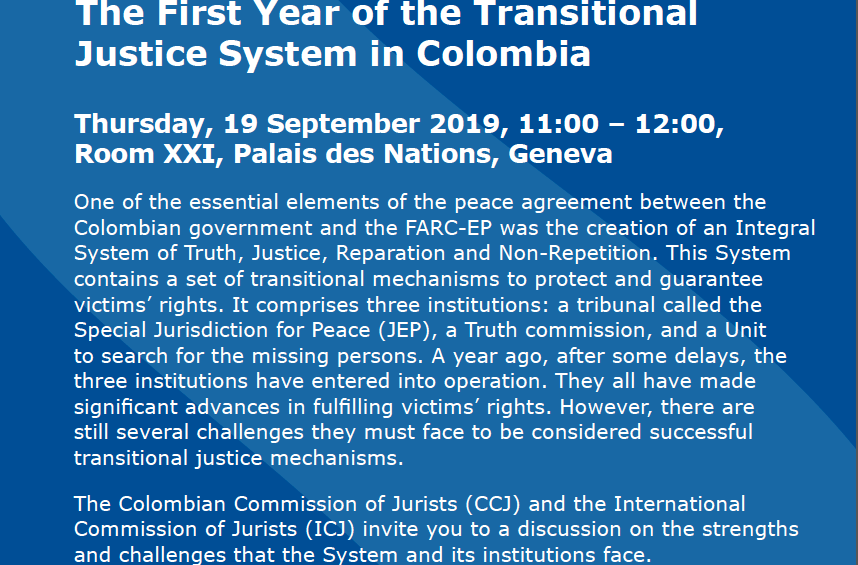
The Colombian Commission of Jurists (CCJ) and the ICJ invite you to a discussion on the strengths and challenges that the System and its institutions face. The event takes place Thursday, 19 September 2019, at 11:00 – 12:00, room XXI, in the Palais des Nations.
One of the essential elements of the peace agreement between the Colombian government and the FARC-EP was the creation of an Integral System of Truth, Justice, Reparation and Non-Repetition. This System contains a set of transitional mechanisms to protect and guarantee victims’ rights. It comprises three institutions: a tribunal called the Special Jurisdiction for Peace (JEP), a Truth commission, and a Unit to search for the missing persons. A year ago, after some delays, the three institutions have entered into operation. They all have made significant advances in fulfilling victims’ rights. However, there are still several challenges they must face to be considered successful transitional justice mechanisms.
The panel will feature:
Moderator:
- Sam Zarifi, ICJ Secretary General
Speakers:
- Philippe Texier, former judge of the Court of Cassation of France and ICJ commissioner.
- Edinson Cuéllar, Colectivo Sociojurídico Orlando Fals Borda
- Ana María Rodríguez, CCJ Senior Legal Adviser
- Rocío Quintero, ICJ Legal Adviser
Printed copies of the ICJ report “Colombia: Jurisdicción Especial para la Paz, análisis a un año y medio de su entrada en funcionamiento” will be available. (Full version in Spanish and Executive Summary in English)
A flyer for the event is available here.