Jul 31, 2017 | News
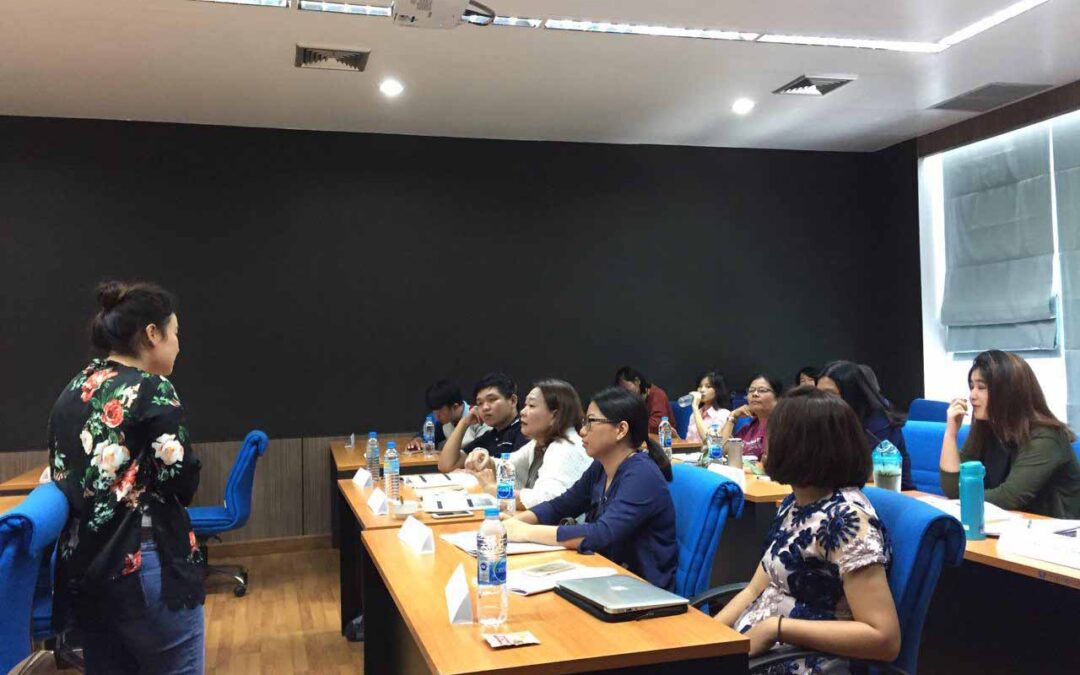
On 29-31 July 2017, the ICJ, in collaboration with Chiang Mai University’s Faculty of Law, held a workshop on “Introduction to Business and Human Rights & Basic Principles on Documenting Human Rights Violations” for 25 academics, NGO representatives and lawyers in Chiang Mai.
The objective of the workshop, held at the Chiang Mai University campus, was to provide an overview of the field of business and human rights, including the UN Guiding Principles on Business and Human Rights and its “Protect, Respect and Remedy” framework, which Thailand affirmed its commitment to on 31 May 2017, and the need for a binding treaty on business and human rights.
Day 1 focused on the UN framework as it applies to business and human rights, investment law, and strategic litigation.
Day 2 focused on criminal and civil litigation, women’s rights and business, children’s rights and business, and land rights.
Day 3 focused on the basic principles that apply to documenting and reporting on human rights violations.
The speakers at the workshop were:
- Daniel Aguirre, ICJ International Legal Adviser, Myanmar
- Irene Pietropaoli, Expert consultant on business and human rights
- Sanhawan Srisod, ICJ Associate National Legal Adviser, Thailand
Jun 8, 2017 | Events, News
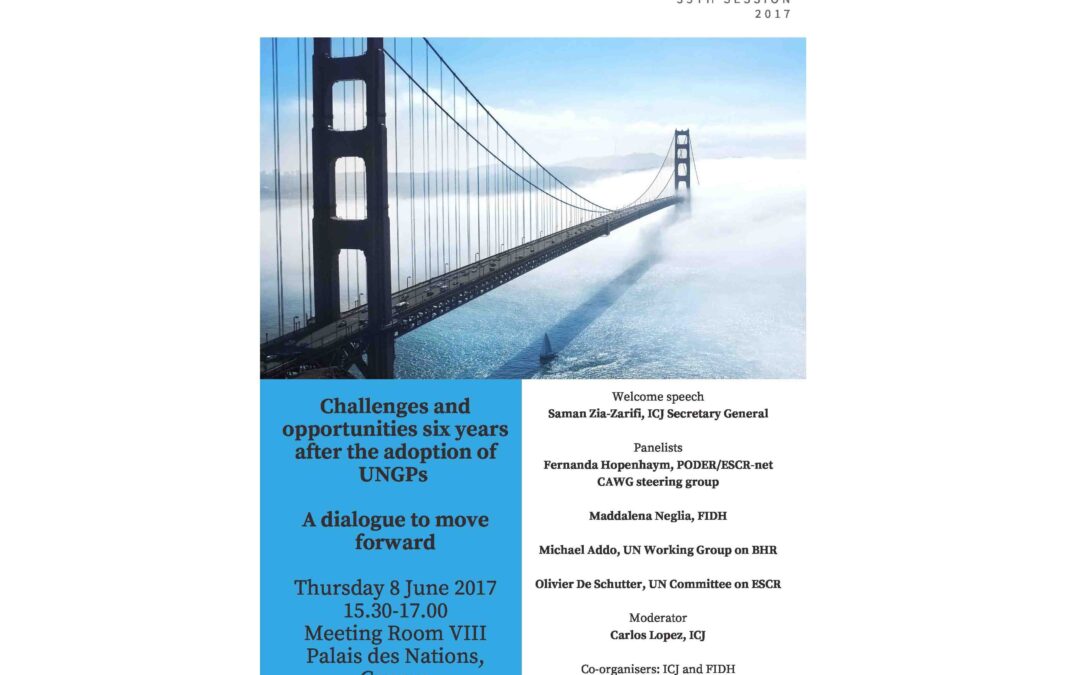
Today, the ICJ and FIDH are organizing a side event to to the 35th Regular session of the Human Rights Council on business and human rights.
Business responsibility to respect human rights
Challenges and opportunities six years after the adoption of UNGPs
A dialogue to move forward
Thursday 8 June 2017, 15.30-17.00
Meeting Room VIII
Palais des Nations, Geneva
After the adoption of the UNGP in 2011, standards on business responsibility to respect human rights and business human rights due diligence have gained prominence in the global debate on business accountability.
Many companies claim to comply with the UNGP by performing a human rights due diligence including across their global supply chain.
Several initiatives have emerged at regional and national level to promote companies’ due diligence processes, including the EU Directive on non-financial reporting, the UK Modern Slavery Act, the French law on company devoir de vigilance.
Despite the progress, serious human rights abuses still occur in both developing and developed countries.
The ability of companies to identify, monitor and prevent negative human rights impacts in their operations and relationships is still weak and the access to effective remedy remains difficult if not impossible.
This is an opportune moment to take stock of the progresses made to date and the challenges ahead in order to create a level playing field that will effectively promote the respect of human rights in business global operations.
Welcome speech
Saman Zia-Zarifi, ICJ Secretary General
Moderator
Carlos Lopez, ICJ
Panelists
Fernanda Hopenhaym, PODER/ESCR-net CAWG steering group
Maddalena Neglia, FIDH
Michael Addo, UN Working Group on BHR
Olivier De Schutter, UN Committee on ESCR/University of Louvain

May 30, 2017 | News
Representatives of large European business enterprises met today with State delegates and representatives of FIDH and the ICJ in Geneva to discuss their views on a prospective international treaty on business and human rights.
The meeting was organized by the FIDH and ICJ and took place under Chatham House rules.
The United Nations Human Rights Council started in 2014 an intergovernmental process towards an international treaty concerning business and the protection human rights.
The first draft elements of that treaty should be discussed in October 2017, after two years of preparatory consultations among the concerned stakeholders.
The meeting in Geneva took place in the context of growing involvement by key business leaders in international discussions, in dialogue with civil society and governments, around global human rights standards.
Business representatives present in the meeting expressed their views regarding the content of a future international treaty founded on their need to have level playing field regarding human rights responsibilities to operate in global markets.
They pointed out that the new treaty should apply to all businesses, go beyond the existing frameworks and create a framework for a fair human rights based competition among businesses towards higher standards.
State delegates and NGOs representatives also shared their perspectives noting that the current circumstances call for bolder collective action as a matter of urgency.
Most participants underlined the key role that State agencies should play in enforcing the rules at the local level and in protecting their people.
Finally, a call was made for businesses, civil society and governments to take their responsibility to promote global human rights binding rules for business operations, including in the global marketplace.
May 3, 2017 | Advocacy
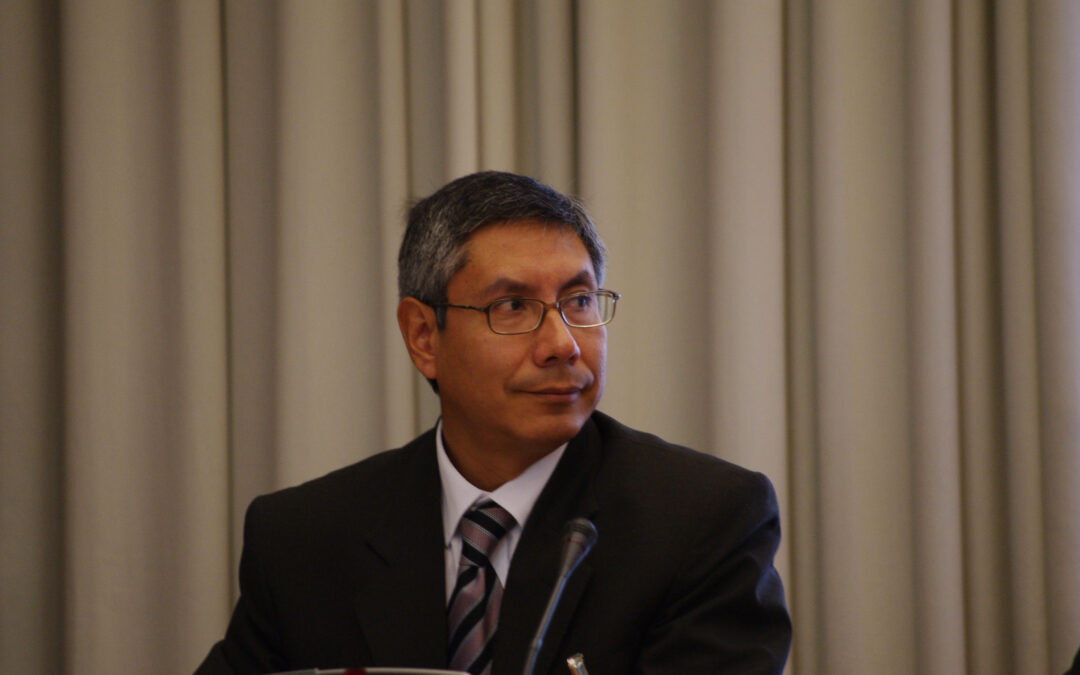
ICJ’s Senior Legal Adviser Carlos Lopez made an important speech today at a Joint Hearing of the European Parliament’s Committee on International Trade and Subcommittee on Human Rights.
The declaration was about the United Nations intergovernmental process towards a treaty in the field of business & human rights.
This treaty could be a crucial instrument for the EU, European countries and European businesses to promote common global rules of respect for human rights that are stronger and enforceable vis a vis companies from all regions.
This will help level the playing field for the companies that have a genuine interest in human rights protection by creating a common standard.
For Governments, it is an important instrument to advance the objective of a level playing field for businesses in the global marketplace.
This is not only important and a condition of success for European businesses who currently have to compete with businesses that do not have to observe the same rules in other parts of the world, but is also a condition for the sustainability of economic globalization and its potential to deliver for the human rights for all.
Download Carlos Lopez’s speech below:
Europe-ICJ speech at the european parliament-ADVOCACY-2017-ENG (in PDF)

Dec 6, 2016 | News
Hosted on 3-4 December, the event was attended by a total of 40 participants which includes representatives of CSOs, lawyers, MPs and village track administrators.
The workshop aimed to raise awareness of international standards and best practice of resettlement and development-based eviction and displacement among local community in order to mitigate potential adverse impact associated with the development of the Kyauk Phyu Special Economic Zone.
In the opening, Dr Daniel Aguirre, ICJ International Legal Adviser, outlined the essential role of lawyers and community members in safeguarding human rights and holding the State and investors accountable.
The discussion was led by international experts and experienced and committed leaders of Civil Society Organization.
Susanna Price from Australian National University highlighted key principles of the ADB’s Involuntary Resettlement Policy along with experiences from China, Cambodia and Indonesia.
U Hayman Oo, ICJ Legal Researcher, explained how the UN principles on Development-based Eviction and Displacement are applicable in the context of Myanmar and urged the participants to use these standards for their advocacy work.
U Myo Mrat Hein, the Director and lawyer of the Thazin Legal Aid Group, discussed important issues surrounding the national land acquisition legislation whilst Sean Bain, legal consultant at the ICJ give a brief overview of important provisions of the Myanmar SEZ Law (2014).
The other two guest local speakers shared their first-hand experiences of advocacy work and resettlement issues which occurred during the development of Dawai and Thilawa SEZ respectively.
Participants exchanged strategies and ideas to take preparatory steps to mitigate potential impacts of the KPSEZ in terms of protecting their economic, social and cultural rights, learning from Dawei and Thilawa, as well as from international standards which Myanmar recognizes.
The new Kyauk Phyu SEZ Management Committee, along with Dawai and Thilawa, was formed last month with over 30 members including international and local social and environmental experts.
In a meeting held in Nay Pyi Taw following the establishment of the SEZ Management Committee, Daw Aung San Su Kyi emphasized that the current three SEZs of the country are leading projects for Myanmar’s economic growth.
She also expressed concerns over the potential negative effect of these zones if not properly implemented.