Sep 16, 2009
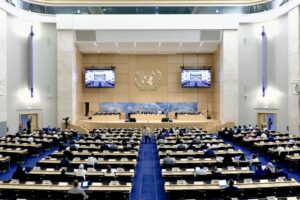
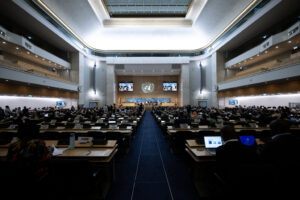
The ICJ welcomes the opportunity to contribute to the Human Rights Council’s (HRC) Universal Periodic Review of Egypt.
Egypt was elected to HRC in May 2007 after pledging to fully promote and protect human rights, including by lifting the current state of emergency and preserving the independence of the judiciary. Despite these commitments, numerous serious human rights violations continued to be committed with impunity in Egypt. These violations have been largely committed under the decades-old state of emergency and the “war on terror” paradigm.
Egypt-ICJ submission UPR-non-jegal submission-2009 (full text, PDF)

Sep 11, 2009
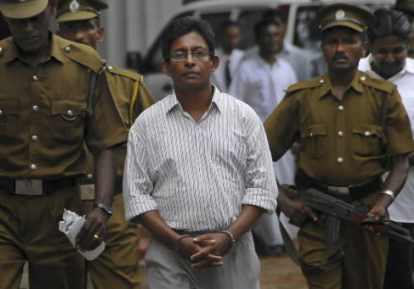 The report summarises the findings of observers appointed by the ICJ for the 2008 and 2009 missions to observe the trial of the journalist J.S. Tissainayagam before the High Court of Colombo.
SriLanka-journalist-trial observation report-2009 (full text, PDF)
SriLanka-journalist-press release-2009 (full text, PDF)

Sep 3, 2009
Security practices and legislation, including related provisions of the Interim Constitution, criminal law and procedures, are outdated and contradict many international human rights standards to which Nepal is a party.

Sep 3, 2009
Centuries of entrenched practices of discrimination and exclusion of disadvantaged groups in Nepal have led to a demand to bring about greater inclusion, and ensure greater justice through a human rights framework.
These aspirations of Nepali people were voiced during the Jana Andolan II, as well as were reflected in the Comprehensive Peace Agreement 2006, and the Interim Constitution 2007. ICJ report discusses the advantages of constitutionalisation of economic, social and cultural rights as fundamental rights in the highest law of the land, thereby upholding its commitment to realizing all human rights of all Nepali people, as well as serve as an effective means to ensure social justice for all Nepali people.
Nepal_Economic, Social and Cultural Rights and The New Constitution_Themetic Report_2009 [Full text PDF]
Jul 27, 2009
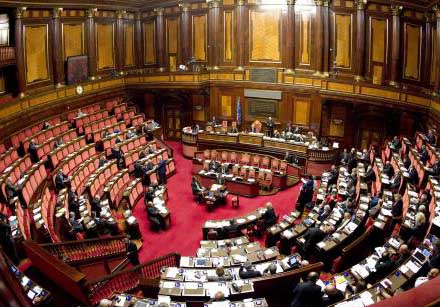
The ICJ presented to the Italian Senate its intervention on Bill no. A.S. 1440 on the reform of criminal procedure.
The ICJ expresses its views on certain provisions of the Bill which risk extending the already excessive length of judicial proceedings in Italy, such as concession of additional periods for the preparation of the defence, new rules on evidence, and the establishment of an additional judicial panel for judicial review of detention. The ICJ also puts forward recommendations for the amelioration of the reform of the Pinto Law, the remedy under Italian law for excessive length of judicial proceedings. Finally, the ICJ addresses the new rules on abstention and recusal of judges, which affect judges’ independence and freedom of expression; the rule on mandatory closure of criminal proceedings; the new rules on revision of criminal trials and the provision on publication of European Court of Human Rights’ decisions.