The Russian Federation: Disciplinary proceedings against Aleksey Ladin should be dropped

The Russian Federation: Disciplinary proceedings against Aleksey Ladin should be dropped

Lawyers for Lawyers, the International Observatory for Lawyers (OIAD), The Law Society of England and Wales (LSEW), the European Association of Lawyers for Democracy & Human Rights (ELDH), the Union of International Lawyers’ Institute for The Rule of Law (UIA-IROL), the International Bar Association’s Human Rights Institute (IBAHRI), and the International Commission of Jurists (ICJ) condemn the continued harassment against human rights lawyer Aleksey Ladin.

On 24 January 2024, the International Day of the Endangered Lawyer, human rights defender and lawyer Aleksey Ladin will face a disciplinary hearing by the Council of the Tyumen Regional Bar Association. The action was initiated by a motion issued by the Ministry of Justice of the Russian Federation. Mr. Ladin has been working since 2015 to provide legal aid to Ukrainians who are alleged to have been subject to criminal prosecution by Russia on politically motivated charges. Since 2017, he has been based in Russian-occupied Crimea, mostly representing Ukrainian and Crimean Tatar political prisoners.

This is the latest in series of instances of harassment and prosecution from the authorities against Mr. Ladin. On 13 October 2023, the Kyivskyi District Court of Simferopol sentenced him to 14 days of administrative detention for allegedly displaying prohibited symbols on his social media pages. The Facebook post in question, a photo of a drawing made by one of his clients, displayed elements of Ukrainian and Crimean Tatar national emblems with the slogan “We are not the terrorists and we are not the extremists.” The court found the “taraq tamga” (the emblem on the Crimean Tatars’ flag) in the picture to be a symbol of a known Crimean volunteer paramilitary unit, Noman Çelebicihan Crimean Tatar Volunteer Battalion. The drawing had no relation to the battalion. Mr. Ladin was prosecuted for the exercise of his right to freedom expression, protected under international and Russian law.

The upcoming disciplinary hearing is based on the sentence of administrative detention handed down on 13 October 2023, as the Ministry of Justice alleges that Mr. Ladin violated the Code of Ethics of the Russian Bar Association, which is based on the Federal Law “On the Bar Association and its activities in the Russian Federation.” The Ministry of Justice affirms that they received this information from the Centre to Counteract Extremism in Crimea on 3 November 2023.

Lawyers play a vital role in upholding the rule of law and the protection of human rights guaranteed under international law, including the rights to an effective remedy and fair trial guarantees, and the right of freedom from torture and other cruel, inhuman, or degrading treatment or punishment. Their work is indispensable for public confidence in the administration of justice by safeguarding due process rights and ensuring access to justice for all. To fulfil their professional duties effectively, lawyers should be able to practice their profession safely and should be free from improper interference, fear of reprisals, and illegitimate restrictions, in compliance with international standards.

The UN Basic Principles on the Role of Lawyers states that ‘Governments shall ensure that lawyers (a) are able to perform all of their professional functions without intimidation, hindrance, harassment or improper interference; (…) and (c) shall not suffer, or be threatened with, prosecution or administrative, economic or other sanctions for any action taken in accordance with recognized professional duties, standards and ethics’ [16]. They also hold that ‘lawyers shall not be identified with their clients or their clients’ causes as a result of discharging their functions’ [18] and that ‘lawyers, like any other citizens, are entitled to freedom of expression, belief, association and assembly’ [23].

In view of the above, the undersigned organisations call on the Tyumen Regional Bar Association, the Russian Federal Bar Association and the Ministry of Justice of the Russian Federation to:

  • Immediately drop the disciplinary proceedings against human rights lawyer Aleksey Lapin, as he is being targeted as a result of his peaceful and legitimate activities;
  • Ensure that any legitimate disciplinary proceedings against lawyers shall be conducted fairly and independently, in accordance with international standards;
  • Refrain from any actions that may constitute harassment, persecution, or undue interference in the work of lawyers, including disciplinary or criminal proceedings on improper grounds, such as the nature of the cases in which the lawyer is involved;
  • Guarantee that all lawyers in Russia and Russian-occupied Crimea are able to carry out their legitimate professional activities without fear of reprisals and free of all restrictions including judicial harassment, arbitrary arrest, deprivation of liberty, or other arbitrary sanctions.


Tunisia: Authorities must end Attacks on Judges and Prosecutors

Tunisia: Authorities must end Attacks on Judges and Prosecutors

In a briefing paper published today, the ICJ called on the Tunisian authorities to immediately end their attacks on independent judges and prosecutors, drop any criminal charges against them, and reinstate all those arbitrarily dismissed.

التقرير بالغة العربية

On 1 June 2022, President Kais Saied granted himself, via decree, absolute power to fire judges and prosecutors summarily, and [on the same day] promptly dismissed 57 of them. The President had earlier pledged to “cleanse” the judiciary on spurious accusations of widespread political bias and corruption.

The ICJ analysis of the cases of 18 dismissed judges and prosecutors, as well of another judge subjected to disciplinary and criminal proceedings, establishes a pattern of arbitrary disciplinary and criminal processes effectively aimed at purging the judiciary of those who asserted their independence and challenged the dismantling of the institutional independence of the judiciary.

“The ongoing arbitrary criminal prosecutions against independent judges and prosecutors for the legitimate exercise of their professional functions or of their right to freedom of expression is an affront to the rule of law and judicial independence in Tunisia,” said Said Benarbia, ICJ MENA director. “The authorities must immediately end such prosecutions and reinstate all judges and prosecutors who have been dismissed without legitimate grounds or due process”  

In the aftermath of his speech on 25 July 2021 announcing exceptional measures, the President promised to “cleanse” and “purify” the judiciary, which he accused of complicity with political parties in power before July 2021, as well as of inefficiency, corruption and political bias. He also targeted the High Judicial Council and its members, limiting certain of their financial benefits. Since then, the President has followed up on his rhetoric with successive decisions and measures aimed directly at dismantling the judiciary’s institutional independence.

The ICJ’s analysis examines the process of arbitrarily dismissing and prosecuting judges and prosecutors in Tunisia since the adoption of these measures in light of the country’s obligations under international human rights law.

The ICJ’s analysis is primarily based on: (i) a review of 20 criminal cases opened by the authorities against 18 dismissed magistrates and of the case of Anas Hmedi, the President of the Association of Tunisian Magistrates (AMT), which is directly linked to his support of the dismissed judges and proseuctors; (ii) 15 interviews with judges, prosecutors and their lawyers; (iii) an analysis of the First President of the Administrative Court’s decisions to suspend the dismissal of 49 magistrates and to dismiss the request for suspension of seven others; and (iv) an analysis of decisions and reports by the General Inspection Service, the High Judicial Council and the Temporary High Judicial Council.

The ICJ considers that the conduct of the dismissed judges and prosecutors, on the basis of which they have apparently been subject to criminal proceedings, did not amount to recognizably criminal offences under general principles of criminal law and international human rights law and standards.

On the contrary, the ICJ’s analysis of these cases establishes that these judges and prosecutors were arbitrarily dismissed and then subject to criminal proceedings in relation to serious offences solely for three types of conduct, none of which is a legitimate basis for criminal prosecution:

  • for the exercise of their prosecutorial and judicial functions in compliance with the law and ethical standards, and
  • for the exercise of human rights protected by international human rights law, including the rights to freedom of expression and freedom of association
  • for private conduct, unrelated to their performance of their duties, which, in any event, was not criminal in nature.

Contact

Said Benarbia, Director, ICJ Middle East and North Africa Programme, t: +41-22-979-3800; e: said.benarbia(a)icj.org

 Download:

Download ICJ briefing on Attacks on Judges and Prosecutors in Tunisia in English: Here

Download ICJ briefing on Attacks on Judges and Prosecutors in Tunisia in Arabic: Here

EU: Protecting Judicial Independence: Lawyers’ strategic litigation workshop

EU: Protecting Judicial Independence: Lawyers’ strategic litigation workshop

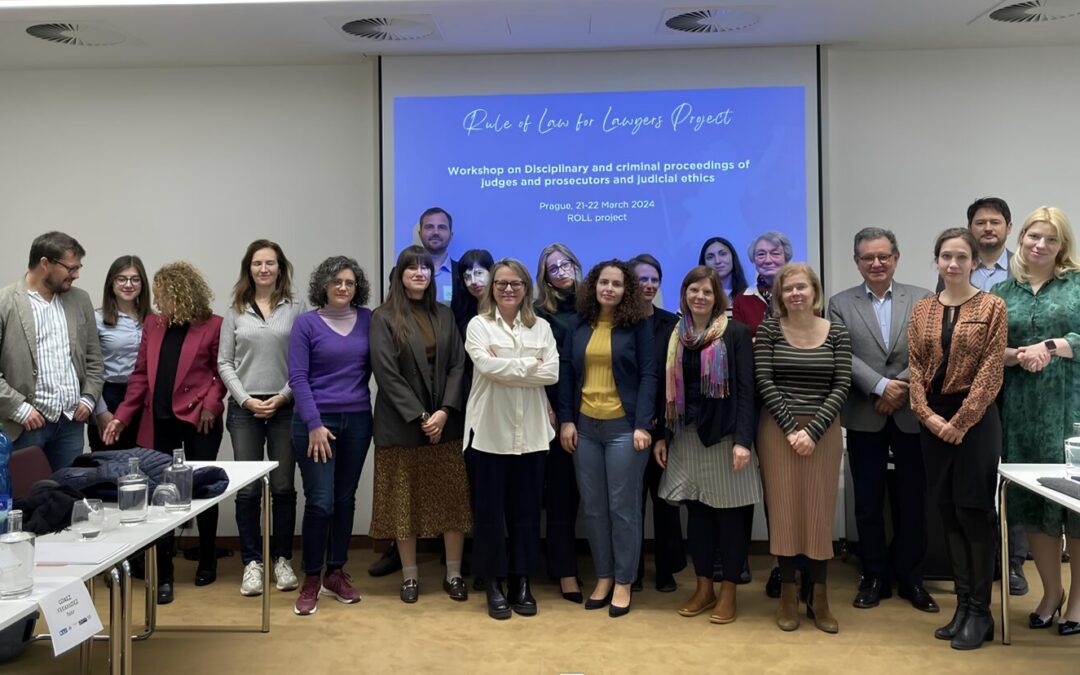
The International Commission of Jurists (ICJ), in collaboration with aditus, Human Rights in Practice, Forum for Human Rights, Free Courts organized a workshop for lawyers on judicial independence and strategic litigation in Malta on 23 and 24 November 2023. The event focused on critical issues of judicial independence, including, appointment procedures, administration of justice, and freedom of expression and association of judges.

Judicial independence is essential for democracy and human rights protection, yet it is frequently under attack or pressure. Judicial independence is possible only with independent organisation and governance, and when judges’ human rights are guaranteed. This includes strict selection criteria and transparency in the appointment of judges and prosecutors, and it implies respect of freedom of expression and association of judges.

The participants discussed the challenges in guaranteeing both institutional and individual independence of judges, and in ensuring fairness and transparency in the appointment procedures. The workshop also focused on the possible limitations of the freedom of expression and association of judges. It was noted that judges  often fear repercussions for expressing their opinions and participating in associations or protests.

The workshop brought together experts and practitioners from six EU Member States – the Czech Republic, Hungary, Malta, Poland, Romania and Slovakia – to discuss their experiences. The participants discussed the international legal framework and the possible ways to protect judicial independence focusing on the role of strategic litigation.

The event was the second of a series of workshops, each considering different aspects of judicial independence. These workshops aim to contribute to the development of the Final Mapping Report with recommendations on strategic litigation for practitioners in the EU, as part of the ROLL (Rule of Law for Lawyers) project.

Please see the workshop agenda here.

Please find recordings of some of the workshop presentations here.

EU: NGOs call on the EU Council to defend EU values in Hungary and Poland in the Article 7 procedure

EU: NGOs call on the EU Council to defend EU values in Hungary and Poland in the Article 7 procedure

Today, the International Commission of Jurists (ICJ) and partners have called on the EU General Affairs Council to make full use of procedure under Article 7.1 in addressing concerns about Hungary and Poland. They advocate for strong stance in defending EU values

The International Commission of Jurists, Amnesty International , Human Rights Watch, International Federation of Human Rights, Open Society Foundations, Reclaim, Reporters Without Borders and Transparency International EU are sharing specific points in their letter this time especially on Hungary, expressing a regret that a state of play is being organized instead of a hearing and highlighting some serious recent shortcomings.

Read the full letter here.

The African Court on Human and Peoples’ Rights’ judgment of 22 September 2022: A clear rebuke of Tunisia’s authoritarian drift

The African Court on Human and Peoples’ Rights’ judgment of 22 September 2022: A clear rebuke of Tunisia’s authoritarian drift

Today, the African Court of Human and Peoples’ Rights (AfCHPR) opens its 71st Ordinary Session. To mark the occasion, the International Commission of Jurists (ICJ), in collaboration with inkyfada, looks back at AfCHPR’s September 2022 judgement against Tunisia, in which it ordered the republic to return to constitutional democracy and establish an independent constitutional court. The ICJ examines the impact of the judgement on human rights in Tunisia, and how individuals can operationalize the AfCHPR to challenge the curtailment of fundamental freedoms, judicial independence and rule of law in Tunisia.

ICJ’s questions and answers:

It has been more than a year since the African Court on Human and People’s rights issued its judgment in case No. 017/2021, “Ibrahim Ben Mohamed Ben Brahim Belguith v. Republic of Tunisia”, of 22 September 2022. The case was brought by Mr. Belguith, a national of Tunisia and a lawyer, who complained of violations of his rights under the African Charter on Human and Peoples’ Rights and other human rights instruments as a result of the promulgation of several Tunisian presidential decrees adopted under the “state of exception” pursuant to article 80 of the 2014 Constitution since 25 July 2021. In this judgment, the African Court ordered Tunisia to repeal these decrees, to return to constitutional democracy within two years and to ensure the establishment and operation of an independent constitutional court within the same period.

What does this judgment mean and why is it important for the rule of law and human rights in Tunisia? The ICJ provides answers in the Q&A below:

    1. What is the African Court on Human and Peoples’ Rights?
      * The African Union 
      * The African Charter on Human and Peoples’ Rights
      * The African Commission on Human and Peoples’ Rights
      * The African Court on Human and Peoples’ Rights
      * Tunisia’s adherence to the African Human Rights System
    1. Why was the African Court seized of the situation in Tunisia? Contextual overview
      * President Kais Saied’s power grab of 25 July 2021
      * The absence of a Constitutional Court
    1. What did the 22 September 2022 judgment rule?
      * How the African Court came to rule on the matter: the application
      * What the judgment ruled:
    1. What are the next steps?
      * Implementation
      * Other complaints against Tunisia pending before the African Court
Download the full Q&A in English here
Download the full Q&A in French here
Download the full Q&A in Arabic here


Translate »