
Dec 4, 2012
In a report published today, the ICJ calls for comprehensive reforms of the disciplinary system for judges in Russia as a means to ensure an independent judiciary that is an effective guardian of the rule of law.
The ICJ report Securing Justice: the Disciplinary System for Judges in the Russian Federation focuses on disciplinary action against judges, in particular on dismissals.
It considers how dismissals and the disciplinary system affect the independence of judges, which is essential to the Rule of Law and the right to a fair trial.
An unusually high number of judges are dismissed each year in the Russian Federation, the report says.
“The threat of dismissal, and the uncertainty of the grounds on which a judge can be dismissed, affects the capacity of all judges to act independently,” said Róisín Pillay, Director of the ICJ Europe Programme. “The threat of disciplinary action may hang over a judge for many years, since there is no limitation period for such action. This makes the judge susceptible to pressure from within the judicial hierarchy or from the executive.”
When disciplinary action is taken, there is a lack of guarantees to ensure fair procedures for the judges concerned, the report further notes.
The report makes recommendations for the reform of laws and procedures on judicial discipline in the Russian Federation to strengthen the safeguards for judges against abuse.
It also stresses that a deeper and more universal culture of respect for the judiciary and its independence, as well as a sense of autonomy and empowerment within the judiciary itself, are necessary to prevent abuses of the judicial disciplinary process.
“Such reform should be conducted through consultation with civil society, academic and legal experts, as well as with the judiciary,” Róisín Pillay added.
The Report follows an ICJ mission to the Russian Federation in April 2012, to assess the guarantees in regard to disciplinary procedure, grounds for disciplining and dismissals of judges and their potential effect on the security of tenure and the independence of the judiciary.
The mission included Azhar Cachalia, Judge of the Supreme Court of Appeals of South Africa and Commissioner of the ICJ; Alejandro Salinas, lawyer from Chile and a member of the CIJL Advisory Committee; Róisín Pillay, Director of the ICJ Europe Programme, and Temur Shakirov, Legal Adviser at the ICJ Europe Programme.
The mission held meetings with the President of the Supreme Court; with judges of the High Arbitration Court, including members of the Disciplinary Judicial Presence and the Judicial Commission on Ethics of the Judicial Council; with the Judicial Department under the Supreme Court; with members of the Human Rights Council under the President of the Russian Federation and its Head, the Human Rights Adviser to the Russian Federation President; with a number of former judges who had been dismissed or resigned; with academic experts on matters of judicial discipline and the judicial system; and with lawyers and human rights NGOs.
Contact:
Róisín Pillay, Director, ICJ Europe Programme, roisin.pillay(at)icj.org
Temur Shakirov, Legal Adviser, ICJ Europe Programme, temur.shakirov(at)icj.org
Russia-ICJ Mission-Press release-2012-rus (full text in pdf)
Russia-ICJ Mission Report-Publications-2012 (full text in pdf)
Russia-ICJ Mission Reprot-Publications-2012-rus (full text in pdf)

Nov 23, 2012 | News
 The ICJ expressed its grave concerns regarding the new Constitutional Declaration issued by President Mohamed Morsi on 22 November.
The President’s unilateral imposition of a constitutional framework on the Egyptian people, under which Constitutional Declarations, decisions, laws and acts taken by the President are shielded from any judicial review, undermines basic rule of law principles.
“Rather than establishing the rule of law and meeting the democratic aspirations of the Egyptian people, President Morsi perpetuates the practices of the old regime by denying the rights of Egyptians to fully participate in the conduct of public affairs and to challenge executive decisions and actions”, said Said Benarbia, ICJ Senior Legal Advisor for the MENA Programme. “The Egyptian authorities must change course to ensure that the new Constitution is in line with international rule of law and human rights principles, and that the drafting and adoption process is transparent and inclusive.”
Under the Declaration, the President has arrogated to himself sweeping powers “to protect the goals of the revolution, including by tearing down the structure of the former regime, excluding its symbols in the state, society and the judiciary, and purging the Sate institutions”. All decisions taken by the President, since he took office and until a new Constitution is adopted and a People’s Assembly is elected, are characterized as “final and binding and cannot be appealed by any way or to any entity. Nor shall they be suspended or cancelled and all lawsuits related to them and brought before any judicial body against these decisions are annulled”.
The ICJ also expresses its concern about the impact of the new Constitutional Declaration and the decision of President Morsi to dismiss the Prosecutor General on the independence of the judiciary.
Under international standards, all disciplinary, suspension or removal proceedings against members of the judiciary must be determined in accordance with well-established procedures that guarantee the right to a fair and transparent hearing and to an independent review.
Only an independent body can ensure the fairness of these proceedings, the ICJ stresses.
In a report published last week, the ICJ described how the Egyptian authorities have failed to ensure the drafting of a new Constitution in compliance with international principles of inclusive participation and transparency. The report concludes that the draft Constitution conflicts with Egypt’s obligations under international human rights law.
Contact:
Saïd Benarbia, Middle East & North Africa Senior Legal Adviser, ICJ, t +41 22 979 3817; e-mail: said.benarbia(at)icj.org
Alice Goodenough, Middle East & North Africa Legal Adviser, ICJ, t +41 22 979 3811; e-mail: alice.goodenough(at)icj.org

Oct 31, 2012 | News
 The ICJ welcomed the judgment issued on 24 October 2012 by the Zimbabwe High Court in favour of Farai Maguwu, a human rights defender and director of the Centre for Research and Development.
In September 2011, members of the Central Intelligence Organisation (CIO) confiscated a number of Farai Maguwu’s possessions, including cash, a laptop computer, a camera, and bank cards, at the Harare International Airport while he was about to depart for a human rights conference in Ireland.
The ICJ is concerned that the seizure of property may have been undertaken as an attack on Farai Maguwu for his legitimate human rights work.
According to media reports, Hon. Justice Mathonsi ordered, “the seizure of the applicant’s property by the State agents…be and is hereby declared wrongful, unlawful and unjustified”.
Since the confiscation of his property by the CIO over a year ago, no charges had been brought against Mr Maguwu, neither was his property returned.
Justice Mathonsi affirmed that deprivation of property must only be done in accordance with due process of law. Farai Maguwu had not been advised of the legal basis or reasons for the seizure of his property.
“We congratulate the judiciary of Zimbabwe for this judgment which adheres to the principles of the rule of law, justice and respect for human rights. Furthermore, it is a reminder to State agents that in carrying out their duties they ought to do so within the parameters of the rule of law,” commented Martin Masiga, Deputy Director of the ICJ Africa Regional Programme.
The ICJ calls on the Zimbabwean judiciary to continue to uphold the rule of law and fulfil their responsibility in protecting human rights in Zimbabwe.
Contact:
Martin Masiga, Deputy Director, ICJ Africa Regional Programme, t: +27 11 02482

Oct 30, 2012 | News
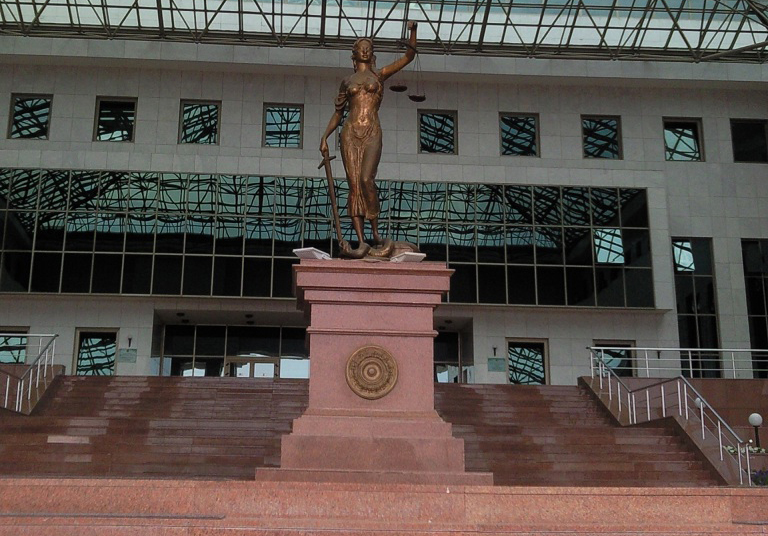 The ICJ today expressed its concern at disciplinary sanctions and threats of criminal prosecution against Judge Aliya Zhumasheva of the Kachirsk District Court of Pavlodar Region in Kazakhstan.