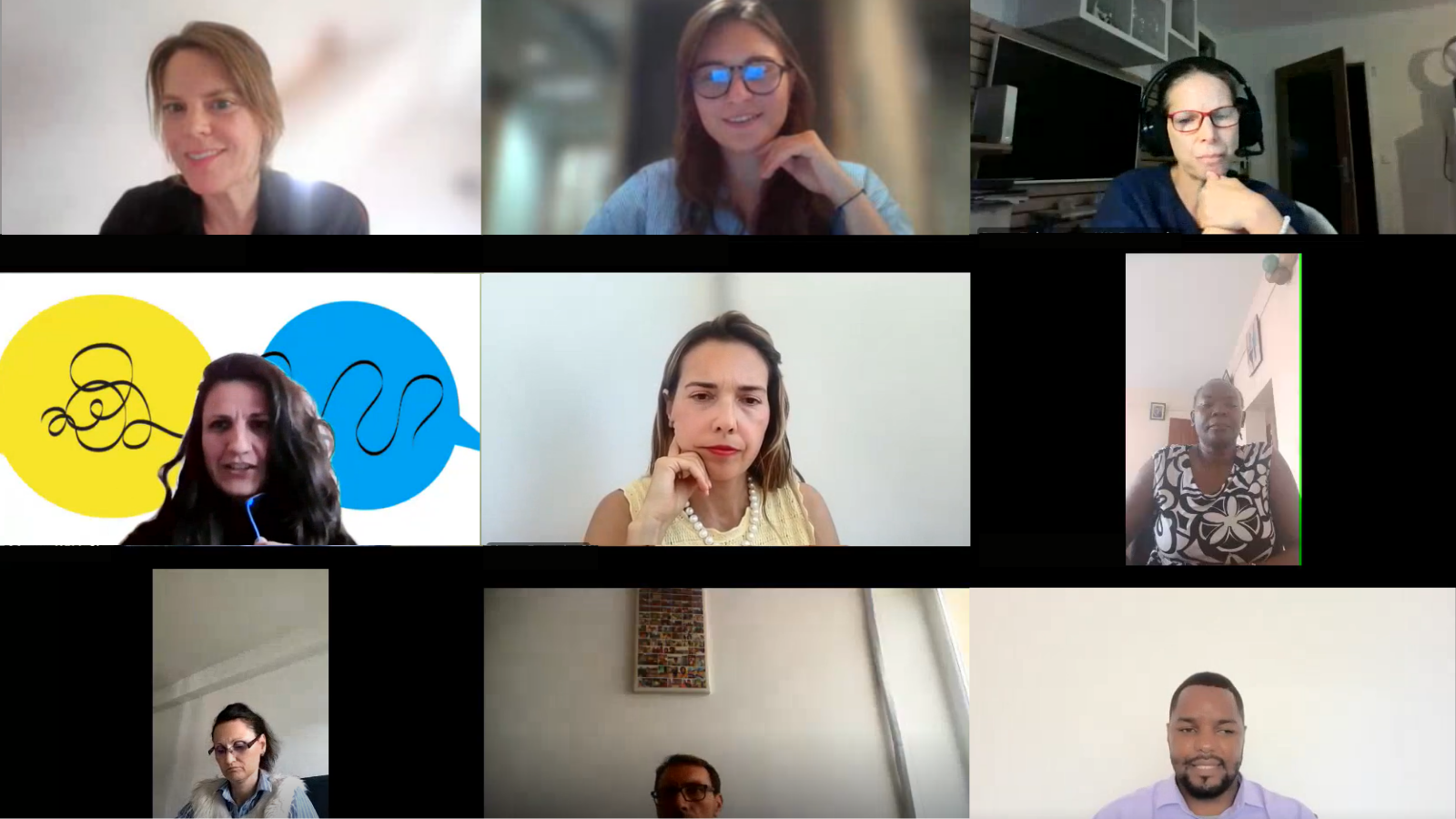
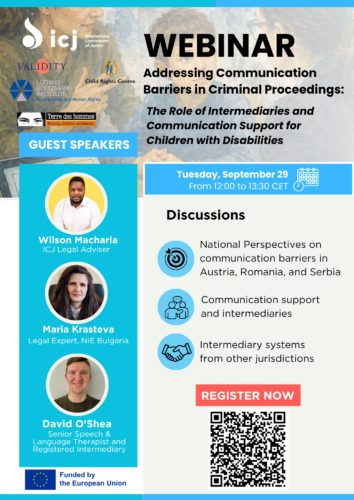
Intermediaries and other forms of communication support play a key role in enabling children with disabilities to understand criminal proceedings and be understood, experts stressed at a webinar held by the International Commission of Jurists (ICJ) on 29 September 2026. The webinar, Addressing Communication Barriers in Criminal Proceedings: The Role of Intermediaries and Communication Support for Children with Disabilities, explored international human rights law and standards, as well as practical approaches to ensuring access to justice for children with disabilities.
It brought together justice professionals, child rights experts, disability and communication specialists, and civil society representatives to discuss how justice systems can better address communication barriers and support meaningful participation in proceedings.
Experts discussed various forms of communication support, including interpreters, translators and accessible information formats. Particular attention was given to intermediaries, who play a key role in facilitating effective communication between children with disabilities and justice professionals.
“Intermediaries do not speak for the court, the prosecutor or the child. Their role is to facilitate effective communication between all parties, ensuring that children with disabilities can understand proceedings and be understood throughout the justice process,” said Wilson Macharia, Legal Adviser and Regional Lead on Disability Rights, Africa Programme, ICJ.
Under article 13(1) of the UN Convention on the Rights of Persons with Disabilities, States Parties must ensure effective access to justice for persons with disabilities on an equal basis with others, including through the provision of procedural and age-appropriate accommodations. The International Principles and Guidelines on Access to Justice for Persons with Disabilities, adopted in 2020 and endorsed by ICJ, list intermediaries and communication support among the procedural accommodations that States must provide.
Speakers also presented examples of intermediary systems and communication support mechanisms from different European jurisdictions. The experiences of Bulgaria and Ireland showed that intermediary systems can develop in different ways. Although the two countries have adopted different approaches, both experiences pointed to the need for specialized training, clear procedural guidance and institutional commitment to ensure effective communication support for children with disabilities in legal proceedings.
The ICJ considers that effective access to justice for children with disabilities requires both strong legal frameworks and effective implementation. States must provide communication support as a procedural and age-appropriate accommodation that enables children with disabilities to participate meaningfully, exercise their rights and be heard throughout legal proceedings.
The agenda is available here.
Background
The Ensuring Access to Intermediaries for Children with Disabilities in Legal Proceedings (ENSURE) project aims to strengthen access to justice for child victims with disabilities in Austria, Romania and Serbia, in line with international and European Union law and standards. Implemented between 2025 and 2027 by the ICJ – European Institutions, together with the Validity Foundation, Terre des Hommes (Romania), the Child Rights Centre (Serbia), and the Ludwig Boltzmann Institute of Fundamental and Human Rights (Austria), the project is dedicated to improving communication with child victims with disabilities in the criminal justice system. It seeks to enhance the capacity of justice and protection professionals, promote multidisciplinary cooperation, and support the development and integration of intermediaries, facilitators and other specialized roles, while fostering the exchange of good practices and raising awareness of the need for disability-inclusive and, child-centred justice systems.
Contact
Karolína Babická, ICJ Senior Legal Adviser, karolina.babicka@icj.org
Viktoryia Konashava, ICJ Legal Researcher, viktoryia.konashava@icj.org