Apr 1, 2019 | News
As military courts in Pakistan once again cease to have jurisdiction over civilians for terrorism-related offences, the Government must bring reforms to strengthen the country’s criminal justice system, the ICJ said today.
Perpetrators of terrorist attacks and other serious crime must be brought to justice fair trials before competent, independent and impartial courts as required under international law, the ICJ added.
“The lapse of the jurisdiction of military courts over civilians is a step in the right direction, but unsurprisingly – even four years after military courts were empowered to try civilians – there is no sign of the promised reforms to strengthen the ordinary criminal justice system to effectively and fairly handle terrorism-related cases,” said Frederick Rawski, ICJ’s Asia Director.
The 23rd Amendment and corresponding amendments to the Army Act, 1952, lapsed on 30 March 2019, as their respective two-year sunset clauses expired. So far, the Government has failed to get support from opposition parties for a constitutional amendment to once again extend the jurisdiction of military courts to conduct trials of civilians.
“The Government must not re-enact legislation to continue secret military trials of civilians, nor resort to more short-term, short-sighted security measures that are contrary to Pakistan’s obligations to protect human rights,” Rawski said.
“Instead, the Government should urgently invest in enhancing the capacity and security of judges, investigators and prosecutors to make the regular criminal justice system more effective in conducting fair, credible terrorism trials, and bringing perpetrators to account without imposing the death penalty.”
According to military sources and ICJ’s monitoring of military trials in Pakistan since January 2015, military courts have convicted 617 people for terrorism-related offences, out of which 346 people have been sentenced to death and 271 people have been given prison sentences. At least 56 people have been hanged. Only four people have been acquitted.
The ICJ has documented serious fair trials violations in the operation of military courts, including: denial of the right to counsel of choice; failure to disclose the charges against the accused; denial of a public hearing; failure to give convicts copies of a judgment with evidence and reasons for the verdict; and a very high number of convictions based on “confessions” without adequate safeguards against torture and ill treatment.
Contact
Frederick Rawski, ICJ Asia Pacific Regional Director (Bangkok), e: frederick.rawski(a)icj.org
Reema Omer, ICJ International Legal Adviser for Pakistan (London), t: +447889565691; e: reema.omer(a)icj.org
Additional information
Military courts were first empowered to try civilians for certain terrorism-related offences in January 2015 through the 21st Amendment to the Constitution and amendments to the Pakistan Army Act, 1952, which were in operation for a period of two years.
The expansion of the jurisdiction of military tribunals was a key part of the Government’s 20-point National Action Plan, adopted following the attack on the Army Public School in Peshawar in December 2014. NAP envisioned military courts to be a short-term “solution” to try “terrorists”, to be operational only for a two-year period during which the government would bring about necessary “reforms in criminal courts system to strengthen the anti-terrorism institutions”.
Despite promises that military courts were only temporary, after the expiration of the 21st Amendment, on 31 March 2017, Parliament enacted the 23rd Amendment and amendments to the Army Act to renew military courts’ jurisdiction over civilians. The amendments were given retrospective effect from 7 January 2017, and were due to lapse two years after their date of “commencement”. The expanded jurisdiction of military courts lapsed on 30 March 2019 (even though earlier reports suggested the amendments would expire on 6 January 2019) — two years after the date of “operation” of the 23rd Amendment).
The ICJ opposes the death penalty in all circumstances as a form cruel, inhuman and degrading punishment and an arbitrary denial of the right to life. The ICJ recalls that the UN General Assembly has by overwhelming majorities repeatedly called on all states the retain the death penalty to place a moratorium on the practice with a view to abolition. Pakistan previously had such a moratorium from 2008 to 2014.
Apr 1, 2019 | News
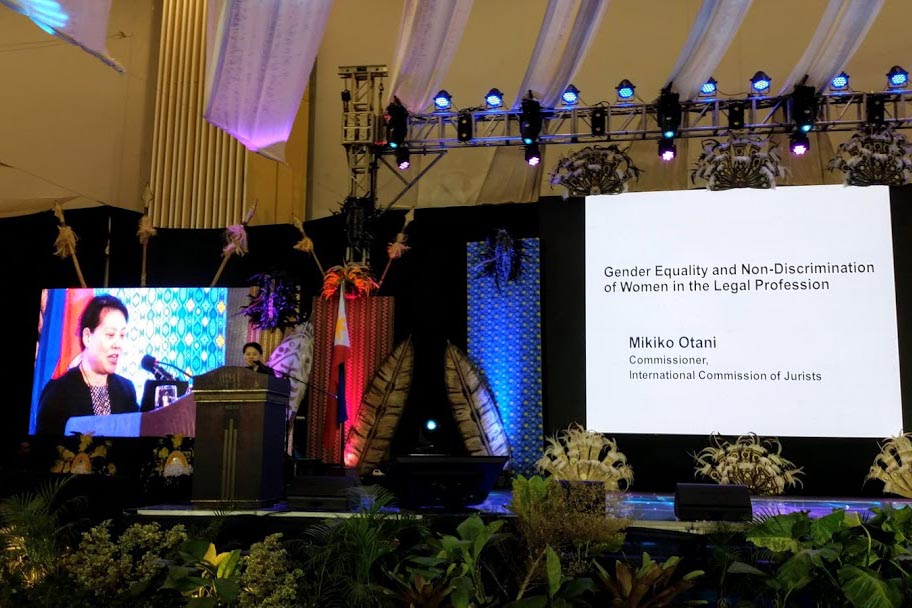
On 31 March, Mikiko Otani, ICJ’s Commissioner and a member of the UN Committee on the Rights of the Child, spoke to Filipino lawyers at the bi-annual National Lawyers’ Conference of the Integrated Bar of the Philippines (IBP), which took place at the Iloilo Convention Center, Iloilo City.
Mikiko Otani, who had been Chair of the Committee on International Human Rights of the Japan Federation of Bar Associations (JFBA) remains active in the JFBA, talked about the importance of advancing gender equality in the legal profession and the important initiatives of the JFBA on eliminating gender discrimination.
She noted that “female lawyers experience many forms of discrimination in the workplaces, practices, court rooms and bar associations.”
In countries all over the world, many formal barriers women used to face in entering the legal profession, including admission to law schools, the bar, have been eliminated.
However, women continue to face barriers, some of which are specific to the legal profession, but others common to women who work more generally.
Mikiko Otani noted that when she started practice as a lawyer in 1990, women applicants for jobs at law firms would often be asked during the interview whether they planned on getting married or having children.
Law firms preferred to hire male lawyers as they were thought to be unencumbered with looking after household matters, such as housekeeping and child care.
She recalled, “My colleagues questioned my decision to get married and have children almost immediately after becoming a lawyer while also continuing my practice as this was an unusual for women lawyers in Japan to do at that time. They felt that my decision to start a family at that point would be a hindrance to my career.”
She also talked about the bias observed in case assignment, where only male lawyers would be assigned to cases that required extensive traveling, while female lawyers would be often assigned to family cases, which are considered to be easy, unpopular or low-profile cases.
There was also frequent bias against female lawyers in promotion or offering partnership in law firms, contributing to a major gender gap in income between male and female lawyers.
In 2008, the JFBA formulated a Basic Plan which included the study of inequalities between male and female lawyers in Japan, finding ways to ensure a work-life balance for women, creating complaint handling bodies, and hosting trainings and educational activities in order to promote gender equality.
Mikiko Otani’s remarks resonated among many female lawyers in the Philippines, who shared in the discussion that followed that they face the same challenges.
“As lawyers, it is our responsibility to assist everyone, including women, in accessing justice,” said Marienne Ibadlit, a member of the Board of Governors of the IBP.
“We cannot be faithful to this responsibility if within our profession, we perpetuate gendered relationships and social inequalities that discriminate against women. A bar association that is committed to gender equality is a prerequisite to a justice system that does not discriminate against women and ensures the full enjoyment of women of their human rights.”
Contact:
Emerlynne Gil, Senior International Legal Adviser for Southeast Asia, t: +662 619 8477 (ext. 206) ; e: emerlynne.gil(a)icj.org

Mar 26, 2019 | News
The ICJ condemns the sentencing of Venezuelan Judge Maria Lourdes Afiuni to a further five years of imprisonment.
On 21 March, a court in Caracas sentenced Judge Afiuni on unfounded charges of “corruption”.
“This further five-year sentence against Judge Afiuni is both the latest in a long series of severe violations of her human rights, and also illustrates the grave extent to which independence of the judiciary in Venezuela has been more broadly undermined,” said Matt Pollard, ICJ Senior Legal Adviser and UN Representative.
Judge Afiuni was arbitrarily arrested and detained in 2009 after then-President Hugo Chavez publicly demanded she be imprisoned for 30 years, as she had released an accused person citing a decision by the UN Working Group on Arbitrary Detention that his detention was unlawful.
While in detention, she was subjected to torture and other ill-treatment.
In 2010, the UN Working Group on Arbitrary Detention issued an opinion declaring Judge Afiuni Mora’s detention arbitrary.
She was held in prison for 14 months before being transferred to house arrest for health reasons in 2011.
In 2013 she was granted parole but ordered not to leave the country or to use social media.
The UN Special Rapporteur on the Independence of Judges and Lawyers reacted earlier today to the latest sentencing by reaffirming the arbitrariness of her deprivation of liberty and the fact that her treatment amounts to reprisals for having implemented the UN Working Group’s decision.
The Rapporteur also said that the ruling “underscored his serious concerns about the independence of the judiciary in Venezuela, the impartiality of judges and prosecutors and the pressures they faced in handling politically sensitive cases.”
Further background on the situation for the judiciary in Venezuela, and Judge Afiuni’s case, is available here.
Mar 13, 2019 | Comunicados de prensa, Noticias
La CIJ, conjuntamente con una jueza de Honduras y otra de Costa Rica, de sus respectivas asociaciones de jueces, sostuvieron una reunión con el Presidente de la Corte Suprema de Justicia.
Una vez más, pidieron la destitución del Director de Seguridad Institucional del Organismo Judicial, ya que a partir de dicho nombramiento, las y los jueces más independientes e imparciales, empezaron a ser vigilados ilegalmente y se han sentido vulnerables e inseguros.
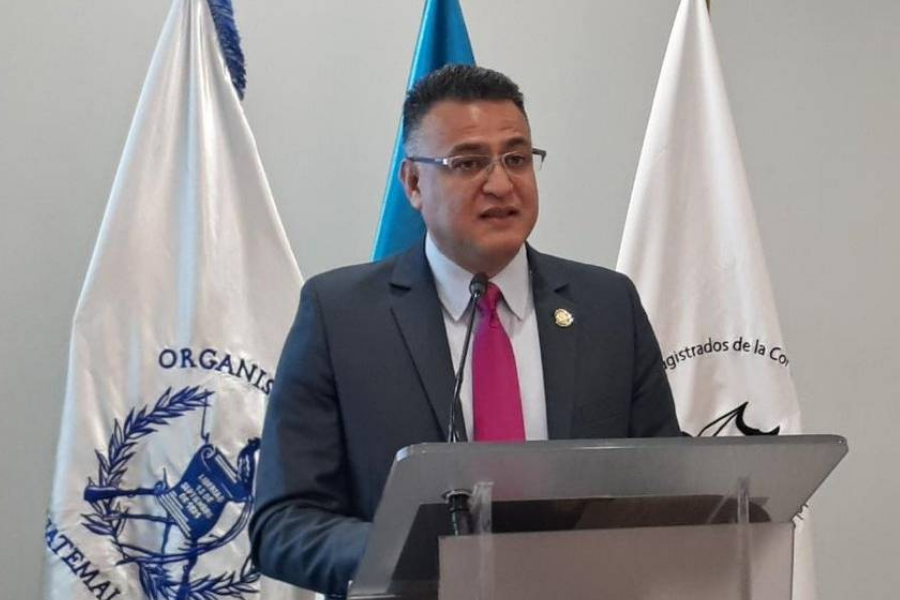
El día de hoy, gracias a una nota periodística, se supo que el Director de Seguridad Institucional del Organismo Judicial, Roberto Mota Bonilla (foto), tiene orden de captura, por la supuesta comisión del delito de violencia contra la mujer.
Esta nueva acusación hace insostenible que el Presidente de la Corte Suprema de Justicia lo siga protegiendo y manteniendo en su puesto y el pleno de magistrados de dicha Corte debería ahora intervenir, por tratarse de un asunto relacionado directamente con la seguridad de jueces y juezas.
“Tal y como nos informara el día de ayer el Presidente de la Corte Suprema de Justicia, en él recae la responsabilidad del nombramiento del Director de Seguridad Institucional, pero los asuntos de seguridad de jueces, debe discutirlos con el pleno de la Corte Suprema de Justicia,” expresó Ramón Cadena, Director de la CIJ para Centroamérica.
La CIJ hace un llamado a las autoridades del Estado de Guatemala, para que respeten el Estado de Derecho y que cesen los ataques en contra de la independencia del Poder Judicial y de las y los jueces que administran justicia en forma independiente e imparcial.
Lamentablemente, tal y como lo confirmara el Presidente del Organismo Judicial, está a la espera de informe de Auditoría Interna para tomar una decisión definitiva. Sin embargo, ante estos nuevos hechos, no debería esperar el informe para tomar una decisión. El Director de Seguridad Institucional Roberto Mota Bonilla, debería ser destituido en forma inmediata.

Mar 13, 2019
The ICJ said today in an new report that Moldova remained a significant way from having a functionally independent judiciary, which is an indispensable element in the country’s capacity to deliver justice for its people and institutions.
The report ”Only an empty shell” – The undelivered promise of an independent judiciary in Moldova sets out a number of specific recommendations for reform which with a view to achieving a fully independent judiciary and effective justice system.
The report followed its field mission to Moldova in November 2018, which built upon the work of previous missions undertaken in 2004 and in 2012.
“While many significant legislative reforms have been undertaken, judicial independence is far from being achieved in Moldova,” said Massimo Frigo, Senior Legal Adviser for the ICJ Europe and Central Asia Programme,
“Reforms are needed in the law, but more than that a change is needed the mindset and working culture of many judges themselves that must protect and promote judicial independence in all of their work,” he added.
The ICJ acknowledged that important progress had been achieved in many areas, including in efforts to secure audio-recordings of all court hearings, the introduction of a system of random allocation of cases, and staff and salary increases for all judges.
However, the ICJ has concluded that the implementation of the most crucial legal reforms is significantly lagging behind and often lacks political will and conviction.
A culture of excessive hierarchy in the judiciary and of the judge remained prevalent among judges.
The ICJ is concerned at reports that the Superior Council of Magistracy (SCM) – a judicial self-governance body – instead of playing its crucial role of defending the independence of the judiciary, institutionally and in respect of individual judges, has become an instrument of pressure on individual judges and a threat to their independence.
“During our mission, we were presented with witness statements and stories of judges living often in a condition of fear: fear to express their opinions on the situation of the judiciary; and fear of criminal prosecution solely for issuing a decision contrary to the requests of the prosecutor’s office or of other powerful interests,” said Massimo Frigo.
Achieving judicial independence requires a change of attitude towards the judiciary from the executive and other sources of State and private power, but most importantly from the judiciary itself.
Contact
Massimo Frigo, Senior Legal Adviser, Europe and Central Asia Programme, International Commission of Jurists, massimo.frigo@icj.org
Download
The full story with additional information:
Moldova-Only an empty shell report launch-News-press releases-2019-ENG
The full version of the report and full set of recommendations is available in English and Romanian:
Moldova-Only an empty shell-Publications-Reports-Mission reports-2019-ENG
Moldova-Only an empty shell-Publications-Reports-Mission reports-2019-ROM