Jun 24, 2018 | Artículos, Noticias
Las y los comisionados de la CIJ en América Latina se reunieron recientemente en Bogotá y firmaron la siguiente declaración conjunta.
Las y los comisionados firmantes de la Comisión Internacional de Juristas, expresamos:
- Nuestra profunda preocupación por la delicada situación de la Independencia Judicial en Guatemala. Tenemos conocimiento que varios jueces y juezas se encuentran bajo hostigamiento y presiones del régimen disciplinario, usados indebidamente por grupos y personas descontentas con las decisiones judiciales en casos de alto impacto. En efecto, Jueces y Juezas de los Tribunales de Mayor Riesgo como Ericka Aifán, Yassmín Barrios, Miguel Ángel Gálvez y Pablo Xitumul y otros han sufrido una serie de denuncias infundadas ante los órganos disciplinarios.
- La compleja función que cumplen los jueces y juezas en el contexto actual en Guatemala, hace evidente que son objeto de ataques que buscan afectar su función como operadores de justicia honestos e imparciales. Según los estándares internacionales, la exigencia de responsabilidad de un Juez o Jueza, no ampara atentados contra la independencia judicial. Además, dichos estándares establecen que al llevar a cabo sus funciones, las y los jueces deben poder hacerlo libres de cualquier influencia y con total imparcialidad; sin ninguna restricción, incitación, presión, amenaza, ni injerencia, directa o indirecta, de cualquier origen o por cualquier motivo que sea.
- Asímismo, expresamos nuestro total apoyo al comisionado Iván Velásquez, Representante de la Comisión Internacional contra la Impunidad (CICIG), quien debido al cumplimiento de sus funciones, también viene sufriendo una serie de actuaciones y campañas de difamación. Asímismo, apoyamos a la CICIG, por la función que cumple en la lucha contra la impunidad y corrupción.
Ante todo ello, solicitamos a la Comunidad Internacional que sigan apoyando a la CICIG con suficientes recursos humanos y financieros; además, hacemos un llamado a la Comisión Interamericana de Derechos Humanos, al Sub Comité de Derechos Humanos del Parlamento Europeo y al Relator de las Naciones Unidas sobre la Independencia de Jueces y Abogados, para que visiten el país y puedan verificar “in situ”, la delicada situación de la independencia judicial en Guatemala.
Carlos Ayala, Vicepresidente de la Comisión Internacional de Juristas (Venezuela)
Mónica Pinto, Comisionada (Argentina)
Miguel Carbonnel, Comisionado (México)
Víctor Rodríguez Rescia, Comisionado (Costa Rica)
Wilder Tayler, Comisionado (Uruguay)
Belisário Dos Santos, Comisionado (Brasil)
Juan Méndez, Comisionado (Argentina)
Aejandro Salinas Rivera, Comisionado (Chile)
Roberto Garretón, Comisionado (Chile)

Jun 22, 2018 | News
Conclusions of the Conference on Judicial Independence, Guatemala City, 18-19 June 2018
The ICJ is deeply concerned about the increase in the abuse of disciplinary measures against independent and impartial judges and about crimes committed against human rights defenders. These attacks are putting the rule of law at risk in Guatemala.
The ICJ therefore urges the Inter-American Commission on Human Rights, the Subcommittee on Human Rights of the European Parliament and the UN Special Rapporteur on the Independence of Judges and Lawyers to carry out visits to the country so as to verify the situation.
Judges facing malicious disciplinary proceedings
From 18-19 June 2018, the ICJ hosted a conference on the independence of judges with participants from different Central American judges’ associations.
The conference was able to verify that impartial and honourable judges face on-going disciplinary actions that seek to have then recused from trials or have them removed from office on account of their judicial decisions.
Judges are facing the malicious use of the judicial disciplinary system by groups or persons who disapprove of judicial rulings in high-impact cases.
The meeting was an opportunity for different justice sector institutions and judges, victims of attacks, to analyse fundamental concepts and international standards on the judiciary.
The conference concluded, the judicial career system must guarantee that a higher judicial authority can only sanction judges for legally established reasons as set down by international standards.
There was a full agenda of discussions with the participation of the Association of Guatemala Judges for Integrity (AGJI), the President of the Supreme Electoral Tribunal, the Supervisor General of Courts, judges from the Penal Chamber of the Supreme Court, the Commissioner of the International Commission against Impunity in Guatemala (CICIG) and the plenary of the Council of the Judicial Career.
The conference examined attacks against judges and their impact, case by case, in the light of international standards. The conference concluded that judges including Ericka Aifán, Yassmín Barrios, Miguel Ángel Gálvez, Carlos Ruano and Pablo Xitumul are facing disciplinary measures because they have acted independently and impartially.
The spurious complaints presented against them before the judicial disciplinary system or other State institutions should be excluded “in limine”.
Read the full Article in English (PDF): Guatemala-Conference-of-Judges-News-Web-stories-June-2018-ENG
Jun 19, 2018 | Advocacy
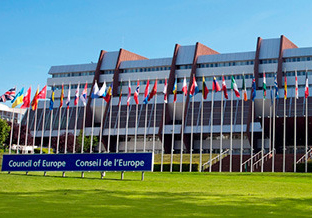
The ICJ welcomes the proposal of the Parliamentary Assembly of the Council of Europe (PACE) in its Recommendation 2121(2018) calling for the development of a Council of Europe Convention on the Profession of Lawyer.
The ICJ believes that such a Convention could make an important contribution to strengthening the rule of law and the protection of human rights in the Council of Europe region, building on existing Council of Europe standards and jurisprudence of the European Court of Human Rights.
The ICJ particularly welcomes PACE’s call for an effective control mechanism to be put in place under a new Convention, as recent developments in a number of Council of Europe Member States show a significant gap in implementation of Council of Europe standards on the independence and security of lawyers.
Lawyers, along with judges and prosecutors, are one of the pillars on which protection of the rule of law and human rights through the justice system rests.
Recognizing this, the ICJ, since its foundation in 1952, has worked to protect lawyers under threat and to develop international standards for the independence, role and integrity of the profession.
Successive ICJ Declarations, adopted by leading jurists from all regions of the world, have affirmed that the role of the legal profession is “paramount in safeguarding human rights and the Rule of Law” (2008 Declaration on Upholding the Rule of Law and the Role of Judges and Lawyers in Times of Crisis (ICJ 2008 Declaration).
In any legal system, the legal profession plays a pivotal role in ensuring access to justice and effective remedies and accountability for violations of human rights, as well as upholding the right to fair trial, right to liberty and freedom from torture and other ill-treatment in the criminal justice process.
In defending criminal cases, in advising and representing victims of human rights violations and their relatives or in challenging before the courts national legislation or policy that is contrary to human rights , lawyers give practical effect to human rights guarantees and rule of law principles.
The importance of this role has been recognized by international standards as well as in the jurisprudence of the European Court of Human Rights, which has emphasized the “specific status of lawyers [having] a central position in the administration of justice as intermediaries between the public and the courts”.
It is thus of fundamental importance that lawyers are able to fulfill their professional duties without interference. As the European Court of Human Rights has held, “persecution and harassment of members of the legal profession strikes at the very heart of the Convention system.”
Full text in ENG (PDF): Europe-Drafting-a-EU-Convention-on-the-Profession-of-Lawyer-2018-ENG
Jun 18, 2018 | News
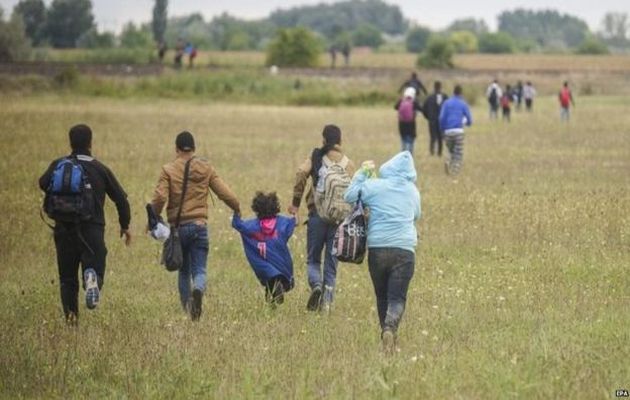
The ICJ today called on the Hungarian National Assembly to reject Bill No. T/333 that, if approved, would risk criminalizing the work of civil society, lawyers and other human rights defenders and lead to violations of the rights of migrants, especially refugees.
The National Assembly of Hungary is considering today Bill No. T/333 tabled by the Hungarian Government that amends immigration and criminal law.
“This draft law would effectively punish activities that aim to apply legal procedures” said Massimo Frigo. “This attack on the work of lawyers and human rights defenders does not constitute a legitimate aim that would allow for a permissible restriction on the rights of freedom of expression, assembly and association consistent with international human rights law.”
The ICJ warned that the draft law, if approved, would, in contravention of international standards, open the way to arrest, prosecute and convict lawyers or representatives of civil society who assist asylum seekers in filing their application for international protection. It would also make funding of such activities a crime.
The law would effectively prevent lawyers and civil society organizations, under threat of criminal punishment, from providing assistance to asylum-seekers unless they can verify that the person is entitled to international protection, even before the person has begun the refugee status determination procedure.
It would further criminalize any activity aimed at regularizing the position of an irregular migrant who had, for example, married a Hungarian citizen or became a parent of Hungarian children.
“This draft law should be rejected because it could in practice deny legal assistance to any asylum seeker, preventing them from defending their rights, ” said Massimo Frigo.
Bill T/333 has been criticized by UNHCR, the Council of Europe Commissioner for Human Rights and several national and international civil society organisations. An opinion of the Venice Commission on the law is expected to be published shortly.
Background
If approved in the current form, section 11 of the draft law would insert in the Criminal Code the offence of “facilitating illegal immigration”, as new section 353/A. This provision, if approved, would make it a criminal offence to carry out organized activities to facilitate the initiation of an asylum procedure for persons “who are not persecuted” in their country of origin or in a third country that they passed through, or “do not have a well-founded reason to fear direct persecution.”
This provision would also make it a criminal offence to carry out these activities to assist a person entering illegaly or residing illegally in Hungary to obtain a residence permit.
The draft law would also make it a criminal offence to provide financial means to carry out these activities.
Full Document in English (PDF): Hungary-Statement-National-Assembly-Criminalizing-Assistance-to-Migrants-Law-2018-ENG
Jun 18, 2018 | Events, News
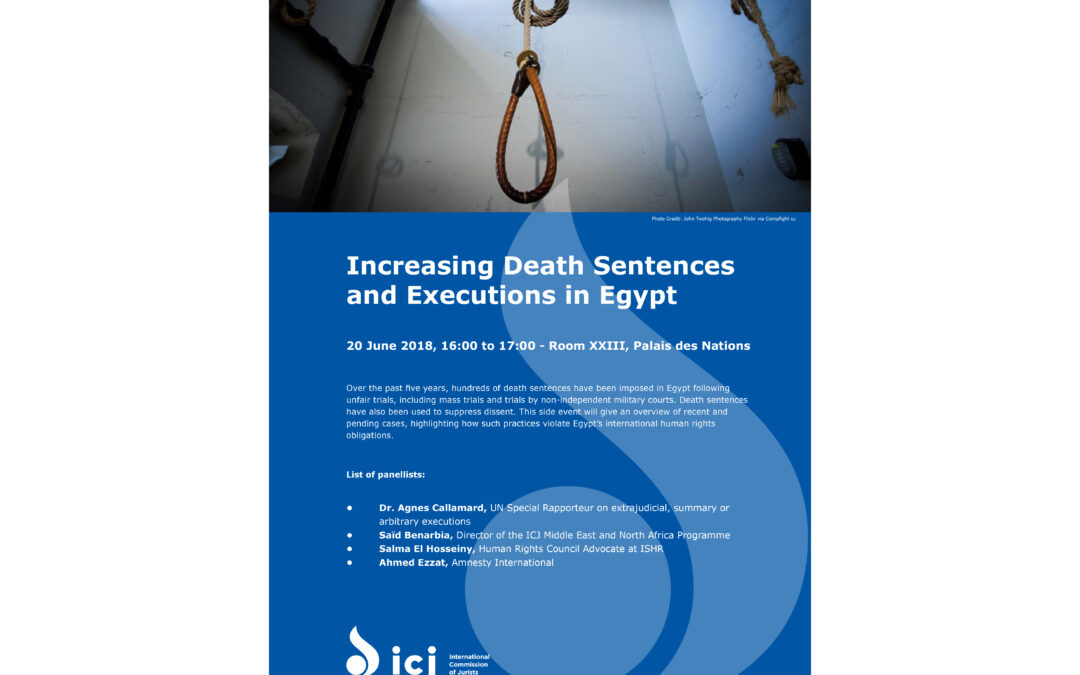
This side event at the Human Rights Council takes place on Wednesday, 20 June, 16:00-17:00, room XXIII of the Palais des Nations. It is organized by the ICJ.
Speakers:

![Smoke rises after an Israeli air strike on the village of Taybeh in southern Lebanon [Source: Al Jazeera]](https://www.icj.org/wp-content/uploads/2026/03/Screenshot-2026-03-20-at-15.56.24-300x200.png)