Dec 17, 2016 | News
The ICJ jointly convened a two-and-a-half day training workshop with the Raoul Wallenberg Institute.
The meeting congregated lecturers from the four law schools from around the country to look into options for the development of clinical legal education programmes.
One of the objectives of the meeting was to acquaint and equip law schools with the various models and approaches to clinical legal education.
To that end the workshop covered issues including: an overview of clinical legal education programmes and models for law clinics; developing clinical legal education curricula; clinical/interactive teaching methods; and practical placement of students with local, regional and international organizations.
This initiative was a first step in a Clinical Legal Education Programme which is a response by the ICJ to concerns from judicial officers on the quality of legal graduates.
The clinical legal education programme is part of a broader ICJ intervention, which is looking to better equip and motivate lawyers to effectively contribute to the maintenance of the rule of law and preservation of human rights.
The process was jointly facilitated by Professor David Mcquoid-Mason (President, Commonwealth Legal Education Association) and Alex Conte of the ICJ and the University of Sussex.
The 17 participant academics (ten males and seven females) who attended the meeting where drawn from the four law schools in Zimbabwe: the Faculty of Law from the University of Zimbabwe; the Herbert Chitepo Law School at the Great Zimbabwe University; the Zimbabwe Ezekiel Guti University; and the Midlands State University.
Additional participants where drawn from the Institute for Peace, Leadership and Governance, at Africa University.
The workshop was held with the support of the European Union Delegation to Zimbabwe (EU).
Dec 15, 2016 | News
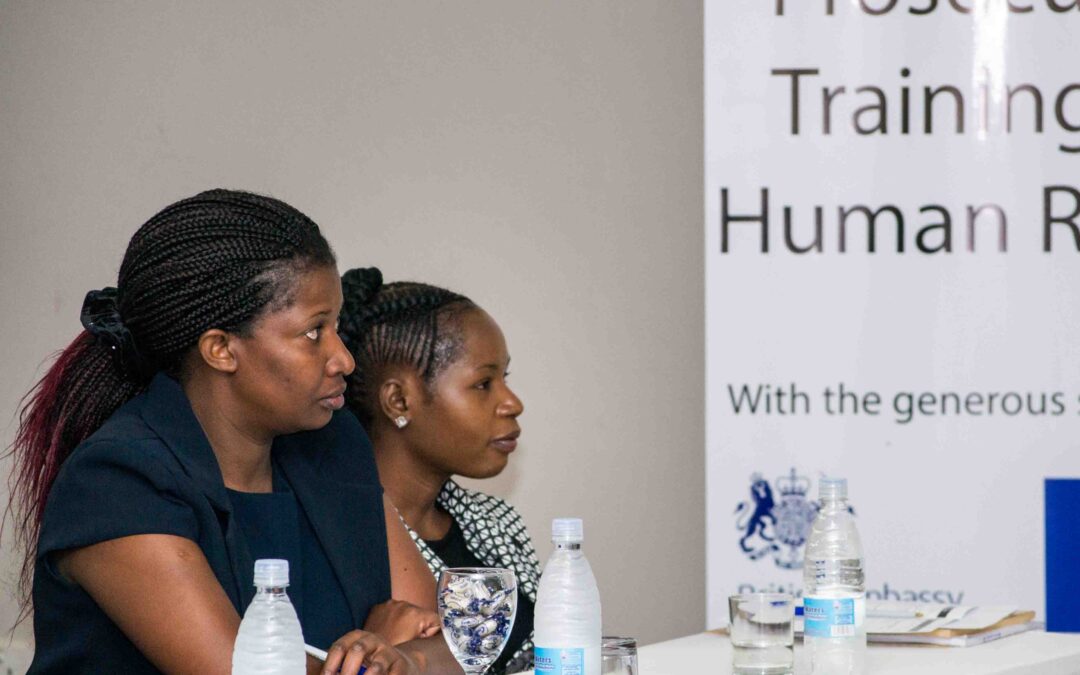
The ICJ and the Judicial College of Zimbabwe (JCZ) have assisted senior prosecutors in their role in strengthening the rule of law and protection of human rights in the country.
The Zimbabwe National Prosecuting Authority (NPA) held a pilot training of trainers for senior prosecutors on fair trial standards and human rights from 15-16 December 2016.
The NPA received substantive legal and technical support for this training from the Judicial College of Zimbabwe (JCZ) and the ICJ.
In consultation with the ICJ, the JCZ designed the training curriculum.
The JCZ has a statutory mandate to provide continuous professional development to various justice sector actors including the prosecution.
The content of the curriculum includes prosecutorial conduct in upholding the rule of law, constitutional and legislative protection of the rights of accused persons, general powers of the prosecutor general and his/her nominees, and the relationship with the other justice actors, such as the police.
In addition, the training focused on aspects relating to warrants for further detention, bail, right to remain silent, admissibility of statements obtained through illegal or abusive means, discharge at close of state case, sentencing and the prosecutors code of ethics.
The framing of the various topics is informed by universal, regional and domestic law and standards on the role, duties and mandate of the NPA, and individual prosecutors.
Fifty (50) senior prosecutors from different provinces and districts were selected to attend this inaugural intensive human rights training, facilitated by Mr. Shana, the JCZ principal, and Mr. Andrew Chigovera, former Attorney-General, former Commissioner, African Commission on Human and Peoples Rights.
Contact
Arnold Tsunga, ICJ Regional Director for Africa, t: +27 73 131 8411, e: arnold.tsunga(a)icj.org
Nov 18, 2016 | Agendas, Events, News
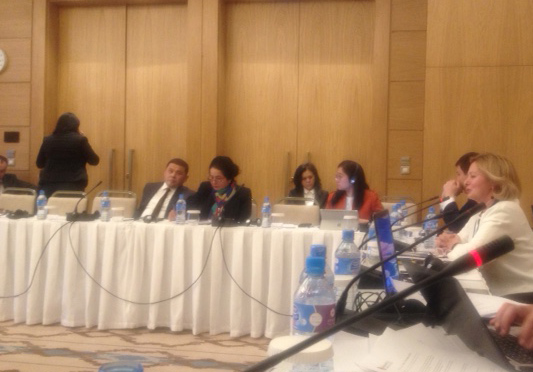
Today, the ICJ holds a round table discussion in Tashkent, Uzbekistan on “Comparative Perspectives on Judicial Ethics”.
The event takes place as part of the Central Asian Forum Expert Forum organized by the Organisation for Cooperation and Security in Europe (OSCE) in Tashkent this year.
International standards, and national standards of judicial ethics in Uzbekistan in other countries will be discussed at the event.
Participants will discuss questions of judicial independence, impartiality and accountability and disciplinary mechanisms.
Speakers at the event include Justice Ketil Lund (photo), an ICJ Commissioner and a former judge of the Supreme Court of Norway, Justice Tatiana Andreyeva, professor of law and a former Judge of the High Arbitration Court of the Russian Federation, as well as a representative of the Uzbekistan judiciary.
Legal practitioners and experts from across the Central Asian region will attend the event.
uzbekistan-side-event-tashkent-events-agenda-2016-rus (Agenda in Russian, PDF)
Nov 17, 2016 | Événements, Multimédia, Nouvelles
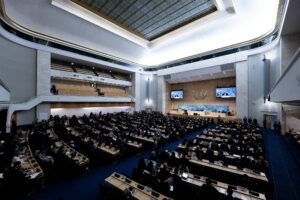
7ème Forum annuel de juges et avocats à Genève, 17-18 Novembre 2016
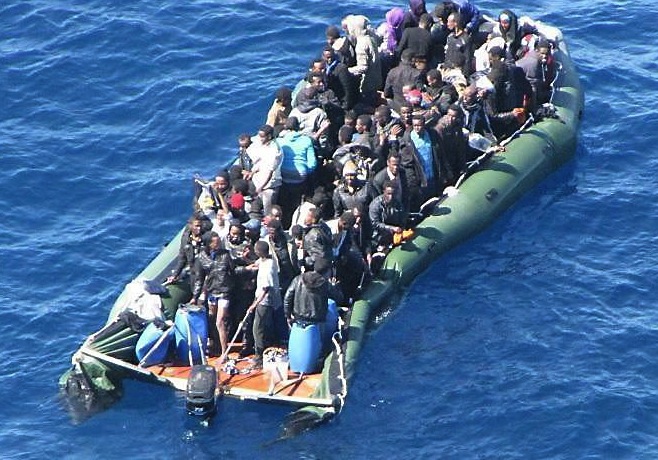
Le septième Forum annuel de juges et avocats, qui aura lieu à Genève les 17 et 18 novembre 2016, réunira juges et avocats provenant du monde entier, ainsi que les agences des Nations Unies concernées à Genève, afin de discuter du rôle des juges et des avocats dans les situations de déplacements massifs de réfugiés et de migrants.
Les participants réfléchiront aux défis pratiques, juridiques et de nature politique soulevés par les mouvements contemporains de réfugiés et de migrants actuels, perçus comme exceptionnels par leur ampleur et leur rapidité.
Les situations particulières considérées visent notamment celles en Europe (avec des personnes venant principalement de et par l’Afrique du Nord et le Moyen-Orient, y-compris la Syrie, l’Erythrée, l’Irak et l’Afghanistan); des Amériques (y-compris des personnes se rendant aux États-Unis d’Amérique depuis l’Amérique centrale et l’Amérique du Sud); en Asie (en particulier concernant les Rohingyas à travers l’Asie du Sud-Est, ainsi que les pratiques migratoires impliquant l’Australie et le Pacifique); et à l’intérieur et en provenance de parties de l’Afrique sub-saharienne.
Dans la plupart de ces situations, les protections juridiques disponibles et les rôles respectifs des pouvoirs exécutif, législatif et judiciaire pour la garantie de ces protections, ont fait l’objet de débats.
Les autorités du monde entier ont été confrontés au défi de s’assurer qu’en toutes circonstances, les individus puissent avoir accès à des procédures équitables et effectives vis-à-vis toutes décisions clés relatives à leurs droits et intérêts tels que: les déterminations relatives au droit d’une personne à la protection internationale, notamment les déterminations relatives au statut de réfugié; les décisions concernant la détention ou les poursuites pénales fondées sur l’entrée ou à la présence d’une personne dans le pays; et les décisions concernant l’expulsion ou le transfert ultérieur.
Dans certains cas, les gouvernements se sont radicalement éloignés des procédures ordinaires. Le cadre de « crise » ou d’« urgence » a été de plus en plus invoqué, parfois, afin de réduire les protections et garanties judiciaires et l’accès à la justice.
Le Forum entend se concentrer en particulier sur le rôle des juges et des avocats dans la garantie des droits procéduraux des individus dans de telles situations, et dans l’examen de la constitutionnalité et de la légalité internationale des législations, politiques et pratiques nationales pertinentes.
Les participants au Forum seront invités à analyser les cadres juridiques et des politiques ainsi que les pratiques en la matière aux niveaux national, régional et universel, et à formuler des recommandations sur le rôle spécifique des juges et des avocats dans ces situations, y-compris, à l’égard des pouvoirs exécutif et législatif.
Le principal résultat du Forum sera un ensemble de Principes sur le rôle des juges et des avocats dans les situations de mouvements massifs de réfugiés et de migrants. Les Principes seront élaborés par la CIJ, et ils ne seront pas être attribués aux participants du Forum.
Ces Principes viseront à compléter le Guide des praticiens de la CIJ n°6 de 2011 sur la migration et le droit international des droits de l’Homme.
fr-programme-2016gf-09-11-2016 (Texte complet en PDF)

Nov 14, 2016
In a new report published today in three languages, the ICJ finds systemic weaknesses in the legal profession in Azerbaijan have undermined its independence, leading to harassment of independent lawyers and preventing them from playing their role in the protection of human rights.
The report Defenseless Defenders: Systemic Problems in the Legal Profession of Azerbaijan concludes that the internal problems in the organization of the legal profession undermine its independence.
It finds that the Bar Association does not act as a self-governing institution of lawyers that protects the independence of the profession or upholds high ethical standards.
Its subsidiary bodies are not elected in a timely manner and the Bar Association does not use the tools of self-regulation which it has at its disposal.
There are serious failings of transparency and accountability to its members.
The report identifies problems in the qualification procedure for lawyers which suffers from a lack of objective criteria for evaluation and has resulted in an acute shortage of lawyers in the country.
The disciplinary procedure is a particularly weak point for the legal profession and is abused as a means of harassment of lawyers.
The report documents multiple cases of harassment of lawyers, contrary to international law and international standards on the independence of the legal profession.
It makes recommendations to address these problems, based on an analysis of international human rights law and standards.
It also emphasizes that the independence and role of lawyers must be respected by all institutions of government: executive, legislative and judicial, and by all public authorities.
The report recommends that the Bar Association should reconsider its role of the governance of the profession, and should initiate, through a consultation process, a reform based on the principle of independence and high ethical standards of the profession.
The qualification process should ensure that there is a sufficient number of lawyers to uphold the principle of access to justice and an effective remedy for violations of human rights.
In regard to the disciplinary procedure it must be fair, objective and should aim to support the independence of lawyers in Azerbaijan; it should not be used for any purposes other than ensuring high professional standards, integrity and independence of lawyers.
The report is available in Azeri, English and Russian and can be downloaded below.
azerbaijan-systemic-problems-legal-prof-publications-reports-mission-reports-2016-eng (English, PDF)
azerbaijan-systemic-problems-legal-prof-publications-reports-mission-reports-2016-rus (Russian, PDF)
azerbaijan-systemic-problems-legal-prof-publications-reports-mission-reports-2016-aze (Azeri, PDF)

![Smoke rises after an Israeli air strike on the village of Taybeh in southern Lebanon [Source: Al Jazeera]](https://www.icj.org/wp-content/uploads/2026/03/Screenshot-2026-03-20-at-15.56.24-300x200.png)