Nov 14, 2016
The ICJ has published a translation of its Practitioner’s Guide N°1 International Principles on the Independence and Accountability of Judges, Lawyers and Prosecutors.
This is the first comprehensive analysis of the existing standards and compilation of universal and regional instruments published in Turkmen.
The Guide outlines the roles to be played by a strong legal profession, an independent judiciary and an impartial and objective prosecuting authority.
Part one of this guide provides an analysis of the law and concrete examples drawn from international practice. Part two includes relevant global and regional standards on the topic.
References to international decisions, reports, texts of treaties and other international standards allow the Guide to be used as a reference book by legal practitioners and policy makers.
Turkmenistan-PG N°1-Publications-Practitioners’ Guide Series-2016-TKM (full guide in Turkmen, PDF)

Nov 14, 2016
Prime Minister Najib Razak should withdraw proposed amendments to Malaysia’s Legal Profession Act 1976 because they will undermine the independence of the Malaysian Bar and its governing body, the Bar Council, said ICJ today in a letter together with other human rights organizations.
The amendments, which will be introduced when Parliament opens in October, seek to allow the Minister in charge of legal affairs to appoint two members of the Bar Council.
Furthermore, they aim to restrict the eligibility for leadership positions to those elected by the Bar Council by the various State Bars, thereby severely limiting those who can stand for office.
Should these amendments take effect, the current president and vice-president and the leaders of the State Bar committees will be precluded from any leadership role in the Bar Council.
“These amendments appear to be another attempt to muzzle an independent institution that has consistently been vocal in its defense of the rule of law and human rights in the country,” said Sam Zarifi, ICJ’s Regional Director for Asia and the Pacific.
“The Malaysian Bar and its governing body, the Bar Council, are more important than ever to help protect the rights of people and the rule of law, especially during this critical time in Malaysia when these are imperiled,” he added.
The UN Basic Principles on the Role of Lawyers (UN Basic Principles) guarantees the right to freedom of association of lawyers.
It specifically provides that “lawyers shall be entitled to form and join self-governing professional associations to represent their interests.” Furthermore, the UN Basic Principles provide that the governing bodies of professional associations of lawyers “shall be elected by its members and shall exercise its functions without external interference.”
“These amendments follow other efforts by the government to undermine the Malaysian Bar’s independence and prevent its members from engaging critically in upholding the standards of professional integrity and independence,” Zarifi said. “This move seems part of the Malaysian government’s efforts to stifle civil society and silence critical voices.”
The ICJ urges the government of Malaysia to respect the independence of the Malaysian Bar and its governing body, the Bar Council, and not pass these proposed amendments to the Legal Profession Act 1976.
The letter to Prime Minister Najib Razak was signed by ICJ, Human Rights Watch, Amnesty International, International Federation for Human Rights, Civil Rights Defenders, the Asia Democracy Network, Fortify Rights, Lawyers’ Rights Watch Canada, and the ASEAN Parliamentarians for Human Rights.
Background
Early this year, Malaysian authorities commenced sedition investigations against members of the Malaysian Bar after a motion was passed by a majority vote during the institution’s 70th Annual General Assembly calling for the resignation of Attorney General Tan Sri Mohamed Apandi Ali.
The Malaysian Bar demanded the resignation of the Attorney General after he summarily ended the investigation of alleged corruption by the Prime Minister. A month after, a proposal was made by parliamentarian Datuk Datu Nasrun Datu Mansur to make the Attorney General automatically the chairman of the Bar Council.
The ICJ has denounced these efforts, pointing out that these are inconsistent with the essential guarantees for the functioning of an independent legal profession under the UN Basic Principles on the Role of Lawyers.
Contact
Emerlynne Gil, ICJ’s Senior International Legal Adviser for Southeast Asia, t: +66840923575 ; e: emerlynne.gil(a)icj.org
malaysia-ngo-letter-on-lpa-amend-advocacy-open-letters-2016-eng (full text of letter, in PDF)
Nov 9, 2016 | News
The ICJ welcomes the judgment of the European Court of Human Rights in Schukurov v Azerbaijan, finding that the right to petition the Court had been violated by the search of a lawyer’s premises and seizure of documents.
The ICJ submitted a third party intervention in the case, outlining international law and standards relevant to legal professional privilege and the seizure of legal documents.
The case files were seized as part of a criminal investigation opened against the lawyer, Intigam Aliyev, who was representing the applicants in the case. The Court found that the search and seizure by the Azeri authorities had violated article 34 of the Convention, which stipulates that States must not hinder in any way the effective exercise of the right of individual application to the Court.
The ICJ notes that the Court’s judgment follows its earlier finding of a violation of article 34 in the case of Annagi Hajibeyli v Azerbaijan, which arose from the same incident.
The ICJ stresses that these searches of lawyers’ premises are contrary to international standards on the role of lawyers. It is particularly worrying that they form part of a pattern of harassment of lawyers in Azerbaijan, including abusive disciplinary proceedings and criminal prosecutions. Such harassment damages the ability of lawyers to protect human rights through the judicial process, and undermines the independence of the legal profession.
The decision of the Court should now be fully and promptly executed, the ICJ said.
Nov 5, 2016 | News
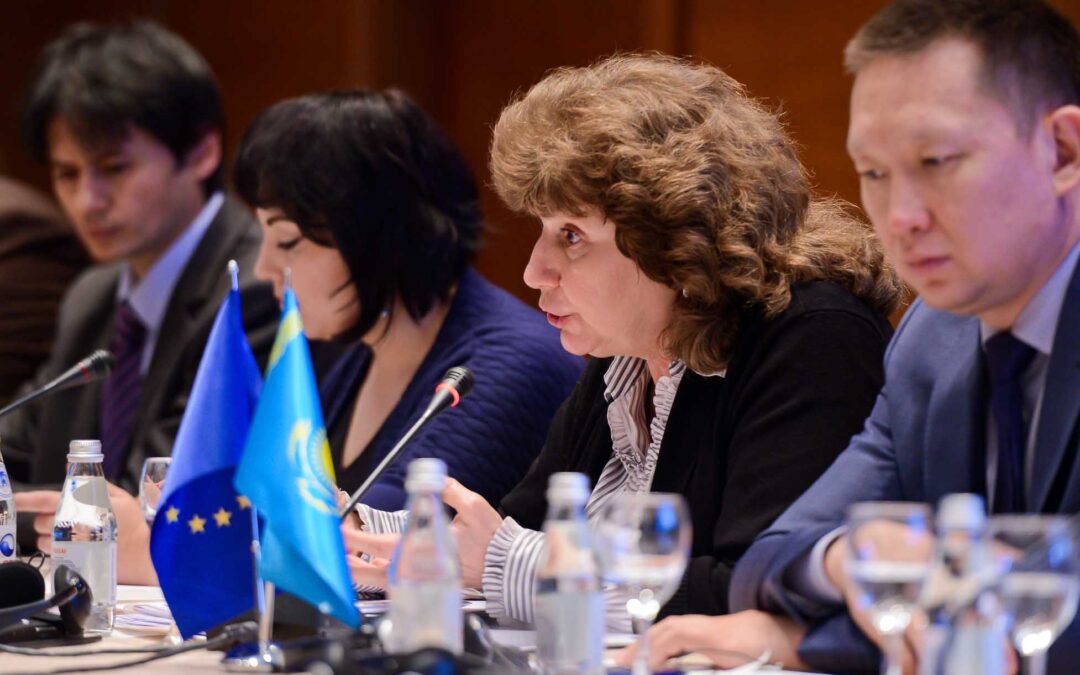
Today the ICJ, in partnership with the National Collegium of Advocates of Kazakhstan, hosts a major regional conference in Almaty, Kazakhstan, on the role and independence of the legal profession in Central Asia.
Bringing together bar associations and lawyers from across Central Asia, as well as representatives of bar associations from European countries and international experts, the conference explores how associations of lawyers can strengthen the role of lawyers in the justice system.
Participants will discuss the organization and self-governance of the profession in each of the countries of Central Asia; will analyse the obstacles lawyers face in protecting the rights of their clients; and will debate standards and good practices in protecting the integrity of the profession through codes of ethics, disciplinary proceedings and professional training.
“Across Central Asia, every day, lawyers do vital work to protect the human rights of their clients. But they can only do this effectively when their independence is protected in law and in practice, and when high ethical and professional standards are enforced by self-governing associations of lawyers.” said Róisín Pillay, Director of the ICJ Europe and CIS programme
“At a time when the organization of the profession is being renewed in several countries of the region, this conference aims to ensure that lawyers work together to learn from each others’ experiences, and from international law and standards, to strengthen associations of lawyers in upholding the vital role of the profession,” she added.
Download the agenda in English and Russian here:
central-asia-agenda-conference-legal-prof-news-web-stories-2016-rus-eng (in PDF)
Sep 22, 2016 | Advocacy, Non-legal submissions
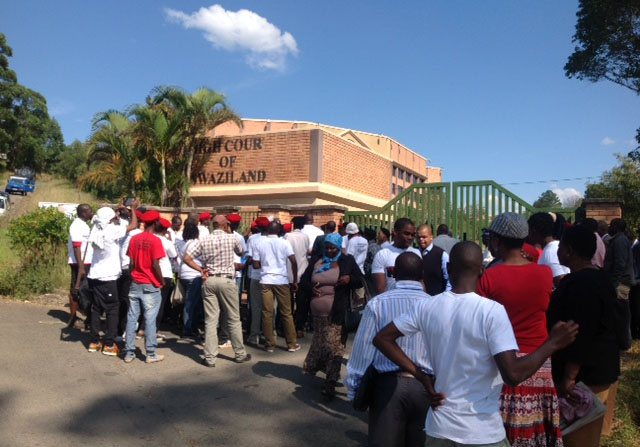
The ICJ today spoke to continuing concerns for human rights and the rule of law in Swaziland, during discussion at the UN Human Rights Council of the outcome of Swaziland’s Universal Periodic Review.
The statement read as follows:
The ICJ is concerned by the lack of implementation of recommendations accepted by the Government of Swaziland during the first UPR cycle.
The Swazi Government undertook to take concrete and immediate measures to guarantee the independence and impartiality of the judiciary. However judges continue to be appointed on the basis of corrupt patronage. The current Chief Justice and another Supreme Court judge are generally perceived to have been appointed on the basis of their traditional roles as former headman and chief, respectively, in the absence of any formal or transparent merit-based recruitment process.
Swaziland still has not ratified key international instruments, including the Rome Statute, the Optional Protocol to the Convention Against Torture, and the Convention for the Protection of All Persons from Enforced Disappearance, which they accepted during the last cycle.
The police have continued to ban and disrupt peaceful protests, relying on the Suppression of Terrorism Act, the Sedition and Subversive Activities Act and Public Order Act. Human rights defenders and political activists continue to be arrested and charged with criminal offences for exercising their rights to freedom of expression, association and assembly.
Swaziland has not enacted into law the Sexual Offences and Domestic Violence Bill, or any other law guaranteeing gender equality.
For these reasons, the ICJ calls upon the Government of Swaziland to accept and fully and promptly implement UPR recommendations from this cycle relevant to:
- Ensuring the independence and impartiality of the judiciary;
- Ratifying and domesticating the international instruments they accepted at the last cycle;
- Aligning national laws with international standards to guarantee freedom of expression, association and assembly;
- Enacting the Sexual Offences and Domestic Violence Bill into legislation.
The statement may be downloaded in PDF format here: hrc33-upr-swaziland-2016

![Smoke rises after an Israeli air strike on the village of Taybeh in southern Lebanon [Source: Al Jazeera]](https://www.icj.org/wp-content/uploads/2026/03/Screenshot-2026-03-20-at-15.56.24-300x200.png)