Jan 17, 2017
The paper aims to analyze relevant international law and standards applicable to the topics discussed at a recent round table, including assessment of the work of judges and its impact on judicial independence; assignment of cases; quality of judgments; and enforcement of judgments.
It sets out the international and European regional law and standards related to these key aspects of the internal functioning of the judiciary, which should serve as guidelines for policy makers and practitioners in the Russian Federation when assessing national legislation and practice in regard to these issues.
The paper also makes recommendations in light of the international law and standards analyzed, having particular regard to the challenges within the Russian judicial system, discussed at the round table.
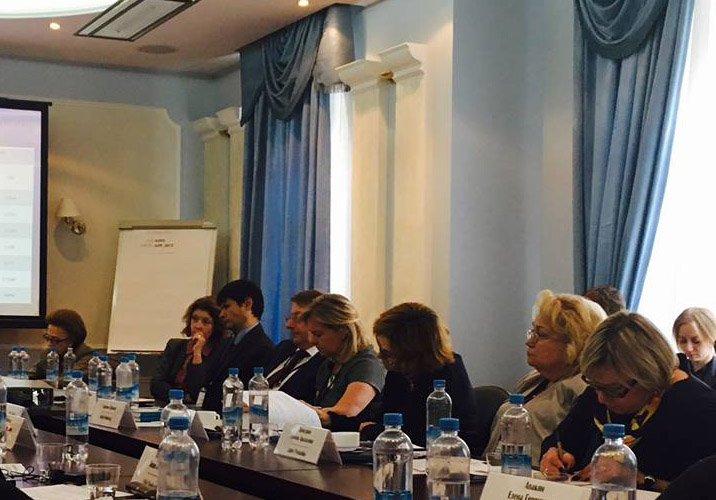
On 26 September 2016, the ICJ, in cooperation with the Institute of Law and Public Policy (ILPP), held a round table discussion in Moscow on Independence, Efficiency and Quality of Justice.
ICJ international and Russian national experts, including judges from Russia, Norway, the Netherlands and Italy, discussed a range of issues related to the efficiency of the judiciary, the allocation of cases, the quality and enforcement of court decisions and related topics.
The meeting allowed Russian and foreign judges and lawyers to share their experiences and discuss key aspects of organization of the judiciary.
Participants at the seminar discussed the continuing low levels of public trust in the judiciary in the Russian Federation and the need for further reforms to ensure that the judiciary can discharge its role as a true guarantor of the rule of law and human rights.
Concerns exist not only in regard to the guarantees that directly relate to the fairness of court hearings, but also as regards the organization of the judiciary.
While these institutional aspects are less often addressed in individual cases, they are essential to uphold the right to a fair trial under Article 6 of the ECHR and Article 14 of the International Covenant on Civil and Political Rights (ICCPR) as well as other international standards on the independence of the judiciary and fairness of court proceedings.
Russia-International standards_Moscow RT-Advocacy-Analysis brief-2017-ENG (Briefing paper in English, PDF)
Russia-International standards_Moscow RT-Advocacy-Analysis brief-2017-RUS (Briefing paper in Russian, PDF)

Jan 12, 2017
The ICJ today called on the Egyptian authorities to refrain from its attacks against independent judges and reinstate all those that have been removed from office following arbitrary and unfair disciplinary proceedings.
The call came as the ICJ released a legal briefing assessing the compliance of the mass disciplinary proceedings in the “the July 2013 Statement case” with international standards on judicial independence and due process.
Upholding a decision by the Disciplinary Board in the “July 2013 Statement case”, the Supreme Disciplinary Board found that 31 judges were “unfit” to hold judicial office for endorsing a public statement following the ousting of President Morsi and the seizure of power by the Military.
The Statement called for the 2012 Constitution to be restored, for a dialogue between all stakeholders to be established within the framework of constitutional legitimacy, and for the right to peaceful demonstration to be respected.
“The July 2013 Statement was a legitimate exercise, by the concerned judges, of their rights to freedom of expression, assembly and association,” said Saïd Benarbia, ICJ MENA Director.
“Removing these judges from office for exercising such rights and following mass, arbitrary, and unfair proceedings runs counter to Egypt’s obligations under international law to respect and observe the independence of the judiciary,” he added.
According to international standards, judges can only be removed for reasons of incapacity or behaviour that renders them unfit to discharge their duties after a fair hearing before an independent and impartial body.
The ICJ briefing analyses the numerous procedural and substantive flaws that marred the July 2013 Statement Case, including violations of the judges’ rights to freedom of expression and assembly, to a fair hearing before an independent and impartial body, and to equality of arms.
According to the study, the judges’ rights of defence were also undermined in a variety of ways, including by the failure to give judges prior and adequate notice of the hearings and access to the case file in advance of the hearings.
“Because of the litany of violations that marred the July 2013 Statement Case, the ICJ calls on the Egyptian authorities to reverse the decisions of the Supreme Disciplinary Board, to reinstate the judges that have been arbitrarily and unfairly removed from office, to refrain from attacks against the judiciary, and to put an immediate end to its campaign to silence independent judges,” Benarbia added.
Contact
Saïd Benarbia, ICJ Director of the ICJ Middle East and North Africa Programme, t: +41 22 979 38 17, e: said.benarbia(a)icj.org
Egypt-Attacks on judges-News-Press release-2017-ARA (Press release in Arabic, PDF)
Egypt-attacks-on-judges-Advocacy-Analysis brief-2017-ENG (Analysis brief in English, PDF)
Egypt-attacks-on-judges-Advocacy-Analysis brief-2017-ARA (Analysis brief in Arabic, PDF)
Jan 6, 2017
The ICJ has published another translation of its Practitioner’s Guide N°1 International Principles on the Independence and Accountability of Judges, Lawyers and Prosecutors.
The Guide outlines the roles to be played by a strong legal profession, an independent judiciary and an impartial and objective prosecuting authority.
Part one of this guide provides an analysis of the law and concrete examples drawn from international practice. Part two includes relevant global and regional standards on the topic.
References to international decisions, reports, texts of treaties and other international standards allow the Guide to be used as a reference book by legal practitioners and policy makers in Uzbekistan.
Uzbekistan-PGN°1-Publications-Practitioners’ Guide Series-2017-UZB (full text in PDF)

Dec 23, 2016 | Nouvelles, Plaidoyer
La CIJ a appelé aujourd’hui les autorités marocaines à élaborer et à adopter, en étroite consultation avec les associations de juges, un code de déontologie et de conduite judiciaire pleinement conforme aux normes internationales en matière d’indépendance et de responsabilité judiciaire.
Le droit à un système judiciaire indépendant et impartial est une pierre angulaire de l’État de droit et de la protection des droits de l’homme. Ce droit comme le droit à un procès équitable sont tous deux garantis par la Constitution du Maroc et par l’article 14 du Pacte international relatif aux droits civils et politiques (PIDCP), ratifié par le Maroc.
Les autorités marocaines sont donc tenues tant par la Constitution et par son droit national, que par le PIDCP, de respecter et protéger l’indépendance et l’impartialité du pouvoir judiciaire.
L’indépendance du pouvoir judiciaire exige non seulement une séparation claire des fonctions exécutive, législative et judiciaire, et des lois établissant des critères objectifs pour la nomination et assurant une rémunération adéquate et l’inamovibilité des magistrats ; mais également que la magistrature dans son ensemble, ainsi que les magistrats à titre individuel, maintiennent l’intégrité de la profession et qu’ils soient tenus responsables pour les fautes professionnelles commises dans l’exercice de leurs fonctions.
En effet, la confiance du public dans l’intégrité du système judiciaire est un élément essentiel de l’État de droit et cette confiance tient notamment au fait que les magistrats agissent de manière indépendante, sans influence ou pression indue, menaces ou autres ingérences, pour quelque raison que ce soit, et qu’ils seront tenus responsables s’ils agissent en violation de certaines normes de conduite judiciaire dans l’exercice de leurs fonctions judiciaires.
Morocco-Code of Ethics-Advocacy-Analysis Brief-2016-FRE (Texte complet en PDF)

Dec 17, 2016 | News
The ICJ jointly convened a two-and-a-half day training workshop with the Raoul Wallenberg Institute.
The meeting congregated lecturers from the four law schools from around the country to look into options for the development of clinical legal education programmes.
One of the objectives of the meeting was to acquaint and equip law schools with the various models and approaches to clinical legal education.
To that end the workshop covered issues including: an overview of clinical legal education programmes and models for law clinics; developing clinical legal education curricula; clinical/interactive teaching methods; and practical placement of students with local, regional and international organizations.
This initiative was a first step in a Clinical Legal Education Programme which is a response by the ICJ to concerns from judicial officers on the quality of legal graduates.
The clinical legal education programme is part of a broader ICJ intervention, which is looking to better equip and motivate lawyers to effectively contribute to the maintenance of the rule of law and preservation of human rights.
The process was jointly facilitated by Professor David Mcquoid-Mason (President, Commonwealth Legal Education Association) and Alex Conte of the ICJ and the University of Sussex.
The 17 participant academics (ten males and seven females) who attended the meeting where drawn from the four law schools in Zimbabwe: the Faculty of Law from the University of Zimbabwe; the Herbert Chitepo Law School at the Great Zimbabwe University; the Zimbabwe Ezekiel Guti University; and the Midlands State University.
Additional participants where drawn from the Institute for Peace, Leadership and Governance, at Africa University.
The workshop was held with the support of the European Union Delegation to Zimbabwe (EU).