Sep 25, 2019 | Advocacy, Non-legal submissions
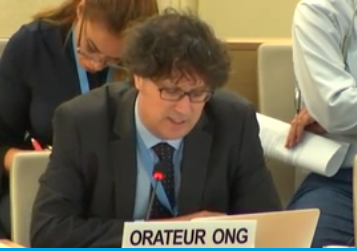
The ICJ today highlighted the need for a Commission of Inquiry or similar accountability mechanism for Libya, at the UN Human Rights Council in Geneva.
The call came in an oral statement, delivered during an interactive dialogue on Libya. It read as follows:
“The International Commission of Jurists (ICJ) welcomes the oral update by the High Commissioner for Human Rights on the situation in Libya.
Violations and abuses under international human rights, humanitarian and refugee law are being committed by State and non-State actors on a widespread and systematic scale in Libya, including since the resurgence of conflict in April. As noted by the High Commissioner on 9 September 2019, the human rights and potentially lives of migrants “intercepted by the Libyan Coast Guard and forcibly returned to Libya … are [also] under serious threat.”
Despite the scale of violations and abuses, only a handful of criminal investigations and prosecutions have been undertaken, resulting in near-total impunity.
A recent ICJ report on the criminal justice system in Libya found that the domestic legal framework governing investigations and prosecutions does not meet international law and standards on the right to a fair trial, the right to liberty and the prohibition on torture and other ill-treatment. As a result, any domestic investigation or prosecution is unlikely to satisfy the requirements of fair and effective justice. Moreover, most crimes under international law, including war crimes and crimes against humanity, are not penalized in domestic law.
These findings undercut the presumption relied upon by States in their engagement with Libya that the Libyan authorities can ensure accountability for crimes under international law.
To fill the accountability gap, the ICJ urges the Human Rights Council to establish a Commission of Inquiry or similar mechanism to document and report on gross human rights violations and to collect and preserve evidence of crimes for future criminal proceedings.
States should also refrain from entering into or implementing agreements with Libyan authorities that could give rise to support for or complicity in violations of international law.”
Sep 23, 2019 | Advocacy, Non-legal submissions
The ICJ today drew the attention of the UN Human Rights Council in Geneva, to the Bangkok General Guidance for Judges on Applying a Gender Perspective, in the context of a discussion of “Gender-responsive initiatives to accelerate gender equality”.
The oral statement read as follows:
“International Commission of Jurists (ICJ) welcomes this opportunity to share information on our ongoing work with women judges in many parts of the world, supporting them and their male colleagues to better ensure women’s access to justice and gender equality.
As part of these efforts, facilitated by the ICJ and UN Women, in 2016 judges from the Philippines, Indonesia, Thailand, and Timor Leste developed and adopted The Bangkok General Guidance for Judges on Applying a Gender Perspective.
Among many other provisions, the Guidance urges States to achieve gender parity in appointments to the bench.
The Guidance provides that: “Gender equality should be a principle that guides judicial appointments. Women and men must be equally represented on the bench as they bring a diversity of perspectives, approaches and life experiences to adjudication, which influence the interpretation and application of laws.”
It further recommends that “[i]f necessary, temporary affirmative measures – like quotas which should be consistent with requirements of integrity and high competency – should be implemented in order to assure that women are adequately represented in the judiciary” and that “[e]valuation panels for the appointment and promotion of judges should be composed of men and women.”
The Guidance builds on global standards such as the Universal Declaration of Human Rights’ provisions on equality, non-discrimination, and equal access to public service; article 10 of the UN Basic Principles on the Independence of the Judiciary, on non-discrimination in judicial selection processes; and related articles of the International Covenant on Civil and Political Rights (ICCPR) and Convention on the Elimination of Discrimination against Women (CEDAW).
We hope the Bangkok Guidance will be a useful reference both in considering how to improve gender parity within the Council’s mechanisms, and as a resource for the Council and its mechanisms to cite in their analysis and recommendations to governments and other stakeholders, on improving access to justice for women in Southeast Asia and around the world.”
Sep 19, 2019 | Advocacy, Non-legal submissions
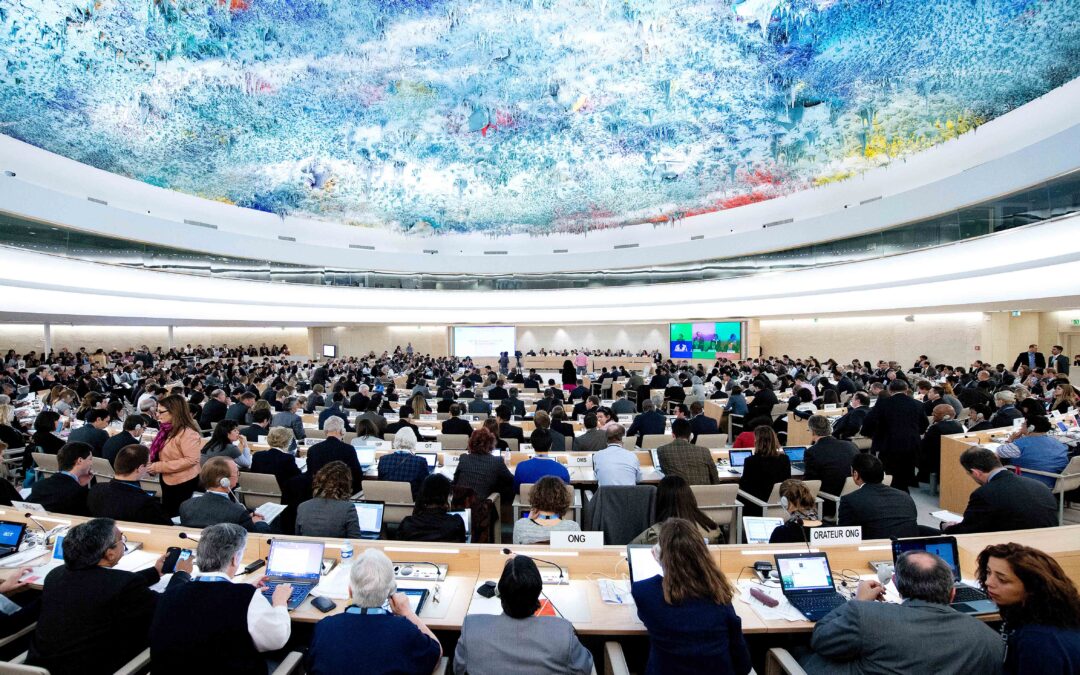
The ICJ today joined other NGOs in an oral statement to the UN Human Rights Council in Geneva, highlighting ongoing challenges faced by independent UN human rights experts, supporting the process the experts have established to make their own work effective, and calling for related issues of funding and non-cooperation of States to be addressed.
The statement was delivered on behalf of the group of NGOs by Amnesty International and read as follows:
“We note the concerns in the Declaration of the Special Procedures’ mandate holders at the Annual Meeting 2019 and share their concern about the global retrenchment against the values and obligations embedded in international human rights law and the challenges they spell out with regard to non-cooperation.
We also express appreciation[1] for the process set in place by the Special Procedures Coordination Committee to discuss ways in which the work can be strengthened including by seeking input from a wide range of stakeholders. This process presents the most appropriate way to ensure the effectiveness of the Special Procedures in protecting and promoting human rights, and to discuss ways to strengthen cooperation and address situations where there may be concerns regarding the actions of individual mandate holders.
We hope that this process will also provide an opportunity to discuss issues of chronic underfunding, non-cooperation of States with the Special Procedures, acts of reprisal and intimidation against human rights defenders and ad hominem attacks against mandate holders and how to make non-cooperation including selective cooperation by states more costly.”
(Partial) list of signatories:
- Amnesty International
- Cairo Institute for Human Rights Studies
- Center for Reproductive Rights
- Child Rights Connect
- CIVICUS: World Alliance for Citizen Participation
- Colombian Commission of Jurists
- Defence for Children International
- Forum for Human Rights and Development (FORUM-ASIA)
- Geneva for Human Rights
- ILGA World
- International Bar Association’s Human Rights Institute
- International Commission of Jurists
- International Movement against All Forms of Discrimination and Racism (IMADR)
- International Service of Human Rights
- Peace Brigades International
- Women’s International League for Peace and Freedom (WILPF)
- World Organisation Against Torture (OMCT)
[1] Civil society statement on efforts to strengthen and increase effectiveness of the United Nations Special Procedures , https://www.amnesty.org/download/Documents/IOR4009672019ENGLISH.pdf
Sep 16, 2019 | Advocacy, News
Antonio Guterres should publicly condemn China’s widespread violations of the rights of its Muslim minority citizens, especially in Xinjiang Province, the ICJ demanded in a joint letter submitted along with Amnesty International, the International Federation for Human Rights (FIDH), Human Rights Watch, and the World Uyghur Congress.
The joint letter urged the UN Secretary-General to call for an end to widespread arbitrary detention of Muslim and minority communities through the immediate closure of Xinjiang’s ‘political education’ camps. Reports by the United Nations and human rights organizations have estimated that more than one million Muslims have been interned in extra-legal ‘political education’ detention camps.
“In the past few years, China’s violations in Xinjiang, including arbitrary detention, ill-treatment, pervasive surveillance and political indoctrination of Turkic Muslims, have intensified, and continue to worsen,” said Sam Zarifi, ICJ’s Secretary General.
“Quiet diplomacy has not worked. Mr. Guterres must exercise the full extent and power of his mandate as leader of the United Nations to demand and ensure protection of the rights of everyone in China, including all individuals in Xinjiang.”
The joint letter urged the UN Secretary-General to publicly support the creation of a UN fact-finding mission to assess the scale and nature of crimes under international law and human rights violations in Xinjiang. It further called on the UN Secretary-General to refrain from unqualified praise of China’s ‘Belt and Road’ Initiative – an investment initiative in which Xinjiang is a centerpiece – and to meet with representatives from the Uyghur community to hear first-hand of their plight.
“China has exerted immense and often inappropriate political pressure on individuals, governments and organizations criticizing its human rights violations,” said Zarifi. “The United Nations must push back against China’s political pressure and provide principled and steadfast leadership to end China’s political and cultural repression, and ongoing human rights violations in Xinjiang.”
Public criticism of China’s actions in Xinjiang has been growing. In August 2018, a member of the UN Committee on the Elimination of Racial Discrimination noted that China’s treatment of its Muslim minority citizens in Xinjiang had turned the region into a “‘no rights’ zone” with individuals being treated as “enemies of the State based on nothing more than their ethno-religious identity”. In March 2019, the UN High Commissioner for Human Rights, Michelle Bachelet, highlighted the need for her office to gain full access to facilitate independent and impartial investigation into ‘wide patterns of enforced disappearances and arbitrary detentions’ in the region. On 10 July 2019, 25 countries issued a joint statement calling on China to refrain from subjecting Uyghurs and other Muslim and minority communities in Xinjiang to arbitrary detention, surveillance and restrictions on freedom of movement.
Sep 7, 2019
An open letter to the UN Secretary General signed by 16 international NGOs regarding the recent report by Gert Rosenthal, “A Brief and Independent Inquiry into the Involvement of the United Nations in Myanmar from 2010 to 2018.”
The Rosenthal report describes the UN’s failure to stop, mitigate, or even draw attention to violence that the UN Independent International Fact-Finding Mission found amounted to crimes under international law including crimes against humanity, and warrants an investigation of the crime of genocide against Rohingya.
Download the letter here: Myanmar-Letter UNSG Rosenthal-Advocacy-open letters-2019-ENG.pdf