Sep 30, 2019 | Advocacy, Non-legal submissions
The ICJ has made a submission to the UN Human Rights Committee in advance of its forthcoming examination of Pakistan’s follow-up report under International Covenant on Civil and Political Rights (ICCPR).
In its submission, the ICJ has brought to the Committee’s attention concerns in relation to the following issues:
- Shortcomings in the legal framework relevant to enforced disappearances;
- The continuing practice of enforced disappearances and, in this context, the ongoing impunity of law enforcement and security agencies;
- The promulgation of the Actions (in aid of civil power) Ordinance, 2019; and
- The ineffectiveness of the Commission of Inquiry on Enforced Disappearances.
The Human Rights Committee will examine Pakistan’s follow-up report during its 127th session, which will be held in Geneva from 14 October to 9 November 2019.
The UN Human Rights Committee issued its Concluding Observations in August 2017, following its review in July 2017 of Pakistan’s first periodic report. Among its many recommendations, for follow-up the Committee prioritized recommendations related to the death penalty; enforced disappearances and extrajudicial killings; and freedom of religion, conscience and belief.
The Committee requested Pakistan to provide information on the implementation on these recommendations within one year of the adoption of the Concluding Observations, which was due on in August 2018.
Pakistan submitted its follow up report to the Committee in May 2019.
Download
Pakistan-UNHCR submission-advocacy-non legal submission-2019-ENG(submission in PDF)
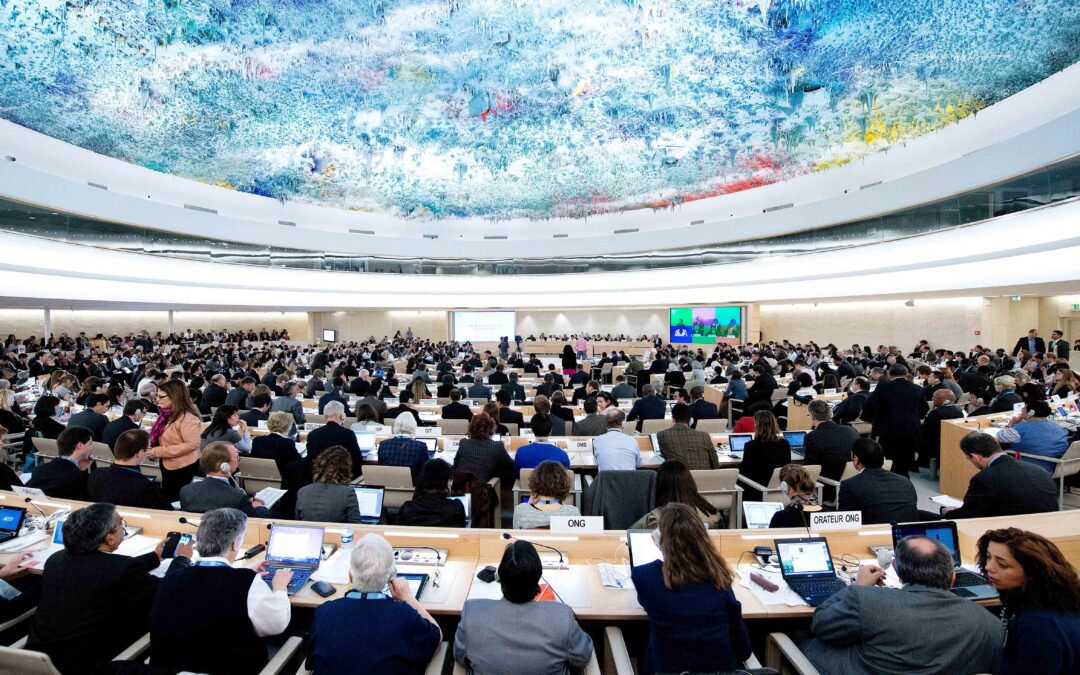
Sep 26, 2019 | Advocacy, Non-legal submissions
The ICJ today highlighted challenges and urged strengthening and support for the Special Jurisdiction for Peace in Colombia, at the UN Human Rights Council in Geneva.
The statement was delivered during a general debate on technical assistance and capacity-building. It read as follows:
“The International Commission of Jurists (ICJ) appreciates the contribution of UN technical assistance and capacity-building to implementation of the Peace Agreement in Colombia.
Full implementation of the Peace Agreement is important to the fulfilment of Colombia’s international human rights obligations, including rights of victims. In particular, the Special Jurisdiction for Peace (JEP by its Spanish acronym) is playing a key role in addressing accountability for gross human rights violations committed during the internal conflict in Colombia.
The JEP faces several challenges.[1] First, the JEP must do more to strengthen effective participation of victims in its procedures. Second, the Special Jurisdiction from the outset should ensure that the sanctions it imposes and reparation measures it orders are sufficient and appropriate to meet international standards. Third, national authorities, including the President and the Parliament, must respect the judicial independence of the Special Jurisdiction.
The ICJ also highlights the need for effective measures to address security threats faced by victims and witnesses appearing before the JEP.
We urge the UN, States and other stakeholders to provide technical assistance and capacity building towards strengthening guarantees for victim’s rights in the JEP’s procedures, and we urge the Human Rights Council to follow closely the work of the Special Jurisdiction for Peace to ensure it makes an effective contribution to fulfilling Colombia’s obligations under international law.”
[1] See also ICJ, Colombia: The Special Jurisdiction for Peace, Analysis One Year and a Half After its Entry into Operation (executive summary in English and full report in Spanish available at: https://www.icj.org/colombia-the-special-jurisdiction-for-peace-one-year-after-icj-analysis/).
Sep 25, 2019 | Advocacy, Non-legal submissions
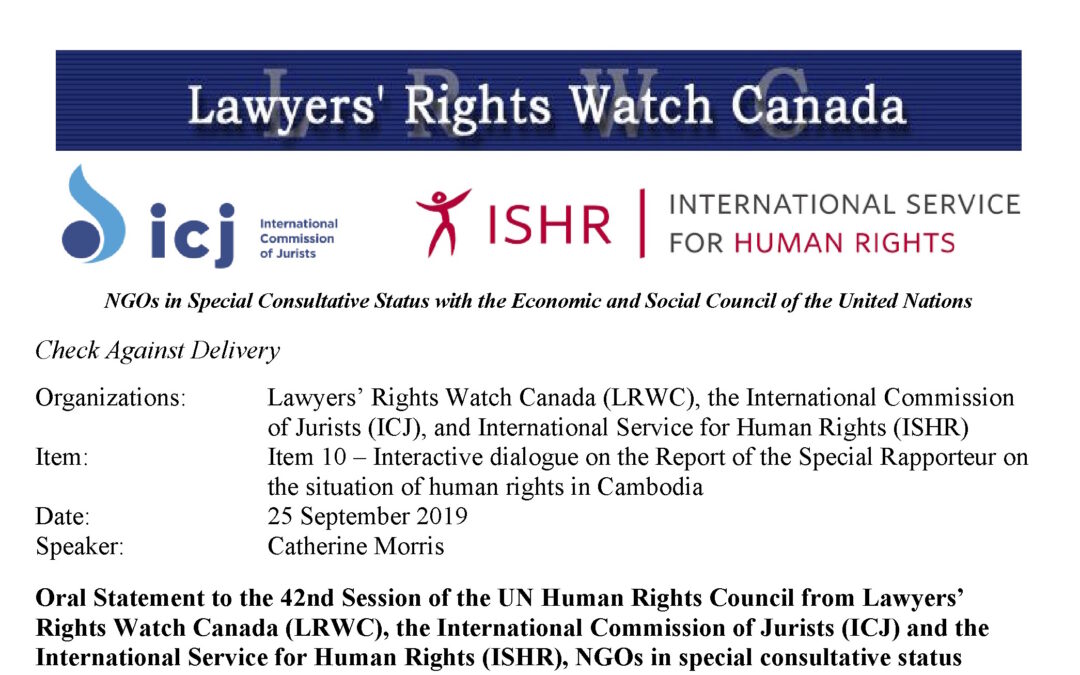
The ICJ today joined other NGOs in drawing the UN Human Rights Council’s attention to the role of the Government of Cambodia in widespread human rights violations and abuses in the country, and called for renewal of the mandate of the UN Special Rapporteur.
The joint NGO statement was delivered by Lawyers’ Rights Watch Canada in a dialogue on the situation in Libya. The statement read as follows:
“Lawyers’ Rights Watch Canada (LRWC), the International Commission of Jurists (ICJ), and the International Service for Human Rights (ISHR) thank the Special Rapporteur for her reports. Implementation of the Sustainable Development Goals, ensuring that no one is “left behind,” necessitates equal access to remedies for rights violations within a trustworthy and independent legal system.
Cambodia has not fulfilled its treaty obligations to establish judicial independence and integrity. Civil society’s rights advocacy is continually resisted. Lawyers, defenders, journalists, politicians, or activists reporting on corruption, election irregularities, labour rights violations, illegitimate land acquisition, environmental degradation, or other rights abuses, often by businesses, are routinely subjected to official vilification; intimidation; interference with rights to expression, association, and assembly; criminalization; arbitrary detention; and even unlawful killings with impunity.
Since 2017, political opposition has been systematically suppressed, including through misuse of the judiciary. Despite the Special Rapporteur’s repeated calls for release of opposition leader Kem Sokha, he remains under court-imposed restrictions tantamount to house arrest. The Special Rapporteur has been denied visits with him contrary to Special Procedures terms of reference for country visits. In May, 25 former opposition members were summoned to court for questioning over two weeks. In September, the government threatened to arrest anyone supporting opposition politician Sam Rainsy’s return to Cambodia.
Cambodia’s responses to Special Procedures’ recommendations for the past twenty-five years have been characterized by disregard, delay, resistance, or hostility. Continued support for the Special Rapporteur’s mandate is critical to ensure that Cambodia fulfils its international human rights obligations. We request that the Council extend the mandate.”
The full written statement, including references, can be downloaded in PDF format here: UN-HRC42-Cambodia-2019
Sep 25, 2019 | Advocacy, Non-legal submissions
The ICJ today highlighted the need for a Commission of Inquiry or similar accountability mechanism for Libya, at the UN Human Rights Council in Geneva.
The call came in an oral statement, delivered during an interactive dialogue on Libya. It read as follows:
“The International Commission of Jurists (ICJ) welcomes the oral update by the High Commissioner for Human Rights on the situation in Libya.
Violations and abuses under international human rights, humanitarian and refugee law are being committed by State and non-State actors on a widespread and systematic scale in Libya, including since the resurgence of conflict in April. As noted by the High Commissioner on 9 September 2019, the human rights and potentially lives of migrants “intercepted by the Libyan Coast Guard and forcibly returned to Libya … are [also] under serious threat.”
Despite the scale of violations and abuses, only a handful of criminal investigations and prosecutions have been undertaken, resulting in near-total impunity.
A recent ICJ report on the criminal justice system in Libya found that the domestic legal framework governing investigations and prosecutions does not meet international law and standards on the right to a fair trial, the right to liberty and the prohibition on torture and other ill-treatment. As a result, any domestic investigation or prosecution is unlikely to satisfy the requirements of fair and effective justice. Moreover, most crimes under international law, including war crimes and crimes against humanity, are not penalized in domestic law.
These findings undercut the presumption relied upon by States in their engagement with Libya that the Libyan authorities can ensure accountability for crimes under international law.
To fill the accountability gap, the ICJ urges the Human Rights Council to establish a Commission of Inquiry or similar mechanism to document and report on gross human rights violations and to collect and preserve evidence of crimes for future criminal proceedings.
States should also refrain from entering into or implementing agreements with Libyan authorities that could give rise to support for or complicity in violations of international law.”
Sep 23, 2019 | Advocacy, Non-legal submissions
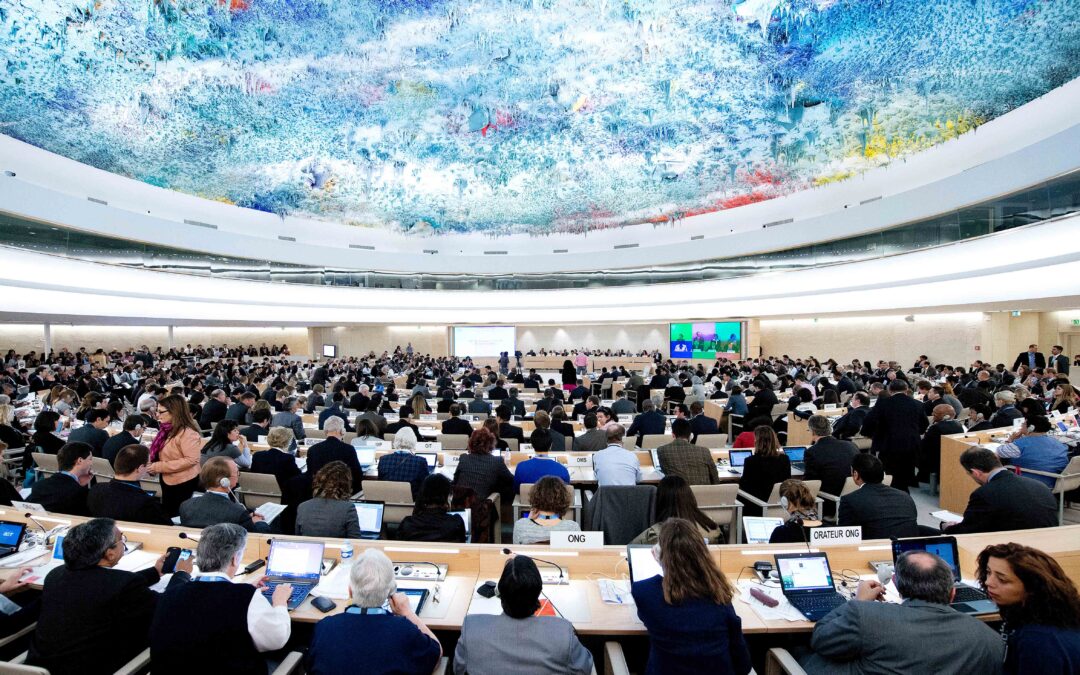
The ICJ today drew the attention of the UN Human Rights Council in Geneva, to the Bangkok General Guidance for Judges on Applying a Gender Perspective, in the context of a discussion of “Gender-responsive initiatives to accelerate gender equality”.
The oral statement read as follows:
“International Commission of Jurists (ICJ) welcomes this opportunity to share information on our ongoing work with women judges in many parts of the world, supporting them and their male colleagues to better ensure women’s access to justice and gender equality.
As part of these efforts, facilitated by the ICJ and UN Women, in 2016 judges from the Philippines, Indonesia, Thailand, and Timor Leste developed and adopted The Bangkok General Guidance for Judges on Applying a Gender Perspective.
Among many other provisions, the Guidance urges States to achieve gender parity in appointments to the bench.
The Guidance provides that: “Gender equality should be a principle that guides judicial appointments. Women and men must be equally represented on the bench as they bring a diversity of perspectives, approaches and life experiences to adjudication, which influence the interpretation and application of laws.”
It further recommends that “[i]f necessary, temporary affirmative measures – like quotas which should be consistent with requirements of integrity and high competency – should be implemented in order to assure that women are adequately represented in the judiciary” and that “[e]valuation panels for the appointment and promotion of judges should be composed of men and women.”
The Guidance builds on global standards such as the Universal Declaration of Human Rights’ provisions on equality, non-discrimination, and equal access to public service; article 10 of the UN Basic Principles on the Independence of the Judiciary, on non-discrimination in judicial selection processes; and related articles of the International Covenant on Civil and Political Rights (ICCPR) and Convention on the Elimination of Discrimination against Women (CEDAW).
We hope the Bangkok Guidance will be a useful reference both in considering how to improve gender parity within the Council’s mechanisms, and as a resource for the Council and its mechanisms to cite in their analysis and recommendations to governments and other stakeholders, on improving access to justice for women in Southeast Asia and around the world.”