Sep 30, 2015 | Advocacy, Non-legal submissions
The ICJ today delivered an oral statement to the UN Human Rights Council, commenting on the landmark UN investigation and report on violations of human rights and humanitarian law in Sri Lanka.
The statement also welcomes recommendations for integration of international judges, prosecutors, lawyers and investigators into any accountability mechanism:
“The International Commission of Jurists (ICJ) welcomes the OHCHR Report on Promoting Reconciliation, Accountability and Human Rights in Sri Lanka (UN Doc A/HRC/30/61), which sets out the principal findings of the Report of the OHCHR Investigation on Sri Lanka (OISL Report, UN Doc A/HRC/30/CRP.2) documenting alleged serious violations and abuses of human rights and related crimes during the armed conflict in Sri Lanka. The ICJ commends the investigation team for its historic contribution towards reconciliation and the realization of victims’ rights in Sri Lanka.
The ICJ works with judiciaries, governments, civil society and victims around the world to address impunity and victims’ right to remedy for violations of international human rights and humanitarian law, including in situations of transition.
For over thirty years, the ICJ has documented and reported on a gradual erosion of judicial independence, impartiality and integrity under successive governments in Sri Lanka, and the resulting culture of impunity, including in the judiciary.[1]
The ICJ considers the International Criminal Court (ICC) to be the preferred mechanism for individual accountability where national authorities and courts lack the capacity or the willingness to genuinely investigate and prosecute all war crimes and crimes against humanity. In the absence of an ICC process, the ICJ’s extensive experience demonstrates that any credible and effective accountability process in Sri Lanka must involve, at a minimum, a majority of international judges, prosecutors and investigators.
The ICJ therefore welcomes the High Commissioner’s recommendation for a hybrid court and prosecutor’s office that fully integrates international judges, prosecutors, lawyers and investigators.
Also essential are the OHCHR recommendations on: mandate and resources of these mechanisms; legislating retroactive recognition of international crimes under national law; justice and security sector reform; repealing the Prevention of Terrorism Act (PTA); strengthening the Witness and Victim Protection Act; accession to the International Convention on the Protection of All Persons from Enforced Disappearances (CED), the Additional Protocols to the Geneva Convention, and the Rome Statute of the International Criminal Court; and continued monitoring of implementation through an OHCHR country office and the Council.
The ICJ welcomes that the tabled draft resolution explicitly recognises the need for international judges, prosecutors, lawyers and investigators. We call on the Council to adopt the resolution with, and call on the Government of Sri Lanka to urgently implement, these and other key elements of the recommendations of the High Commissioner’s Report in full.
[1] See, e.g., ICJ, Authority Without Accountability: The Crisis of Impunity in Sri Lanka (2012)
The statement can be downloaded in PDF format here: Sri Lanka-ICJ Oral Statement HRC-Advocacy-Non Legal submission-2015-ENG
Sep 26, 2015
The ICJ submitted a briefing to the UN Human Rights Committee in advance of the Committee’s examination of Greece’s compliance with its obligations under the International Covenant on Civil and Political Rights (ICCPR).
In its submission the ICJ expressed concern and made recommendations about the following issues:
i. the Greek asylum system’s failure to comply in practice with the
non-refoulement obligations and the right to an effective remedy (article 2.3, read in conjunction with articles 6, 7, 9 and 14 ICCPR, in particular);
ii. the immigration detention of refugees, asylum seekers and other migrants and the conditions of their detention (article 7, 9 and 10 ICCPR);
iii. the treatment and immigration detention of unaccompanied children (articles 7, 9 and 24 ICCPR); and
iv. the reception and living conditions of asylum seekers amounting to
destitution (article 7 ICCPR).
Contact:
Massimo Frigo, Europe Programme Legal Adviser, email: massimo.frigo(a)icj.org
Greece-Europe-HRC Briefing-Advocacy-non-legal submissions-2015-ENG (full text in PDF)
Sep 21, 2015 | Advocacy, Non-legal submissions
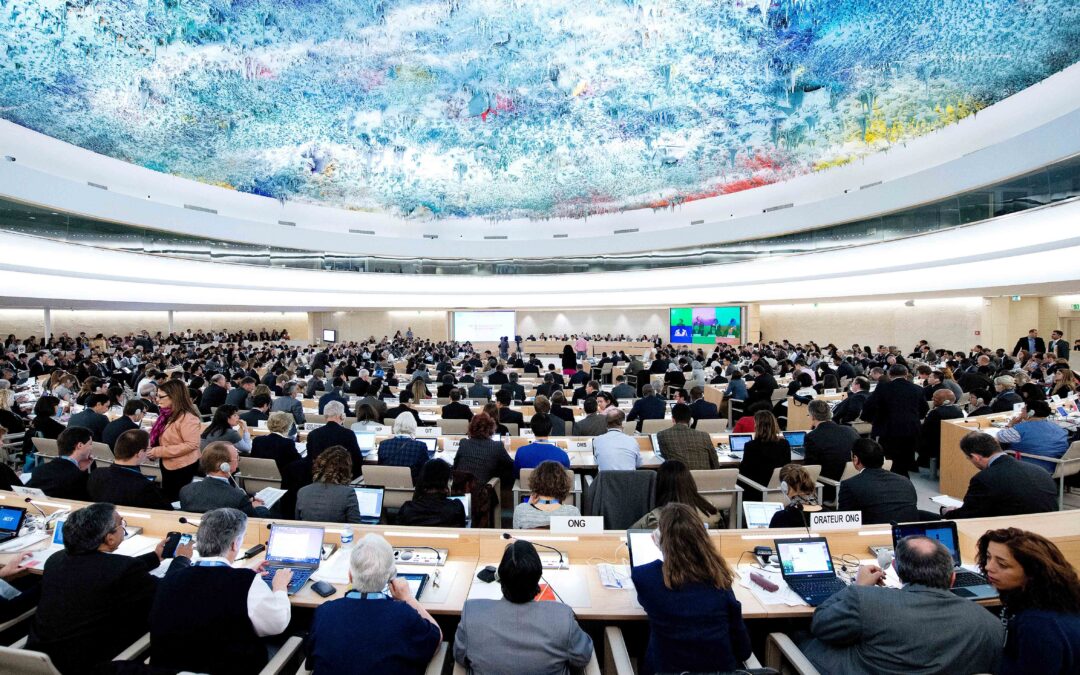
The ICJ today delivered an oral statement at the UN Human Rights Council during the Interactive Dialogue with the Commission of Inquiry on the Syrian Arab Republic concerning accountability and other measures to address the Syrian conflict.
In the statement the ICJ called upon the UN Human Rights Council and the Security Council to respond to the findings of the 10th report of the Syria Commission of Inquiry, including with a view to ensuring accountability for the serious violations of international law.
The ICJ also called upon all states to comply with their obligations under international law vis-à-vis the Syrian conflict, including by searching for all those responsible for international crimes committed in this conflict and bringing them before their own courts, and by protecting the rights of Syrian refugees and abiding by the principle of non-refoulement.
The full statement may be downloaded in PDF format, here: Syria-UN-HRC30-OralStatement-Advocay-non legal submission-2015-ENG

Sep 21, 2015 | Advocacy, Non-legal submissions
Today, the ICJ and Thai Lawyers for Human Rights (TLHR) made a joint submission to the Human Rights Council’s Working Group on the Universal Periodic Review in advance of the Human Rights Council’s review of Thailand in April/May 2016.
In their submission, the ICJ and TLHR expressed concern about the following issues:
(1) the impact of the new legal and institutional framework, imposed since the May 2014 coup d’état, on human rights in Thailand;
(2) instances of suspected enforced disappearance and torture; and
(3) issues concerning international human rights instruments and mechanisms.
A copy of the submission can be found here:
THAILAND-UPR SUBMISSION FINAL AS LODGED-Advocacy-Non legal submission-2015-ENG (full text in PDF)
Jul 2, 2015
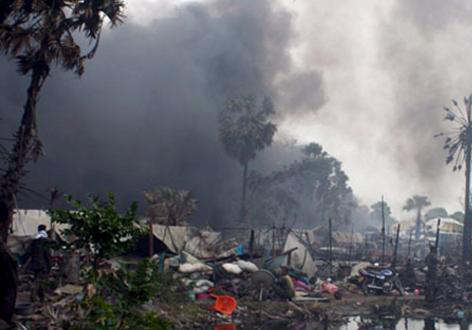
The ICJ today joined other organisations in urging Sri Lanka and the international community to measure progress against three key tests before September 2015, to assess the Government’s willingness towards establishing a credible and transparent justice and accountability process.
First, the Government should ensure that any mechanism created to address wartime abuses is defined through genuine consultations with those affected by violations; one that has their confidence and not one imposed on them from the above. To this end the government should be guided by the advice of UN experts that victims be consulted and involved, and it should announce and implement a convincing framework for such a credible process, within a clear timeframe. Given the track record of past domestic inquiries, any mechanism needs to be international, or at a minimum one with a majority of international judges and prosecutors, in order to guarantee its independence and give greater security to those who participate in it.
Second, the Government should take immediate steps towards resolving key outstanding issues to demonstrate its commitment. This includes: repealing the PTA; a substantial scaling down of military presence in the North and East and ending all undue military interference in the political, social, economic and cultural lives of the population of the region; resolving all conflict induced land issues; ending all forms of harassment of civil society, media and human rights defenders particularly in the North and East; and restoring fundamental freedoms fully and equally in all parts of the country. The government must also act to resolve all disappearances in the country, and to this end the President must make the report of the Presidential Commission on Disappearances public when it is finalised in August.
Third, the government must keep its promise to the UN and fully cooperate with the Office of the High Commissioner for Human Rights and allow it full access to any new or additional information it may require. It was on the basis of the promise of such cooperation and additional information, that extra time was provided to the new government in Sri Lanka through a deferral of the OHCHR report.
Until these three tests are satisfactorily met, the international community and the UN Human Rights Council must maintain the fullest scrutiny of Sri Lanka on questions of justice and accountability. Although it is to be acknowledged that since January Sri Lanka’s government has induced some positive change in easing the abusive human rights climate of the previous Presidency, it must also be recognised that many challenges still remain unaddressed.
The full letter is available here: SriLanka-JointOpenLetter-Accountability-Advocacy-2015