Apr 14, 2015
Today the ICJ published a briefing paper addressing harmful gender stereotypes and assumptions in law and practice and highlighting efforts in a number of countries to reform such law and practice.
The briefing paper is intended to assist legal practitioners and human rights defenders working to ensure effective criminal justice response to sexual violence against women.
“Around the world harmful stereotypes have the effect of denying many victims of sexual violence effective access to justice and redress for violations. This briefing paper demonstrates the onerous and unfair burdens placed upon victims arising from their gender when they seek to access justice,” said Ian Seiderman, ICJ Legal and Policy Director.
The paper highlights the importance of upholding a suspect’s right to a fair trial, including the presumption of evidence and rights to examine witnesses and challenge evidence while at the same time ensuring victims and witnesses also maintain equality before the law.
The publication addresses common assumptions that women are inherently untruthful; that credibility is premised on chastity; that women will fight back and therefore should demonstrate evidence of physical force or a struggle; that women’s passive sexuality opens up room for debate in defining consent; that women should obey their husbands; and that sexual violence is a matter of dishonor to the victims and their families.
In identifying these underlying harmful gender stereotypes and assumptions the paper also identifies a number of reform measures and examples of good legislative practice that can help states to enhance protection against sexual violence of women in accordance with their international obligations.
Download the report here:
Universal-GenderStereotypes-Publications-Thematic report-2015-ENG (full text in PDF)
Apr 10, 2015
Today, the ICJ submitted a briefing to the Committee on the Rights of the Child in view of the Committee’s preparation of a List of Issues for the examination of Brunei Darussalam’s Second and Third Periodic Reports under the Convention on the Rights of the Child.
In its submission, the ICJ draws the attention of the Committee to concerns related to:
i.) the minimum age of criminal responsibility;
ii.) minimum age for marriage and/or forced marriage;
iii.) whipping as a judicially imposed punishment on children; and
iv.) undue limitations on the right to freedom of religion.
The ICJ’s submission concludes with a list of recommended questions for inclusion in the List of Issues for the examination of Brunei Darussalam.
Brunei-UNC right of the Child-Advocacy-legal submission-2015-ENG (full text in PDF)
Oct 15, 2014 | News
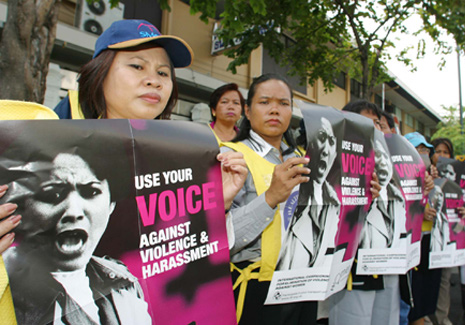
Judges and representatives from judicial institutes from across Southeast Asia are attending a regional workshop to discuss how they can help counter gender-based violence and gender stereotypes.
The workshop, organized by the UN Women Regional Office for Asia and the Pacific, in collaboration with the Office of the Thai Judiciary and the ICJ is held in Bangkok on 15 and 16 October 2014.
This Regional Workshop for Judicial Training Institutions on Good Practices in Promoting Women’s Human Rights Compliant Justice Delivery will focus on using the CEDAW Convention and on eradicating gender stereotypes, especially in cases related to violence against women.
It also aims to improve the progress of the implementation of the CEDAW Convention and strengthen the regional network of judicial training institutions in eight Southeast Asian countries, namely Cambodia, Indonesia, Lao PDR, Myanmar, the Philippines, Thailand, Timor-Leste and Vietnam.
Speakers at the opening session include Hon. Justice Pattarasak Vannasaeng, Secretary-General of the Office of the Thai Judiciary; H.E. Mr. Philip Calvert, Ambassador of Canada for Thailand; Ms. Roberta Clarke, Regional Director of the UN Women Regional Office for Asia and the Pacific; and Sam Zarifi, ICJ’s Regional Director for Asia and the Pacific.
Thailand-Women Judicial training-News-web story-2014-ENG (full text in PDF)
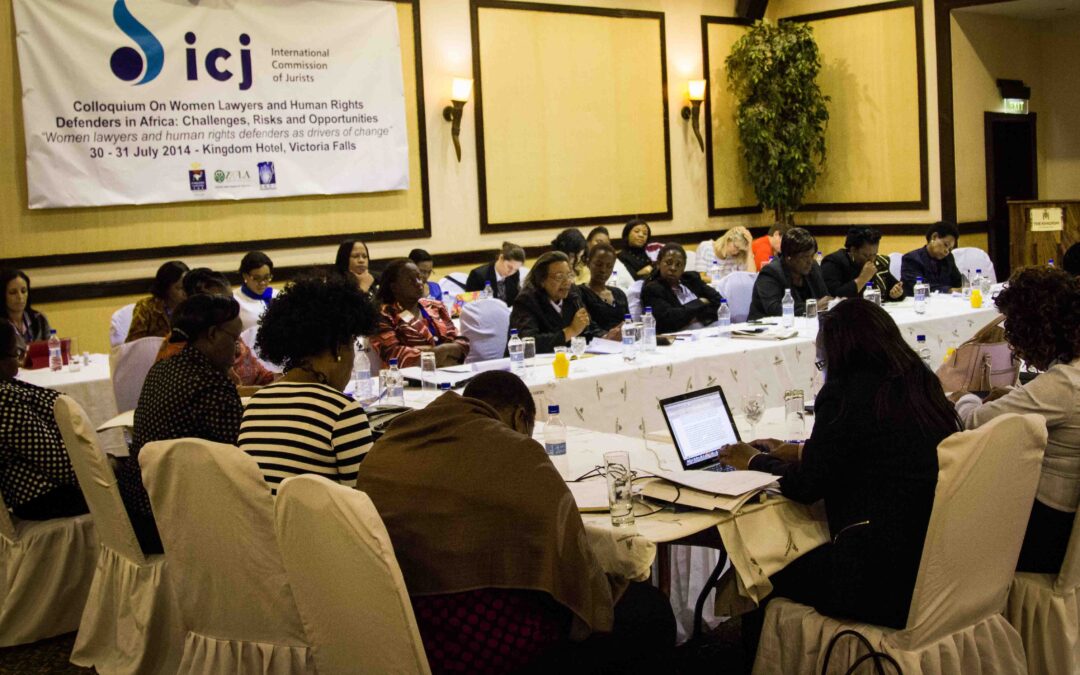
Aug 2, 2014 | Multimedia items, News, Video clips
Women judges, lawyers and human rights defenders from across Africa participated in ICJ Colloquia on “Women Lawyers and Human Rights Defenders: Challenges and Opportunities” on 30 and 31 July in Victoria Falls, Zimbabwe.
The colloquia were hosted in collaboration and partnership with the Gender Committee of the SADC Lawyers Association, the Zimbabwe Women Lawyers Association and Zimbabwe Lawyers for Human Rights.
It enabled over 40 women lawyers, human rights defenders and judges to come together to identify the challenges faced by women lawyers and human rights defenders and elaborate action steps.
Discussions also addressed the role of the judiciary in advancing gender equality, women’s access to justice and protection of women human rights defenders.
The Colloquia are part of an ICJ multi-year initiative on women judges, lawyers and human rights defenders as agents of change.
Interviews:
Justice Martha Koome (Kenya)
Justice Lillian Tibatemwa-Ekirikubinza (Uganda)
Doo Aphane (Swaziland)
Jane Serwanga (Kenya)
May 21, 2014
The ICJ has released a briefing paper entitled ‘International Human Rights Law and Gender Equality and Non-Discrimination Legislation. Requirements and Good Practices.’
Ensuring women’s enjoyment of their human rights on a basis of equality and without discrimination is a fundamental tenet of international law and is enshrined in a range of international human rights treaty provisions. In order to give effect to this obligation, States must enact legislative guarantees of gender equality and prohibitions of discrimination that are effective and fit for purpose.
This short briefing paper provides an overview of the basic components that international treaty monitoring bodies have repeatedly held must be encompassed within national legal provisions in order to meet the requirements of international law and standards.
GenderEquality&NonDiscriminationLegislation-BriefingPaper-Legal-2014 (download briefing paper in PDF)