Sep 3, 2018 | Communiqués de presse, Nouvelles
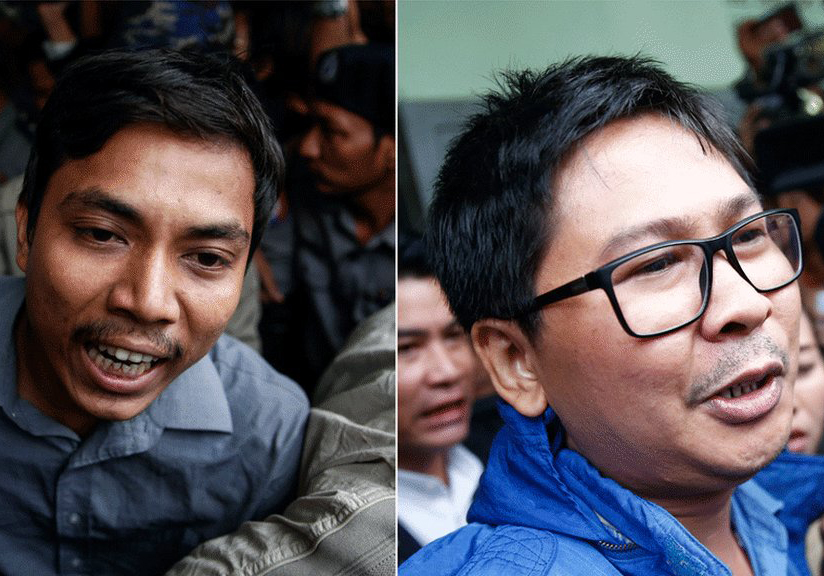
La décision du Tribunal de District de Yangon de condamner aujourd’hui les journalistes de Reuters, Wa Lone et Kyaw Soe Oo, à sept ans d’emprisonnement pour violation de la loi sur les secrets officiels porte gravement atteinte aux droits de l’Homme et à l’état de droit au Myanmar.
“La décision de la Cour punit dans les faits ces deux journalistes courageux pour avoir dénoncé des violations des droits de l’Homme, à la suite d’un procès manifestement inéquitable”, a déclaré Frederick Rawski, directeur de la CIJ pour l’Asie-Pacifique.
“La décision est une erreur judiciaire qui leur inflige des souffrances inutiles ainsi qu’à leurs familles, menace la liberté d’expression, porte atteinte à la réputation mondiale du Myanmar et sape ses institutions judiciaires en même temps”, a-t-il ajouté.
La CIJ a suivi l’affaire depuis la détention initiale des journalistes en décembre 2017.
Comme indiqué précédemment par la CIJ, la détention et le procès ont violé de nombreuses garanties fondamentales relatives à l’équité des procès.
Les procureurs avaient le devoir d’abandonner les accusations et le juge aurait dû rejeter l’affaire en raison de l’absence de preuves et de l’illégalité de la détention en raison de violations du droit à un procès équitable.
“L’affaire est emblématique de la manière dont le système judiciaire finit par renforcer l’impunité des militaires plutôt que de la remettre en cause”, a déclaré M. Rawski.
“Le résultat sape les affirmations du gouvernement selon lesquelles il peut rendre des comptes par lui-même sur les violations des droits de l’Homme, et ne fait rien pour que le système judiciaire agisse de manière indépendante et impartiale après des décennies de régime militaire”.
Les membres des forces de sécurité jouissent généralement de l’impunité pour la perpétration de violations des droits de l’Homme, notamment pour des crimes en droit international.
La CIJ a déjà rapporté que les victimes et leurs familles, ainsi que les journalistes, font souvent l’objet de représailles pour avoir diffusé des informations sur les violations des droits de l’Homme commises par l’armée.
Wa Lone et Kyaw Soe Oo ont été arrêtés en décembre 2017 et détenus au secret pendant près de deux semaines avant d’être accusés, en vertu de la loi sur les secrets officiels datant de l’époque coloniale, pour avoir prétendument été en possession de documents liés aux opérations des forces de sécurité dans le nord de l’État de Rakhine, lors “d’opérations de nettoyage”.
Les deux reporters avaient dénoncé des violations des droits de l’Homme dans l’État de Rakhine, notamment l’assassinat de Rohingyas par l’armée dans le village d’Inn Dinn.
Dans un rapport publié la semaine dernière (uniquement disponible en anglais), la mission d’enquête internationale indépendante des Nations Unies a constaté que les forces de sécurité avaient commis des crimes en droit international au cours de ces opérations, notamment des crimes contre l’humanité et peut-être un crime de génocide.
La détention et la mise en accusation de quiconque, y compris de journalistes, se basant uniquement sur la collecte et la publication de preuves pertinentes en matière de violations graves des droits de l’Homme constituent une violation du droit international et des normes relatives à la liberté d’expression, au droit de participer à la conduite des affaires publiques et au rôle des défenseurs des droits de l’Homme.
Les options légales disponibles pour les journalistes incluent de requérir à la décision d’aujourd’hui et demander une grâce présidentielle.

Sep 3, 2018 | News
The ICJ held a workshop on reforming Myanmar’s 1982 citizenship law in Yangon from 1 to 2 September 2018.
The workshop convened a group of international and national legal experts, human rights defenders, political scientist, academics and researchers to jointly consider the way forward to identify creative legal and non-legal advocacy approaches for reforming Myanmar’s 1982 Citizenship Law.
The ICJ, UN organs and civil society organizations, through research and legal analysis, have consistently found this law to be discriminatory both in its content and application.
Unlike many other laws promulgated during the military junta era of General Ne Win, this law remains in force. Its tiered hierarchy of citizenship has effectively rendered many individuals as second- or third-class citizens, or in some instances stateless.
In August 2017, the government’s own Advisory Commission on Rakhine State, chaired by the late Kofi Annan, recommended a review of the Citizenship Law. The recommendation was accepted by the Government of Myanmar in principle, but in practice this commitment has not been followed up by any implementing measures.
The workshop’s participants included academics, researchers, human rights defenders, political scientist, legal and non-legal experts of different ethnic and religious backgrounds from a range of organizations from the U.K, Spain, Australia, Kachin, Chin, Mandalay, Rakhine, and Yangon.
The ICJ’s legal adviser, Sean Bain, introduced the workshop by noting that legal recognition of nationality is central to the enjoyment of many human rights.
Noting that protecting the right to nationality is an essential part of the rule of law in any democratic society, he highlighted that too often it is members of minority groups who experience a violation of their human rights due to discriminatory laws and their application with regards to citizenship.
The ICJ’s legal researcher Dr. Ja Seng Ing presented the overview and assessment of the Citizenship Law, including problematic provisions and key institutional actors with authority in Myanmar.
Amal de Chickera, a Sri Lankan Human Rights lawyer and Co-Director of Institute on Statelessness and Inclusion, delivered an introduction on the International law and comparative studies and the approaches and strategies for law reform from international perspectives.
José María Arraiza, Information, Counselling and Legal Assistance Specialist, Norwegian Refugee Council, spoke about a number of approaches and strategies for legal reform, including imperative role of collective identities, inclusive dialogue and evidence based advocacy strategies with comparative international experiences.
Michelle Yesudas, a Malaysian Human Rights lawyer, shared good practices and lesson learned from application of strategic litigation in citizenship related cases in Malaysian context to raise the awareness of the public and also discussed potential strategies for pushing the legislative reform and enforcement of the law in Myanmar.
The ICJ’s legal adviser Daw Hnin Win Aung, facilitated a panel discussion where the Senior legal scholars and researchers from Myanmar also provided their perspectives, based on their own independent research and writing on the legal and non-legal opportunities and challenges for law reform in Myanmar.
Advocate lawyer, Daw Zar Li Aye highlighted the legal consequences of mixed-nationality marriage in Myanmar, for instance, the authorities used physical appearance of the children as a determining factor when considering provision of citizenship / documentation in practice.
The participants considered a wide range of issues relating to statelessness and citizenship in Myanmar with comparative case studies, including the varying approaches for law reform across the region to improve understanding of the advocacy target groups on the issue and potentially inform public policy.
The participants also recognized the importance of multidisciplinary approaches, including strategic litigation in citizenship related cases, for developing advocacy strategies for law reform and to increase knowledge and understanding of the general public on the issue.
This event is part of the ICJ’s ongoing efforts to convene civil society actors including lawyers to discuss critical human rights issues in Myanmar with a view to advancing the protection of human rights in the country.

Sep 3, 2018
Today, the ICJ called on the President of the Council of Ministers, Giuseppe Conte, to remove the legal obstacles that for over a decade have frustrated justice in the case of Abu Omar, a victim of gross human rights violations during the so-called war on terror launched by the US in the 2000s.
Specifically, the organization said that the doctrine of “secret of state” , which shields from public and judicial disclosure information purported to affect national security interests, should be lifted in any case pertaining to the rendition of Abu Omar.
In a letter to President Conte, the President of the ICJ, Robert K. Goldman, recalls that Italy has been condemned by the European Court of Human Rights for its complicity in the unlawful rendition and enforced disappearance of Abu Omar and that Italy has a duty under international law to do all that is possible to unveil the truth to the victims and the general public about such crimes under international law.
“The Italian public has a right to know the truth about a gross violation of human rights that occurred in its country and about the role its own secret services and institutions played in it”, said Massimo Frigo, Senior Legal Advisor for the ICJ’s Europe Program.
“President Conte should lift state secrecy on this case right away, to demonstrate that he holds true to Italy’s obligations under international law and transparency and accountability of Government before its people.”
The ICJ noted that the European Court of Human Rights has determined, in Nasr and Ghali v. Italy, that Italian government violated human rights, including by allowing for effective impunity for such crimes despite the laudable efforts of the Italian judiciary to prosecute and try those responsible,” said Massimo Frigo.
“It is time for Italy to live up to its international obligations and show to the world and its people that gross violations of human rights and crimes under international law will not be tolerated and that accountability must be upheld at all times and without hesitation,” he added.
Background
Hassan Mustafa Osama Nasr (also known as Abu Omar) is an Egyptian national who was kidnapped in the streets of Milan in 2003 by CIA operatives, with the collaboration of Italian agents, while he was living in Italy with refugee status.
He was then subjected to torture and other cruel, inhuman or degrading treatment during his travel to Egypt and in Egypt, where he endured several years in arbitrary detention.
The rendition of Abu Omar, that also constituted an enforced disappearance under international law, was investigated and prosecuted by the Public Prosecutor’s Office of Milan and tried in the criminal tribunal, court of appeal of Milan and Court of Cassation.
This has been the only known prosecution and trial anywhere in the world against State agents alleged to be responsible for human rights violations in the context of the US-led rendition and secret detention system.
While 23 US agents and three Italian citizens were convicted – though without serving their sentences – the apex of the Italian military secret service (then SISMI) could not be tried because the Government invoked the doctrine of state secrecy in the proceedings.
The European Court of Human Rights found unanimously that that Italy had been complicit in the operation and had breached its obligations to prohibit and investigate torture and inhuman of degrading treatment of punishment (article 3 ECHR); the right to liberty of Abu Omar (article 5 ECHR); the right of his wife, Nabila Ghali, not to be subject to inhuman or degrading treatment caused by the suffering of not knowing the whereabouts of her husband (article 3 ECHR); their right to family life, and their right to an effective remedy for human rights violations (article 13 ECHR).
The judgment is still awaiting full execution by the Italian authorities, although there have been payments to the victims.
Contact:
Massimo Frigo, Senior Legal Advisor for the ICJ’s Europe Program
E-mail: massimo.frigo(a)icj.org
Italy-justice for Abu Omar-advoacy-open letters-2018-eng [Open Letter in English PDF]
Italy-justice for Abu Omar-news-press releases-2018-ita [Press Release in Italian PDF]
Italy-justice for Abu Omar-advocacy-open letters-2018-ita [Open Letter in Italian PDF]
Sep 2, 2018 | News
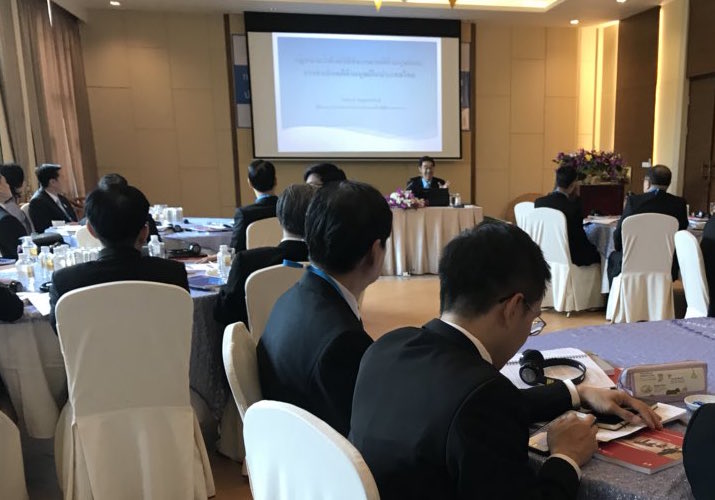
On 1 and 2 September, the ICJ held a “Workshop on the Independence of the Judiciary in the Context of the Inquisitorial Judicial System in Thailand” for members of the Thai judiciary in the north of the country.
Some 31 judges from 21 courts and the Administrative Office of the Court of Justice, Region V, attended the workshop, which was held in Chiang Mai.
The objective of the workshop was to discuss the role of judges and exercise of judicial power within the inquisitorial system, particularly in the context of adjudicating cases of human trafficking.
In an effort to combat human trafficking in Thailand, the Procedures for Human Trafficking Cases Act B.E. 2559 (2016) established inquisitorial system procedures for adjudication of cases of human trafficking.
With an increasing number of cases of human trafficking in Northern Thailand, judges in Northern Thailand are increasingly required to utilize inquisitorial processes in human trafficking cases.
Courts in Thailand generally adjudicate cases based on the adversarial judicial system.
In this context, the ICJ held the workshop in collaboration with the Administrative Office of the Court of Justice, Region V, in the North of Thailand, to share information and expand collaboration between Thai and international judges about inquisitorial processes.
Justice Aree Thecharuwichit, Chief Justice of the Office of the Chief Justice, Region V, Frederick Rawski, Regional Director of ICJ Asia and the Pacific, and Justice Radmila Dragicevic-Dicic, Vice-President of the ICJ, ICJ Commissioner, Acting President of the Belgrade Court of Appeals and Judge of the Supreme Court of Serbia delivered opening statements at the Workshop.
Justice Sittipong Tanyaponprach, Chief Judge of the Office of the Chief Justice, Region I, spoke about existing procedures in Thailand’s justice system to deal with human trafficking cases under the Procedures for Human Trafficking Cases Act 2016.
Justice Marcel Lemonde, Honorary President of Chamber in France’s Court of Appeal and an International Consultant in Judicial Matters, delivered an introduction to the inquisitorial system based on the French judicial system and spoke about existing challenges in inquisitorial processes.
Justice Radmila Dragicevic-Dicic, of the Supreme Court of Serbia and ICJ Vice-President spoke about judicial practice in cases involving human trafficking and shared her experience in adjudicating human trafficking cases in Serbia.
ICJ’s Senior Legal Adviser Kingsley Abbott moderated the workshop and provided an introduction to the ICJ’s resource materials on the independence of the judiciary and judicial accountability, including the ICJ’s Practitioners’ Guide No. 13 on Judicial Accountability.
The ICJ ended the Workshop with a statement reiterating its commitment towards working with Thailand’s judiciary to strengthen the rule of law and administration of justice in Thailand.
This Workshop is the second workshop held by the ICJ for Thailand’s judiciary in the North of Thailand.

Aug 31, 2018 | Advocacy, Non-legal submissions
Today, the ICJ made a submission to the Committee on Economic, Social and Cultural Rights in advance of Committee’s examination of South Africa’s initial periodic report under the International Covenant on Economic, Social and Cultural Rights. South Africa ratified the Covenant in 2015.
When CESCR convenes to consider South Africa’s report on 2-3 October 2018, it will therefore be the first time that the Committee has the opportunity to review a report from South Africa on the implementation of its Covenant obligations.
In its submission, supplementing submissions made by a range of South African civil society organizations, the ICJ drew the Committee’s attention to:
a) South Africa’s incomplete discharge of its obligations in terms of the Covenant;
b) The South African Government’s need for guidance from the Committee on the discharge of its obligations in terms of the right to work;
c) The South African Government’s need for guidance from the Committee on the discharge of its obligations in terms of the right to an adequate standard of living;
d) The South African Government’s failure to report effectively and accurately on its efforts to realize the ESC rights of persons with disabilities;
e) The uncertain status of the South African Government’s commitment to the enactment of legislation to ensure the implementation of the Covenant;
f) The uncertain status of the South African Government’s intention to ratify the Optional Protocol to the Covenant; and
g) The uncertain status of the South African Government’s declaration with regard to the right to education.
The ICJ’s submission invites CESCR to make various specific recommendations to the Government of South Africa in its Concluding Observations on each of these issues. Broadly, the ICJ also invites CESCR to recommend to the Government of South Africa time-bound commitments to processes leading to:
1. The full domestication of Covenant in South African law;
2. A comprehensive review of South Africa’s domestic laws and policies on ESC rights to ensure that they are implemented consistently with South Africa’s obligations in terms of the Covenant; and
2. The ratification of Optional Protocol to the International Covenant on Economic, Social and Cultural Rights.
The ICJ’s submission also supports submissions by civil society organizations and the South African Human Rights Commission inviting CESCR to recommend that South Africa withdraw its declaration relating to its “immediate” obligations in terms of the Covenant right to education.
Finally, the ICJ considers it critical that the South African Government reflect on the ways in which the Covenant to increases, alters and nuances the nature and content of its human rights commitments and obligations in terms of the realization of economic, social and cultural rights.
This the ICJ submits is particularly crucial in regard to rights which are entrenched in the Covenant but not the South African Constitution such as the right to work (Articles 6-8) and the right an adequate standard of living (Article 11).
In undertaking this process, the ICJ submits that due regard should be had the standards set out in the Covenant as interpreted by the Committee in its general comments.
SouthAfrica-ICJSubmissionCESCR-Advocacy-Non-legal submission-2018-ENG (full text, PDF)