Apr 4, 2018 | Comunicados de prensa, Noticias
La CIJ está hondamente preocupada ante la falta de independencia de los miembros de la comisión de postulación para la elección de fiscal general.
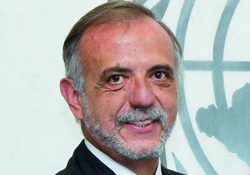
Desde el 27 de agosto de 2017, cuando el Presidente de la República declaró “persona non grata” al Comisionado de la Comisión Internacional contra la Impunidad (CICIG), Iván Velásquez (foto), el Estado de Derecho de Guatemala viene siendo seriamente afectado por diferentes funcionarios al más alto nivel.
En dicha ocasión, la Corte de Constitucionalidad jugó un papel primordial en la defensa del Orden Constitucional y a favor del rescate del Estado de Derecho, al emitir varias resoluciones que lograron detener las acciones ilegítimas, que intentaron implementar al más alto nivel, el Presidente de la República y las y los diputados del Congreso de la República, para consolidar la impunidad.
En este contexto, se ha llevado a cabo la primera fase de la elección de Fiscal General por parte de la Comisión de Postulación. Informes, como el de la organización “Insight Crime”, señalan que los miembros de la Comisión de Postulación para la elección de Fiscal General, en lugar de actuar para cumplir correctamente con su mandato constitucional y coadyuvar para que el Estado de Guatemala logre alcanzar el bien común, lo hacen únicamente para satisfacer intereses de grupos vinculados al poder político, económico o militar.
Este actuar arbitrario socava el Estado de Derecho y provoca que la ciudadanía en general pierda la credibilidad en las instituciones de justicia y en el Estado de Derecho.
La CIJ considera oportuno recordar, en este momento del proceso de elección de Fiscal General, a los miembros de la Comisión de Postulación, que son funcionarios públicos sujetos a la Constitución Política de la República de Guatemala, a los Convenios internacionales de derechos humanos ratificados por el Estado de Guatemala, a las leyes ordinarias y a las decisiones de la Corte de Constitucionalidad en la materia.
La Constitución prescribe que el nombramiento en empleos o cargos públicos sólo se debe hacer sobre “razones fundadas en méritos de capacidad, idoneidad y honradez” (artículo 133).
En ese contexto, la CIJ recuerda el precedente de la elección de Fiscal General en el año 2010, cuando la Corte de Constitucionalidad ordenó repetir y reiniciar todo el proceso. En dicha oportunidad, varios de los comisionados tuvieron que inhibirse y se retiraron del proceso. Cuatro de dichos comisionados, vuelven a integrar hoy la Comisión de Postulación, lo cual introduce más dudas acerca de la legitimidad del proceso.
La CIJ recuerda que, para la realización de investigaciones independientes e imparciales, que garanticen el acceso a la justicia de las víctimas de los delitos y para romper el círculo de la impunidad, es fundamental que la Fiscalía pueda llevar a cabo su labor de modo independiente, autónomo e imparcial.
En ese sentido la Comisión Interamericana de Derechos Humanos y el Relator de las Naciones Unidas para la Independencia de los Magistrados y Abogados, han señalado que la relación de dependencia que puedan tener la Fiscalía respecto de otros órganos – como el Poder Ejecutivo- puede tener un impacto negativo en su actuación independiente e imparcial, socavar la efectividad de las investigaciones y ser un factor de impunidad.
La CIJ considera que el “pacto de impunidad” que está en marcha, pretende cooptar al Ministerio Público y afectar el buen trabajo que realiza el comisionado Iván Velásquez, a favor de la lucha contra la impunidad.
De llegar a ser electo un o una Fiscal General que no reúna los requisitos establecidos en el artículo 113 de la Constitución, el daño a la sociedad guatemalteca en su conjunto, puede llegar a ser de múltiples dimensiones, difíciles de cuantificar y causar “daños irreparables al sistema de justicia”, por su falta de independencia frente a cualquiera de los tres poderes del Estado o por su compromiso de defender los intereses de grupos del poder político, económico, militar o del crimen organizado.
La CIJ esta hondamente preocupada por el hecho de que exista un potencial conflicto de intereses por parte del Presidente de la República en el proceso de seleción y nombramiento del Fiscal General, toda vez que el primer mandatario ha sido sido cuestionado por su posible involucramiento en el Caso Hogar Seguro, en el que resultaron muertas 41 niñas, hechos que deben ser investigados por el Ministerio Público y además, su hijo y hermano están siendo procesados por casos denunciados por el Ministerio Público y vinculados a la lucha contra la corrupción.
Ramón Cadena, Director de la CIJ para Centro América, expresó: “La decisión final de la Comisión de Postulación deberá estar bien fundamentada y de ninguna manera podrán elegir personas que no reunan las condiciones previstas por el artículo 113 de la Constitución, que generen la más mínima duda con respecto a su independencia, honestidad e idoneidad o que resulten ser parte del pacto de impunidad existente.”
Apr 3, 2018
An opinion piece by Belisário dos Santos Júnior, ICJ Commissioner & Member of ICJ’s Executive Committee
The recent Federal military-led intervention in Rio de Janeiro was carried out, according to the executive decree ordering the operation, “to put an end to a serious breach of public order in the State of Rio”.
The Brazilian Constitution authorizes such exceptional political measures, but they must be ordered by the President and ratified by the Congress.
As far as the security situation was concerned, this additional military intervention was not necessary because the (Rio) State police, the National Public Security Forces and the Army had already been working together for many months, planning and executing numerous so-named “operations to guarantee law and order.”
Nor did the military intervention have anything to do with checks and controls of borders, ports, airports and federal highways, to prevent the international traffic of weapons, ammunition and drugs, notably from Paraguay. Other federal police forces are in charge of these controls.
Recently the Chief Commander of the Army himself said in an interview that the intervention in Rio would only bear fruits in the very long term because it was crucial to first implement structural changes, especially in the public security system, the prison system, and the enforcement of penal law.
It has become obvious that corruption and links with organized crime reach to the highest levels of the civil and military police forces in Rio de Janeiro.
Arguably, the main objective of the military intervention was indeed to reform these police forces. But then if that was the case, it should have started with the removal of the present Governor of the State of Rio, Luis Fernando Pezão, who was the right-arm man of the former Governor Sérgio Cabral, convicted and imprisoned for corruption.
It should have also focused on all areas of the State government, and not just the security forces, which do not work in isolation. Moreover, the police reform would need to be accompanied by public policies and investment to provide local communities (in the favelas) with access to water, sanitation, and electricity.
Today, these local communities are hostage to the numerous drug-traffickers, territorial disputes between gangs and shoot-outs between police forces and organized crime.
In the favelas, services, such as the telephone, cable television, electricity supplies, and the sale of gas canisters are all controlled by criminal gangs and public service providers are systematically defrauded.
The military intervention has been used as a theatrical opportunity to parade armoured vehicles in strategic points of the city, with soldiers who are not trained to manage situations of urban violence but for troop action, and therefore not used to individual decision-making.
Furthermore it should be recalled that in 2018 alone, more than 60 policemen were killed by organized crime, which is approximately equivalent to the number of human rights defenders assassinated in Brazil last year, according to Amnesty International.
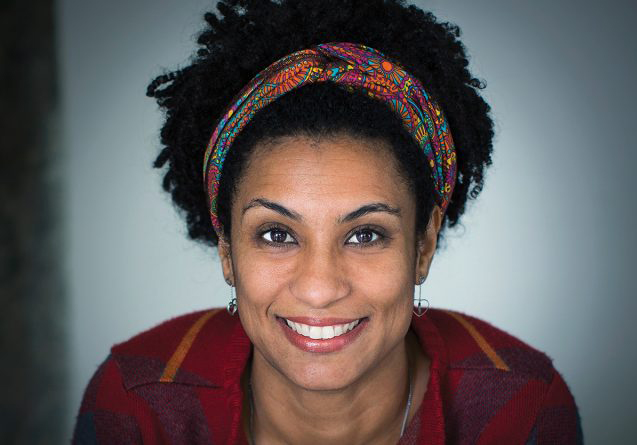
Tragically, the recent execution of Marielle Franco, the city councillor and human rights defender, is not even surprising. She and her driver were killed in the centre of the city, while the military intervention was in full force and all the country’s eyes focused on Rio de Janeiro.
This crime is not only odious, but a clear attack on the rule of law and a challenge to the democratic system. Elected with over 46,000 votes, Marielle Franco was a very active councillor, who in little more than a year, had already presented 13 important draft bills, on issues such as sexual harassment, legal abortion and evening opening hours for nurseries.
Above all it is important to remember that she was highly critical of both the police forces because of their abuses and human rights violations as well as the criminal gangs operating in the communities. And, supreme irony, she had been elected rapporteur of the City Council’s Commission for military oversight in Rio.
It is now known that the bullets that killed Marielle and her driver were from a stolen Federal Police stock and similar bullets had already been used in another similar murder. But both the material and intellectual authors of these murders remain free.
The State Police investigation looks far from being independent. Both the investigation and prosecution should be a Federal responsibility, which is permissible under the Constitution, Article 109, paragraph 5, in cases of serious human rights violations, exactly for the same motives that led to the military intervention in the first place.
However, the Prosecutor General of the Republic apparently declined this option, and only four Federal staff have been assigned to support the State-level Public Ministry in the investigation.
The huge outcry of protest that followed Marielle Franco’s assassination and brought thousands of people onto the streets in various cities of the country might change this situation.
Numerous and diverse demonstrations reveal there is a mounting rejection of Brazilian politics.
Human rights groups are considering how to increase international pressure, so that such a gross attack on the rule of law does not remain in impunity. For this reason, international missions will be very welcome in Brazil.
On the other hand, organized crime, both in Brazil and throughout Latin America, has become an extremely serious social phenomenon.
With the capacity to mobilize important financial resources, weapons and ammunition, organized crime has orchestrated riots in prisons, protests and blockades, paralyzing major cities with the burning of buses, for example, taking advantage of State police strikes.
Taken together with the attacks and the killing of public authorities, it seems that Brazil is in danger of “Colombianization”.
With the combination of corrupt security forces and armed groups linked to drug trafficking Brazil finds itself in a similar situation to what happened previously in Colombia and Mexico.
According to the National Justice Council, some 200 Brazilian judges are under police protection, including a Supreme Court Judge who is a rapporteur in cases of corruption.
In Rio de Janeiro in 2011, Judge Patricia Accioly was killed, shot no less than 28 times, after she had ordered the arrest of three military police officers.
During the last elections in Brazil, in 2016, there were 45 attempted murders of election candidates and 28 were killed, with half of these deaths occurring in Rio de Janeiro alone.
The situation in Rio is very serious, but the systematic violence and corruption in the whole of the country is equally concerning. The rule of law and the democratic system itself are at risk.
One of the first film pictures of the Federal military intervention in Rio showed school children, with their hands up, being searched by soldiers.
Is this the way to go? Is this the right way to protect the rule of law and to defend citizens?
Tragically, this situation is continuing. There will soon be more to write about it.
Brazil-Belisario sobre Marielle Franco-News-op-eds-2018-POR (Portuguese version in PDF)

Apr 3, 2018 | News
The secret military trials of civilians charged with terrorism-related offences are a continuing breach of Pakistan’s international human rights obligations, the ICJ said today.
Military courts were first empowered to try civilians for certain terrorism-related offences on 7 January 2015 by the 21st amendment to the Constitution and amendments to the Pakistan Army Act, 1952, which were in operation for a period of two years.
One year ago, on 31 March 2017, President Mamnoon Hussain signed into law the 23rd amendment to the Constitution to renew military courts’ jurisdiction over civilians until 6 January 2019.
“The renewal of military trials for civilians accused of terrorism last year has only weakened the rule of law, and undermined the right to fair trial and equality before the law in Pakistan,” said Matt Pollard, ICJ’s Senior Legal Adviser.
“Pakistan should end the role of military courts in such cases, and instead strengthen the ability of ordinary courts and law enforcement to ensure investigations and trials that are both fair and effective, in line with its domestic law and international human rights obligations,” he added.
According to the military’s media office and information collected by the ICJ, military courts have convicted 346 people since January 2015, out of which 196 people have been sentenced to death and 150 people have been given prison sentences.
At least 56 people have been hanged. Only one person has been acquitted.
The ICJ has documented serious fair trials violations in the operation of military courts, including: denial of the right to counsel of choice; failure to disclose the charges against the accused; denial of a public hearing; failure to give convicts copies of a judgment with evidence and reasons for the verdict; and a very high number of convictions based on “confessions” without adequate safeguards against torture and ill treatment.
Such use of military courts to try civilians is inconsistent with international fair trial standards, and the imposition of the death penalty after such trials violates the right to life.
Families of more than a hundred people convicted by military courts have alleged the convicts were denied a right to a fair trial in petitions to the Supreme Court and various high courts in the country.
Despite acknowledging possible denial of fair trial, the ordinary courts have thus far refused to provide relief to the petitioners due to their lack of jurisdiction over military courts.
The expansion of the jurisdiction of military tribunals through the amendments to the Constitution and the Pakistan Army Act were a part of the Pakistani government’s 20-point “National Action Plan”, adopted following the horrific attack on the Army Public School in Peshawar in December 2014.
The NAP contemplated military courts only as a short-term “solution” to try “terrorists”, on the basis that they would be operational only for a short period during which the Government would bring about necessary “reforms in criminal courts system to strengthen the anti-terrorism institutions.”
However, with less than a year left before the extension under the 23rd Constitutional Amendment is set to expire, no such reforms have taken place.
Contact
Matt Pollard, ICJ Senior Legal Adviser and UN Representative (Geneva); e: matt.pollard@icj.org
Reema Omer, ICJ International Legal Adviser for South Asia (London), t: +447889565691; e: reema.omer@icj.org
Background
The 23rd constitutional amendment allows military tribunals to try civilians who allegedly belong to “a terrorist group or organization misusing the name of religion or a sect” and are suspected of committing a number of offences, including: abducting any person for ransom; raising arms of waging war against Pakistan; causing any person injury or death; using or designing vehicles for terrorist attacks; creating terror or insecurity in Pakistan; and attempting, aiding or abetting any of these acts.
In July 2017, in its Concluding Observations after Pakistan’s first periodic review under the International Covenant on Civil and Political Rights (ICCPR), the UN Human Rights Committee stated that it was concerned by the extension of the jurisdiction of military courts over civilians and allegations of fair trial violations in military courts’ proceedings.
The Human Rights Committee recommended that Pakistan “review the legislation relating to the military courts with a view to abrogating their jurisdiction over civilians and their authority to impose the death penalty” and “reform the military courts to bring their proceedings into full conformity with articles 14 and 15 of the Covenant in order to ensure a fair trial.”

Apr 3, 2018 | Events, News
The ICJ will present a panel discussion on the continued role of the rule of law in the 70th anniversary year of the Universal Declaration of Human Rights on Monday 16 April, 18.30-20.00, Room C1, Maison de la Paix, Geneva.
In a global context where pushback against rights protection is becoming increasingly more pronounced this panel discussion, organized in co-ordination with the Graduate Institute and supported by the Permanent Mission of Germany, will address critical areas of concern for the rule of law in upholding the universal rights set out in the UDHR 70 years ago.
The event, composed of diplomats, academics and legal experts from around the world, will look at issues around the realisation of rights set out in the UDHR, particularly in relation to gender and women’s rights, and will consider how these have been implemented domestically as well as how breaches of the UDHR have been treated as international crime.
Panellists will also comment on the role of the rule of law as set out in the Sustainable Development Goals in ensuring rights protection as an essential element of sustainable development.
The event will also assess how problems in human rights frameworks can be addressed in a way that strengthens the rule of law and human rights and will consider the increasing role of developing countries in taking ownership of the international rights framework initiated by the UDHR.
Introduction:
- Saman Zia-Zarifi, Secretary General of the ICJ
Panellists:
- Carlos Ayala, ICJ Vice-President and former Chair of the Inter-American Commission on Human Rights
- Andrew Clapham, Professor of Public International Law, The Graduate Institute, Geneva; Member of the UN Commission on Human Rights in South Sudan
- Luis Gallegos, Permanent Representative of Ecuador to the United Nations in Geneva
- Sanji Monageng, ICJ Commissioner and Judge at the International Criminal Court, The Hague
- Patricia Schulz, Member of the UN Committee on the Elimination of Discrimination against Women
Moderator:
- Robert Goldman, Acting ICJ President and Professor of Law, Washington College of Law, American University, Member of Eminent Jurists Panel on Terrorism, Counter-terroism and Human Rights
Sign up to the event via the link on the Graduate Institute’s website.
Universal – Rule of Law UDHR 70 – News – Events – 2018 – ENG (Event flyer in PDF)

Mar 28, 2018 | Advocacy, Non-legal submissions
The ICJ today submitted a report to the UN Committee against Torture, calling for recommendations to be made on prevention of and accountability for continued recourse to torture and ill-treatment in Tajikistan.
The ICJ’s submission is made ahead of consideration by the Committee against Torture in April to May 2018 of Tajikistan’s third periodic report on the implementation of its obligations under the Convention against Torture and Other Forms of Cruel, Inhuman or Degrading Treatment or Punishment.
The ICJ’s report draws from an earlier study on Achieving Justice for Gross Human Rights Violations in Tajikistan and calls on the Committee against Torture to make recommendations concerning:
- The obligation to adequately sanction torture;
- The obligation to prevent torture and other forms of ill-treatment, including in places of detention;
- The obligation to investigate allegations of torture and ill-treatment;
- The use of amnesties and pardons for torture;
- The prohibition against the use of evidence obtained by torture;
- The right to complain about torture and ill-treatment; and
- The right of victims to effective remedies and reparation.
Tajikistan-CAT-Advocacy-AlternativeReport-2018ENG (download the ICJ’s submission, in PDF)