Oct 10, 2017 | Multimedia items, News, Video clips
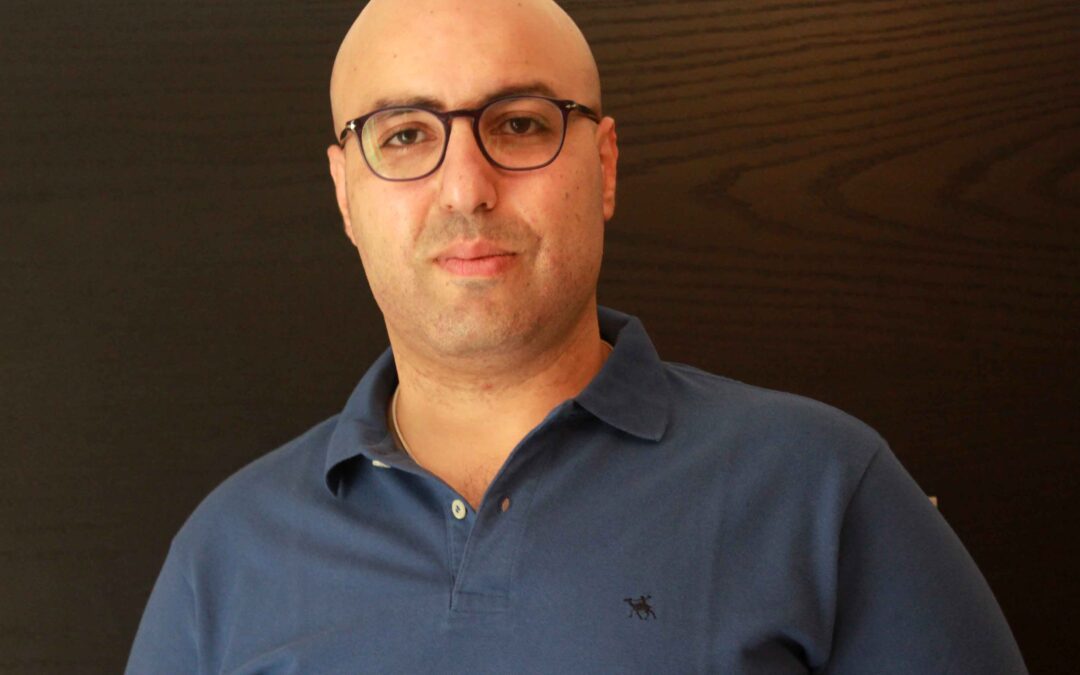
Selected by a jury of 10 global human rights organizations, including the ICJ, Mohamed Zaree is a devoted human rights activist and legal scholar whose work focuses on human rights advocacy around freedom of expression and association.
Mohamed Zaree is also known for his role as the Egypt Country Director of the Cairo Institute for Human Rights Studies (CIHRS), which works throughout the Arabic speaking world.
He assumed this role after government pressure on CIHRS prompted them to relocate their headquarters to Tunis in 2014.
The Egyptian government has been escalating its pressure on the human rights movement.
Human rights NGOs and defenders are confronted with a growing wave of threats, harassment, and intimidation, legal and otherwise.
Despite this, Mohamed Zaree is leading CIHRS’ research, human rights education, and national advocacy initiatives in Egypt and is shaping the media debate on human rights issues.
During this critical period for civil society, he is also leading the Forum of Independent Egyptian Human Rights NGOs, a network aiming to unify human rights groups in advocacy.
Zaree’s initiatives have helped NGOs to develop common approaches to human rights issues in Egypt.
Within the context of the renewed crackdown on Egyptian human rights organizations, he has become a leading figure in Egypt’s human rights movement.
He is currently facing investigation under the “Foreign Funding Case” and is at high risk of prosecution and life imprisonment. The “Foreign Funding Case” highly restricts NGO activities.
Despite this, Mohammed Zaree continues to engage the authorities in dialogue wherever possible, arguing that respect for human rights will increase stability in Egypt.
He has been under a travel ban since May 2016 but remains present and active in Egypt and represents CIHRS inside the country.
“Mohamed Zaree is a leading voice for justice in Egypt. Honoring him with the Martin Ennals Award is a recognition of the courageous and tireless work done by Egyptian human rights defenders, individuals and NGOs, in their fight against all forms of intimidation, harassment and repression waged by the Egyptian military and government against them,” said Said Benarbia, Director of the ICJ Middle East and North Africa Programme.
FreeThe5KH (Cambodia) and Karla Avelar, the two other finalists, received Martin Ennals Prizes.
FreeThe5KH are five Human Rights Defenders who were recently released after 427 days of pre-trial detention.
They are awaiting trial and are banned from travel.
There were widespread international calls for their unconditional release, and a stop to judicial harassment of human rights defenders in Cambodia.
This comes in the context of an increasingly severe crackdown on civil society and the political opposition in Cambodia.
Karla Avelar, a transgender woman in El Salvador, founded the country’s first organization of transgender women – COMCAVIS TRANS.
She grew up on the streets, suffering discrimination, violence, sexual exploitation, rape, and attempted murder.
She works to change national legislation and the authorities’ practices, by publicizing violations suffered by LGBTI people.
Her advocacy helped prompt the authorities to segregate LGBTI prisoners for their own safety, and provide HIV treatment.
Background
The “Nobel Prize of Human Rights”, the Martin Ennals Award for Human Rights Defenders (MEA) is a unique collaboration among ten of the world’s leading human rights organizations to give protection to human rights defenders worldwide.
Strongly supported by the City of Geneva, the award is given to Human Rights Defenders who have shown deep commitment and face great personal risk.
Its aim is to provide protection through international recognition.
The Jury is composed of the following NGOs: ICJ, Amnesty International, Human Rights Watch, Human Rights First, Int’l Federation for Human Rights, World Organisation Against Torture, Front Line Defenders, EWDE Germany, International Service for Human Rights, and HURIDOCS.
Contact:
Michael Khambatta, Director, Martin Ennals Foundation, t: +41 79 474 8208, e: khambatta(a)martinennalsaward.org
Olivier van Bogaert, Director, ICJ Media and Communications, and ICJ Representative on the MEA Jury, t: +41 22 979 38 08, e: olivier.vanbogaert(a)icj.org
The Award will be presented by the United Nations Deputy High Commissioner for Human Rights at 18.15 on 10 October at the University of Geneva. The ceremony can be watched live on Martin Ennals Award Facebook page
Watch the movie on Mohammed Zaree

Oct 10, 2017 | News
At UN General Assembly First Committee, over 40 organisations from across the world endorsed a statement calling on states to take concerted action to address harm from armed drones and work towards agreement on the limits of the acceptable use of these technologies.
Few states have raised this issue at the First Committee recently, despite the urgent need to address the peace and security implications of armed drones.
Universal-dronesstatement-advocacy-2017-ENG (full pdf)
Oct 9, 2017 | Events, News
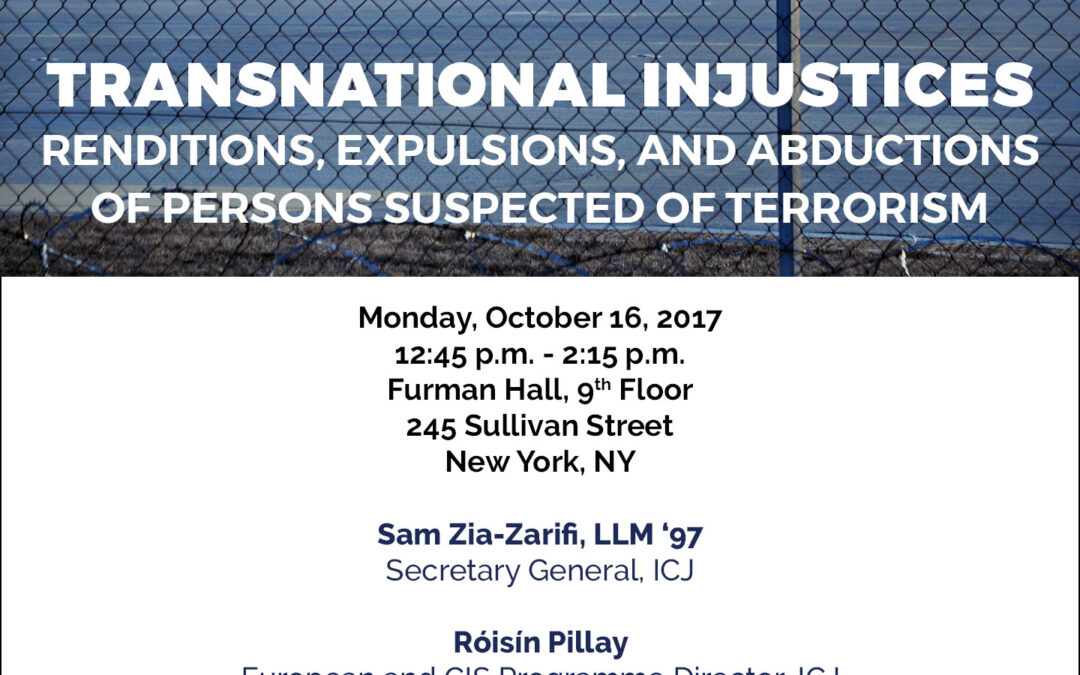
The ICJ, the Center for Human Rights and Global Justice and Amnesty International invite you today to an event to discuss challenges in prevention of, and accountability for, violations of human rights in the US-led rendition system, and in transfers of suspects in the CIS region.
Join us for a moderated discussion marking the U.S. launch of the International Commission of Jurists’ report, Transnational Injustices: National Security Transfers and International Law.
Panelists will discuss the ongoing practice of states unlawfully rendering people accused of terrorism, particularly in Russia and Central Asia, and explore the extent to which the impact of the CIA’s notorious extraordinary renditions can still be felt today.
When: Monday, October 16, 2017 – 12:45 pm to 2:15 pm
Where: Lester Pollack Colloquium Room – Furman Hall, 9th Floor, NYU School of Law – 245 Sullivan Street, New York City
RSVP here
Refreshments will be served
Speakers:
- Sam Zia-Zarifi, Secretary General, ICJ
- Róisín Pillay, European and CIS Programme Director, ICJ
- Margaret Satterthwaite, JD ’99, Professor of Clinical Law, NYU School of Law
Moderated by Julia Hall, Expert on Counter-Terrorism and Human Rights, Amnesty International
A flyer for this event is available in PDF format by clicking here.
Oct 6, 2017 | Advocacy, Cases, Legal submissions
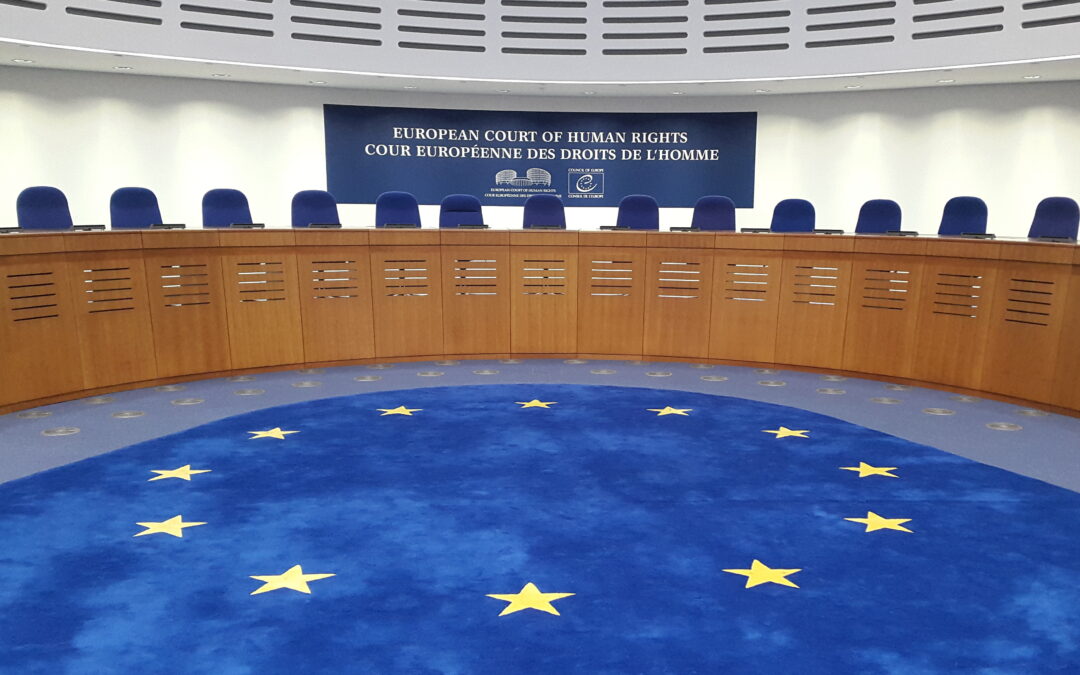
The ICJ and other human rights organisations intervened before the European Court of Human Rights in a case challenging the returns of migrants and refugees from Greece under the EU-Turkey deal.
The ICJ, the AIRE Centre, the European Council on Refugees and Exiles and the Dutch Council for Refugees have submitted a third party intervention before the European Court of Human Rights in the case of J.B. v. Greece. The case concerns the decision of Greek authorities to return a Syrian refugee to Turkey under the legal assumption that Turkey is a safe third country for refugees, that has been introduced following the EU-Turkey deal reached in reaction to the “refugee crisis”.
The interveners challenge the implementation of the rule of safe third country in these situations with regard to Greece’s obligations under the European Convention on Human Rights (ECHR). Specifically, the intervention focuses on:
- The principle of non-refoulement under the ECHR;
- The safe third country concept in international refugee law and EU law;
- The respect of the right to an effective remedy in cases of returns to Turkey under the safe third country rule.
Greece-JB_v_Greece-ECtHR-amicus-ICJ&others-final-eng-2017 (download the intervention)
Oct 6, 2017 | Advocacy, Non-legal submissions
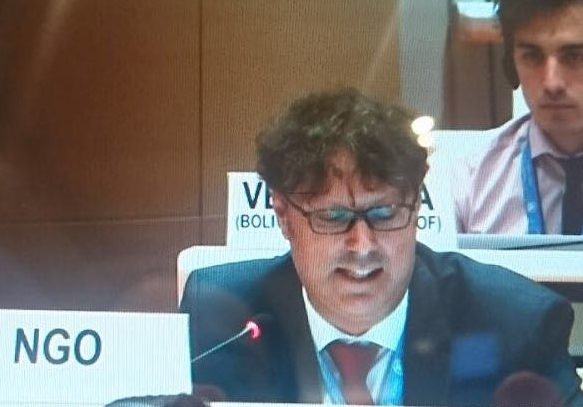
The ICJ today highlighted the role of judges, lawyers, and prosecutors at a UN seminar on prevention of torture in police custody and pre-trial detention.
The ICJ made the interventions during the “Seminar on the implementation of effective safeguards to prevent torture and other cruel, inhuman or degrading treatment or punishment during police custody and pre-trial detention” organized by the Office of the High Commissioner for Human Rights pursuant to a mandate from Human Rights Council resolution 31/31 (2016). A report of the seminar will be delivered and discussed at the March 2017 session of the Council.
The ICJ stated as follows in the first session:
The ICJ’s Commissioners are 60 senior judges and lawyers from all parts of the world. The ICJ works extensively with judges and absolutely agrees that their role is key to prevention of torture and ill-treatment in police custody and pre-trial detention.
Some of the key aspects of the role of judges include:
Judges should rigorously pursue all allegations. They should inquire when there are signs of abuse even if the detainee does not specifically allege abuse. They should demand that detainees be physically brought before them. Judges should be prepared to hold authorities in contempt of court when the authorities do not comply. The ICJ was very interested in what the Panelist Judge Dias Toffoli from Brazil said during the session about developments for custody hearings there, and how the judiciary can take practical systematic measures to fulfil their role even when legislators and other authorities may hesitate to act.
Judges should recognise and balance for evidentiary issues faced by detainees and their lawyers given the control authorities exercise over the place of detention
Judges should ensure that authorities respect rights of access to the outside world (including lawyers, family, friends, doctors, letters, and so on), both as safeguard but also to ensure detainees are not subjected to isolation that in its cumulative impact can itself amount to ill-treatment or even torture. The ICJ was pleased that Special Rapporteur Melzer highlighted the importance of such access.
Judges should ensure that confessions, other information and evidence obtained by torture and similar abuse is not allowed to be part of proceedings before them. The ICJ was interested in what justice Donoso from Chile said about relevant developments there.
In many places, judicial authorities are responsible for supervision of places of pre-trial detention. Where this is the case, judges should visit regularly, and at times without prior notice, such places of detention.
Judges should ensure accountability of perpetrators.
Judges should ensure rigorous constitutional review of relevant laws and practices, and maintain knowledge of and apply in practice international law against torture and ill-treatment. Even non-legally-binding international standards (such as the UN Standard Minimum Rules for the Treatment of Prisoners or “Mandela Rules”, and the UN Body of Principles for the protection of all persons under any form of detention or imprisonment) should be seen by judges as a useful and persuasive source of guidance in interpreting national laws.
To effectively fulfil their role, the judiciary must enjoy all necessary guarantees of independence from other authorities and other powerful interests in society. At the same time, at the ICJ we have also more recently been concerned to ensure accountability of judges when they fail to fulfil their duties to prevent and respond to torture, or are indeed intentionally complicit in mistreatment of prisoners.
Judges acting to protect human rights of criminal detainees are often subject to public criticism, and are often unable for reasons of impartiality and dignity of the court to defend themselves. It is therefore incumbent on members of the Executive, Legislature, legal profession, and others to defend such judges, and certainly not to pile on further unjustified criticism.
Finally, the ICJ would note that recent resolutions of the Human Rights Council on the independence of judges and lawyers, and on the administration of justice, stress the role of continuing professional education of judges on human rights issues (best organised by judicial institutions themselves, but involving other actors). Continuing education on prevention of torture and ill-treatment is a key area needed by all judiciaries in all countries.”
The ICJ continued as follows in the second session:
“A common thread that has already emerged from the first two panels is the role that pressure on police to obtain confessions plays in the incidence of torture and abuse in police custody. Thank you to the Panelists for their insights on this issue.
Values and signales from superiors and political leadership, including for instance in relation to practical aspects like career progression of police officials, is very important. Having clear rules is also very important in this regard. As is the perception of police that they lack alternatives to confessions as form of proof. Training on interviewing techniques, having an adequate number of officers, access to materials like fingerprinting kits and means of assuring chain-of-custody for physical evidence, are all also important.
The Seminar has addressed judges and police already, and will discuss lawyers later; the ICJ would also like to highlight the role of prosecutors in removing incentives on police to focus on obtaining confessions by any means.
The UN Guidelines on the Role of Prosecutors (Article 16) provide that prosecutors shall refuse to use evidence that they believe to have been obtained by torture.
A similar provision is incorporated in the professional standards adopted by the International Association of Prosecutors (which have also been endorsed by the UN Crime Commission). This also is an example of how international and regional professional associations can play an important role with their members in practical measures for prevention of torture and ill-treatment in police custody and pre-trial detention.”
In the third Session, the ICJ expressed its agreement with points made by Ms Miti-Drummond, the representative of the International Bar Association Human Rights Institute regarding the role of the legal profession in the prevention of torture, particularly regarding the importance of access to and presence of a competent and independent lawyer prior to and during any interview.
The ICJ also pointed out that some States have period of delay or even preclusion of access of detainee to the lawyer of his or her choosing, for instance in counter-terrorism, national security or similar cases. Often these are cases where there is a particular risk of abuse, and also may involve delay in bringing the person before a judge. In some places the independent bar association assigns a lawyer who has immediate access, if the access to the person’s lawyer of choice is denied or delayed. The ICJ invited comments or recommendations about this practice or other means to ensure lawyers can effectively prevent torture in such circumstances.