Jul 25, 2017 | News
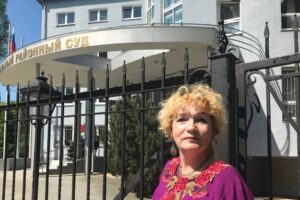
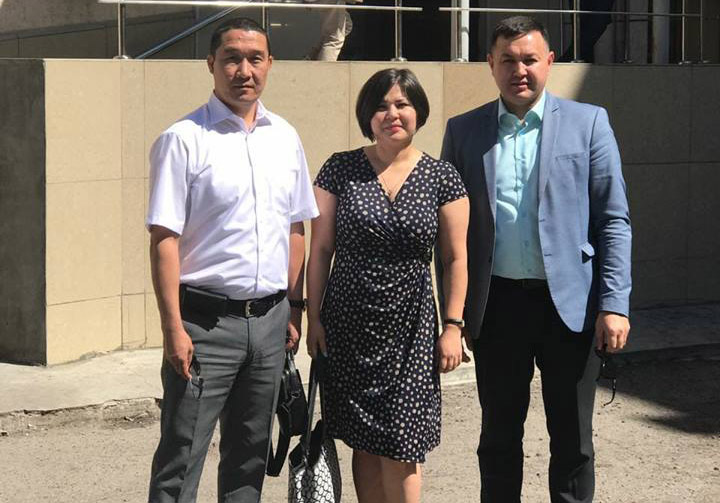
Today the ICJ expressed concern about the real threat of criminal prosecution against lawyers Yerlan Gazimzhanov, Amanzhol Mukhamedyarov and Assel Tokayeva (photo) in Kazakhstan.
The ICJ said the action against lawyers was aimed at their discharging of their professional functions on behalf of clients, and not for any genuine criminal misconduct.
The ICJ called on the responsible authorities of Kazakhstan to discontinue the proceedings against the lawyers, which are contrary to international law and standards on the role of lawyers and the rule of law in the administration of justice.
On 22 June, in a court hearing in the criminal case, judge Ubasheva issued interim rulings against the lawyers seeking their prosecution for a number of acts, which on their face do not consist of criminal misconduct. The conduct for which prosecution is sought includes lodging a complaint alleging unethical conduct by the judge with the Commission on Judicial Ethics and Judicial Jury of the Supreme Court of the Republic; filing a motion for recusal of the judge; stating that the crime for which their clients had been accused had in fact been committed by another defendant; and participating in an international conference, rather than attending a court hearing to defend clients.
The various legal procedures used by the lawyers, including their complaint against the judge and the request for the judge’s recusal, are not prohibited by law. On the contrary, acts such as filing motions for recusal, lodging ethics complaints through officially prescribed channels, and performing standard criminal defence functions they constitute regular procedures prescribed in legislation Kazakhstan. They are also fundamental pursuant to the proper administration of justice under the rule of law.
The interim rulings of the court did not provide an analysis of the legal provisions allegedly violated by the lawyers. Certain of the lawyers were said by the court to have “demonstrated superiority over other actors in criminal proceedings.” It was also alleged that the information posted on a Facebook page about the proceedings in which one of the lawyers took part was false. However, the ruling failed to cite any specific details or conduct of the lawyers which would support these conclusions.
Regarding the charge that two of the lawyers had chosen to participate in an international conference rather than appear at the court hearing, this at most would fall under disciplinary procedures governing the conduct of members of the bar, and not the criminal law. The ICJ notes these charges should normally be made to competent disciplinary body, the Collegium of Lawyers, and not the Ministry of Justice through the request of the judge.
In addition to the criminal prosecution, judge Ubasheva asked the Ministry of Justice to take measures against the lawyers for a breach of professional ethics, causing unjustified delays in criminal trial, and contempt of court, and asked the Ministry of Interior to undertake an inquiry to determine whether the conduct of the lawyers constituted an offence punishable under Article 407 of the Criminal Code of Kazakhstan (obstruction of justice).
On 20-21 July 2017, the Criminal Chamber of Appeals examined the lawyers’ appeals against the conviction and interim appeals against the interim rulings.
The appeal proceedings before the Astana City Court were attended by Gulnora Ishankhanova, ICJ Commissioner acting as an ICJ observer.
Kazhakstan-Trial observation 3 lawyers-News-web story-2017-RUS (story in Russian, PDF)

Jul 25, 2017 | News
The ICJ is concerned with the passing of Constitutional Amendment no. 1 of 2017 by the House of Assembly of Zimbabwe on 25 July 2017.
The House of Assembly voted with over two-thirds majority for the amendment of the Zimbabwean Constitution.
The amendment grants the President the right to appoint to office, the Judge President of the High Court, the Deputy Chief Justice and the Chief Justice of Zimbabwe.
Before this amendment the Judicial Services Commission (JSC) spearheaded the process of selection and appointment of judges with the President merely appointing from candidates recommended to him by the JSC.
The enactment of this Bill to law is likely to have a negative effect on the public’s perception of the judiciary. It also has the potential to affect the impartiality and the independence of the judiciary.
“The amendment to the 2013 Constitution will negatively affect public confidence in the judiciary. Not only is this a departure from a position that was in line with international standards and best practices; the amendment is likely to have a ripple effect on the judiciary,” said Arnold Tsunga, the ICJ Africa Director.
“In the short term the executive now has a carrot, which it can dangle in front of judicial officers. If a judge wants to be promoted to Judge President, Deputy Chief Justice or Chief they may have to align themselves with the thinking of the executive. Over time, given the central roles that these three office bearers play in the appointment process and thought leadership, Zimbabwe is likely to have a very executive minded bench,” he added.
To this end the ICJ calls upon the government of Zimbabwe to reconsider its decision to amend the Constitution in the manner proposed in the bill.
The procedure in section 180 of the constitution had distinguished Zimbabwe’s appointment procedures as exemplary in the region.
It is unfortunate that through this amendment the country has failed to consolidate this leadership position.
The amendment would be regressive and poses a real risk of undermining the essential role of the judiciary in securing the rule of law in Zimbabwe.
Zimbabwe-Constitutional Amendment-News-web stories-2017-ENG (full statement, in PDF)

Jul 24, 2017 | Advocacy, Legal submissions
The AIRE Centre, ICJ, ILGA-EUROPE and ECRE have submitted a third party intervention in case O.S. v. Switzerland (no. 43987/16).
This intervention addresses the following points:
i) enforced concealment of one’s same-sex sexual orientation constitutes persecution under refugee law and is incompatible with the Convention, in particular, Article 3
ii) the criminalisation of consensual same-sex sexual conduct gives rise to a real risk of Article 3 prohibited treatment, thus triggering non-refoulement obligations under the Convention
iii) the risk of persecution based on sexual orientation in Gambia.
Universal-SexualOrientationRefugee-Advocacy-LegalSubmissions-2017-ENG (full legal submission)

Jul 24, 2017
In a report published today, Judges for Judges and the ICJ analyze disciplinary proceedings against Bulgarian Judge Miroslava Todorova in relation to international standards on judicial independence and accountability.
On 12 July 2012, the Supreme Judicial Council of Bulgaria dismissed Judge Miroslava Todorova, at that time a judge of the Sofia City Court and Chairperson of the Bulgarian Judges Association, on the grounds that she was responsible for delays in a number of cases.
Subsequently, Judges for Judges and the ICJ followed the disciplinary proceedings against Todorova and sent trial observers to Sofia on two occasions, in May 2013 and November 2014.
In their findings, the ICJ and Judges for Judges do not address whether, and if so which, disciplinary sanctions may have been appropriate in this case.
They note, however, that the disciplinary proceedings concerned delays, constituting judicial misconduct, in a context where according to many internal and external observers the workload between the courts is divided unevenly and may be very high for some.
The two organizations also note that, as the second three-judge panel pointed out, the overall organization of the workflow was never properly considered in considering and reaching a determination n the disciplinary case.
With the quashing of the second three-judge panel’s decision, likewise other relevant circumstances were not taken into account.
Furthermore, the report finds, disciplinary practice in Bulgaria is deficient in respect of its lack of predictability and consistency, and doubts expressed by many observers as to the independence of the Judicial Service Council muddy the waters further.
The 2013 amendments to the legal framework only partially served to remedy the disciplinary practice’s deficiencies.
In particular, a full right of defence that includes the opportunity for the defendant to address all arguments and evidence remained wanting at the time of the Todorova proceedings.
In the report, the ICJ and Judges for Judges also note the animosity towards Todorova from certain quarters in the Executive and SJC for her activities as the chair of the BJA in defence of judicial independence.
Under the circumstances, there is an appearance that the disciplinary proceedings against Todorova were instituted and pursued selectively, and the system of the disciplinary proceedings in Bulgaria does not provide sufficient safeguards to dispel this appearance.
The disciplinary proceedings against Todorova demonstrate why it is crucial that accountability mechanisms be independent not only in theory but in practice, and for such mechanisms to be in some way themselves publicly accountable.
Bulgaria-The Todorova Case-Publications-Reports-Trial observation reports (full report, in PDF)
For additional background, see:
ICJ Practitioners Guide no 13, Judicial Accountability (2016, in PDF)
and more generally:
ICJ Practitioners Guide No 1, International Principles on the Independence and Accountability of Judges, Lawyers and Prosecutors (2007, in PDF)
Jul 20, 2017 | Artículos, Noticias
Una entrevista del Secretario General de la CIJ Sam Zarifi con la periodista de Reuters Stephanie Nebehay.
El presidente estadounidense Donald Trump es parte de una nueva estirpe de líderes en el mundo que, como el venezolano Nicolás Maduro, quieren utilizar su mandato democrático para socavar el estado de derecho, dijo el miércoles el jefe de una ONG de derechos humanos y asuntos jurídicos.
Saman Zia-Zarifi, secretario general de la Comisión Internacional de Juristas (ICJ por sus siglas en inglés), que tiene su sede en Ginebra, llama a Trump un “populista autoritario” y lo compara a los líderes de países como Venezuela, Turquía, Filipinas o Hungría.
Zarifi, que nació en Irán y se mudó a Estados Unidos cuando era adolescente, citó como ejemplo la restricción a los viajes impuesta por el gobierno de Trump a los ciudadanos de seis países de mayoría musulmana.
“Lo que es diferente ahora es que se usa un cierto tipo de populismo para contrarrestar la noción del estado de derecho”, dijo Zarifi en una entrevista en la sede de la ICJ, que está conformada por 60 jueces y abogados destacados del mundo que buscan proteger los derechos humanos y el imperio de la ley.
“El nuevo populismo tiene un cierto descaro que es nuevo. No es que están negando que están violando derechos, lo que dicen es que pueden violar derechos porque de alguna manera están empoderados por el pueblo”, señaló.
Zarifi, que encabeza la ICJ desde abril, dijo que esta nueva generación de populistas incluye a Nicolás Maduro de Venezuela, Tayyip Erdogan de Turquía y Rodrigo Duterte de Filipinas; al primer ministro Viktor Orban de Hungría y al líder del partido oficialista de Polonia, Jaroslaw Kaczynski.
“Yo diría que en Estados Unidos Trump es un populista autoritario. Tiene tendencias autoritarias pero aún hay mecanismos de control y equilibrio”, estimó Zarifi. “Así es que no es una figura totalmente autoritaria”.
La Corte Suprema revisó partes del decreto del gobierno de Trump que establecía restricciones al ingreso de viajeros de Irán, Libia, Somalia, Sudán, Siria y Yemen, una normativa que según Trump busca combatir el terrorismo.
La decisión del tribunal, de acuerdo a Zarifi, pondría a prueba “la salud del sistema de equilibrios” de los poderes en Estados Unidos.
En Venezuela, Maduro busca establecer una Asamblea Constituyente con autoridad para reformar a Constitución y cerrar el Congreso dominado por la oposición, con una votación prevista para el 30 de julio.
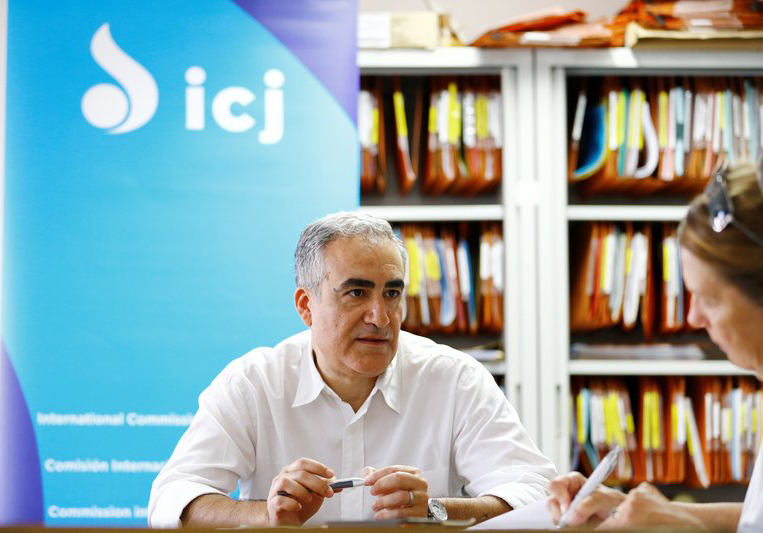
Foto: Reuters / Pierre Albouy