Jun 30, 2017 | News
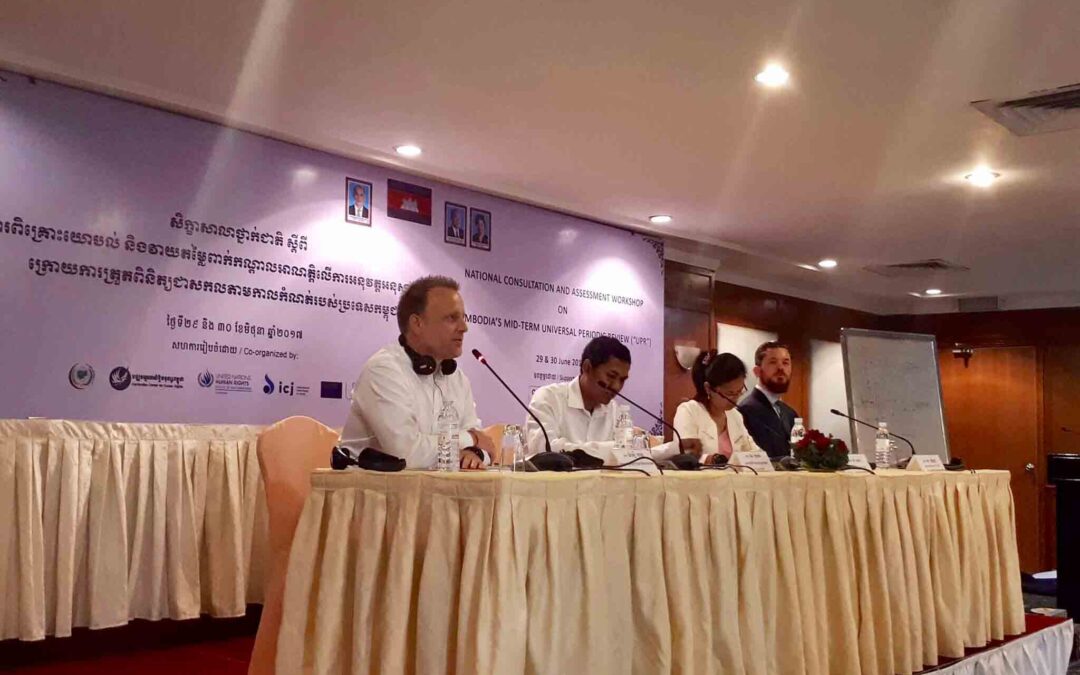
On 29 and 30 June, the ICJ co-organized a workshop for Cambodian civil society on the UPR.
The workshop was organized with the Cambodian Center for Human Rights, the Cambodia Country Office of the Office of the High Commissioner for Human Rights, UPR Info, and the Cambodian Human Rights Committee on the mid-point review of the Human Rights Council’s (HRC) Universal Review (UPR) of Cambodia.
The Royal Government of Cambodia (RGC) underwent its second UPR in January 2014.
The objectives of the workshop were to:
1. conduct a comprehensive mid-term assessment of the progress and challenges as of late June 2017 of the RGC’s implementation of those recommendations made during the second UPR cycle of Cambodia that the RGC had accepted with a view to informing advocacy around the September 2017 session of the HRC;
2. To take stock of the situation of UPR implementation to provide a basis for preparation of NGO shadow reports during the 3rd cycle of the UPR;
3. To discuss a specific set of UPR recommendations among relevant government bodies and civil society organizations in order to build relationships and raise awareness of the recommendations;
4. To advocate for the full implementation of the recommendations accepted during the second UPR cycle of Cambodia; and
5. To increase awareness of and demand among the Cambodian public for the implementation of the accepted UPR recommendations and to increase awareness of the HRC and UPR process.
Kingsley Abbott, Senior International Legal Adviser for Southeast Asia for the ICJ, moderated a panel discussion on “developing strategic advocacy plans for monitoring the implementation of UPR recommendations” and delivered a presentation on “strategies to effectively implement recommendations and lessons learned from other countries” focusing on past UPR cycles of Thailand Lao PDR.
After a comprehensive review of the recommendations accepted by the RGC during the last UPR cycle it was determined that many of the recommendations had not been implemented.
Civil society agreed that it was important to further strengthen coordinated efforts to monitor and conduct advocacy around the UPR process, engage constructively with the RGC, and begin preparation for the third UPR cycle focusing on lessons learned from the last cycle and regional experiences.
Contact
Kingsley Abbott, ICJ Senior International Legal Adviser for Southeast Asia, t: +66 94 470 1345 ; e: kingsley.abbott(a)icj.org

Jun 29, 2017
The ICJ presented today a submission to the Human Rights Council’s Universal Periodic Review of Serbia on the independence of the judiciary and the autonomy of the prosecution service.
In its submission, the ICJ drew attention to the following issues:
- the involvement of the National Assembly in the appointment and dismissal of judges and prosecutors;
- the composition of the High Judicial Council (HJC) and State Prosecutors’ Council (SPC) ;
- the tenure of judges, court presidents, public prosecutors, and deputy public prosecutors;
- the protection of judges and prosecutors; and
- Serbia’s engagement with international human rights instruments and mechanisms.
The submission concludes with recommendations addressing the above-mentioned concerns. It builds on the findings of the ICJ contained in its report Serbia’s judges and lawyers: the long road to independent self-governance.
Serbia-IndependenceJudiciaryProsecution-UPRSubmission-Advocacy-2017-ENG (download the submission)

Jun 29, 2017 | Advocacy, News, Non-legal submissions
The ICJ, together with other 60 national and international human rights organizations urged today the Myanmar authorities, and in particular the Ministry of Transport and Communication and the Parliament, to ensure the repeal of the offence of criminal defamation.
Myanmar-JointStatement-CriminalDefamation-2017-ENG (joint statement in English)
Myanmar-JointStatement-CriminalDefamation-2017-BUR (joint statement in Burmese)
Jun 28, 2017
NGOs, including the ICJ, have sent an open letter to the OHCHR Petitions Unit and Treaty Bodies chairs on threats and assaults against Treaty Body petitioners.
The purpose of this letter is to encourage Treaty Bodies to proactively request that State parties adopt protection measures in cases of reprisals against Treaty Body petitioners, and seek follow-up to those measures by OHCHR field presences.
Universal-ReprisalsTreatyBodies-Advocacy-OpenLetter-2017-ENG (full text in PDF)
Jun 28, 2017 | Advocacy, Non-legal submissions
The ICJ has joined other leading human rights NGOs in setting out a range of specific measures to increase the effectiveness of UN Special Procedures – independent experts appointed by the Human Rights Council to address particular themes or countries.
The written submission was made in the context of the Annual Meeting of the Special Procedures, in Geneva.
Coordinated by the International Service for Human Rights (ISHR), the document assesses current practices against a range of recommendations made in an earlier joint civil society submission in 2016.
The 2017 submission welcomes progress on a number of the recommendations, but also highlights issues where little or no progress has been made. It also offers several new recommendations.
Among the positive developments are the enhanced role of the Coordination Committee, action taken to combat reprisals, the creation of a database where details of individual communications (i.e. complaints) can be accessed, and engagement of Special Procedures with international and regional forums.
The full 2017 submission, entitled “The Special Procedures: Developments in Institutional Strengthening and Working Methods”, can be downloaded in PDF format here: UN-Submission-AnnualMeetingSpecialProcedures-2017