Mar 21, 2017 | News
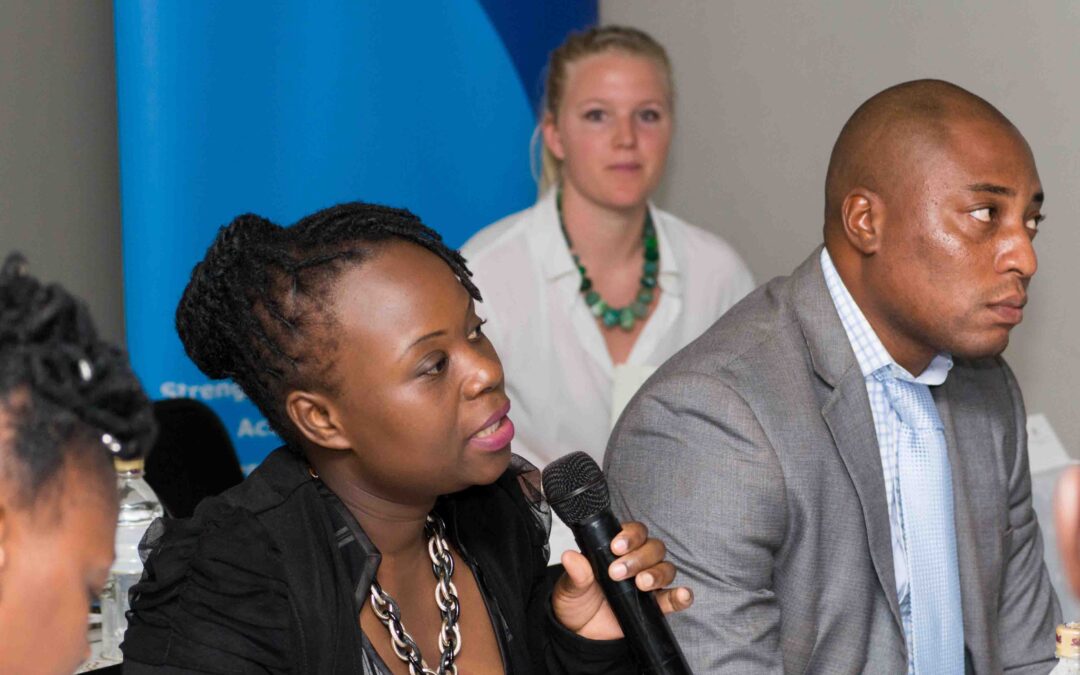
The National Prosecuting Authority (NPA) held a consultation conference on case and docket management system in Harare on 21 March 2017. The ICJ provided technical support.
The consultation conference was intended to validate findings of the field and desk research conducted in respect of case management in Zimbabwe.
The ICJ engaged consultants reviewed the case and docket management system as it relates to other justice actors such as the judiciary, police, prisons and legal aid providers.
The case and docket management assessment was measured against regional and international comparative standards.
The assessment focused on how case and docket management systems address the rights of vulnerable groups’ including women, unrepresented minors, juveniles and persons with disabilities.
From these consultations and field work, the NPA will be supported with a comprehensive, specific and detailed proposal with practical steps for adopting an improved case and docket management system.
Further, the findings will make recommendations on strengthening the case management system in Zimbabwe and how to address the needs and interests of the various justice sector stakeholders.
The consultation conference was attended by the Acting Prosecutor General, Deputy Prosecutor General, National Director of Public Prosecutions, senior law officers, senior magistrates, clerks (criminal courts), representatives from Zimbabwe Prisons and Correctional Services (ZPCS), Zimbabwe Republic Police (ZRP), and Zimbabwe Human Rights Commission (ZHRC).
Civil society representatives included directors and senior staffers from Zimbabwe Human Rights NGO Forum, Zimbabwe Lawyers for Human Rights (ZLHR) among others.
This consultation was held with financial support from the Foreign Commonwealth Office (FCO) Magna Carta Fund, through the British Embassy in Harare.
Contact
Arnold Tsunga, ICJ Regional Director for Africa, t: +27 716 405 926, e: arnold.tsunga(a)icj.org
Mar 20, 2017
An opinion piece by Reed Brody, a New York-based human rights lawyer and ICJ Commissioner.
After two months of Trump’s presidency, the battle lines are drawn.
On one side, a would-be dictator with an utter disregard for the foundations of a constitutional democracy: checks and balances, the independence of the judiciary (“so-called” judges), freedom of the press (“the enemy of the people”), the rule of law and the protection of minorities.
Despite the lack of a popular mandate, which he preposterously blamed on millions of illegal voters, Donald Trump is determined to radically transform America, and its relation with the world.
His demonization of Muslims and undocumented foreigners, like the border wall with Mexico, are cruel tactics to stoke fear for political gain and part of a long-term strategy to remake America by changing its demographics.
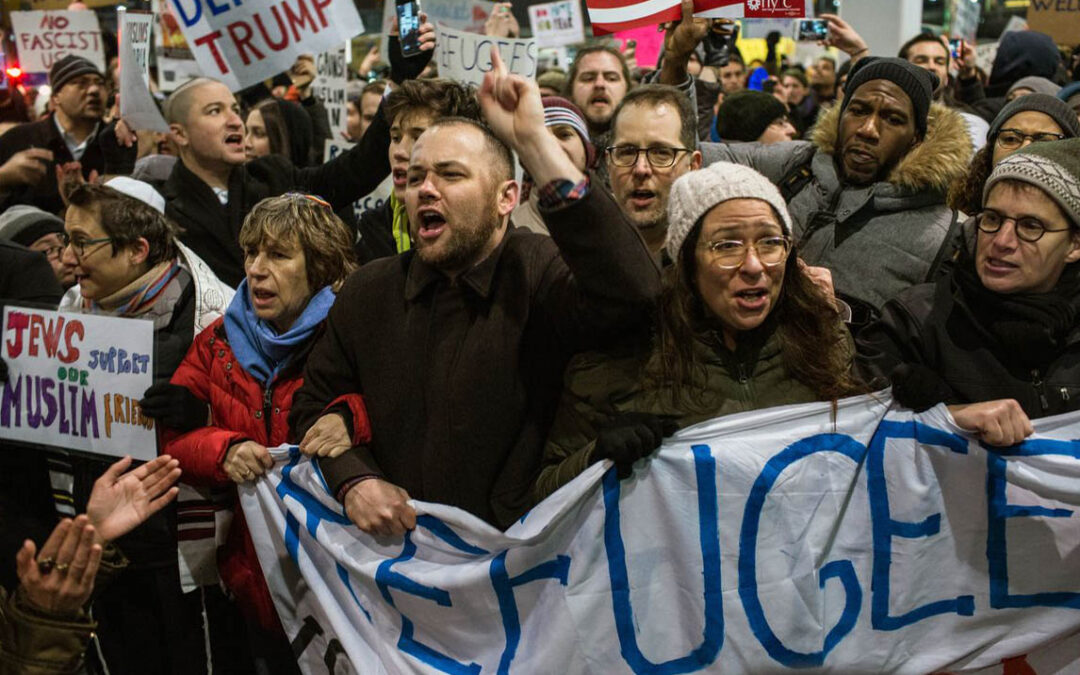
On the other side, an unprecedented citizen mobilization. The nationwide Women’s Marches the day after Trump’s inauguration were by far the largest demonstrations in US history.
When Trump’s first “Muslim ban” was announced only days later, people spontaneously flooded the airports around the country.
Two months later, this “Resistance” has not slowed – “this is a marathon not a sprint” is the warning one hears at almost every meeting and rally in which we participate.
All around the country, citizens fearful for the future have packed elected officials’ town hall meetings and flooding Congress with petitions, postcards, and phone calls.
Over 500,000 people have downloaded the “Indivisible Guide for Resisting the Trump Agenda”. Over 30,000 people take part in regular nationwide “”Ready to Resist” calls on upcoming strategies.
The premier legal organization challenging Trump’s actions in the courts, the American Civil Liberties Union, raised $24 million in the days following the first Muslim ban.
At my Brooklyn neighborhood synagogue, over 3,000 people organize local activities through 33 working groups including “standing with our immigrant neighbors” and “opposing Trump’s conflicts of interest and corruption.”
What can we expect next?
We live, more than at any time since the US Civil War, in a nation divided into “two Americas.” Liberals and ethnic minorities dominate the cities and the coasts, conservatives the vast rural areas in between.
We watch our TV channels, they watch theirs. We have our newspapers (virtually all of them), they have inflammatory “talk radio.” We have our elected officials, they have theirs, in districts dominated by one party or the other.
The urban concentration of progressives means that the electoral system at all levels favors rural white conservatives, which is why Trump won a large electoral college victory despite losing the popular vote by over three million, and also why the House and Senate are Republican despite an equally large Democratic majority.
But it also means that Democrats are the overwhelming majority in the places that matter most to the economy and the culture – cities like New York City (79% Clinton), Washington DC (93%), Los Angeles (72%), and so on.
Establishment Republicans who were once horrified by Trump have made a Faustian bargain to ignore the clear danger he poses as long as he helps enact their conservative agenda of tax cuts for the rich, elimination of business and environmental regulations, repeal of “Obamacare,” and the transformation of the federal judiciary.
Trump’s proposed budget deeply slashes social programs for the poor, as well as funding for the environment and arts, while super-sizing the military. Paul Ryan, the Speaker of the House who kept his distance from candidate Trump, said they were working together on the “most productive Congress and presidency in our lifetime.”
The question for moderate Republicans (a dying breed) is whether there will ever come a “line in the sand” which they will not let Trump cross.
It is also a question for America’s allies who can challenge Trump on human rights, as has Angela Merkel, Justin Trudeau and most recently Irish PM Enda Kenny.
Because if Trump gets his way, we will see increasingly authoritarian measures in the name of “security.”
Already, large-scale deportations of undocumented persons are underway, ripping apart families and communities.
Who knows how the Administration will take advantage of the next terrorist attack and the one after (Trump said he “didn’t know” if he would have supported the internment of 110,000 Japanese-Americans and Japanese after the attack on Pearl Harbor). With Trump’s reckless approach to foreign policy, we could very well see international calamity.
But it is increasingly possible that Trump will not get his way. The mass resistance, coupled with the White House’s breathtaking incompetence, has stiffened many spines.
The courts have suspended enforcement of both the first and second Muslim Bans. The mainstream press has indeed, in the words of Trump strategist Stephen Bannon, taken on the role of the “opposition party.”
Everything has become political today. Sports. Oscars. Shopping. Companies in high-tech and globalized industries opposed the travel ban. Consumer companies support Trump (or sell his family’s products) at their peril – when Uber appeared to seek profit a New York City taxi strike to protest the Muslim Ban, 200,000 customers deleted their Uber accounts.
The leaks from US intelligence agencies about the Trump campaign’s contacts with Putin’s Russia also threaten Trump’s future, not only for what they may reveal about his collusion with Russia, but because they suggest that the “deep state,” (a term familiar to Turks and Egyptians but never used in America until now) is worried about where Trump might take the country and the world.
Another scenario then is that at some point the chaos and disruption will become so costly that the establishment will risk enraging Trump’s already angry base and seek to replace him with the more traditional conservative Mike Pence.
Even if they don’t lead to Trump’s impeachment or resignation, though, all of these actions make it harder for him to implement his radical agenda and more likely that America (and the world) will survive Trump with some semblance of our liberties and democracy intact.
If that happens, perhaps we will indeed “Make America Great Again,” just not in the way Donald Trump intended.
Mar 20, 2017
Today, the European Committee of Social Rights registered a collective complaint prepared by the ICJ in cooperation with Forum for Human Rights, against the Czech Republic.
The complaint argues that the Czech Republic fails to ensure equal legal protection and participation of children below the age of criminal responsibility in the pre-trial stage of juvenile justice procedures.
The ICJ and FORUM submit that serious systemic flaws in the Czech juvenile justice system deprive a specific group of particularly vulnerable individuals – children below the age of criminal responsibility – of an adequate level of social protection and leave them at risk of inappropriate or unfair procedures leading to arbitrary punitive measures, in violation of Article 17 of the European Social Charter, both alone and read in conjunction with the principle of equality in the preamble to the Charter.
This situation concerns more than one thousand children every year and as a matter of urgency, it requires a structured response.
Mar 15, 2017 | Advocacy, Non-legal submissions
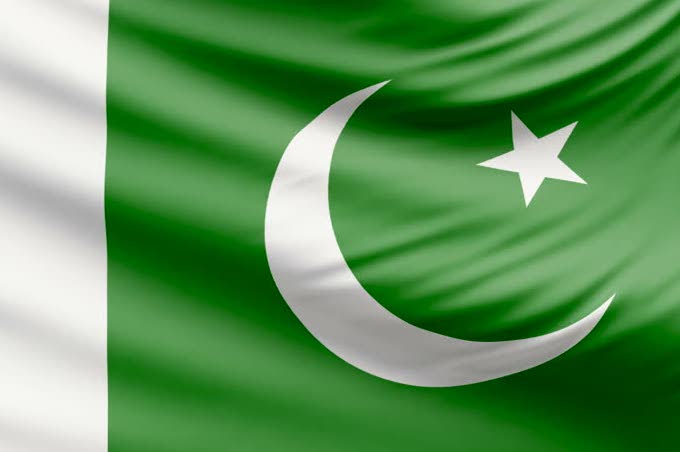
The ICJ and Human Rights Commission of Pakistan (HRCP) made a statement to the UN Human Rights Council highlighting the alarming human rights situation developing in Pakistan.
The statement addressed the situation for human rights defenders, abuse of blasphemy laws, and violations in the context of countering terrorism.
“Pakistan has increased its clamp down on human rights defenders, even attempting to shut down NGOs for reasons such as the NGO “presenting a very bleak picture of human rights” to the UN.
State agents have subjected human rights defenders exercising their right to freedom of expression and peaceful assembly to excessive force and even prosecution under Pakistan’s anti-terrorism laws. Others have been assaulted, killed or forcibly disappeared. Not a single perpetrator has been successfully brought to justice.
Misuse and persecution are inherent in the logic, structure and formulation of blasphemy laws in Pakistan: vague and over-broad language leaves them open to abuse; they blatantly discriminate against minority religions and sects; they are incompatible with the rights to freedom of expression and religion; and their implementation raises serious fair trial concerns.
Finally, Pakistan’s counter-terrorism laws and policies disregard human rights protections, including in the practice of enforced disappearances of terrorism suspects and others, and in the exposure of civilians accused of terrorism-related offences to unfair, secret and opaque trials in military courts. Laws such as the Actions (in Aid of Civil Powers) Regulations allow indefinite detention without judicial supervision.
The statement can be downloaded in PDF format here: HRC34-Pakistan-OralStatement-2017