
Turkmenistan: the ICJ holds a seminar on judicial ethics
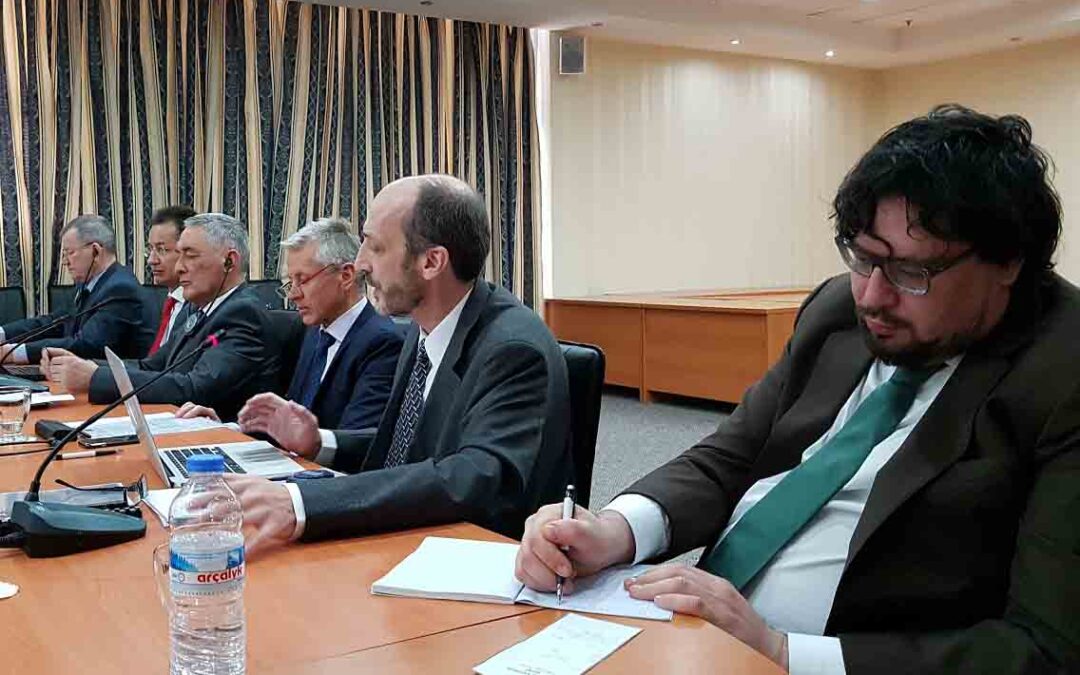
Today, the ICJ in cooperation with the the Supreme Court of Turkmenistan holds a seminar on Comparative Approaches to Judicial Ethics.
The seminar, supported by the European Union, will be attended by judges of the Supreme Court of Turkmenistan as well as other judges.
ICJ experts, including Judge Vladimir Borissov, former judge of the Supreme Court of Kazakhstan, Judge Georg Stawa, the President of the European Commission for the Efficiency of Justice (CEPEJ), and others will present comparative perspective and international standards related to the judicial ethics, accountability and guarantees for judges.
This is the second such event the ICJ holds in Turkmenistan. The first event, organized in June 2016, was dedicated to the issue of international obligations in national courts.
Turkmenistan-Judicial ethics seminar-News-web story-2017-RUS (full story in Russian, PDF)
Turkmenistan-Seminar Ethics-Agenda-2017-ENG (agenda in English, PDF)
Turkmenistan-Seminar Ethics-Agenda-2017-RUS (agenda in Russian, PDF)
Туркменистан: МКЮ проводит семинар по судейской этике
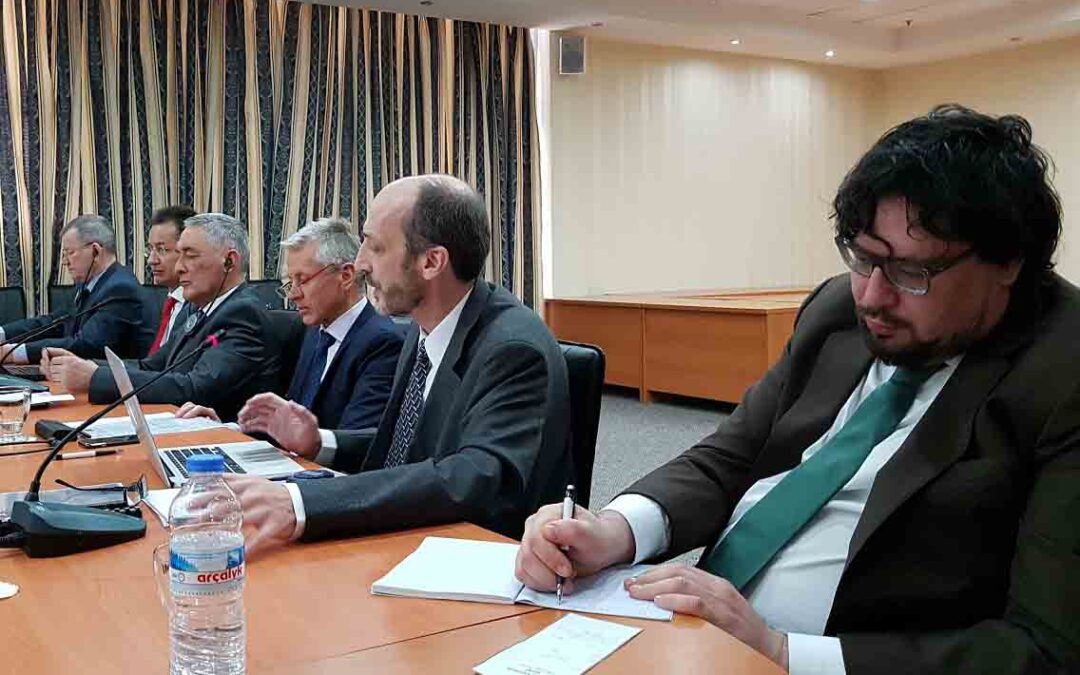
Сегодня МКЮ в сотрудничестве с Верховным Судом Туркменистана проводит семинар «Сравнительные подходы к судейской этике».
Семинар проходит при поддержке Европейского Союза. В нем примут участие судьи Верховного Суда Туркменистана, а также другие судьи.
Эксперты МКЮ, среди которых Владимир Борисов, бывший судья Верховного Суда Казахстана, судья Георг Става, Председатель Европейской комиссии по эффективности правосудия (CEPEJ), и другие представят сравнительные подходы и международные стандарты, связанные с судейской этикой, подотчётностью судей и гарантиями их защиты.
Это уже второе мероприятие такого рода, которое проводится МКЮ в Туркменистане. Первый семинар, прошедший в июне 2016 года, был посвящён проблеме международных обязательств в национальных судах.
Turkmenistan-Judicial ethics seminar-News-web story-2017-RUS (полный текст на русском, PDF)
Turkmenistan-Seminar Ethics-Agenda-2017-RUS (повестка дня на русском, PDF)
ICJ launches global redress and accountability initiative
The ICJ today launched a new global initiative focussed on redress and accountability for gross human rights violations.
In all regions of the world, perpetrators of gross human rights violations enjoy impunity while victims, especially the most vulnerable and marginalized, remain without effective remedies and reparation.
Governments of countries in transition and/or experiencing a wider rule of law crisis often seek to provide impunity for perpetrators of gross violations of human rights, or make no effort to hold them to account, or misuse accountability mechanisms to provide arbitrary, politically partial justice.
Yet international law requires perpetrators to be held accountable and victims to be provided with effective remedies and reparation, including truth and guarantees of non-recurrence.
This is reinforced by the 2030 Sustainable Development Agenda, which recognizes the need to build peaceful, just and inclusive societies that provide equal access to justice, are based on the rule of law and respect for human rights, and provide for accountability.
“Impunity and lack of redress dehumanizes victims and acts as an impediment to the cementing of democratic values and the rule of law”, said Alex Conte, coordinator of the ICJ initiative.
Lack of accountability and claims for justice dominate national debates, frequently leading to a paralysis or reduced functioning of the institutions of the State and detracting from the pursuit of other rule of law and development initiatives.
Impunity threatens a nascent democracy by rendering its constitution hollow, weakening its judiciary and damaging the political credibility of its executive.
Public institutions often act in ways that bring them into disrepute and undermine the public confidence in them that is required for sustainable transition, for example through the legislature enacting laws providing for impunity, through law enforcement and the judiciary acting on a selective basis or without independence, and/or through the executive ignoring rule of law based judgments by higher courts.
A failure to guarantee redress and accountability has too often also resulted in former structures of power, to the extent that they enjoy impunity, transforming into criminal and hostile elements that may perpetuate violence and conflict.
The ICJ’s new initiative, generously sponsored by the Finnish Ministry of Foreign Affairs, currently focuses on seven countries (Cambodia, Mozambique, Myanmar, Nepal, Tajikistan, Tunisia and Venezuela) aims to combat impunity and promote redress for gross human rights violations.
It concentrates on the transformative role of the law, justice mechanisms and justice actors, seeking to achieve greater adherence of national legal and institutional frameworks with international law and standards so as to allow for effective redress and accountability; more independent justice mechanisms capable of dealing with challenges of impunity and access to redress; and judges, lawyers, human rights defenders, victims and their representatives that are better equipped to demand and deliver truth, justice and reparation.
The initiative will commence with the production of baseline studies on the situation in each focus country concerning accountability, access to justice/redress and the independence and accountability of judges and lawyers.
These will form the basis for tailored plans of action for each country identifying interventions and capacity building activities that can best drive the brining to justice of perpetrators of human rights violations and the access of victims to effective remedies and reparation.
Implementation of those activities will follow, alongside the production of global manuals and guides on key challenges for redress and accountability.
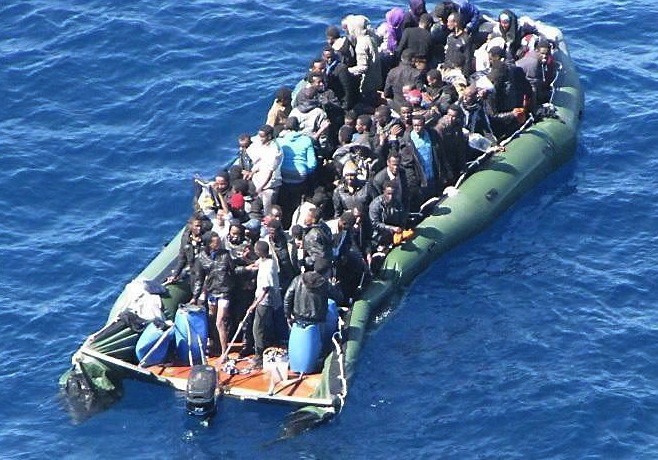
ICJ, European and Turkish partners join forces to train Turkish lawyers to protect refugees, migrants and asylum seekers’ rights
The ICJ, the European Council on Refugees and Exiles, Refugee Rights Turkey, Mülteci-Der and the ICJ-European Institutions begun today a two-year project to enhance access to justice for migrants, refugees and asylum-seekers in Turkey.
The project, which also aims to ensure protection of their rights, at the national and international levels, is co-funded by the European Union.
More information here: Turkey-ICJ project migrants-News-2017-ENG
Recent News
 Tunisia: Quash sham conviction and sentence of judges’ association President, Anas Hmedi06 Apr 2026
 The UN Human Rights Council makes significant but limited progress in addressing human rights around the world, as atrocities multiply in the Middle East and elsewhere02 Apr 2026
 ICJ hosts an African Regional Convening in Kenya on Transformative Equality Jurisprudence31 Mar 2026
 Russian Federation: Arbitrarily detained human rights lawyer Maria Bontsler must be released30 Mar 2026