Sep 25, 2019 | Advocacy, Non-legal submissions
The ICJ today joined other NGOs in drawing the UN Human Rights Council’s attention to the role of the Government of Cambodia in widespread human rights violations and abuses in the country, and called for renewal of the mandate of the UN Special Rapporteur.
The joint NGO statement was delivered by Lawyers’ Rights Watch Canada in a dialogue on the situation in Libya. The statement read as follows:
“Lawyers’ Rights Watch Canada (LRWC), the International Commission of Jurists (ICJ), and the International Service for Human Rights (ISHR) thank the Special Rapporteur for her reports. Implementation of the Sustainable Development Goals, ensuring that no one is “left behind,” necessitates equal access to remedies for rights violations within a trustworthy and independent legal system.
Cambodia has not fulfilled its treaty obligations to establish judicial independence and integrity. Civil society’s rights advocacy is continually resisted. Lawyers, defenders, journalists, politicians, or activists reporting on corruption, election irregularities, labour rights violations, illegitimate land acquisition, environmental degradation, or other rights abuses, often by businesses, are routinely subjected to official vilification; intimidation; interference with rights to expression, association, and assembly; criminalization; arbitrary detention; and even unlawful killings with impunity.
Since 2017, political opposition has been systematically suppressed, including through misuse of the judiciary. Despite the Special Rapporteur’s repeated calls for release of opposition leader Kem Sokha, he remains under court-imposed restrictions tantamount to house arrest. The Special Rapporteur has been denied visits with him contrary to Special Procedures terms of reference for country visits. In May, 25 former opposition members were summoned to court for questioning over two weeks. In September, the government threatened to arrest anyone supporting opposition politician Sam Rainsy’s return to Cambodia.
Cambodia’s responses to Special Procedures’ recommendations for the past twenty-five years have been characterized by disregard, delay, resistance, or hostility. Continued support for the Special Rapporteur’s mandate is critical to ensure that Cambodia fulfils its international human rights obligations. We request that the Council extend the mandate.”
The full written statement, including references, can be downloaded in PDF format here: UN-HRC42-Cambodia-2019
Sep 25, 2019 | Advocacy, Non-legal submissions
The ICJ today highlighted the need for a Commission of Inquiry or similar accountability mechanism for Libya, at the UN Human Rights Council in Geneva.
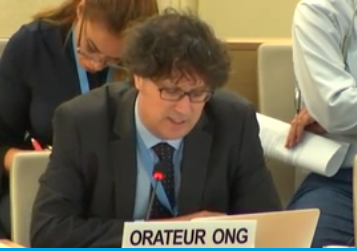
The call came in an oral statement, delivered during an interactive dialogue on Libya. It read as follows:
“The International Commission of Jurists (ICJ) welcomes the oral update by the High Commissioner for Human Rights on the situation in Libya.
Violations and abuses under international human rights, humanitarian and refugee law are being committed by State and non-State actors on a widespread and systematic scale in Libya, including since the resurgence of conflict in April. As noted by the High Commissioner on 9 September 2019, the human rights and potentially lives of migrants “intercepted by the Libyan Coast Guard and forcibly returned to Libya … are [also] under serious threat.”
Despite the scale of violations and abuses, only a handful of criminal investigations and prosecutions have been undertaken, resulting in near-total impunity.
A recent ICJ report on the criminal justice system in Libya found that the domestic legal framework governing investigations and prosecutions does not meet international law and standards on the right to a fair trial, the right to liberty and the prohibition on torture and other ill-treatment. As a result, any domestic investigation or prosecution is unlikely to satisfy the requirements of fair and effective justice. Moreover, most crimes under international law, including war crimes and crimes against humanity, are not penalized in domestic law.
These findings undercut the presumption relied upon by States in their engagement with Libya that the Libyan authorities can ensure accountability for crimes under international law.
To fill the accountability gap, the ICJ urges the Human Rights Council to establish a Commission of Inquiry or similar mechanism to document and report on gross human rights violations and to collect and preserve evidence of crimes for future criminal proceedings.
States should also refrain from entering into or implementing agreements with Libyan authorities that could give rise to support for or complicity in violations of international law.”
Sep 24, 2019 | Events, News
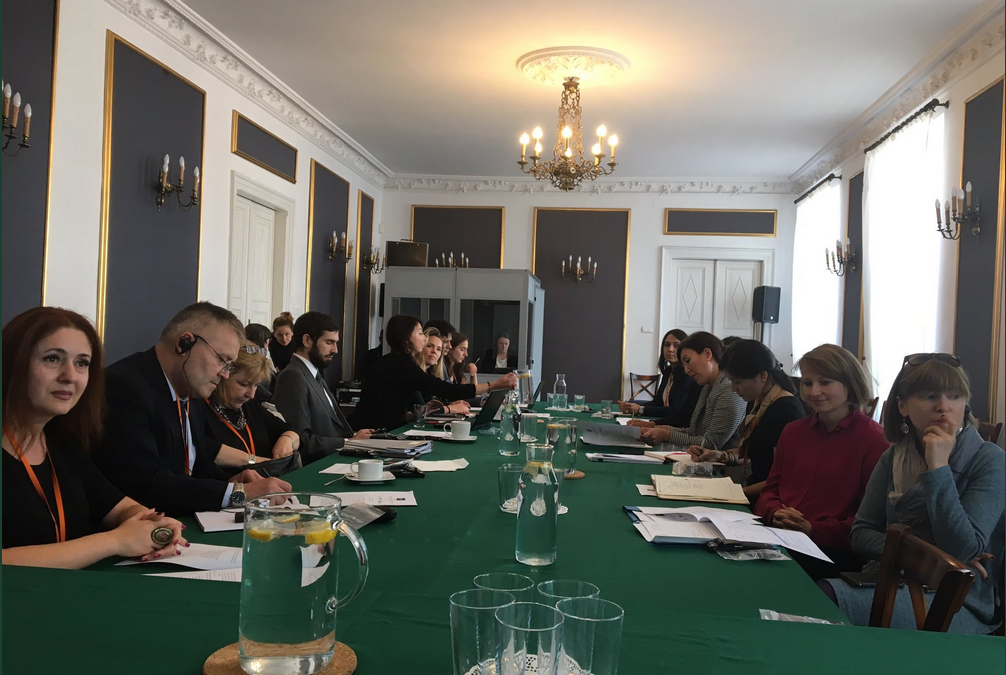
The ICJ in cooperation with a number of other leading international NGOs has organised a discussion on key challenges and opportunities for the legal profession in a number of CIS countries. The discussion aimed to share the experience of bar associations in achieving greater independence from the governmental authorities and any other undue influences.
The participants have shared their legislation and practices, specific challenges and lessons learned in taking steps to achieve institutional sustainability and independence to date, and opportunities for the legal profession, domestically and in coordination with other associations and international NGOs, to raise awareness and build legal and practical framework to enable a stronger institutional capacity and independent functioning. In addition, the ICJ, ABA, IBA, Lawyers for Lawyers, representatives of bar associations and legal experts have discussed what steps should be taken to support these efforts.
Sep 24, 2019 | Événements, Nouvelles
L’ICJ organise son premier gala-concert de récolte de fonds, le lundi 14 octobre 2019 à 19h30 au Palais Eynard, 4 rue de la Croix Rouge à Genève. Ce gala soutient l’ICJ et son combat pour la défense de l’Etat de Droit dans le monde et qui marque la fin de la série d’événements organisés pour notre 60e anniversaire dans la capitale des droits humains.
Le thème de notre gala sera: “Genève, la défense de l’Etat de Droit: que puis-je faire?”
Après un mot de bienvenue de la maire de Genève et une présentation de Me Pierre de Preux, ancien Bâtonnier de l’Ordre des avocats de Genève, les Commissaires de l’ICJ incluant Sir Nicolas Bratza (ancien Président de la Cour européenne des Droits de l’Homme), Dame Silvia Cartwright (ancienne juge et Gouverneur Général de la Nouvelle-Zélande), le professeur Bob Goldman (président de l’ICJ et ancien président de la Commission interaméricaine des Droits de l’Homme) et Mme Roberta Clarke (Présidente du Comité Exécutif de l’ICJ, Bureau de l’ONU Femmes pour les Caraïbes, Bureau régional de l’ONU Femmes pour l’Asie et le Pacifique), donneront des réponses concrètes à cette question.
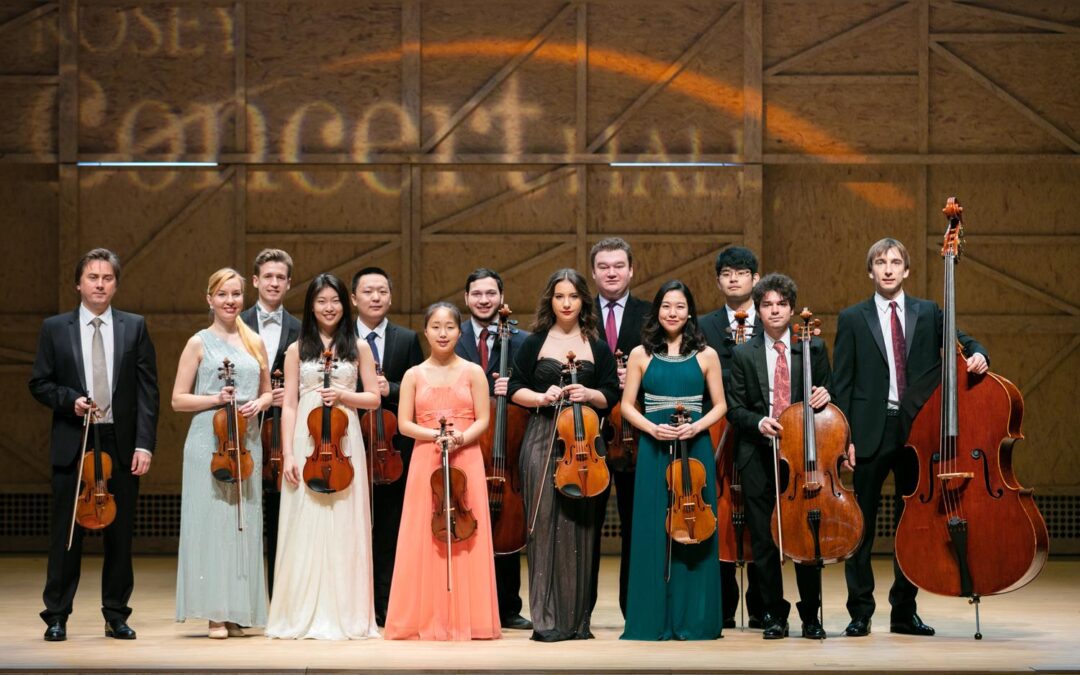
Ces interventions seront suivies d’un merveilleux concert des «Solistes de la Menuhin Academy» (photo) et d’un cocktail dînatoire.
Réservations: Pascale.andris@icj.org
Vous ne pouvez pas venir mais désirez malgré tout nous soutenir: cliquez ici
Téléchargez l’invitation:
Invitation Gala 14 Oct
Sep 24, 2019 | News
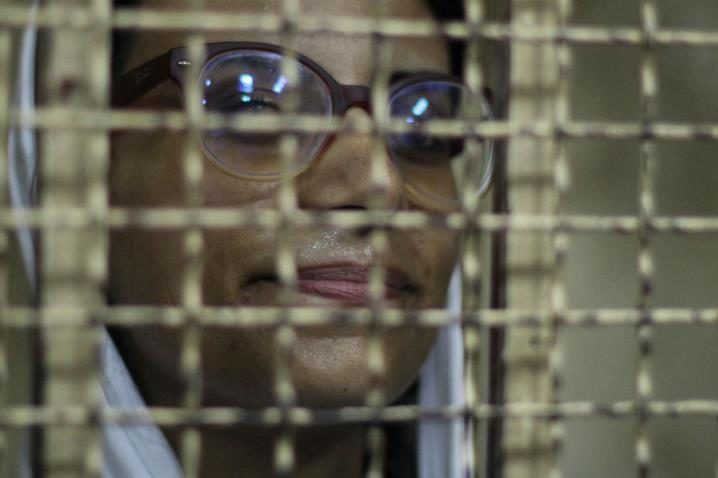
The ICJ today called for the immediate release of lawyer Mahienour al-Massry and hundreds of peaceful protestors who have been arbitrarily arrested by the Egyptian authorities in the context of recent protests against government corruption and President Abdel Fattah al-Sisi.
On 22 September 2019, Mahienour al-Massry was arrested by plain-clothes police officers outside the Supreme State Security Prosecution headquarters in Cairo, after representing five detainees in judicial investigations.
The next day she was brought before the same Supreme State Security Prosecution on unknown charges.
The detainees represented by Al-Massry had been arrested during the recent protests against President Sisi, which commenced on 20 September 2019 when hundreds of Egyptians took the streets in Cairo, Alexandria, Damietta, Mahalla al-Kubra and Suez, among other cities.
Police responded by firing tear gas and arresting hundreds.
Media accounts indicate that nearly 500 people have been arrested, most or all arbitrarily, since the protests commenced. However, documentation by local NGOs indicates that as many as 800 people may have been arrested, apparently for “participating in a ‘terrorist group’ operation” and “distributing fake news to disturb the public opinion.”
“The Egyptian authorities must drop the charges against Mahienour al-Massry, promptly release her and immediately stop persecuting, intimidating and interfering with the work of lawyers protecting the rights of others,” said Said Benarbia, Director of ICJ’s Middle East and North Africa Programme.
Mahienour al-Massry was charged in 2013 and again in 2015 for taking part in peaceful protests, for each of which she received one year-long terms of imprisonment.
Mahienour al-Massry’s recent arrest constitutes an effective sanction that violates her right to liberty under article 9 of the International Covenant on Civil and Political Rights and UN Basic Principles on the Role of Lawyers.
It also impedes the right of her clients to legal representation under article 14 of the ICCPR.
The ICJ previously filed a submission to the Universal Periodic Review regarding arbitrary arrests and detentions and systematic use of pre-trial detention in Egypt, and documented the use of the Egyptian justice system as a repressive tool to eradicate political expression and human rights work.
“The systematic use of arbitrary arrest and detention by State authorities is one of the very reasons Egyptians took to the street in protest,” said Benarbia.
“The authorities’ response provides further evidence of the widespread violations of rights Egyptians face under the current regime,” he added.
Contact:
Said Benarbia, Director of the ICJ Middle East and North Africa Programme, t: +41-22-979-3817; e: said.benarbia(a)icj.org
Download:
Egypt-al-Massry-News-web stories-2019-ARA (story in Arabic, PDF)