Jul 22, 2015 | News
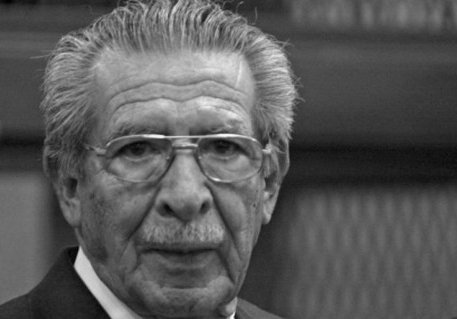
El genocidio perpetrado contra población Ixil de Guatemala será debatido en el segundo juicio seguido en contra del ex Presidente de facto Efraín Ríos Montt y el ex Director de inteligencia José Mauricio Rodríguez Sánchez.
El juicio está por reiniciarse el 23 de julio. Lamentablemente, este segundo juicio ya se ha visto afectado por diferentes hechos, que a continuación describimos.
La recusación de la jueza Presidenta del Tribunal B de Mayor Riesgo, debido a la redacción de su tesis doctoral sobre el delito de Genocidio, no debió de haber sido aceptada por no existir una causa razonable, ya que dicho trabajo de tesis se relaciona con su formación académica especializada en justicia de transición.
Posteriormente, la jueza fue sustituida por un juez que ha evidenciado relaciones de amistad a través de las redes sociales con uno de los abogados defensores del acusado Ríos Montt (photo).
Nuevamente la defensa busca que por lo menos un juez “amigo” integre el tribunal. A ello se suma el hecho de que recientemente el Instituto Nacional de Ciencias Forenses (INACIF) emitió un informe que hace referencia al supuesto problema de salud física y mental del acusado Ríos Montt.
La CIJ de la manera más enérgica expresa que estos actos son parte de una estrategia que tiene como propósito eludir la acción de la justicia.
La CIJ considera que ello constituye una violación al derecho de las víctimas al acceso a la justicia y contra el derecho a un juicio justo, libre de intromisiones de todo actor externo.
La CIJ se permite recordar al Poder Judicial que el combate a la impunidad de acuerdo con los estándares internacionales la justicia debe obedecer a tres imperativos: juzgar y sancionar a los responsables de graves crímenes, como el genocidio; satisfacer el derecho de las víctimas a conocer lo sucedido y obtener reparación integral; y fortalecer la independencia de las autoridades judiciales.
El supuesto problema de salud física y mental del acusado Ríos Montt podría ser solo una simulación, para evitar que sea nuevamente llevado a juicio.
Al respecto, la CIJ denuncia las acciones violatorias del debido proceso realizadas una vez más, por la jueza Carol Patricia Flores, quien ordenó se le practicasen exámenes médicos a Ríos Montt, para averiguar acerca de su estado de salud físico y mental.
Esta orden de la jueza Flores es ilegal, debido a que el proceso ya se encontraba a cargo del tribunal de Sentencia Penal B de Mayor Riesgo y ella carecía de competencia para ordenar tal medida.
La CIJ insta a los jueces a ejercer su poder de contralores del proceso penal, rechazando todos los actos de litigio de mala fe que sean promovidos por la defensa de los procesados.
Se requiere que los jueces a cargo del juicio se encuentren libres de toda presión externa que pueda intimidarlos en su función.
Para garantizar su independencia deben contar con el apoyo de la Corte Suprema de Justicia, quien debe velar por su seguridad y por el desarrollo del proceso en un marco de respeto.
Ramón Cadena, Director de la CIJ para Centro América, expresó: “Otra vez estamos ante una serie de medidas dilatorias, que demuestran que existen jueces que se prestan a promover la impunidad de graves violaciones a los derechos humanos.”
Jul 22, 2015 | News
Cambodian authorities must immediately quash the convictions for insurrection handed down to eleven opposition party activists on 21 July, the ICJ said today.
The Phnom Penh Municipal Court sentenced the National Rescue Party (CNRP) activists to between seven and 20 years in prison following an unfair trial.
“These men were grossly over-charged with insurrection in the first place,” said Kingsley Abbott, ICJ International Legal Adviser.
“The fact they have now been handed down disproportionately severe sentences following an unfair trial only serves to underscore that a serious miscarriage of justice has taken place in violation of Cambodia’s international obligations,” he added.
The charges arose out of their participation in a demonstration on 15 July 2014 against the closure of Phnom Penh’s designated protest site, Freedom Park, that became violent after “public-order” para-police attempted to break up the protest and were attacked by some people in the crowd.
According to information provided to the ICJ, all but one of the accused’s nine lawyers either boycotted or were unable to attend Tuesday’s suddenly-scheduled hearing in protest against a decision by the Court on Monday to fast track the trial.
When the Court unexpectedly called for closing arguments, the accused requested their lawyers to be present, which was denied.
According to observers, no credible evidence was produced during the trial connecting the eleven to the violence and the verdicts were read out after only 15 minutes of deliberation.
“In the event that fresh charges are brought, they must be consummate with the seriousness of the alleged offending, based on reliable evidence, and be adjudicated upon at a trial that scrupulously respects international fair trial standards in accordance with Cambodia’s international obligations,” Abbott said.
Background
Three men – Meach Sovannara, Oeur Narith, and Khin Chamreun – were convicted of participating in and leading an insurrectionary movement and were sentenced to 20 years imprisonment.
Eight men – Sum Puthy, Neang Sokhun, San Kimheng, Tep Narin, San Seihak, An Batham, Ouk Pich Samnang, and Ke Khim – were convicted of participating in an insurrectionary movement and were sentenced to seven years imprisonment.
Tuesday’s verdicts are inconsistent with international law and standards including article 14 of the International Covenant on Civil and Political Rights (ICCPR), to which Cambodia is a State Party, which states that everyone has the right to a “fair and public hearing by a competent, independent and impartial tribunal established by law.”
Contact:
Kingsley Abbott, International Legal Adviser, Asia & Pacific Programme, t: + 662 6198477, + 662 6198478 Ext. 203 ; e: kingsley.abbott(a)icj.org
Jul 21, 2015
An opinion piece by Vani Sathisan, Sanhita Ambast and Reema Omer, ICJ International Legal Advisers for Myanmar and South Asia, respectively.
Blasphemy prosecutions are undermining the rule of law in Myanmar, India and Pakistan.
Blasphemy laws, such as section 295A of the penal code, are inconsistent with human rights including freedom of opinion and expression, freedom of thought, conscience, and religion, the right to liberty, and the right to equality before the law without discrimination.
They are also applied arbitrarily and accused persons are often punished after unfair trials.
Section 295A, enacted by colonial authorities in 1927 to curb communal tension, is the same in all three countries.
It states that, “deliberate and malicious intention of outraging the religious feelings of any class by insulting its religion or religious beliefs” shall be punished with imprisonment, or with fine, or with both.
In a litany of recent cases, however, courts have convicted individuals in the absence of evidence of any deliberate and malicious intent to insult a religion.
People have been severely punished simply because their acts of expression without such intent were perceived to be at odds with conservative interpretations of a religion. In Myanmar, at least, statements offensive to minority religions go unpunished.
Earlier this year in Myanmar, Philip Blackwood and his colleagues Tun Thurein and Htut Ko Ko Lwin, were jailed for two and a half years with hard labour under 295A for distributing on Facebook a psychedelic image of the Buddha wearing headphones to promote their bar.
More recently, Htin Linn Oo, a writer and National League for Democracy information officer, was sentenced to two years imprisonment with hard labour under 295A.
An edited ten-minute video of his two-hours speech at a literary event was posted on social media, outraging some Buddhist groupsA Buddhist himself, he had questioned the Buddhist credentials of those using Buddhism to incite violence.
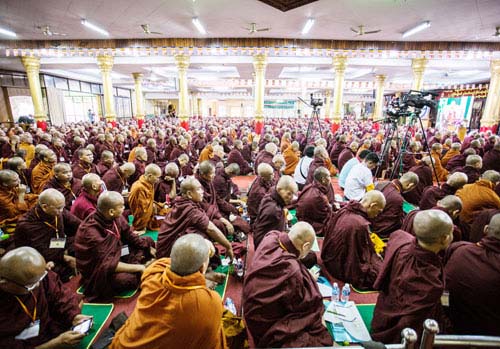
The Ma Ba Tha, an ultra-nationalist movement seeking to “control the spread of Islam” in predominantly-Buddhist Myanmar, and other nationalist monks, protested outside the court and demanded for a tougher punishment.
The District Court rejected his appeal, reportedly stating it “should not interfere” with the lower court’s decision.
These convictions violate international law, including a range of human rights recognized by the Universal Declaration of Human Rights and by international treaties.
Myanmar’s Constitution guarantees the right to freedom of expression, conscience, and to freely profess and practice religion, and this, together with the absence of proof of intent, make the convictions difficult to reconcile with Myanmar’s own laws.
The convictions are a worrying indicator of growing religious intolerance in the country.
Examples from India demonstrate how the very existence of section 295A can chill free speech, even before a case has a chance to reach the courts.
Section 295A has been used to arrest and charge individuals who express allegedly “outrageous” opinions, even without evidence of intent.
Shaheen Dhada and Renu Srinivasan, for example, were originally charged under 295A for criticizing Mumbai’s shut down following the death of right-wing politician, Bal Thackeray, on Facebook. This charge was later modified.
In 2014, Penguin India decided to withdraw publication and destroy remaining copies of Wendy Doniger’s scholarly work “The Hindus: An Alternative History” in response to a case filed under section 295A by a right wing religious group accusing the book of hurting Hindu sentiments.
While police may drop such charges at a later stage, section 295A has still damaged free expression by enabling the initial harassment.
Pakistan has enacted even broader provisions such as section 295C of the Pakistan Penal Code, criminalizing words, representations, imputations, innuendos, or insinuations, which directly or indirectly, lead to “defiling the sacred name of the Holy Prophet”.
Courts are even more willing to dispense entirely with proof of intent or any objective standard for what constitutes blasphemy under this section.
The UN Human Rights Committee established by the International Covenant on Civil and Political Rights (a key human rights treaty to which India and Pakistan are parties), has emphasized that, “Prohibitions of displays of lack of respect for a religion or other belief system, including blasphemy laws, are incompatible with the Covenant”.
The only limited exception under the Covenant would be for proportionate and non-discriminatory measures to prohibit “advocacy of … religious hatred that constitutes incitement to discrimination, hostility or violence”; section 295A, and in Pakistan, section 295C, fall far short of this threshold.
The incompatibility of these laws with international human rights, as well as their discriminatory application, renders the proceedings and punishments based upon them arbitrary.
The concern is all the more acute when the judicial systems lacks independence or impartiality, as the ICJ has found to be the case in Myanmar, or where blasphemy trials are grossly unfair and the prescribed punishment is mandatory death penalty, as in Pakistan.
Those who support prosecutions under the blasphemy laws may honestly believe they are protecting the dignity of their religion, but by violating human rights such prosecutions deny the human dignity of the defendants and undermine the rule of law for all.
The laws must be repealed or fundamentally changed, ongoing prosecutions ended, and those imprisoned for their beliefs or protected speech immediately and unconditionally released.
Photo: Zarni Phyo/The Myanmar Times
Jul 19, 2015 | News
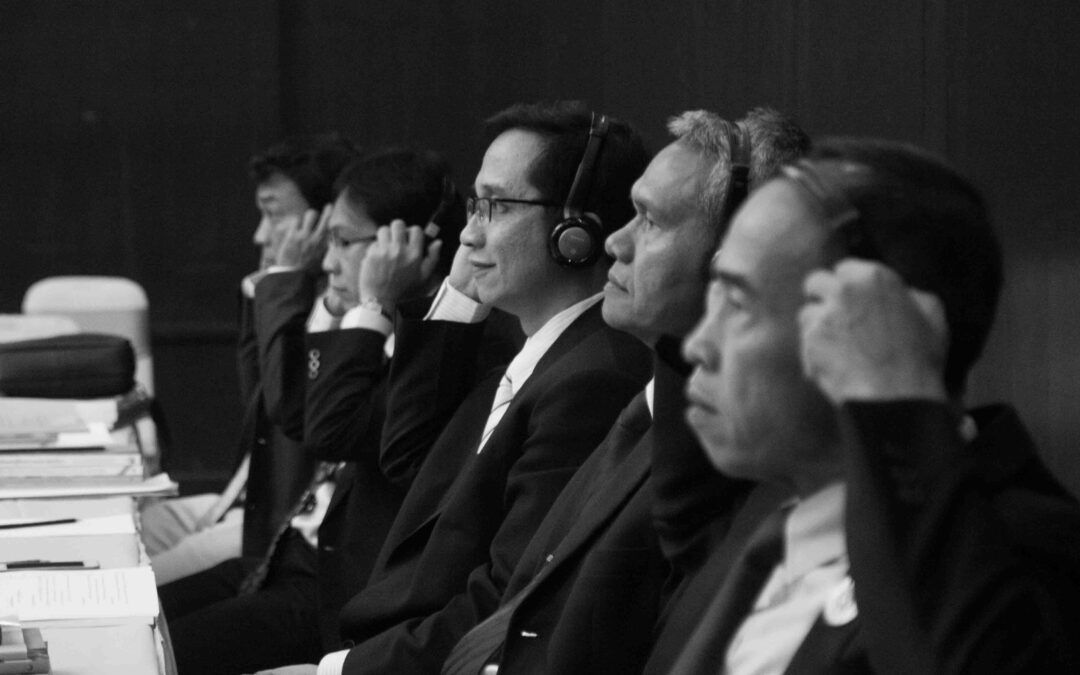
On 18-19 July 2015, the ICJ held a workshop on “The Protection of Victims in Criminal Cases” for 35 judges in Thailand’s deep South. This is the fifth workshop the ICJ has held with the judges of Region 9 since 2011.
The objective of the workshop, held in Hat Yai, was to discuss how to improve procedural measures to protect victims in Thailand with reference to international law and standards.
Speakers at the workshop included Justice John Lawrence O’Meally, an ICJ Commissioner from Australia, Judge Dol Bunnag, Chief Judge of the Juvenile and Family Court of Sakonnakorn Province, Chief Judges from Region 9, and Marie Guiraud, International Civil Party Lead Co-Lawyer at the Khmer Rouge Tribunal in Cambodia.
Background:
Previous ICJ workshops with the Judges of Region 9 have covered the following topics:
- Rule of Law and Strengthening the Administration of Justice in the Context of the Application of Emergency Laws in the Southern Border Provinces (2011)
- Rule of Law and Strengthening the Administration of Justice in the Context of Bail in the Southern Border Provinces (2012)
- Rule of Law and Strengthening the Administration of Justice in the Context of Habeas Corpus in the Southern Border Provinces (2012)
- The Principle of Inadmissibility of Evidence Obtained by Unlawful Means and Hearsay Evidence: International Standards Compared to Thai Law (2014)
Jul 17, 2015
In a briefing paper released today, and an accompanying letter to Nepal’s Constituent Assembly, the ICJ raises a number of concerns about Nepal’s Draft Constitution.
The Constituent Assembly’s endorsement of a Draft Constitution on 7 July 2015, and the subsequent opening of a 15-day public consultation on this draft, represents a unique and crucial moment in Nepal’s constitutional history, the ICJ said.
But to fulfill the promises of the Comprehensive Peace Accord that ended the decade-long armed conflict and the guarantees of the Interim Constitution it will replace, changes to the drafting process must ensure adequate opportunity for meaningful and inclusive public participation, and amendments to the Draft Constitution are required to protect human rights in accordance with Nepal’s international obligations.
“This 15-day timeframe must be expanded, and provisions of the draft Constitution must be amended, to ensure that the Nepali people have the opportunity to frame a Constitution which guarantees the rule of law, human dignity and enhanced human rights protection,” said Wilder Tayler, Secretary General of the International Commission of Jurists.
In a letter to the Chairperson of the Constituent Assembly on 17 July 2015, accompanied by a detailed briefing paper, the ICJ has made recommendations for changes to both the constitution-making process and text of the Draft Constitution in light of Nepal’s obligations under international human rights law.
The ICJ has underscored that, while the renewed momentum within the Nepali government in the aftermath of the earthquake to finalize and adopt the long-awaited Constitution is welcome, the speed and manner in which the consultation on the first Draft Constitution is being conducted is undermining people’s right to participate.
“Such ‘fast-tracking’ risks delegitimizing the constitution-making process by undermining people’s right to participate in it”, Secretary-General Tayler said. “The government must urgently revise the timetable to ensure that all individuals, including minorities, historically marginalized groups and people in remote areas whose accessibility is further compromised by the rainy season, have the necessary time and resources to meaningfully review and comment on the draft”.
The ICJ has also noted several provisions of the Draft Constitution that must be amended to fully comply with international human rights standards and to protect the rule of law.
The ICJ’s analysis of the provisions of the Draft Constitution on citizenship, fundamental rights and judicial independence, in light of Nepal’s international human rights obligations, found that:
- The citizenship provisions are vague and discriminatory, and risk making people stateless;
- Non-citizens are excluded from key rights entitlement and protections;
- Several rights, including women’s rights and key economic, social and cultural rights, are not adequately protected;
- Restrictions on the rights to free speech, expression, information and press freedom, as well as the rights to freedom of association and assembly are broad and vague and do not conform with international human rights standards;
- Provisions on remedy for human rights violations are lacking;
- Protections of the independence of the judiciary are weak and inadequate;
- Provisions on emergencies and consequent restriction of rights are overbroad.
“Amendments to the Draft Constitution to address these concerns, among others are needed if Nepal is to adopt a strong and progressive Constitution which safeguards the rule of law, human rights and the independence of the judiciary, consistent with the country’s obligations under international human rights law,” Tayler said.
Download the ICJ’s letter to the Constituent Assembly here:
NEPAL-DRAFT CONST-ADVOCACY-OPEN LETTER-2015-ENG
Download the ICJ’s full briefing here:
NEPAL-CONSTITUTION-ADVOCACY-ANALYSIS BRIEFS-2015-ENG
Contact:
Nikhil Narayan, Nepal Head of Office and ICJ Senior Legal Adviser, m: +977-(0)9813187821, e-mail: nikhil.narayan(a)icj.org