Jul 4, 2015 | Artículos, Noticias
Venezuela está intimidando y hostigando a defensores y defensoras de derechos humanos y les ha acusado infundadamente de que estarían intentando desestabilizar la democracia en el país, indicaron hoy 28 organizaciones de derechos humanos internacionales y latinoamericanas.
Los señalamientos de las autoridades se refieren a las funciones legítimas que ejercen estas organizaciones al documentar abusos y representar a víctimas ante organismos internacionales de derechos humanos.
Las autoridades venezolanas deberían desistir inmediatamente de esta táctica, expresaron las organizaciones. Los gobiernos que participarán en la Cumbre de las Américas, que tendrá lugar en Panamá el 10 y 11 de abril de 2015, deberían exigir al gobierno de Nicolás Maduro que asegure que las defensoras y los defensores de derechos humanos puedan realizar su labor sin temor a sufrir represalias, dijeron las organizaciones.
La persecución del gobierno apunta claramente a desacreditar e intimidar a organizaciones que documentan violaciones de derechos humanos, indicaron las organizaciones.
Venezuela-Harassment of HRDs-News-web stories-2015-SPA
Venezuela-Harassment of HRDs-News-web stories-2015-POR (em Português)
Jul 3, 2015
The three-day hearing on the assessment of damages on the civil defamation case against blogger Roy Ngerng was concluded today in Singapore. The Supreme Court will issue its decision at a later date.
A representative of the ICJ observed the hearing that took place from 1 to 3 July 2015. The ICJ considers the judge, Justice Lee Seiu Kin, to have conducted himself independently and impartially with regard to the procedural aspects of the hearing.
During the first day, Prime Minister Lee himself took to the witness stand and was cross-examined by Roy Ngerng.
Prime Minister Lee brought this action against Roy Ngerng claiming that the blogger suggested in his blog post that the Prime Minister was guilty of criminal misappropriation of the Central Provident Fund (CPF), the social security savings plan of the citizens of Singapore.
Roy Ngerng maintains a blog called The Heart Truths, where he comments on pressing social issues. Many of the posts on his blog advocate for more transparency in the management of the CPF.
Last year, the High Court ordered Roy Ngerng to pay Prime Minister Lee SG$29,000 (approximately US$22,300) for the legal fees and related expenses incurred up to the conclusion of the application for summary judgment.
In June, the ICJ produced a legal opinion (download text below) which was submitted to the court in support of certain aspects of the defendant’s position.
The brief drew attention to relevant international law and standards.
It underscored, among other things, that the exercise of freedom of expression is essential to enable the work of human rights defenders to carry out their work.
It also noted the particular standards applying to defamation cases involving public offices, particularly that those exercising the highest political authority such as heads of states may legitimately be subjected to criticism and challenges.
It also emphasized that damages awarded that are disproportionate to the harm caused could serve to create a chilling effect on the freedom of expression in Singapore.
At the end of the hearing, the court directed the parties to file written submissions to address issues that were raised during the three-day hearing by 30 August 2015.
Singapore-RoyNgerng-Advocacy-LegalSubmission-2015-ENG (download the legal opinion)
CONTACT:
Emerlynne Gil, ICJ’s Senior International Legal Adviser for Southeast Asia,
email: emerlynne.gil(a)icj.org or mobile: +668 4092 3575
Jul 2, 2015 | News
The Royal Thai Government must immediately end its harassment and intimidation of human rights lawyer, Sirikan Charoensiri, the ICJ said today.
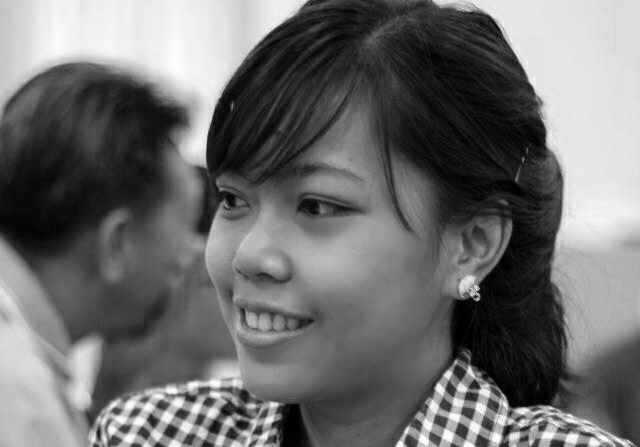
Sirikan Charoensiri (photo), a lawyer with Thai Lawyers for Human Rights (TLHR), has been providing legal aid to 14 students who were arrested on 26 June 2015 after carrying out peaceful protests calling for democracy and an end to military rule.
Since then, the Royal Thai Police have threatened Sirikan Charoensiri with legal action, publically announced they are considering charging her with a crime, and visited her home and questioned her family.
“The government must immediately end its harassment and intimidation of human rights lawyer Sirikan Charoensiri,” said Matt Pollard, Head of the ICJ’s Centre for the Independence of Judges and Lawyers in Geneva. “The case against her clients clearly violates Thailand’s obligations under international law, and cannot be a valid basis for the police to take any action against her for defending their rights.”
On 30 June 2015, the ICJ met in Geneva with staff members of the United Nations Special Rapporteurs on the Independence of Judges and Lawyers, and on the Situation of Human Rights Defenders, in order to bring Sirikan Charoensiri’s case to their attention.
“The ICJ has been repeatedly warning of Thailand’s steady slide away from open democracy and the rule of law,” added Pollard. “These actions of the police, targeting peacefully protesting students with prosecution in a military court, and then targeting the lawyer who comes to their defence, underscores the urgent need to restore respect for human rights in Thailand.”
Contact:
Matt Pollard, Senior Legal Adviser, ICJ’s Centre for the Independence of Judges and Lawyers, t: +41 22 979 38 12, e: matt.pollard(a)icj.org
Background
The 14 students were arrested during the evening of 26 June 2015 and were brought to a police station in Bangkok and then to the Bangkok Military Court for a hearing on pre-trial detention, which proceeded until midnight.
The students have been charged with violating order 3/2015 of the National Council for Peace and Order (which prohibits the public assembly of more than five people for political purposes) and a ‘sedition’-type offence under section 116 of Thai Criminal Code, which carries a maximum sentence of seven years imprisonment.
Upon hearing of the students’ arrest, Sirikan Charoensiri and three other lawyers drove in her car to the Bangkok Military Court in order to provide legal aid to the students.
Following the hearing and during the early morning of 27 June 2015, the police asked Sirikan Charoensiri for her permission to search her car for the student’s phones, without a warrant. She refused to consent to the warrantless search. As a result, the Police impounded her car, which contained the lawyers’ case files and personal computers, and five phones belonging to the students.
At 12:45pm, Sirikan Charoensiri went to the police station to file a complaint of malfeasance regarding the seizure of her car. The police refused to accept the complaint and in the meantime another police team searched her car with a warrant. Five phones belonging to the students were seized as evidence.
At 18:00pm, Sirikan Charoensiri again attempted to file a complaint at the police station for malfeasance. A senior investigator told her that the police had power to search her car and suggested that if she filed a complaint, it would not finish there and that the police would consider countering with some form of legal action against her. The police finally accepted the complaint at 11:00pm.
On 28 June 2015, a senior police officer told the media that they had found “important evidence” in Sirikan Charoensiri’s car and are considering whether to charge her with a crime.
On 29 June 2015, the police visited Sirikan Charoensiri’s family home and asked her parents to identify her in photos and questioned them about her background.
The International Covenant on Civil and Political Rights (ICCPR), to which Thailand is a State Party, guarantees the right to peaceful assembly; the right to freedom of expression; the prohibition of arbitrary arrest or detention and the right to a fair and public hearing by a competent, independent and impartial tribunal established by law (including the right of prompt access to a lawyer and precluding jurisdiction of military courts over civilians in circumstances such as these); and the prohibition of arbitrary or unlawful interference with privacy, family, home and correspondence (which includes arbitrary searches or seizures).
The UN Declaration on Human Rights Defenders affirms the right of everyone peacefully to oppose human rights violations. It prohibits retaliation, threats and other harassment against anyone who takes peaceful action against human rights violations, both within and beyond the exercise of their professional duties. It protects the right of persons to file formal complaints about alleged violations of rights. The UN Basic Principles on the Role of Lawyers provide that governments are to ensure that lawyers are able to perform their professional functions without intimidation, hindrance, harassment or improper interference.
Sirikan Charoensiri formerly served as a National Legal Consultant with the ICJ.
Thailand-Sirikan case-News-press releases-2015-THA (full text in PDF, Thai version)

Jul 2, 2015 | News
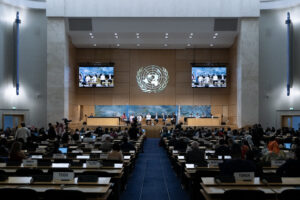
The Human Rights Council today adopted a resolution on the independence of judges & lawyers, with several new provisions on gender balance in the judiciary, judicial accountability, children and court proceedings, and development of professional guidance on marginalized and other groups.The resolution builds on past resolutions of the Human Rights Council.
The full text of the resolution is here: HRC29-ResolutionJudgesLawyers-2015 Its official resolution number has not yet been assigned.
The main sponsors of the resolution were Australia, Botswana, Hungary, Maldives, Mexico, Thailand. The resolution was adopted by consensus (without a vote).
A resolution on this topic will next be presented in 2017.
Jul 2, 2015
The ICJ today joined other organisations in urging Sri Lanka and the international community to measure progress against three key tests before September 2015, to assess the Government’s willingness towards establishing a credible and transparent justice and accountability process.
First, the Government should ensure that any mechanism created to address wartime abuses is defined through genuine consultations with those affected by violations; one that has their confidence and not one imposed on them from the above. To this end the government should be guided by the advice of UN experts that victims be consulted and involved, and it should announce and implement a convincing framework for such a credible process, within a clear timeframe. Given the track record of past domestic inquiries, any mechanism needs to be international, or at a minimum one with a majority of international judges and prosecutors, in order to guarantee its independence and give greater security to those who participate in it.
Second, the Government should take immediate steps towards resolving key outstanding issues to demonstrate its commitment. This includes: repealing the PTA; a substantial scaling down of military presence in the North and East and ending all undue military interference in the political, social, economic and cultural lives of the population of the region; resolving all conflict induced land issues; ending all forms of harassment of civil society, media and human rights defenders particularly in the North and East; and restoring fundamental freedoms fully and equally in all parts of the country. The government must also act to resolve all disappearances in the country, and to this end the President must make the report of the Presidential Commission on Disappearances public when it is finalised in August.
Third, the government must keep its promise to the UN and fully cooperate with the Office of the High Commissioner for Human Rights and allow it full access to any new or additional information it may require. It was on the basis of the promise of such cooperation and additional information, that extra time was provided to the new government in Sri Lanka through a deferral of the OHCHR report.
Until these three tests are satisfactorily met, the international community and the UN Human Rights Council must maintain the fullest scrutiny of Sri Lanka on questions of justice and accountability. Although it is to be acknowledged that since January Sri Lanka’s government has induced some positive change in easing the abusive human rights climate of the previous Presidency, it must also be recognised that many challenges still remain unaddressed.
The full letter is available here: SriLanka-JointOpenLetter-Accountability-Advocacy-2015