Feb 27, 2014 | News
The ICJ is profoundly concerned at the recent enactment of legislation in Nigeria and Uganda that heralds further persecution based on sexual orientation and/or gender identity.
On 24 February 2014, Uganda’s President, Yoweri Museveni, gave his assent to the Anti-Homosexuality Bill recently adopted by the Uganda Parliament by signing it into law.
His Nigerian counterpart, President Goodluck Jonathan, had signed the Same Sex Marriage (Prohibition) Bill into law on 7 January this year.
In both countries pre-existing legislative provisions already criminalized consensual same-sex sexual activity in private in contravention of international human rights law and standards, including the Universal Declaration of Human Rights, the International Covenant on Civil and Political Rights and the International Covenant on Economic, Social and Cultural Rights.
These core global instruments each affirm the universal and inalienable rights to human dignity, equality and non-discrimination.
“Carnal knowledge…against the order of nature,” for example, was already a criminal offence in both Nigeria and Uganda, carrying, upon conviction, maximum sentences of 14 years’ imprisonment in the former and life imprisonment in the latter.
The new Nigerian legislation makes people of the same gender who contract a marriage or civil union liable upon conviction to 14 years’ imprisonment.
Further, it makes criminally responsible anyone who “administers, witnesses, abets or aids” a same-sex marriage or civil union ceremony, rendering those found guilty of the offence liable to 10 years’ imprisonment.
It also outlaws the registration, activities and funding of any “gay” organization, making them offences attracting 10 years’ imprisonment upon conviction.
In Uganda, the new law, among other things, explicitly criminalizes consensual same-sex conduct between women and makes it an offence for people to discuss and be open about their sexuality.
Further, it criminalizes “homosexuality”, “aggravated homosexuality” and same-sex marriages, all of which carry sentences of life imprisonment upon conviction.
Moreover, it makes it a criminal offence to make available information about sexual orientation, safe sex and gender identity. Renting premises to those who may “practice homosexuality” is also a crime.
The ICJ considers that laws or regulations that directly or indirectly criminalize consensual same-sex sexuality or conduct provide State actors with the means to perpetrate human rights violations, including through harassment, extortion and discriminatory “criminal” investigations, prosecutions, trials and imprisonment.
Equally, these laws enable non-State actors to persecute with impunity individuals based on their real or perceived sexual orientation and/or gender identity.
Indeed, laws that criminalize same-sex consensual sexual activity contribute to an atmosphere of State-supported homophobia and transphobia and serve as both the motivation and justification for harassment, extortion and physical abuse of people based on their real or attributed sexual orientation and/or gender identity by non-State actors.
In the circumstances, not only is cruel, inhuman or degrading treatment at the hands of non-State actors on the basis of real or perceived sexual orientation and/or gender identity not prevented, but such treatment and other human rights abuses are fostered when the authorities enact laws criminalizing consensual same-sex sexuality or conduct.
Overall, the existence of such laws works to deprive individuals who are, or are perceived to be, lesbian, gay, bisexual, transgender or intersex of adequate protection from violence and discrimination, including police protection and judicial redress.
This makes the provision of effective protection by State authorities extremely unlikely if not altogether impossible given that extending such protection would in turn be tantamount to aiding and abetting the perpetration of the very acts that such laws criminalize.
Putting the same point another way: protection is neither effective nor available when laws criminalizing consensual same-sex sexual relations or acts exist, because the individuals who need protection would effectively be outing themselves to the authorities should they decide to seek protection from them.
Accordingly, the existence of these laws entails a real risk of violations of the right to life, to liberty and security of the person, and to mental and physical integrity.
In light of the above, the ICJ considers that Uganda’s Anti-Homosexuality Act and Nigeria’s Same Sex Marriage (Prohibition) Act contravene each country’s respective Constitution and their international treaty and customary law obligations by which both countries are bound.
In particular, the Acts directly violate the right to dignity; equality, including equality before the law and equal protection of the law; non-discrimination; liberty and security of person; privacy; opinion and expression; association and peaceful assembly; and the right to access health services and care without discrimination.
Both pieces of legislation also undermine and criminalize the critical work of human rights defenders and civil society organizations that seek to combat discrimination and persecution based on sexual orientation and/or gender identity.
They also have very serious public health implications, including, for example, as a result of the fact that they hinder the prevention and treatment of HIV/AIDS.
The UN High Commissioner for Human Rights, Navi Pillay, has strongly denounced both pieces of legislation.
In relation to the Nigerian law, the High Commissioner said: “rarely have I seen a piece of legislation that in so few paragraphs directly violates so many basic, universal human rights”.
She further noted that the legislation “purports to ban same-sex marriage ceremonies but in reality does much more.
It turns anyone who takes part in, witnesses or helps organize a same sex marriage into a criminal. It punishes people for displaying any affection in public towards someone of the same sex.
And in banning gay organizations it puts at risk the vital work of human rights defenders who speak up for the rights of lesbian, gay, bisexual, transgender (LGBT) and intersex people”.
In his reaction to the enactment of the Nigerian legislation, the Executive Director of UNAIDS, Michel Sidibé, expressed concern that: “The provisions of the new law in Nigeria could lead to increased homophobia, discrimination, denial of HIV services and violence based on real or perceived sexual orientation and gender identity … It could also be used against organizations working to provide HIV prevention and treatment services to LGBT people.”
In relation to the Ugandan legislation, the High Commissioner said: “Disapproval of homosexuality by some can never justify violating the fundamental human rights of others” adding that the law “will institutionalise discrimination and is likely to encourage harassment and violence against individuals on the basis of their sexual orientation. It is formulated so broadly that it may lead to abuse of power and accusations against anyone, not just LGBT people.”
The ICJ urges the Nigerian and Ugandan authorities to urgently repeal the new legislation, as well as the pre-existing legislative provisions criminalizing consensual same-sex sexual activity in private.
Contact:
Livio Zilli, ICJ Senior Legal Adviser, Sexual Orientation and Gender Identity Programme, t +41 22 379 3823; email: livio.zilli(a)icj.org
Feb 25, 2014
The ICJ urges the Human Rights Council to establish an international commission of inquiry to investigate alleged violations of international human rights and humanitarian law in Sri Lanka.
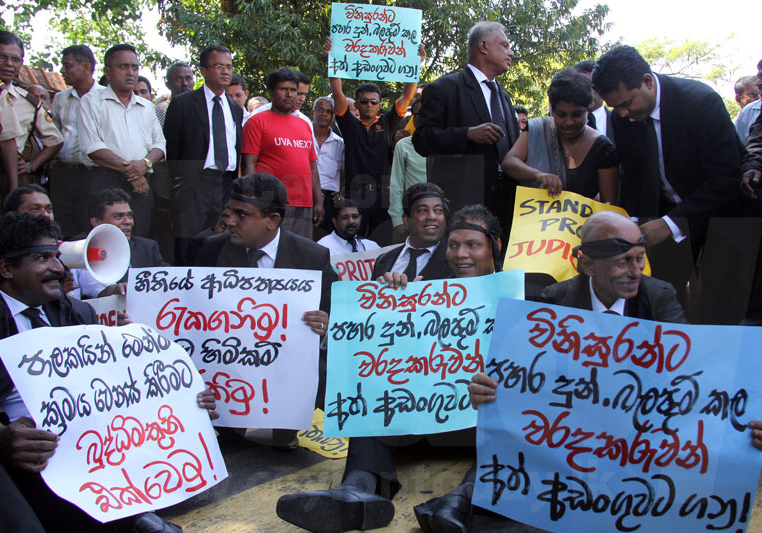
“The Sri Lankan justice system can no longer ensure accountability for human rights violations and war crimes,” said Sam Zarifi, ICJ Asia Pacific Regional Director. “The judiciary has been stripped of its independence and impartiality, and lawyers continue to be intimidated, harassed and subjected to improper interference.”
The ICJ welcomes the UN High Commissioner’s report on Sri Lanka released yesterday.
In the report, Navi Pillay notes with concern that the Government of Sri Lanka has failed to make any significant progress in any of the areas of concern she had highlighted in her oral update to the Human Rights Council in September 2013.
The Government has failed to show any progress towards a credible national investigation process with tangible results, including the prosecution of perpetrators of serious violations of human rights and international humanitarian law; failed to address the serious and ongoing problem of enforced disappearances; failed to set a clear timeline for the disengagement of the military from activities that should be civilian; failed to prosecute a single incident of violence against journalists and human rights defenders; and failed to take measures to address the increasing attacks against religious minorities.
The High Commissioner remarked that ‘national mechanisms [in Sri Lanka] have consistently failed to establish the truth and achieve justice.’
A briefing paper prepared jointly with the International Bar Association published today (see below) explains how ongoing attacks on the judiciary and legal profession have undermined the rule of law and resulted in a general failure of the Sri Lankan justice system to ensure accountability for human rights.
“Judges and lawyers are routinely subjected to intimidation, hindrance, harassment, and improper interference,” Zarifi added. “In the last 18 months, we are aware of at least 10 incidents against judges and lawyers and to date, no one has been prosecuted for these attacks.”
More than a year after the highly politicized impeachment of the 43rd Chief Justice Dr Shirani Bandaranayake, there continues to be no transparent, independent, impartial and fair procedure for the removal or discipline of judges in Sri Lanka.
Pursuant to its legal obligations under the International Covenant on Civil and Politicial Rights, as elaborated on by the UN Basic Principles on the Independence of the Judiciary, Sri Lanka must take measures to ensure the judiciary is protected from improper influences, inducements, pressures, threats and interferences.
The appointment process for the judiciary must be based on integrity and ability and there must be safeguards against judicial appointments for improper motives.
“The 18th Amendment, which endows President Mahinda Rajapaksa unilateral authority to make judicial appointments has cleared the way for a politicized appointments process, where appointments are made on the basis of loyalty and personal patronage rather than seniority, integrity and proven competence,” said Zarifi.
“What we are left with is a judiciary that is no longer capable of achieving justice and ensuring accountability for human rights violations.”
The High Commissioner concluded that in the absence of a credible national process, ‘the international community has a duty to take further steps, which will advance the right to truth for all in Sri Lanka and create further opportunities for justice, accountability and redress.’
The ICJ supports the recommendations in the High Commissioner’s report and calls on the member States of the Human Rights Council to establish an international independent commission of inquiry to investigate allegations of violations of human rights and humanitarian law in Sri Lanka.
Contact:
Sam Zarifi, ICJ Asia Pacific Regional Director, (Bangkok); t: +66 807819002; email: sam.zarifi(a)icj.org
Sheila Varadan, ICJ Legal Advisor, South Asia Programme (Bangkok), t: +66 857200723; email: sheila.varadan(a)icj.org
Background
The United Nations High Commissioner for Human Rights issued its Report pursuant to Human Rights Council Resolution 22/1, which encouraged the Government of Sri Lanka to implement the constructive recommendations of the Lessons Learnt and Reconciliation Commission, to implement the recommendations of the 2013 report of the United Nation High Commissioner for Human Rights on Sri Lanka, as well as conduct an independence and credible investigation into allegations of violations of international human rights and humanitarian law.
At the September 2013 session of the Human Rights Council, the ICJ delivered a statement saying, “We look forward to the presentation of a comprehensive report from the High Commissioner at the 25th session and urge the Council to prepare to take action at that time if the Government continues to fail to take concrete steps to ensure justice and accountability for alleged violations of international human rights law and humanitarian law in Sri Lanka.”
Sri Lanka-Rule of Law undermined-Advocacy-analysis brief-2014 (download Advocacy Note in English pdf)
Sri Lanka-Rule of Law undermined – Advocacy-analysis brief 2014 -Fr (download Advocacy Note in French pdf)
Sri Lanka-Rule of Law undermined – Advocacy-analysis brief 2014-Sp (download Advocacy Note in Spanish pdf)
Sri Lanka-Rule of Law undermined – Advocacy-analysis brief 2014-Ar (download Advocacy Note in Arabic pdf)
Feb 24, 2014 | Events, Training modules
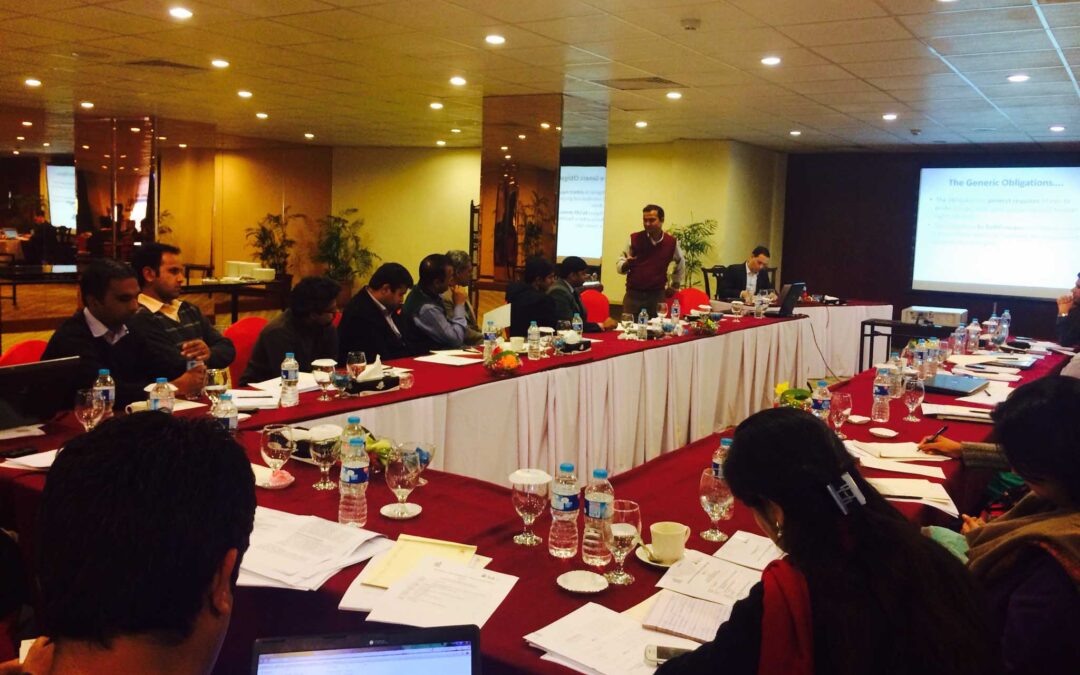
In partnership with the Human Rights Commission of Pakistan (HRCP), the ICJ conducted two-day workshops on NGO engagement with the United Nations, held in Pakistan on 18-19 and 21-22 February 2014.
The workshops, held in Lahore and Islamabad, focused on enhancing the meaningful participation of national NGOs with the UN human rights system. Participants included representatives from civil society working on a wide range of human rights issues, including enforced disappearances, education, violence against women and child rights.
Drawing from experiences of ICJ staff and participants, the workshops considered how international advocacy and engagement with the UN can benefit NGOs and addressed:
- The nature of international human rights law;
- State obligations under international human rights law;
- The UN human rights system;
- The Universal Periodic Review mechanism;
- The UN Special Procedures and the making of individual complaints to them;
- The UN Treaty Bodies, individual complaints and periodic reporting; and
- Documenting human rights violations.
Background materials on the Universal Periodic Review: (ENG) and (URDU)
Background materials on the UN Special Procedures: (ENG) and (URDU)
Background materials on the core functions of the UN Treaty Bodies: (ENG) and (URDU)
BAckground materials on periodic reporting to the UN Treaty Bodies: (ENG) and (URDU)
Feb 21, 2014 | News
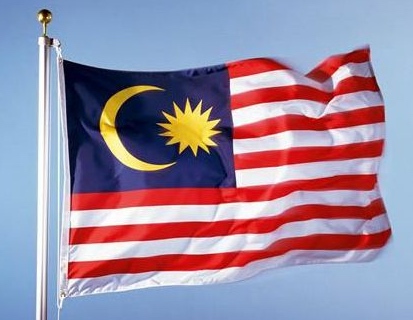
The Kuala Lumpur High Court’s decision today to convict prominent Malaysian lawyer Karpal Singh on charges of sedition is inconsistent with international law and standards regarding free expression of opinion by lawyers, the ICJ said.
“This conviction sends a message that lawyers in Malaysia are not free to express their opinions about legal issues,” said Emerlynne Gil, ICJ’s International Legal Adviser on Southeast Asia.
Karpal Singh’s conviction was based on the fact that during a press conference held at his law firm in early 2009 he had spoken allegedly “seditious words” when questioned about whether Sultan Azlan Shah had the legal authority to remove the province’s Chief Minister, Datuk Seri Mohammad Nizar Jamaluddin, from office.
“This case is another sign of the lack of respect of the Malaysian government for the principle of free expression,” said Gil. “Karpal Singh was expressing an opinion in his capacity as a lawyer over a matter of law. He has every right to do that, as a lawyer, and of course as someone exercising his right to free expression of his views. He also has acted in fulfilment of a core function of the legal profession, which is to contribute to the public discourse on matters of law.”
The UN Basic Principles on the Role of Lawyers specifically provide that lawyers, like ordinary citizens, are entitled to freedom of opinion and expression. They have the right “to take part in public discussion of matters concerning the law, the administration of justice and the promotion and protection of human rights” without fear of suffering professional restrictions or repercussions due to their lawful action.
The High Court has fixed 7 March 2014 to hear Karpal’s mitigating circumstances, and for sentencing.
Under section 4(1) of the 1948 Sedition Act, Karpal Singh now faces a fine of up to RM 5,000 (approximately US$1,5010) and/or imprisonment of up to three years.
The conviction may force Karpal Singh to give up his seat as a member of the Malaysian parliament. Under the Federal Constitution, an elected representative is disqualified from office if fined more than RM 2,000 or jailed for a term exceeding one year.
Karpal Singh has provided legal defense in several high profile cases, including that of opposition leader Anwar Ibrahim, whose trial on charges of ‘sodomy’ has drawn heavy criticism in Malaysia and internationally.
Contact:
Emerlynne Gil, ICJ International Legal Adviser for Southeast Asia, t +66 2 619 8477; email: emerlynne.gil(a)icj.org
Craig Knowles, ICJ Media Consultant, t +66 81 9077653; email:craig.knowles(a)icj.org