Sep 2, 2013 | News
The ICJ today called on the Bangladesh authorities to immediately withdraw the contempt of court notice issued against the international human rights organization Human Rights Watch.
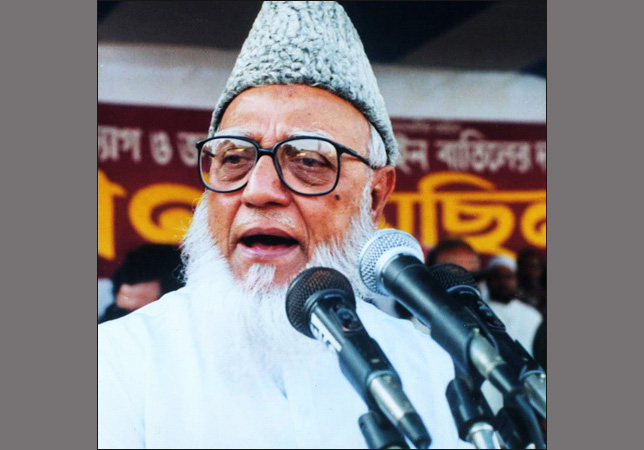
The charges are in response to well documented concerns by Human Rights Watch that the trial of Ghulam Azam (photo), former head of the Islamist group Jamaat-e-Islami Azam’s trial was “deeply flawed” and failed to meet international fair trial standards.
“Silencing voices that highlight the shortcomings of the International Crimes Tribunal impede rather than advance the enormously important task of ensuring that those responsible for committing atrocities during Bangladesh’s war of liberation are brought to justice in a process that complies with international law and standards”, said Alex Conte, Director of the ICJ’s International Law and Protection Programmes.
On 2 September 2013, the International Crimes Tribunal (ICT) in Bangladesh issued a show cause notice asking Human Rights Watch to explain why contempt of court proceedings should not be initiated against it for its allegedly ‘biased’, ‘scandalous’ and ‘inaccurate’ statements about the ICT. Human Rights Watch has to respond within three weeks, or possibly face trial and conviction in absentia.
“Assessing the conduct of administration of justice in judicial proceedings, including where it entails criticism of judicial performance is an important means of ensuring accountability,” said Conte. “Judges and prosecutors should defend the right to freedom of expression, not use their discretionary powers to muzzle criticism”.
Contact:
Alex Conte, Director, International Law & Protection Programmes, t: +41 79 957 2733; email: alex.conte(a)icj.org
Additional information:
The Bangalore Principles on Judicial Conduct clarify that “since judicial independence does not render a judge free from public accountability, and legitimate public criticism of judicial performance is a means of ensuring accountability subject to law, a judge should generally avoid the use of the criminal law and contempt proceedings to restrict such criticism of the courts”.
The Commonwealth (Latimer House) Principles on the Accountability of and the Relationship Between the Three Branches of Government also stress that “criminal law and contempt proceedings should not be used to restrict legitimate criticism of the performance of judicial functions”.
The UN Declaration on Human Rights Defenders underscores that “everyone has the right, individually and in association with others, to promote and to strive for the protection and realization of human rights and fundamental freedoms at the national and international levels”.
The Declaration also highlights that human rights defenders have the right to “freely to publish, impart or disseminate to others views, information and knowledge on all human rights and fundamental freedoms” and to hold opinions and draw public attention to the observance of human rights.
Sep 2, 2013
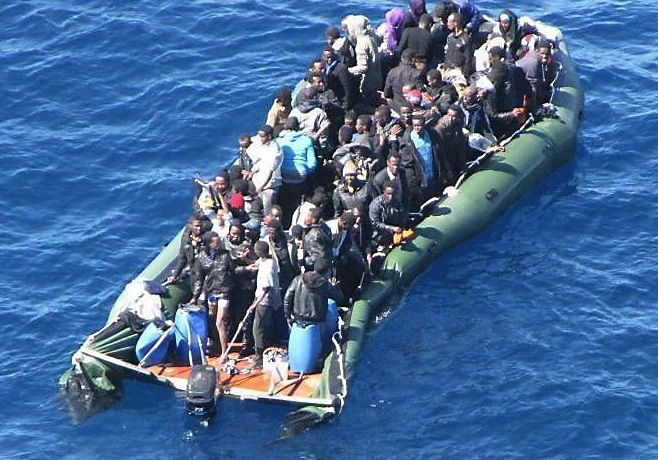
Today, the ICJ and other rights groups submitted to the EU institutions their comments on a European Commission proposal for a Regulation establishing rules for the surveillance of the external sea borders in the context of operational cooperation coordinated by the FRONTEX.
In their submission, the ICJ, Amnesty International and the European Council on Refugees and Exiles acknowledge that the Commission proposal contains a number of positive elements, including the introduction of more extensive provisions on the protection of human rights and the principle of non-refoulement (Article 4), and a clearer definition of “a situation of uncertainty”, “situation of alert” and “situation of distress” (Article 9).
The proposal explicitly requires that “the existence of a distress situation shall not be exclusively dependent on or determined by an actual request for assistance”, implying an obligation for participating units to take active measures to ensure the safety of the persons concerned, and reflecting existing international law obligations in this regard.
The proposal also usefully affirms the fact that the concept of border surveillance under EU law clearly includes measures to ensure that search and rescue operations can be carried out effectively during sea operations, as it is mandated by the international law of the sea. Finally, the provisions contained in the Regulation would be fully binding on Member States for operations conducted under the auspices of Frontex.
Despite these positive elements, the ICJ, AI and ECRE have considered in their submission that other aspects of the Commission’s proposal fail to meet the requirements of international law, including refugee law, human rights law, the law of the sea and EU law.
This briefing presents the organizations’ key concerns, including in respect of how the proposed Regulation potentially contravenes the principle of non-refoulement as established in international human rights law and jurisprudence; the lack of clear guarantees to ensure access to a fair and effective asylum procedure in practice; the risk of the proposal legitimizing the practice of “push-backs” at sea; and the lack of arrangements to address legitimate concerns arising from the disembarkation in EU Member States and third countries whose asylum systems are affected by systemic deficiencies.
At the outset, the briefing briefly discusses the relevance of the ECtHR’s main findings in the case of Hirsi Jamaa and Others v. Italy (hereinafter Hirsi) with respect to the non-refoulement obligations of EU Member States and Frontex in the context of operations at sea.
The three organizations stressed in their submission that, under this judgment, and in accordance with international law, including international human rights law, operations constituting what are sometimes referred to as “push-backs” are prohibited as they constitute violations of the prohibition of collective expulsion, and seriously risk breaching the principle of non-refoulement.

Sep 1, 2013
The ICJ organized a high level mission to the Kingdom of Lesotho in March 2013 to gather facts concerning a crisis in judicial leadership in this country.
The dispute emerged from a dispute between the office of the Chief Justice, presently occupied by the Honourable Justice M Lehohla1, and the office of the President of the Court of Appeal, presently occupied by the Honourable Justice M Ramodibedi, over the issue of which of them is the head of the judiciary.
The mission team’s objective was also to make recommendations on possible solutions to the crisis.
The ICJ considers that a resolution of this crisis is necessary to bring about harmony in the administration of justice in Lesotho, to facilitate access to justice, to protect the independence of the judiciary and to preserve public confidence in Lesotho’s judicial institutions.
The full mission report can be downloaded below.
Lesotho-Crisis judicial leadership-Publications-Mission report-2014-ENG (full text in pdf)
Aug 30, 2013 | News
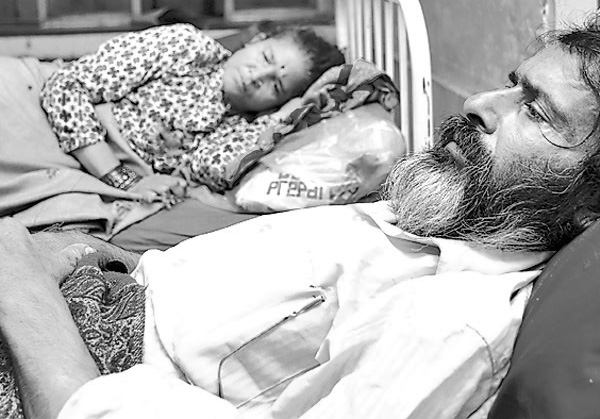
The ICJ is highly concerned by the deteriorating health of Nanda Prasad and Gangamaya Adhikari who are on hunger strike, protesting the failure of the state to investigate and prosecute the 2004 killing of their son Krishna by Maoist insurgents.
Ben Schonveld, the South Asia Director of ICJ said: ” Mr and Mrs Adhikari are just one of thousands of families in Nepal who are asking for something very simple: justice. They are not looking for more commitments or words. They are asking the State of Nepal to obey its own laws and investigate and punish very serious crimes (committed by both sides to the conflict) that violate international human rights law; laws that Nepal has repeatedly committed itself to uphold.”
Contact:
Ben Schonveld, South Asia Director, t: +977 9804596661; email: ben.schonveld(a)icj.org
Photo by eKantipur.com
Aug 30, 2013 | News
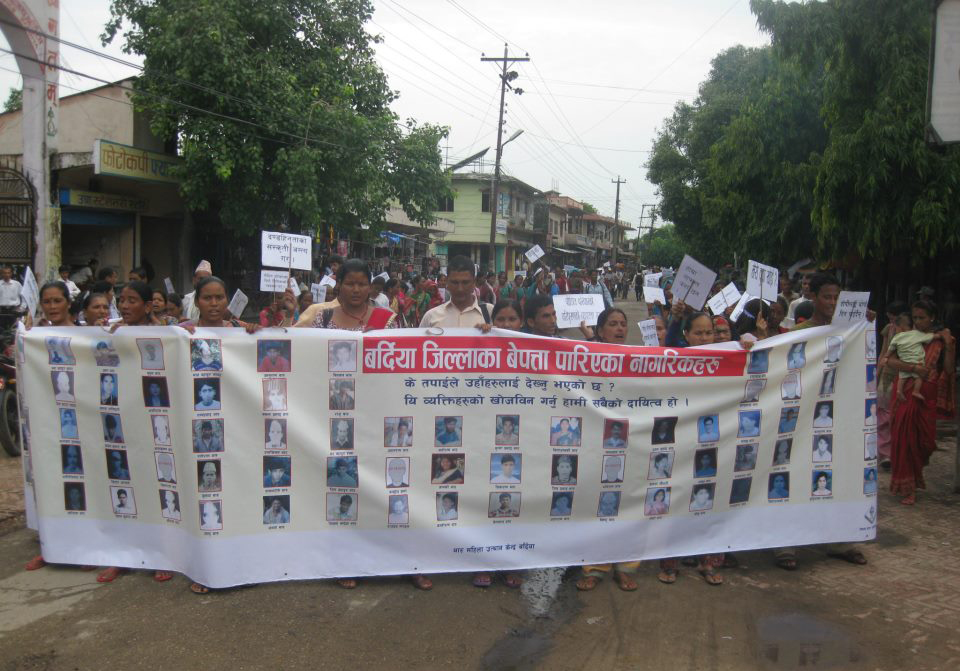
On the 30th annual International Day of the Disappeared, the ICJ urged the Nepali Government to act immediately to disclose the fate and whereabouts of “disappeared” persons and to provide accountability for the perpetrators of these gross violations of human rights.
The systematic practice of enforced disappearance during Nepal’s 1996-2006 armed conflict was among the worst anywhere in the world, the ICJ says.
The fate and whereabouts of more than 1,300 possible victims of enforced disappearance are still unknown.
To date, not one individual suspected of criminal responsibility for serious human rights violations or crimes under international law committed during the conflict has been brought to justice.
“The Government must meet its human rights obligations”, said Ben Schonveld, ICJ’s South Asia Director. “Ending impunity, ensuring accountability, and strengthening the rule of law are essential for a durable transition from armed conflict to sustainable peace in Nepal”.
On 21 November 2006, the Government of Nepal and Communist Party of Nepal (Maoist) signed the Comprehensive Peace Agreement (CPA), committing to investigate and reveal the fate of those killed or disappeared during the armed conflict within 60 days.
Both parties promised they would “not protect impunity” and vowed to safeguard the rights of families of the “disappeared.”
Almost seven years later, the promises made in the CPA have still not been fulfilled, the ICJ says.
Instead, the Government has actively protected and even promoted those suspected of committing human rights violations.
On 14 March 2013, Nepal’s President promulgated an Ordinance to establish a Commission on Investigation of Disappeared Persons, Truth and Reconciliation to investigate human rights violations committed during the armed conflict.
However, the establishment of the commission was temporarily halted after the Supreme Court issued a stay order in April following legal challenges.
The proposed commission is not in compliance with international law and standards on commissions of inquiry to effectively discharge Nepal’s duty to provide remedy and reparation to victims in a number of respects.
First, the process of the appointment of the Chairperson of the Commission does not ensure independence and impartiality.
Second, the Commission has wide discretion to recommend amnesty for crimes under international law, including enforced disappearance, to those who repent.
When combined with the fact that the crime of enforced disappearance is not yet a distinct offence punishable under the law of Nepal, there are grounds for real concern that impunity for the hundreds of enforced disappearances carried out during the course of the conflict will continue.
“The framework for the Commission set out in the Ordinance was the result of a bargain between the political parties”, Schonveld added. “The Commission seems designed to enable those suspected of criminal responsibility to avoid accountability for human rights violations and crimes under international law committed over the course of Nepal’s decade-long conflict”.
The ICJ urges the Government of Nepal to:
1. Withdraw the Ordinance, or establish a mechanism for its review and amendment, which includes inclusive consultation with victims of conflict related human rights abuses and representatives of civil society, with the aim of ensuring that the Commission established is consistent with international law and standards;
2. Promptly accede to the UN International Convention for the Protection of All Persons from Enforced Disappearance;
3. Ensure that enforced disappearance, as defined under the International Convention for the Protection of All Persons from Enforced Disappearance, is included as a distinct offence and is punishable by penalties that are proportionate with its gravity criminalized under domestic law;
4. Respect court orders calling on the police to investigate human rights violations and crimes under international law and, if there is sufficient admissible evidence, prosecute those suspected of criminal responsibility in trials that meet international due process standards;
5. Ensure that victims of enforced disappearance, other human rights violations and crimes under international law have access to effective remedies and receive adequate reparation, including appropriate compensation, restitution, rehabilitation and measures of satisfaction;
Contact:
Ben Schonveld, ICJ South Asia Director, (Kathmandu); t: 977 9804596661; email: ben.schonveld(at)icj.org
NOTES:
Enforced disappearance occurs when a person is arrested, detained or abducted by an agent of the State and then officials refuse to acknowledge the deprivation of liberty or conceal the fate or whereabouts of the “disappeared” person.
These acts remove an individual from the protection of the law, leaving the individual at the mercy of his or her captors.
Enforced disappearance violates many rights of the victims and their families alike, which are guaranteed under the under the International Covenant on Civil and Political Rights (ICCPR), which Nepal, as a State Party, is obliged to respect.
The UN General Assembly has described enforced disappearances ‘an offence to human dignity’ and a grave and flagrant violation of international human rights law.