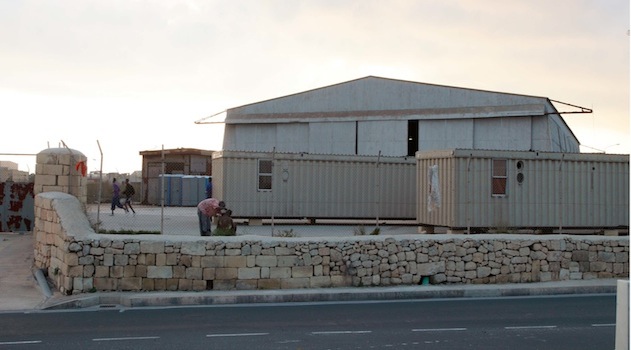
Malta: not here to stay
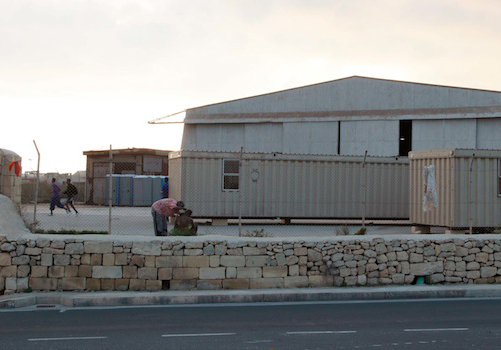 Malta should abandon its policy of mandatory detention of undocumented migrants and asylum seekers and dedicate resources to significantly improve their reception conditions, says a new ICJ report.

Malta should abandon its policy of mandatory detention of undocumented migrants and asylum seekers and dedicate resources to significantly improve their reception conditions, says a new ICJ report.

The ICJ and ECRE presented a joint detailed submission on the situation of detention, application procedures and remedies for asylum seekers in Greece to the Committee of Ministers of the Council of Europe.
The ICJ and the European Council on Refugees and Exiles (ECRE) presented a joint submission to the Committee of Ministers of the Council of Europe in occasion of a meeting on the implementation by Greece of the European Court of Human Rights’ judgment in the case of M.S.S. v Belgium and Greece. The submission highlighted legal and practical shortcomings in the Greek system on detention of asylum seekers, conditions of detention, judicial review and access to an effective remedy, living conditions of asylum seekers, access to information and non-refoulement.
Greece-ICJECRE-MSSSubmission-2012 (download the joint submission)
Photo credit: © Stabilisation Unit/DFID (the DFID has no involvement in nor does support this submission)

During the 60th session of the Committee on the Rights of the Child (CRC) in Geneva, the CRC will undertake an examination of Australia’s fourth periodic report under the Convention on the Rights of the Child. Focussed primarily on the issue of the business and child rights, the International Commission of Jurists has made a submission to the CRC addressing issues concerning: (1) the Tobacco Packaging Bill and its potential impact on children’s rights; (2) mining companies and children’s rights; (3) children in migration detention centres; (4) the operation of investment and export credit agencies; (5) the operation of internet service providers; (6) the situation of working parents; and (7) the exploitation of workers’ and children’s rights.

The ICJ today called upon the Israeli authorities to end the abusive practice of administrative detentions of Palestinians held in Israel.
Israel must also ensure that those who are on hunger strike have full access to appropriate medical assistance and are treated humanely, the ICJ said.
Over the last months, more than 1,500 Palestinian administrative detainees, pre-trial detainees and convicted prisoners have gone on hunger strike to challenge the conditions of their detention, including the use of solitary confinement, restrictions on family visits and other punitive measures taken against them.
The ICJ stresses that Palestinian detainees and prisoners have been regularly denied their right to have contact and correspond with and be visited by members of their families.
Their rights to have regular access to independent doctors and to their lawyers have also been systematically denied.
“Under international law, administrative detention is unlawful, except in narrow circumstances as an exceptional and temporary measure. However, Israel has routinely resorted to unlawful prolonged administrative detention of individuals from the Occupied Palestinian Territory, sometimes as an alternative to criminal proceedings,” said Saïd Benarbia, Senior Legal Adviser for the Middle East and North Africa Programme. “Israeli authorities must comply with their obligations under international law and fully guarantee the rights of persons arrested or imprisoned without charge to the presumption of innocence, medical assistance, communication with family members and full and unrestricted access to a legal counsel.”
The ICJ is also gravely concerned that detainees on hunger strikes have been allegedly subjected to various forms of coercion that may amount to ill-treatment under international law, including shackling, solitary confinement, daily fines, and forced medical treatment.
Bilal Diab, Thaer Halahlah, Hassen El-Safadi, Omar Abu Shalal, Jafar Izz El-Din and Mahmoud Sarsaq, held in Israel under administrative detention orders, have been on extended hunger strike for more than two months and have seen their health conditions seriously deteriorate, the ICJ deplores.
“The Israeli Authorities must immediately end all forms of psychological and ill-treatment of hunger strikers, guarantee their rights to have full access to independent doctors and appropriate medical care, and ensure they are treated humanely in all circumstances,” Benarbia added. “Unless these detainees are charged with internationally recognizsable criminal offenses, they must be immediately and unconditionally released.”
Contact:
Saïd Benarbia, Middle East & North Africa Senior Legal Adviser, T +41 22 979 3817

 The report provides a general overview of the pre-trial investigation and the court of appeal hearing in a criminal case in St. Petersburg (Russia) and offers some recommendations based on the main findings.
Having received credible information about possible violations of fair trial principles in a criminal case in St. Petersburg, the ICJ took a decision to send a Mission of observation at the appeal hearing on case # 1-553/10; # 22-2154/2011 at the Saint Petersburg City Court against Gurgen Stepanyan, Vardan Sakanyan, Tigran Arutyunyan. The report provides a general overview of the pre-trial investigation and the court of appeal hearing. As explained below, the appeal hearing was held in camera and despite a request by the ICJ request that it be open for observers, it was closed.
Nevertheless the ICJ observers were able to meet with the Deputy President of the Court and with lawyers involved in the case, and to study documents in the case. The observers express their gratitude to all who met with them and who assisted in the Mission.
Russia-appeal hearing Saint Petersburg-trial observation report-2012-eng (full text in English, PDF)
Russia-appeal hearing Saint Petersburg-trial observation report-2012-rus (full text in Russian, PDF)
 Thailand: Three draft anti-SLAPP laws must deliver comprehensive protection
 Egypt’s Matsda2sh case: end the crackdown on media workers with fake “terrorism” charges
 Joint Letter: Addressing Human Rights Abuses During Vietnam’s To Lam’s Visit
 Thailand: Judges have a critical role to play in combating and ensuring accountability for torture and enforced disappearance