May 4, 2019 | News
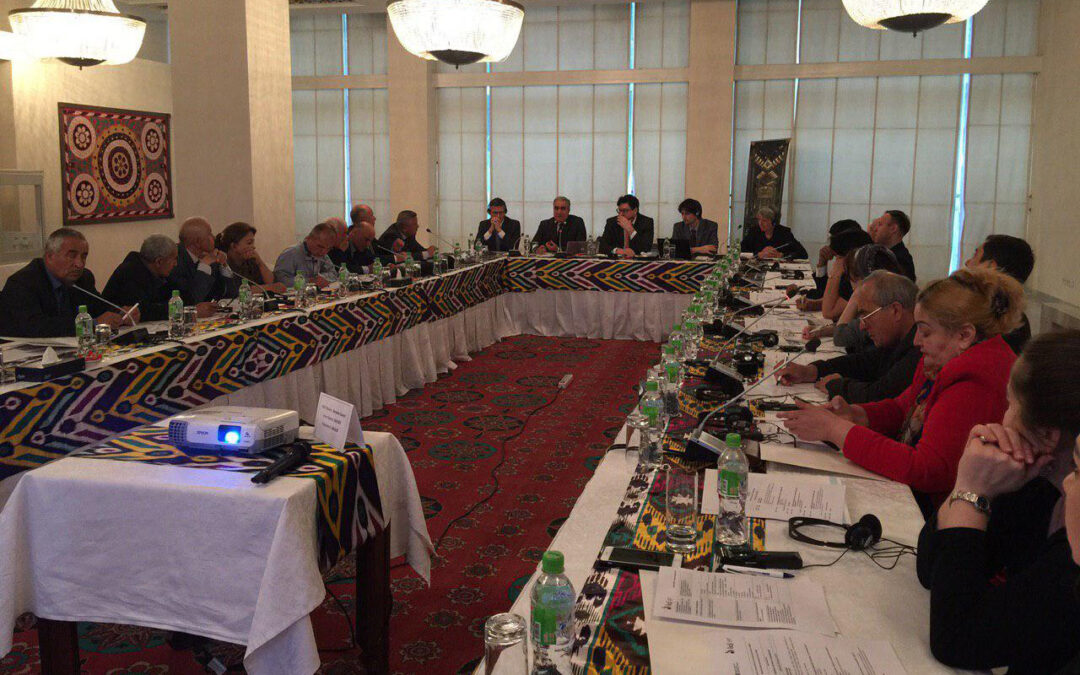
The ICJ concluded a research mission on the independence of the judiciary in Tajikistan on 3 May. Following the mission, the ICJ expressed concerns about the independence of individual judges as well as the functioning of judicial institutions and procedures in law and in practice.
The mission included ICJ Commissioner Justice (ret.) Martine Comte of the Orleans Court of Appeal (France) and ICJ Secretary General Saman Zia-Zarifi.
The ICJ spoke with a wide cross-section of stakeholders, including senior government officials, numerous former judges, senior advocates and working lawyers, as well as journalists and members of civil society. The ICJ will provide its findings in a final mission report that will set out include key recommendations to help Tajikistan meet its international obligations.
Among other things, the ICJ mission discussed recent initiatives to reform the judiciary, including the Judicial Reform Programme of 2019-2021 which has been recently been adopted by the President of Tajikistan, and which provides an opportunity to strengthen judicial independence.
The ICJ mission gathered information about the newly formed Qualification Commission for qualification and disciplinary procedures for judges. This replaced the Council of Justice, which had been criticized by international observers for its lack of independence.
Although formally established under the Supreme Court, the Qualification Commission consists predominantly of members of the executive with only two out of seven members being representatives of the judiciary.
Multiple lawyers and former judges expressed serious concerns about the right to a fair trial in criminal proceedings, pointing in particular to the extremely low acquittal rate for suspects. It appears that numbers of acquittals have declined over several decades and that acquittals are now extremely rare.
The ICJ also received complaints that pubic access to court hearings is impeded in practice despite clear legal provision for the public nature of court proceedings, with limited exceptions. Members of the public were said to be generally unable to attend court hearings freely where they are not parties to the proceedings.
Furthermore, the ICJ heard that judicial decisions are generally not available to members of the public unless they are participants in the proceedings.
The ICJ wishes to express its gratitude to everyone who contributed to the successful conduct of the mission, including State, inter-State and non-State organisations and bodies which the ICJ met and communicated with.
The ICJ wishes to stress its appreciation of the support provided by the OSCE Office in Dushanbe and the United Nationals Human Rights Office.

Apr 29, 2019 | News
On 27 and 28 April 2019, the ICJ held a workshop on “Ensuring accountability through the Specialized Criminal Chambers” in coordination with the Association des Magistrats Tunisiens (AMT).
Participants in the workshop included 28 Tunisian judges attached to the Specialized Criminal Chambers (SCC).
The workshop aimed to reinforce the capacity of SCC judges to effectively exercise their role in adjudicating crimes under international law, in line with international law and standards.
ICJ legal advisers and Tunisian experts gave presentations on State the obligations of State actors to respect and apply international law, the legal framework governing the application of international law in Tunisia, and the principle of legality and statutory limitations to crimes under international law. They also spoke on the international and domestic definitions of crimes under international law and modes of liability.
Through working group and plenary sessions, the participants discussed options for applying international law and standards at the national level.
Expert speakers included Judge Brahim Weslati, Judge Radhouane Werthy and Imen Soussi.

Apr 25, 2019 | Advocacy, Non-legal submissions
The ICJ draws attention to instances of alleged human rights abuses by the private military and security companies in all regions and analyses the challenges related to the accountability frameworks and access to justice.
The ICJ contribution is in response to the call by the UN Working Group on the use of mercenaries, which also has a mandate on private security companies, for written information to assist in its deliberations on “private military and security companies in extractive industries – impact on human rights”.
Private Military and Security Companies (PMSCs) are hired by companies engaged in extractive operations in all geographic regions of the world, but their activities or operations that give rise to allegations of human rights violations and abuses seem to be prevalent regions where abundance of natural resources and the favorable environment for foreign investment are propitious to the establishment of extractive companies in, many times, fragile contexts.
In this regard ICJ suggests the Working group to consider the following recommendations:
- States should ensure that their domestic legal framework provides for real access to effective remedies for victims of human rights abuse by PMSCs and extractive companies.
- Provide guidance to States to establish effective legal accountability frameworks of criminal or civil nature that pay due consideration to the inherently dangerous nature of the mining activity and the security services operating in that context.
- Recommend that States establish legal frameworks that require meaningful reporting/disclosure of company policies and practices in relation to human rights, including their use and effectiveness of grievance mechanisms at the operational level.
- Both extractive and security companies should respect all human rights in accordance with international standards, including the UN Guiding Principles on Business and Human Rights, the Voluntary Principles on Security and Human Rights and other sectorial guidance applicable to PMSCs.
- Security companies, whatever their structure or ownership, should carry out enhanced processes of due diligence consistent with international best practices, and participate in remediation schemes.
Universal-ICJ Submission PSC and extractive industries-Advocacy-non legal submissions-2019-ENG (full text of the report, in PDF)
Apr 25, 2019 | News
The statement alerts the public of the danger of a bill which dismantles the specialized criminal chambers in Tunisia and replaces them with an institution which would guarantee impunity for those who committed gross violations of human rights in Tunisia between 1955 and 2013.
The statement has been signed by the ICJ as well as other members of the Coalition for Transitional Justice
The statement can be downloaded here:
Link to French Version
Link to Arabic Version
Apr 25, 2019 | Nouvelles
Le communiqué alerte l’opinion publique sur le danger d’une proposition de loi visant à démanteler les chambres criminelles spécialisées en Tunisie et à les remplacer par une institution qui garantirait l’impunité pour les personnes ayant commis des violations flagrantes des droits humains en Tunisie entre 1955 et 2013.
Le communiqué a été signé par la Commission Internationale de Juristes avec d’autres organisations membres de la Coalition pour la justice transitionnelle.
Le manifeste peut être téléchargé ici:
Version française
Version arabe