Sep 30, 2020 | News
Today, the ICJ joined fourteen other human rights organizations in condemning the Indian government’s actions against Amnesty India and pledged to continue support for local human rights defenders and organizations against the recent crackdown.
Amnesty International India announced that it is halting its work in the country after the Indian government froze its bank accounts in an act of reprisal for the organization’s human rights work.
The Indian government’s actions against Amnesty India are part of increasingly repressive tactics to shut down critical voices and groups working to promote, protect, and uphold fundamental rights, said the Association for Progressive Communications, Global Indian Progressive Alliance, International Commission of Jurists, International Federation for Human Rights (FIDH), CIVICUS: World Alliance for Citizen Participation, Front Line Defenders, FORUM-ASIA, Foundation the London Story, Hindus for Human Rights, Human Rights Watch, International Service for Human Rights, Minority Rights Group, Odhikar, South Asians for Human Rights (SAHR), and World Organisation Against Torture (OMCT) in the framework of the Observatory for the Protection of Human Rights Defenders.
The Hindu nationalist Bharatiya Janata Party (BJP)-led government has accused Amnesty India of violating laws on foreign funding, a charge the group says is politically motivated and constitutes evidence “that the overbroad legal framework is maliciously activated when human rights defenders and groups challenge the government’s grave inactions and excesses.”
The BJP government has increasingly cracked down on civil society, harassing and bringing politically motivated cases against human rights defenders, academics, student activists, journalists, and others critical of the government under sedition, terrorism, and other repressive laws.
These actions increasingly mimic that of authoritarian regimes, which do not tolerate any criticism and shamelessly target those who dare to speak out. With growing criticism of the government’s discriminatory policies and attacks on the rule of law, the authorities seem more interested in shooting the messenger than addressing the grievances. Women’s rights activists and indigenous and minority human rights defenders have been especially vulnerable. The recent action against Amnesty India highlights the stepped-up pressure and violence felt by local defenders on the ground, regardless of their profile.
The authorities have repeatedly used foreign funding regulations under the Foreign Contribution Regulation Act (FCRA), a law broadly condemned for violating international human rights law and standards, to target outspoken groups. United Nations experts on human rights defenders, on freedom of expression, and on freedom of association have urged the government to repeal the law, saying it is “being used more and more to silence organisations involved in advocating civil, political, economic, social, environmental or cultural priorities, which may differ from those backed by the Government.”
Yet, the Indian parliament amended the FCRA this month, adding further onerous governmental oversight, additional regulations and certification processes, and operational requirements that would adversely affect civil society groups and effectively restrict access to foreign funding for small nongovernmental organizations.
A robust, independent, and vocal civil society is indispensable in any democracy to ensure a check on government and to hold it accountable, pushing it to do better. Instead of treating human rights groups as its enemies, the government should work with them to protect the rights of all people and ensure accountability at all levels of government.
Contact
Ian Seiderman, ICJ Law and Policy Director: ian.seiderman@icj.org
Sep 29, 2020 | Advocacy, News
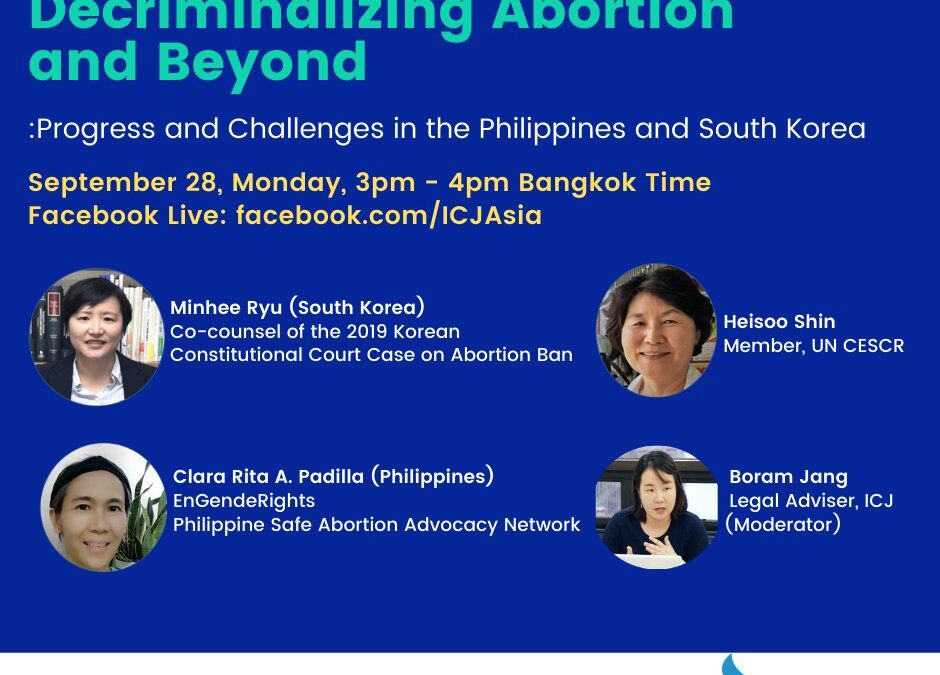
On the International Safe Abortion Day, the ICJ held a webinar on the decriminalization of abortion in the Philippines and the Republic of Korea.
The webinar focused on the legal provisions criminalizing abortion and on women human rights defenders’ struggle to decriminalize abortion in the Philippines and in the Republic of Korea. In addition, the participants highlighted States’ legal obligation to guarantee access to legal, safe and affordable abortion and post abortion care for all persons under international human rights law and standards.
Ms. Clara Rita A. Padilla from the Philippines’ Safe Abortion Advocacy Network; Ms. Minhee Ryu, Co-counsel in the 2019 Korean Constitutional Court case on the country’s criminal ban on abortion; and Dr. Heisoo Shin, member of the UN Committee on Economic, Social and Cultural Rights (CESCR) participated as speakers.
“The law imposing penalties on women who have an abortion and those assisting them only endangered the lives of women forced to seek unsafe abortion,” said Ms. Padilla. “Today, the Philippine Safe Abortion Advocacy Network introduced a draft bill, An Act Decriminalizing Induced Abortion to Save the Lives of Women, Girls, and Persons of Diverse Gender Identities, and we will continue advocating the repeal of the current discriminatory law against women and eliminate harmful stigma against women due to the restrictive abortion law and imposition of judgmental religious beliefs.”
Ms. Minhee Ryu talked about the women human rights defender’s movement in the Republic of Korea, including the work of the Joint Action for Reproductive Justice. She also highlighted the legal strategy to draw the Constitutional Court’s attention to the experience of girls, migrant women and women with disabilities in the context of the case that resulted in the Court holding that the criminalization of abortion was unconstitutional in April 2019.
“It is the core obligations of States to ensure the repeal of laws, policies and practices that criminalize, obstruct or undermine access by individuals or a particular group to sexual and reproductive health facilities and services,” said Dr. Heisoo Shin. “Denial of abortion often leads to maternal mortality and morbidity, which, in turn, constitute violations of the rights to life, dignity, autonomy, security, equality and non-discrimination, equality before the law and equal protection of the law without discrimination, privacy, physical and mental health, and the right to freedom from ill-treatment.”
The participants agreed that international human rights law and standards, such as the Human Rights Committee’s General Comment 36 on the right to life, and the CESCR’s General Comment 22 on the right to sexual and reproductive health, are instrumental in worldwide efforts to ensure access to legal, safe and affordable abortion and in advocating for its complete decriminalization.
Contact
Boram Jang, International Legal Adviser, e: boram.jang(a)icj.org
Sep 29, 2020 | Advocacy, Non-legal submissions
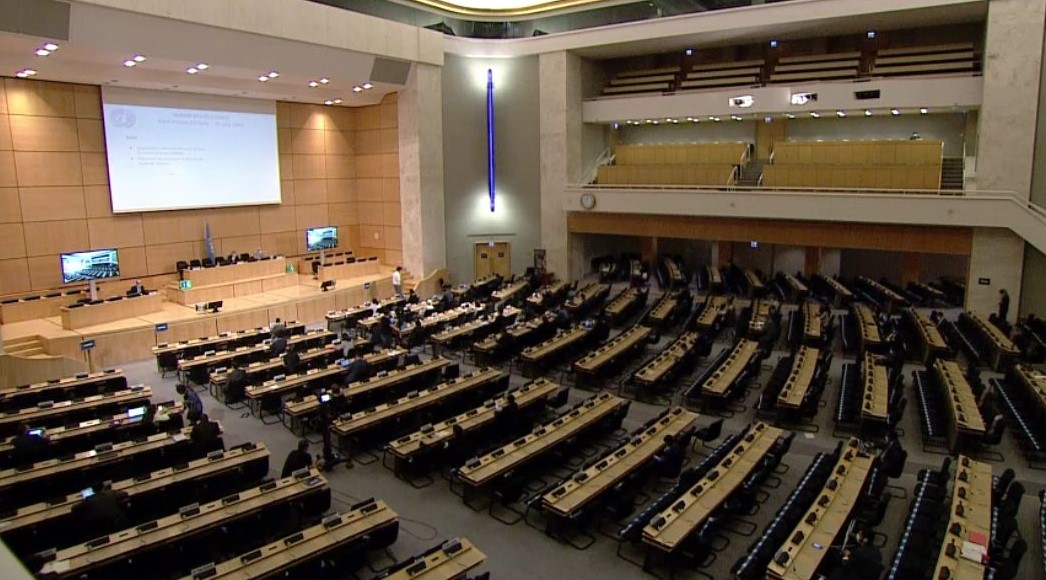
At the Human Rights Council, the ICJ and other NGOs highlighted with concern renewed attacks against the Council’s independent experts, aimed at interfering with their independence.
The oral statement was delivered by Amnesty International, in the general debate on human rights bodies, on on behalf of 14 NGOs. It read as follows:
“It is with great concern that we note the renewed attacks against the Special Procedures of this Council, through which certain states seek to interfere with their independence and impose political oversight over individual experts. While we welcome the outcome of the informal discussions, we would like to raise a few issues of concern.
As we noted in our letter to you Madame President, the states signatories of the letters rely on PRST 8/2 of 18 June 2008 on the Terms of office of special procedure mandate-holders, which was originally adopted in the specific context of Council discussions on the extension of the terms of mandate holders, and should not be regarded as a wider framework for assessing the performance of mandate holders. Furthermore, the groups of states appear to have ignored the existing Internal Advisory Procedure, instead proceeding directly to attempts to impose political oversight by this Council.
We also note with great concern that several of the signatory states launched wholly inappropriate attacks of a personal nature against Special Procedure mandate holders in the past.1
The allegations presented against the Special Rapporteur on extrajudicial, summary or arbitrary executions, in particular, seem little more than objecting to her being especially effective and proactive in doing exactly what this Council has tasked her to do, including monitoring and reporting on violations of the right to life and bringing these to the attention of the Council, and promoting respect for the right to life more generally.
We appreciate the efforts by the Coordination Committee to address broader issues related to the working methods of the Special Procedures, and welcome its willingness to work with the Special Rapporteur on the right to privacy on issues related to methodology and programming of the six outstanding country reports.
The independence of the Special Procedures is absolute in nature, and any attempts to erode that status threatens the credibility and integrity of this Council.
Thank you.”
Amnesty International
ARTICLE 19
Asian Forum for Human Rights and Development (FORUM-ASIA)
Center for Reproductive Rights
Child Rights Connect
CIVICUS: World Alliance for Citizen Participation
DefendDefenders (East and Horn of Africa Human Rights Defenders Project)
Geneva for Human Rights
International Commission of Jurists
International Federation for Human Rights (FIDH)
International Movement Against All Forms of Discrimination and Racism (IMADR)
International Service for Human Rights
Privacy International
Women’s International League for Peace and Freedom (WILPF)
1 Amnesty International and ISHR: HRC 37: Item 5: Human rights bodies and mechanisms, 14 March 2018, Index number: IOR 40/8032/2018, https://www.amnesty.org/en/documents/ior40/8032/2018/en/
Sep 29, 2020 | Advocacy, Non-legal submissions
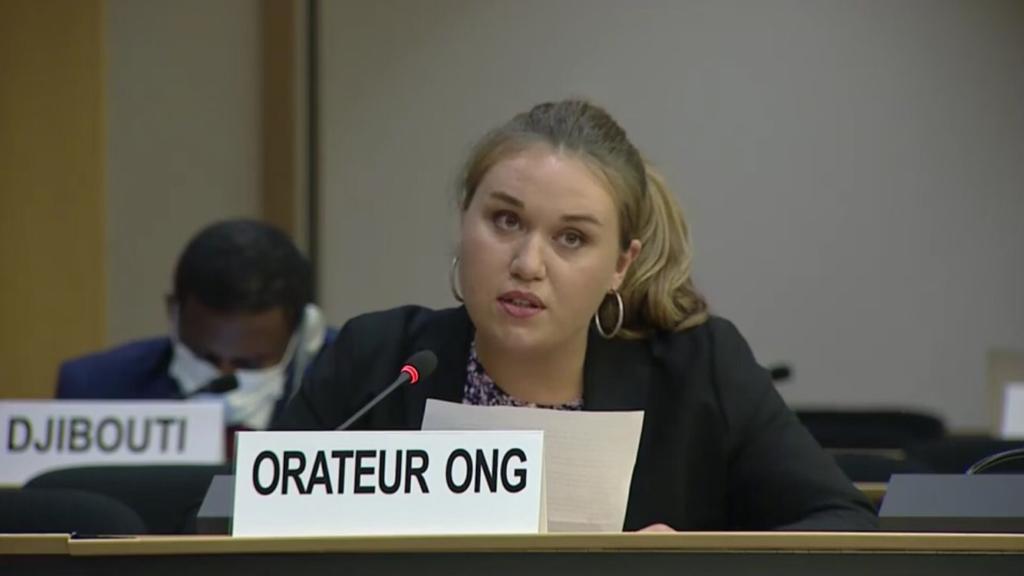
At the Human Rights Council, the ICJ today highlighted the problem of abuse of counter-terrorism laws to perpetrate reprisals against those who cooperate with the UN, including particularly by Egypt.
The oral statement was delivered in a general debate on human rights bodies and mechanisms (item 5), and read as follows:
“Madame President,
The International Commission of Jurists (ICJ) welcomes the report of the Secretary General on Cooperation with the United Nations, its representatives and mechanisms in the field of human rights (A/HRC/45/36). The ICJ particularly concurs with its conclusion that reprisals perpetrated through abuse of national security and counter-terrorism laws and measures continue at alarming levels (para 131), and that such abuse also frequently occurs in the context of broader repressive environments for civil society or dissent (para 132).
While the report documents such abuses in a number of countries, the pattern of abuse of such laws by the government of Egypt presented in the report should be of particular concern to this Council (paras 65 to 70, Annex I paras 40 to 51, Annex II paras 44 to 53).[1] Further relevant cases from Egypt continue, including shortly before this session began.
These reprisals resonate with broader patterns of abuse of counter-terrorism and national security laws in Egypt, including for instance targeting lawyers, which are also severely exacerbated by the lack of independence of the judiciary in Egypt, particularly in the special terrorism court circuits.
Madame President, these patterns of abuse only further illustrate and underscore civil society’s concern with the role Egypt seeks for itself on issues of terrorism and human rights at the Council. In that regard, we reiterate our concerns about the pending report of the Advisory Committee, responding to the request it received under the last Egypt-led separate resolution on “the effects of terrorism” (resolution 34/8) to report on “the negative effects of terrorism on the enjoyment of all human rights and fundamental freedoms, with a particular focus on economic, social and cultural rights, including as a result of diverting foreign direct investment, reducing capital inflows, destroying infrastructure, limiting foreign trade, disturbing financial markets, negatively affecting certain economic sectors and impeding economic growth.”
The Human Rights Council should not, Madame President, countenance such attempts to divert and dilute its limited resources and attention away from the most acute issues on this theme from a human rights perspective: preventing and responding to violations in countering terrorism and a human-rights based approach to victims of terrorism.”
[1] Underlying documents in a number of cases mentioned in A/HRC/45/36 reveal further links to abuses of counter-terrorism and national security laws: see e.g. A/HRC/39/31 para 38 and Annex I paras 32-35; A/HRC/27/38, para 24; A/HRC/36/31 para 33 and Annex I, para 34; and A/HRC/39/31 Annex II, paras 17-18, 21.
Sep 29, 2020
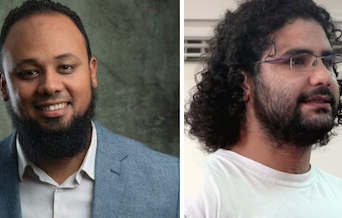
The ICJ and six other international non-governmental organisations call on the Egyptian authorities to immediately and unconditionally release human rights defenders Mohamed El-Baqer and Alaa Abdel Fattah, who were arbitrarily arrested and detained a year ago today.
In the context of a massive crackdown on Egyptian civil society, the ongoing arbitrary detention of Mohamed El-Baqer and Alaa Abdel Fattah, and the continuous renewal of their pre-trial detention is paradigmatic of the systematic repression, acts of intimidation and prosecution used against human rights defenders and all dissenting voices in the country.
On September 29, 2019, Mohamed El-Baqer, human rights lawyer and Director of Adalah Center for Rights and Freedoms, was arrested at the State Security Prosecution premises in Cairo while he was attending an investigation session with his client Alaa Abdel Fattah, who had been arrested earlier in the morning of that same day.
Mohamed El-Baqer and Alaa Abdel Fattah were subsequently accused under Criminal Case 1356 of 2019 by State Security Prosecution and ordered 15 days of preventive detention under vague and unfounded charges that have been broadly used to criminalise all those that dare to defend human rights in Egypt: “belonging to a terrorist group”, “funding a terrorist group”, “spreading false news undermining national security” and “using social media to commit publishing offenses”.
Their place of detention remained unknown until October 1, 2019, when the prison authorities informed their families that they were detained in Tora High Security prison 2, which is known for its very poor conditions of detention.
One year on from their arrest, Mohamed El-Baqer and Alaa Abdel Fattah’s right to due process has been continuously violated through countless and unjustified renewals of their preventive detention by both the Supreme State Security Prosecution and Cairo Criminal Court.
While in prison both have been denied access to books, time in the prison yard, access to a radio, warm clothes during the winter, a mattress, and fresh air within their cells.
Moreover, on August 31, 2020, Mohamed El-Baqer was informed of new charges brought against him under a new criminal case, which include fabricated accusations of “joining an illegal organisation” and “being part of a criminal agreement with the purpose of committing a terrorist act from inside the prison”. The State Public Prosecution ordered 15 days of pre-trial detention against him.
The ongoing arbitrary detention of Mohamed El-Baqer and Alaa Abdel Fattah is part of a clear human rights crackdown which Egypt has been suffering from in recent years. Authorities have increasingly employed repressive tactics such as prolonged pre-trial detention, enforced disappearance, torture, and judicial harassment to silence all critical voices, including through unfounded investigations for national security and counter-terrorism related charges.
Our organisations recall that in the aftermath of the outbreak of popular protests across Egypt in September 2019, several other human rights defenders have been arrested, including women human rights defenders Mahienour El-Massry, Esraa Abdel Fattah and Solafa Magdy, who as of today all remain detained under similar trumped-up terrorism charges and spreading false news.
We the undersigned strongly condemn the ongoing arbitrary detention and judicial harassment of Mohamed El-Baqer, Alaa Abdel Fattah, Mahienour El-Massry, Esraa Abdel Fattah, Solafa Magdy as well as other human rights defenders, which aim at punishing them for their legitimate human rights activities.
Given the poor detention conditions in the country’s detention facilities, the high risk of contracting COVID-19, and the totally unacceptable deprivation of their liberty, we reiterate our call on the Egyptian authorities to immediately and unconditionally release them as well as all other human rights defenders arbitrarily detained in Egypt. We further urge the authorities to immediately put an end to the abusive use of anti-terrorism charges to criminalise human rights defenders in the country.
Signatories:
Cairo Institute for Human Rights Studies (CIHRS)
DIGNITY – Danish Institute Against Torture
EuroMed Rights
International Commission of Jurists (ICJ)
International Federation for Human Rights (FIDH), in the framework of the Observatory for the Protection of Human Rights Defenders
International Service for Human Rights (ISHR)
World Organisation Against Torture (OMCT), in the framework of the Observatory for the Protection of Human Rights Defenders