Jul 30, 2020 | Advocacy
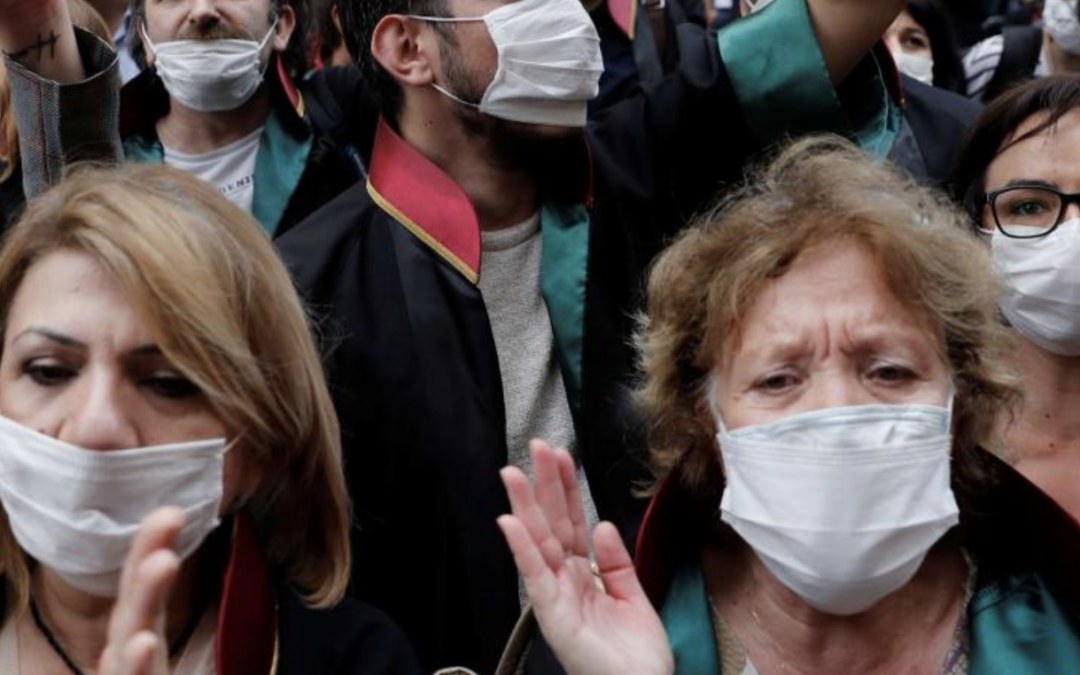
The ICJ is concerned that in Kazakhstan, Kyrgyz Republic, Tajikistan and Uzbekistan the COVID-19 pandemic, and measures taken purportedly to contain it, have significantly curtailed access to justice. Restrictions have affected the operation of the courts and impeded lawyers’ ability to provide effective legal assistance to their clients.
In the context of the COVID-19 pandemic — whether under a state of emergency or not — States’ obligations under international human rights law to uphold the fundamental guarantees of a fair trial, and to ensure access to effective remedies for violations of human rights endure.
The right to a fair trial entails the right to adequate time and facilities to prepare a defense, which, in turn, requires the opportunity to communicate with one’s lawyer effectively and in confidence.
In light of this, the ICJ calls on Central Asian States to ensure that, while COVID-19 restrictions are in place, access to a lawyer continues to be ensured, and that measures be put in place so that lawyers are able to communicate with their clients safely, effectively and confidentially, including in places of detention or during online hearings.
In addition, wherever and whenever the authorities put in place restrictions on physical meetings or travel with the stated purpose of containing the COVID-19 pandemic, the ICJ calls on Central Asian States to ensure that access to court is guaranteed through specific legal, administrative and practical measures.
ICJ research and discussions with lawyers have shown that across Central Asia, regulations adopted during COVID-19 relating to the administration of justice have suffered from vague language, inconsistencies and unclear guidance.
In practice, this had serious implications for the right to fair trial of defendants: in some cases defence lawyers were not allowed to meet their clients who were charged with serious crimes; in other instances lawyer-client meetings were very short, undermining the ability of lawyers to take proper instructions from their clients and to advise them accordingly; in other cases defence lawyers met their clients in circumstances where the confidentiality of their communication was compromised as a result of the virtual communication platforms they were forced to use.
The restriction measures relating to the administration of justice that the authorities have imposed have also had negative consequences for access to justice and effective remedies for victims of human rights violations; notably, access to legal assistance in domestic violence cases was impeded across the region.
In many court buildings social distancing requirements were not adjusted in such a way as to uphold the right to a public hearing. There has been a lack of sufficient guidance on how the right to a public hearing may be ensured online, including as to how the right to equality of arms and the right to legal representation would be protected.
Download
Central Asia-Statement COVID-19-Advocacy 2020-ENG (full article with additional information, in PDF)
Jul 29, 2020 | Advocacy
The Sri Lankan government should end the targeted arrests, intimidation and threats against the lives and physical security of lawyers, activists, human rights defenders and journalists, the ICJ and 9 other international human rights organizations said today.
A campaign of fear has intensified since the 2019 presidential election, and has cast a shadow over the 2020 parliamentary election campaign.
The United Nations, as well Sri Lanka’s partners and foreign donors, should immediately call for full respect, protection and fulfillment of the human rights of all Sri Lankans, and particularly to halt the reversal of fragile gains in the protection of human rights in recent years.
Numerous civilian institutions, including the NGO Secretariat, have been placed under the control of the Defence Ministry. Serving and retired military officers have been appointed to a slew of senior government roles previously held by civilians.
The authorities have recently established military-led bodies such as the Presidential Task Force to build “a secure country, disciplined, virtuous and lawful society,” which has the power to issue directives to any government official. This represents an alarming trend towards the militarization of the state.
Many of those in government, including the president, defense secretary, and army chief, are accused of war crimes during the internal armed conflict that ended in 2009.
Since the presidential election in November 2019, anti-human rights rhetoric intended to restrict the space for civil society has been amplified by senior members of government.
On 6 July 2020, at an election rally, Prime Minister Mahinda Rajapaksa stated that “NGOs will be taken into a special attention under the new government formed after the General Election, specifically, how foreign monies and grants are received to the NGOs from foreign countries and further, activities of the international organizations will be observed.”
The government has also announced a probe into NGOs registered under the previous government.
In the months following the November 2019 presidential election, a number of organizations reported visits from intelligence officers who sought details of staff, programs and funding, in particular, organizations in the war-affected Northern and Eastern provinces of the country. Such visits are blatant attempts to harass and intimidate Sri Lankan civil society.
In February, the acting District Secretary in the Mullaitivu District (Northern Province) issued a directive that only non-governmental organizations with at least 70 percent of their activities focused on development would be allowed to work, effectively enabling arbitrary interference with and prevention of a broad range of human rights work.
A Jaffna-based think-tank was visited several times, including soon after the Covid-19 lockdown, and questioned about its work, funding and staff details.
Lawyers taking on human rights cases have been targeted through legal and administrative processes and have faced smear campaigns in the media.
Journalists and those voicing critical opinions on social media, have been arbitrarily arrested. The UN High Commissioner for Human Rights expressed alarm at the clampdown on freedom of expression, including the 1 April announcement by the police that any person criticizing officials engaged in the response to Covid-19 would be arrested.
It is unclear whether there is any legal basis for such arrests. The Human Rights Commission of Sri Lanka has cautioned against “an increasing number of such arrests since the issuing of a letter dated 1 April 2020”.
The targeting and repression of journalists and human rights defenders is not only an assault on the rights of these individuals, but an attack on the principles of human rights and the rule of law which should protect all Sri Lankans.
These policies have a chilling effect on the rights to freedom of expression and association, which are crucial for the operation of civil society and fundamental to the advancement of human rights.
Those working on ending impunity and ensuring accountability for past crimes, and especially victims, victim’s families, members of minority communities, and networks in the Northern and Eastern provinces, are particularly at risk of intimidation and harassment.
The Sri Lankan authorities must end all forms of harassment, threats, and abuse of legal processes and police powers against lawyers, human rights defenders and journalists. Human rights defenders living and working in Sri Lanka should be able to carry out their peaceful human rights work without fear of reprisals, which requires a safe and enabling environment in which they can organize, assemble, receive and share information.
Download:
Sri Lanka-Harassment civil society-Advocacy-2020-ENG (the full statement with additional information, in PDF)
Jul 28, 2020 | Advocacy, Cases, Legal submissions, News
The ICJ intervened today in the case of the potential surveillance by Polish secret services of Mikołaj Pietrzak, lawyer and chair of the Warsaw Bar Association, Dominika Bychawska-Siniarska et Barbara Grabowska-Moroz of the Helsinki Foundation of Human Rights, and Wojciech Klicki and Katarzyna Szymielewicz of the foundation Panoptykon.
The five applicants applied to the European Court of Human Rights claiming a violation of their rights to privacy and to an effective remedy because the system of secret surveillance and collection of metadata created by the Law amending the Law of the Police of 15 January 2016 and the Anti-Terrorism Law of 16 June 2016 does not provide sufficient guarantees for this rights’ protection.
In its third party intervention, the ICJ addressed (1) the application of the principles of prescription by law, necessity and proportionality, in circumstances when mass and targeted surveillance interferes with the right to respect for private life under Article 8 ECHR, in particular when it affects lawyers and human rights defenders; (2) the obligations of States under Article 8 and 6 ECHR to ensure respect for the confidentiality of lawyer-client relations and the principle of legal professional privilege.
The ICJ argued that secret surveillance, in particular where it interferes with the confidentiality of communications of lawyers and human rights defenders, and endangers lawyer-client privilege protected under Articles 8 and 6 ECHR, should be subject to specific safeguards and to particularly strict scrutiny of its necessity and proportionality.
The third party intervention can be found here: PIetrzak&HF_v_Poland-AmicusCuriae-ECtHR-Cases-2020-ENG
Jul 24, 2020 | News
The ICJ urges Israel to repeal or amend the “Great Coronavirus Law” adopted on 23 July. In the context of concerns about the emergency measures taken in recent months, the Law restricts parliamentary oversight of measures to address the COVID-19 pandemic in a manner that could undermine human rights protection and the rule of law.
The Law would enter into force on 10 August, replacing a “placeholder” law adopted by the Knesset (Israel’s parliament) earlier in July that currently gives even wider powers to the executive government but will expire on that date.
Under the new Law, the executive government has authority to declare COVID-19-related states of emergency for 60 days at a time until 30 June 2021, although the Knesset retains the power to revoke any such state of emergency.
Once a state of emergency is in place, the Law accords the Government the power to adopt “emergency regulations” for renewable periods of 28 or 14 days, depending on the type of restrictions envisaged.
The ability of Knesset committees to reverse such “emergency regulations” is significantly restricted under the Law.
As the ICJ highlighted in a briefing paper, “emergency regulations” already adopted since March 2020, and continued under the “placeholder” law, have failed in many respects to comply with international law and standards on the declaration of a state of emergency and related formal and substantive requirements under article 4 of the the International Covenant on Civil and Political Rights (ICCPR); the protection of the right to privacy with regard to the “tracking programme” of Israeli citizens; and respect for detainees’ rights to independent legal counsel and to family visits.
“The emergency powers legislation significantly weakens the ordinary role of the Parliament and risks paving the way for further arbitrary restrictions on human rights beyond those already seen in the regulations adopted to date,” said Said Benarbia, the ICJ’s MENA Programme Director.
“The Law should be repealed or amended to ensure effective oversight by Parliament over all emergency measures.”
Since March 2020, the Israeli Government has adopted a number of “emergency regulations” with the purported aim of tackling the COVID-19 pandemic.
“Respecting international law while tackling the COVID-19 pandemic is not optional, Israel must handle the pandemic in a way that guarantees the full enjoyment of human rights,” Benarbia added.
Contact
Said Benarbia, Director, ICJ Middle East and North Africa Programme, t: +41-22-979-3817; e: said.benarbia(a)icj.org
Jul 22, 2020 | Advocacy, Cases, Legal submissions, News
The ICJ and Amnesty International have submitted a joint third party intervention before the European Court of Human Rights in the case of Judges Mariusz Broda and Alina Bojara.
The case concerns the premature termination of their mandates as vice-presidents of the regional tribunal of Kielce in Poland. The two judges, that had been appointed to six-year terms in 2014, had their position revoked by the Minister of Justice in 2018.
The revocation was based on article 17.1 of the Law of 12 July 2017 modifying the Law on the Judicial System. This provision, presented and approved by the ruling Law and Justice Party (PiS), gave the Minister of Justice the power to revoke courts’ presidents and vice-presidents without justified grounds and with no possibility of appeal.
The two judges applied to the European Court of Human Rights alleging that they had been denied access to a tribunal to challenge the termination of their mandate .
In their third party intervention, the ICJ and Amnesty International analyze international standards on judicial independence, including as regards the role court presidents and vice-presidents, and the consequences of these standards for the right of access to court under Article 6.1 ECHR. The intervention also analyses the recent legislative and policy developments that have seriously undermined the independence of the Polish judiciary.
Read the full intervention here: Broda_v_Poland-AmicusCuriae-ICJ&AI-Cases-2020-ENG.