Jul 20, 2018
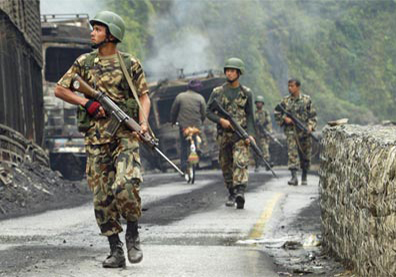
The legitimacy and viability of the government of Nepal’s draft “Bill to Amend the Act on Commission on Investigation of Disappeared Persons, Truth and Reconciliation, 2014” must be questioned, said the ICJ, Amnesty International and Trial International today.
There is a lack of a meaningful consultation process and serious shortcomings when evaluated against international law and standards, the three international human rights organization say in their preliminary comments on the draft bill.
While welcoming certain aspects of the draft bill, the three organizations identified weaknesses in the draft bill from an accountability perspective that, if not addressed, will contribute to impunity.
This is especially true when it comes to the failure to address the demand for reconstituting the current transitional justice commissions, ensure punishment proportionate to the gravity of the crimes and a need to comply with not just the “letter” but also the “spirit” of decisions by Nepal’s Supreme Court.
Amnesty International, the International Commission of Jurists and TRIAL International called on the government of Nepal to heed the concerns of victims of the conflict-era human rights abuses by embarking on an effective and transparent consultative process that meets the “reparative principle of victim satisfaction”.
“There are critical flaws in the amendment related to accountability for crimes under international law, including crimes against humanity; in relation to sentencing, … and in relation to the overall architecture of the transitional justice process, which must strike a balance between the four pillars of truth, justice, reparations, and measures to avoid repetition of past crimes,” the briefing says.
The organizations also expressed concern about the lack of meaningful consultation with the victims’ community, and urged the government to ensure that the draft bill is responsive to the self-identified needs of victims and civil society.
The briefing also calls on the international community to heed “the lessons of history regarding transitional justice” and read carefully each provision within the context of the law as a whole and in relation to the broader reality on the ground – including a lack of demonstrated willingness to bring all those suspected of criminal responsibility to justice in fair trials.
“The removal of the inclusion of crimes against humanity and the lack of an explicit reference to war crimes demonstrates a weakening commitment to stand against “crimes against humanity” and war crimes, principal crimes under the Rome Statue of International Criminal Court (ICC) and customary international law” the briefing says.
Full Analysis in English (PDF): Nepal-Transitional-Justice-Advocacy-Analaysis-brief-June-2018-ENG
Jun 11, 2018
The ICJ today called on the Egyptian authorities to ensure that the framework on the state of emergency is comprehensively reformed consistent with the country’s international human rights obligations.
The ICJ is particularly concerned that Egypt seems to be returning to the continuous and permanent state of emergency that prevailed in Egypt, uninterrupted, from 1981 until 2012, and that resulted in grave and systematic human rights violations.
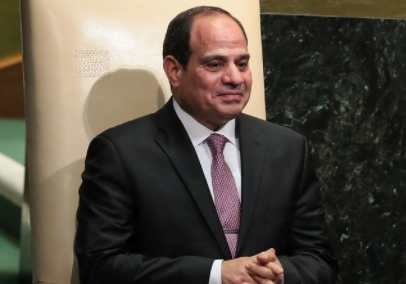
Since April 2017, President El- Sisi (photo) declared the state of emergency, renewed it, and then declared a new state of emergency five consecutive times.
“In declaring and renewing exceptional measures under the state of emergency, Egypt has consistently failed to demonstrate that the situation ‘threatens the life of the nation’, the threshold for such measures under international law,” said Said Benarbia, ICJ MENA Director.
Egypt has also failed to set out clear and precise conditions in which the President is allowed to declare the state of emergency and in which measures derogating from human rights under the state of emergency can be declared, the ICJ says.
It has also failed to ensure that each such measure is strictly limited and proportionate to the exigencies of the specific emergency, specify which rights can or cannot be subject to derogation, and notify relevant stakeholders of such derogations, the Geneva-based organization adds.
“Repealing or amending emergency measures to ensure they are limited in time and scope and are not used to curtail rights or to crush dissent, is a prerequisite to establishing and upholding the rule of law in Egypt,” added Benarbia.
The ICJ’s findings and recommendations are based on a position paper published today, in which the ICJ analyses the framework on the state of emergency and assesses its impact on certain aspects of the administration of justice, including those relating to the use of emergency state security courts and to the right to liberty and to fair trial.
Under the framework of the state of emergency, Prime Minister Sherif Ismail issued a decree on No. 2165/2017 through which numerous crimes, including those related to protest, assembly, terrorism and labour law have been placed under the jurisdiction of the emergency state security courts.
These courts have mainly been used to try students, human rights defenders, political activists, union members and those suspected of opposing the government in proceedings that fall short of international standards on fair trial.
“Authorities must abolish the emergency state security courts and ensure that any existing proceedings before them should be either nullified or transferred to the ordinary courts,” said Benarbia.
Contact
Said Benarbia, Director of ICJ’s Middle East and North Africa Programme, t: +41-22-979-3817 ; e: said.benarbia(a)icj.org
Egypt-Return to State of Emergency-Advocacy-Analysis brief-2018-ENG (full memo in English, PDF)
Egypt-State of emergency-News-Press releases-2018-ARA (full story in Arabic, PDF)
Egypt-Return-State-of-Emergency-Advocacy-Analysis-brief-2018-ARA (full memo in Arabic, PDF)
Jun 7, 2018
In a memorandum published today, the ICJ called on the Lebanese authorities to introduce comprehensive legal and institutional reforms with a view to ensuring that the Office of the Public Prosecutor (OPP) is strictly separated from the judiciary and judicial functions.
The reforms must also guarantee that the OPP’s independence and impartiality is fully safeguarded consistent with internationals standards, the ICJ says.
“The structure of the OPP, its role, status and functions are not in compliance with international standards on the independent and impartial functioning of prosecutors,” said Said Benarbia, ICJ MENA Director.
“The Lebanese authorities must ensure that the functions of judges and prosecutors are clearly separated and distinct and that prosecutors are not granted any powers to take decisions of a judicial character, including those relating to renewing police custody and ensuring oversight over police custody’s facilities, periods and conditions,” he added.
In the memorandum, the ICJ also formulates recommendations for amendment and reform of law and practice with a view to ensuring the administration of criminal justice in a manner that respects and protects human rights, due process and the rule of law.
The Code of Criminal Procedure and Decree-Law No. 150/83 on the Organization of the Judiciary do not provide for appropriate safeguards and limitations on internal and external instructions to prosecutors, do not adequately limit the power of the Minister of Justice in relation to the conduct of prosecutions, and, therefore, do not safeguard the real and perceived independence of the prosecution services.
If public faith and confidence in the integrity of the justice system is to be restored, the functional independence of prosecutors must be safeguarded from any undue or improper interference, including those emanating from within the OPP itself.
“The Lebanese authorities must ensure that the executive is prohibited from issuing instructions not to prosecute or requiring prosecution in a specific case,” said Benarbia.
“Any instructions to individual prosecutors regarding the conduct of a prosecution must be in writing, exercised transparently, and take into account established prosecution guidelines and the interests of victims and other interested parties,” he added.
Contact
Rola Assi, Associate Legal Adviser, t: 0096170821670 ; e: rola.assi(a)icj.org
Lebanon-Memo re prosecutors-Advocacy-Analysis Brief-2018-ENG (full memo in English, PDF)
Lebanon-Prosecutors memo launch-News-2018-ARA (full story in Arabic, PDF)
Lebanon-Memo prosecutors-Advocacy-Analysis Brief-2018-ARA (full memo in Arabic, PDF)
May 29, 2018
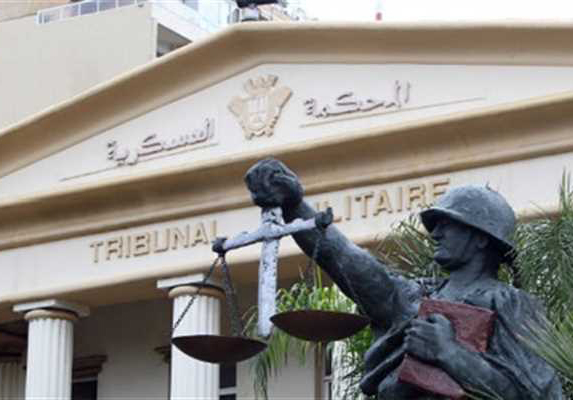
In a memorandum published today, the ICJ urged the Lebanese authorities to introduce comprehensive legal reforms to ensure the independence and impartiality of military courts and to restrict their jurisdiction to cases involving members of the military for alleged breaches of military discipline.
The country should transfer the competence of military courts to civilian, ordinary courts in all cases involving civilians and all cases involving human rights violations and non-military offences committed by members of security and armed forces, the ICJ added.
“Lebanese military courts have a long history of prosecuting civilians, including those critical of the military and the government, in trials that fall short of international standards,” said Said Benarbia, ICJ MENA Director.
“Lebanese authorities must prohibit military courts from exercising jurisdiction over civilians, even where the target or victim of the offence is military, as well as over all persons under the age of 18, with no exceptions,” he added.
The ICJ also called for legal and institutional reforms to be introduced with a view to ensuring the independence and impartially of military courts and the fairness of their procedures, including by ensuring that the selection, appointment, transfer and evaluation of military judges are based on transparent procedures and objective criteria, and that any disciplinary action against them is only pursuant to well-defined standards and respectful of all due process guarantees.
In the memorandum, the ICJ formulates recommendations for amending the Code of Military Justice with a view to enhancing due process guarantees, including by providing that individuals convicted by military courts have the right to appeal their conviction and sentence to the civilian courts of the ordinary court system, and that the nature of the review is to be substantive and based both on sufficiency of the evidence and of the law and to allow for due consideration of the nature of the case.
“Limiting the jurisdiction of the military courts and enhancing their independence and impartiality and the fairness of their procedures is required not only to establish and uphold judicial independence, but also to restore public faith and confidence in the integrity of the Lebanese justice system,” said Benarbia.
Contact
Rola Assi, Associate Legal Adviser, ICJ MENA Programme, t: +96170821670 ; e: rola.assi(a)icj.org
Lebanon-Memo re army courts-Advocacy-Analysis Brief-2018-ENG (full memo in English)
Lebanon-military courts memo launch-News-2018-ARA (full story in Arabic)
Lebanon-Memo army courts-Advocacy-Analysis Brief-2018-ARA (full memo in Arabic)
Feb 8, 2018
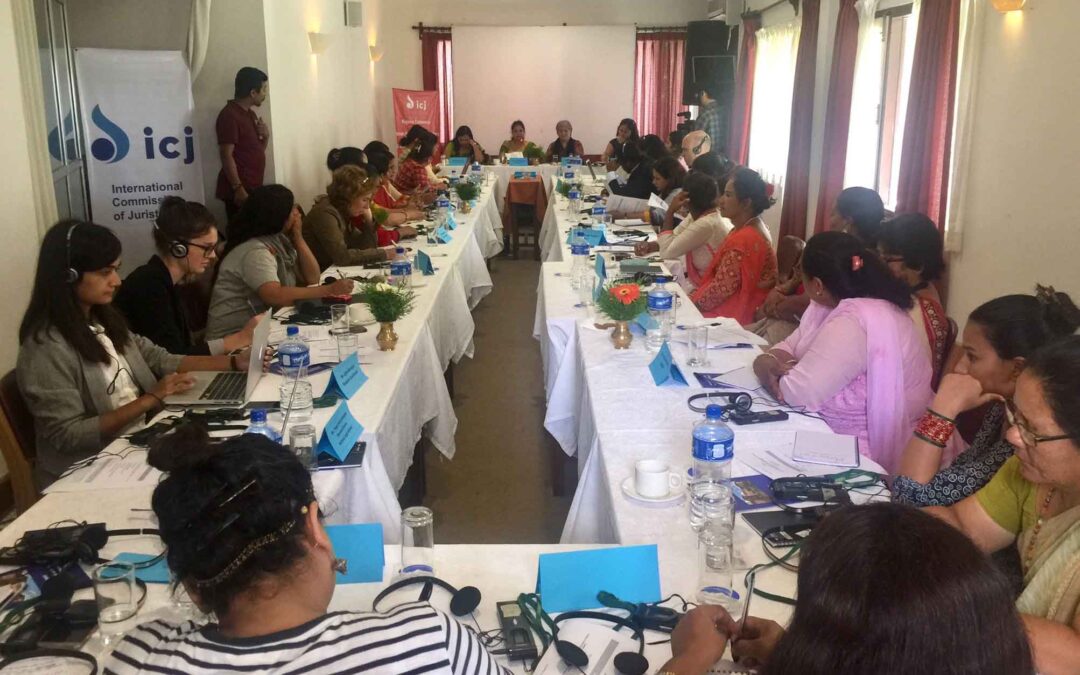
Today, the ICJ released a new briefing paper concerning its Regional Conference on Women Human Rights Defenders as Political Actors (28-29 August 2017), which brought together women human rights defenders (WHRDs) from all over Nepal who were elected in May 2017.
The conference focused on how newly-elected WHRDs could continue to advance human rights in their new roles as elected officials, with specific attention paid to encouraging equal participation of women in public affairs and furthering their advocacy for human rights.
The attached briefing paper lays out the key points of the conference and offers a set of future actions aimed at supporting WHRDs in their role as political actors pursuing a human rights agenda.
Nepal-WHRD-Advocacy-Analysis brief-2018-ENG (Briefing Paper in PDF)