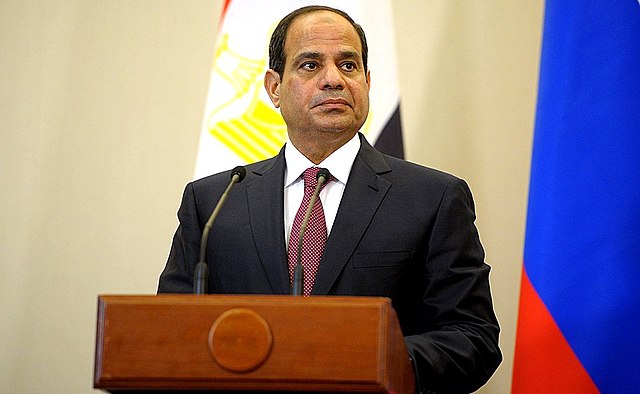
President Abdel Fattah al-Sisi of Egypt should immediately end a crackdown on freedom of association, independent groups, and peaceful dissent, 63 organizations, including the ICJ, said today.
هذا البيان الصحفي متوفر باللغة العربية أيضاً
The groups issued the following public statement recommending a series of actions Egypt should take to make tangible improvements in the human rights situation in Egypt and to ensure that Egypt complies with its international obligations:
We the undersigned 63 organizations call on the Egyptian authorities, including President Abdel Fattah al-Sisi, to take immediate action to end the Egyptian authorities’ wholesale crackdown on independent organizations and peaceful dissent.
More than 30 countries at the United Nations Human Rights Council issued a joint statement on 12 March 2021 expressing their deep alarm over “the trajectory of human rights in Egypt and share[d] the concerns expressed by the [UN] High Commissioner for Human Rights and [UN] Special Procedure mandate holders.”
Our organizations have been calling for the establishment of a monitoring and reporting mechanism on Egypt at the Human Rights Council and will continue to do so until there is meaningful and sustained improvement in the country’s human rights situation.
We remain greatly concerned over the arbitrary arrest, detention, and other judicial harassment of human rights defenders. Those held unjustly include NGOs directors Mohamed al-Baqer and Ezzat Ghoniem, human rights researchers Patrick George Zakiand Ibrahim Ezz el-Din, and lawyers Mahienour al-Massry, Haytham Mohamdeen, and Hoda Abdelmoniem. The founder and director of the Cairo Institute for Human Rights Studies (CIHRS) Bahey Eldin Hassan was handed down an outrageous 15-years imprisonment sentence in absentia.
Other attacks against human rights defenders include travel bans, asset freezes, additions to the “terrorists list” in arbitrary proceedings, protracted criminal investigations under case No. 173 of 2011, and reprisals for their engagement with UN mechanisms. We share concerns by seven Special Procedures mandate holders – United Nations experts – about Law No. 149/2019 on Non-Governmental Organizations, as it fails to meet Egypt’s international obligations to ensure the right to freedom of association.
We also have serious concerns over the overly broad definition of terrorism in Law No. 94 of 2015 on counterterrorism and in the Penal Code that contravenes international standards and allows for the criminalization of acts falling within the scope of the rights to freedom of expression, association and peaceful assembly, as well as the misuse of “terrorism circuits” of criminal courts and the Supreme State Security Prosecution to target human rights defenders and other peaceful critics in order to silence dissent.
We are also deeply concerned over the crackdown on independent journalists and media, as hundreds of websites remain blocked and at least 28 journalists remain behind bars for simply doing their work or expressing critical views, including Esraa Abdelfatah and Ismail Iskandarani.
We share the assessment of the UN Working Group on Arbitrary Detention that arbitrary detention is a systematic problem in Egypt. Since President al-Sisi came to power, Egyptian security forces, with the complicity of prosecutors and judges, have arbitrarily arrested and detained thousands of people on the basis of unfounded terrorism-related charges. They include human rights defenders, religious minority rights activists, peaceful protesters, journalists, academics, artists, lawyers, opposition politicians, and relatives of dissidents forced into exile.
Egyptian security forces routinely subject those in custody to enforced disappearance and torture, which the UN Committee against Torture concluded to be “a systematic practice in Egypt.” Those disappeared and tortured are then routinely convicted in grossly unfair mass trials, in some cases before military courts.
Since 2014, hundreds have been sentenced to death and dozens executed after trials that rely on torture-tainted “confessions.” Thousands of others are being held in prolonged pretrial detention without the opportunity to meaningfully challenge the lawfulness of their detention, sometimes for periods exceeding the two-year maximum permissible under Egyptian law.
Even when prosecutors and judges order their release, the National Security Agency (NSA), with prosecutors’ complicity, routinely accuse them of similar charges in new cases to keep them detained indefinitely without trial, in the practice known as ”rotation.”
We also share the UN experts concerns over cruel and inhuman prison conditions, and the deliberate denial of adequate medical care that has led or contributed to preventable deaths in custody and serious damage to prisoners’ health. In 2020 alone, at least 35 people died in custody or shortly after following medical complications. The health and human rights crisis in prisons was further exacerbated by the authorities’ failure to adequately address Covid-19 outbreaks.
We share the High Commissioner’s concerns regarding worrying patterns in the Sinai peninsula of forcible displacement, enforced disappearances, and torture and other ill-treatment of detainees. We note her call to the Egyptian authorities “to recognise that, as in all countries facing security challenges and violent extremism, depriving people of their rights will not make the State safer, but more unstable.”
Discrimination against women and girls remains entrenched in law and practice. The authorities have not only failed to address pervasive sexual and gender-based violence, but have also targeted women’s human rights defenders and campaigners against sexual violence and harassment through arrests, harassment, threats, and other reprisals. The authorities have also used morality and debauchery laws to arbitrarily arrest, detain, and prosecute survivors and witnesses of sexual and other gender-based violence, women social media influencers, and LGBTQI+ people and activists.
This catalog of serious violations continues as a result of endemic impunity that prevails in Egypt, as highlighted by UN experts and the UN Committee against Torture.
We urge President al-Sisi to order and ensure full implementation of the following recommendations in order to secure tangible improvements in the human rights situation in Egypt and to ensure that Egypt complies with its international obligations:
- Immediately and unconditionally release anyone held solely for peacefully exercising their rights to freedom of expression, association and assembly; and release others detained arbitrarily, including those held in prolonged pretrial detention without trial or the possibility to challenge the lawfulness of their detention; cease the practice commonly called “rotation”, and protect those in custody from torture and other ill-treatment and ensure their regular access to their families, lawyers of their choosing, and adequate medical care;
- Publicly condemn and order independent, impartial, thorough, and effective investigations into extrajudicial executions and other unlawful killings, enforced disappearances, torture, and other serious human rights violations and crimes under international law, including those committed in custody and in the context of counterterrorism operations in Sinai, with a view to bringing those responsible to justice; and guarantee the victims’ rights to truth, justice, and reparation;
- Establish a moratorium on executions, pending the abolition of the death penalty;
- Create a safe and enabling environment for human rights defenders, including by effectively protecting them from arbitrary arrest, detention, and other forms of reprisal or harassment; instructing the public prosecution to close Case No. 173 of 2011; removing all arbitrary measures including travel bans and asset freezes against human rights defenders and their families; quashing verdicts against human rights defenders including those sentenced in their absence; and removing human rights defenders from the “terrorists list”;
- Prevent sexual and gender-based violence and prosecute offenders; put a stop to the policing of women’s bodies and behavior as well as prosecutions over vague charges of “indecency”, “violating family principles and values”, and “debauchery”;
- End arbitrary arrests and prosecutions against LGBTQI+ people, including police entrapment of LGBTQI+ through dating apps or social media and quash the verdicts of anyone already convicted; instruct officials to end forced anal examinations and sex determination tests as they can amount to torture; and
- Amend Law No.94 of 2015 on counterterrorism, Law No.8 of 2015 on terrorist entities, Law No.175 of 2018 on cybercrime, and Law No. 149 of 2019 on NGOs to bring them in line with Egypt’s international obligations.
Signatories:
Access Now
Amnesty International
ANKH (Arab Network for Knowledge about Human rights)
Association Beity (Tunisia)
Association for Juridical Studies on Immigration (ASGI)
Association for the Defense of Human Rights in Morocco (ADDHOM)
Baytna
Cairo Institute for Human Rights Studies (CIHRS)
CELS Centro de Estudios Legales y Sociales
Center for Reproductive Rights
Center of Studies and Initiatives for International Solidarity (CEDETIM, France)
CNCD-11.11.11
Committee for Justice
Committee for the Respect of Liberties and Human Rights in Tunisia (CRLDHT)
DefendDefenders (East and Horn of Africa Human Rights Defenders Project)
Democratic Association of Tunisians in France (ADTF)
Democracy for the Arab World Now (DAWN)
Dignity – Danish Institute Against Torture
Egyptian Human Rights Forum
Egyptian Initiative for Personal Rights (EIPR)
EgyptWide (Egyptian-Italian Initiative for Rights and Freedoms)
English PEN
EuroMed Rights
Freedom House
Front Line Defenders
Geneva Bridge Association
Global Voices
Gulf Centre for Human Rights (GCHR)
Hassan Saadaoui Association for the Defense of Democracy and Equality (Tunisia)
humanrights.ch
Human Rights Watch (HRW)
Initiative Franco-égyptienne pour les Droits et les Libertés
International Commission of Jurists (ICJ)
International Federation for Human Rights (FIDH)
International Service for Human Rights (ISHR)
Karapatan Alliance Philippines Inc.
Lawyers for Lawyers (L4L)
Legal Resources Centre
Mawjoudin Initiative (Tunisia)
MENA Rights Group
Minority Rights Group International (MRG)
Mwatana for Human Rights
Nachez (Dissonance), Tunisia
The National Union for Tunisian Journalists (SNJT)
Odhikar, Bangladesh
PEN Norway
People in Need
Project on Middle East Democracy (POMED)
REDRESS
Réseau des Organisations de la Société Civile pour l’Observation et le Suivi des Élections en Guinée (ROSE)
Robert F Kennedy Human Rights
South East Europe Media Organisation (SEEMO)
The Freedom Initiative
Tunisian Association of Democratic Women
Tunisian Association for Democracy and Civic State (AVDDH)
The Tunisian Association for the Defense of Academic Values (ATDVU)
The Tunisian Association for the Defense of Individual Liberties (ATDLI)
Tunisian Center for Press Freedom (CTLP)
Tunisian Coalition Against Death Penalty
The Tunisian Federation for Citizenship on both Shores (FTCR)
The Tunisian Human Rights League (LTDH)
UIA-IROL (Institute for the Rule of Law of the International Association of Lawyers)
Vigilance for Democracy in Tunisia (Belgium)
Contact: