Sep 28, 2020 | Events, News
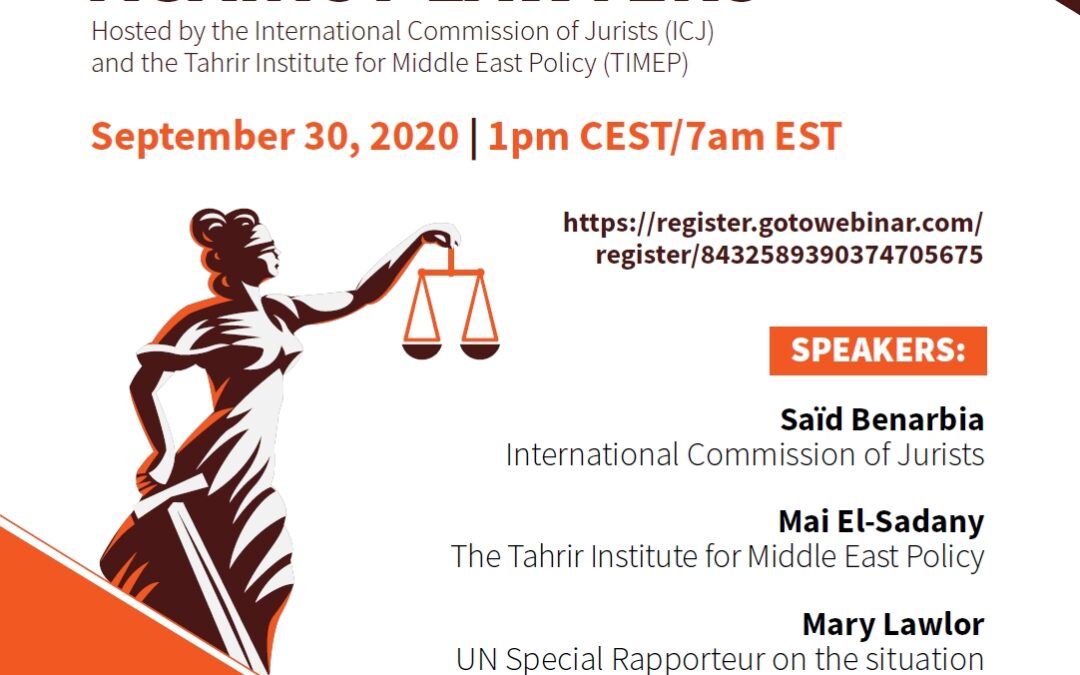
Join this panel discussion with ICJ, the Tahrir Institute, and the UN Special Rapporteur on human rights defenders, Wednesday 30 September 2020, 13:00.
Targeting the Last Line of Defense:
Egypt’s attacks against lawyers
A Virtual Side Event to the Human Rights Council 45th Session
Wednesday 30 September 2020, 13:00 – 14:30 (Geneva time)
The International Commission of Jurists (ICJ) and the Tahrir Institute for Middle East Policy (TIMEP) cordially invite you to join this online side event, including the UN Special Rapporteur on human rights defenders, this coming Wednesday.
The ICJ and TIMEP will present their joint report Targeting the last line of defense: Egypt’s attacks against lawyers. The report documents systematic targeting of lawyers through arbitrary arrests and detention, physical assaults, torture and enforced disappearances, as well as politicized criminal proceedings under counter-terrorism and other overbroad laws.
In the report, the ICJ and TIMEP call on the Egyptian authorities to immediately end their crackdown on lawyers and to unconditionally release all lawyers who are detained or convicted solely on the basis of the peaceful exercise of their human rights and/or the legitimate discharge of their professional duties.
Speakers:
- Mary Lawlor, UN Special Rapporteur on the situation of human rights defenders
- Saïd Benarbia, International Commission of Jurists
- Mai El-Sadany, The Tahrir Institute for Middle East Policy
Register for the event here:
https://attendee.gotowebinar.com/register/8432589390374705675.
For more information contact: un(a)icj.org
Sep 25, 2020 | News
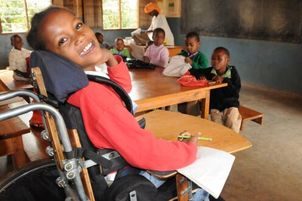
On 24 September 2020, the ICJ held a webinar in collaboration with the Lesotho National Federation of Organisations of the Disabled on the right to education for children with disabilities.
Presenters and participants included representatives from civil society organizations, teachers’ unions, teachers and the Lesotho Department of Education.
“Children with disabilities have a right to access to education on an equal basis with all other children. The COVID-19 pandemic must not hamper the Lesotho governments efforts to ensure access to inclusive education for all children,” said Kaajal Ramjathan-Keogh, ICJ’s Africa Director.
Participants highlighted accessibility-related problems faced by learners with disabilities in the context of the COVID-19 pandemic. Some examples include:
- Ordinary masks necessary to combat the spread of COVID-19 inhibit communication for learners with hearing disabilities who often communication in part by lip-reading. These require access to face visors and/or transparent masks. Some deaf students also had difficulty in understanding the COVID-19 pandemic and virus, despite efforts to explain it to them.
- Blind learners need more access to hand sanitizer as they need to touch their surroundings for mobility. This also makes social distancing more difficult for them.
- Teachers have trouble understanding how to comply with social distancing measures while assisting learners experiencing epileptic seizures.
- Many learners with disabilities have stayed at home during the pandemic, not understanding why they were not at school.
- Many children with disabilities are rendered more vulnerable to sexual violence and exploitation as they observe stay at home rules.
A representative of the Department of Education explained various measures which government had put in place to ensure that these obstacles could be overcome so that learners with disabilities could enjoy their right to education in the context of COVID-19. Learners’ health and safety would also remain a priority.
The Department noted the delays in the implementation of its inclusive education policy as a result of a lack of funding as government resources are diverted to COVID-19 responses.
The need for compliance with Lesotho’s global and regional international human rights obligations was also highlighted with participants agreeing about the importance of ensuring that there is “strength in numbers” in advocacy efforts toward the realization of children with disabilities’ right to education.
“Ensuring the right to education of persons with disabilities does not imply sacrificing and compromising their right to health. All human rights are interdependent and Lesotho should be guided by all of its human rights obligations as it continues to implement its domestic inclusive education policy during the COVID-19 pandemic,” Ramjathan-Keogh added.
Background
Article 24 of the Convention on the Rights of Persons with Disabilities (CRPD) and the Protocol to the African Charter on Human and Peoples’ Rights on the Rights of Persons with Disabilities in Africa require States parties to ensure that their education systems are inclusive and fully realize the right to education of all children with disabilities. The normative content of Article 24 of the CRPD and corresponding obligations of member States are expanded on in the General Comment No 4 of the Committee on the Rights of Persons With Disabilities.
For more information on the impact of COVID-19 on access to education, find the UN Special Rapporteur on the right to education’s report here.
Contact
Nokukhanya (Khanyo) Farisè, Legal Adviser (Africa Regional Programme), e: nokukhanya.farise(a)icj.org
Tanveer Jeewa, Communications Officer (Africa Regional Programme), e: tanveer.jeewa(a)icj.org
Sep 23, 2020 | News
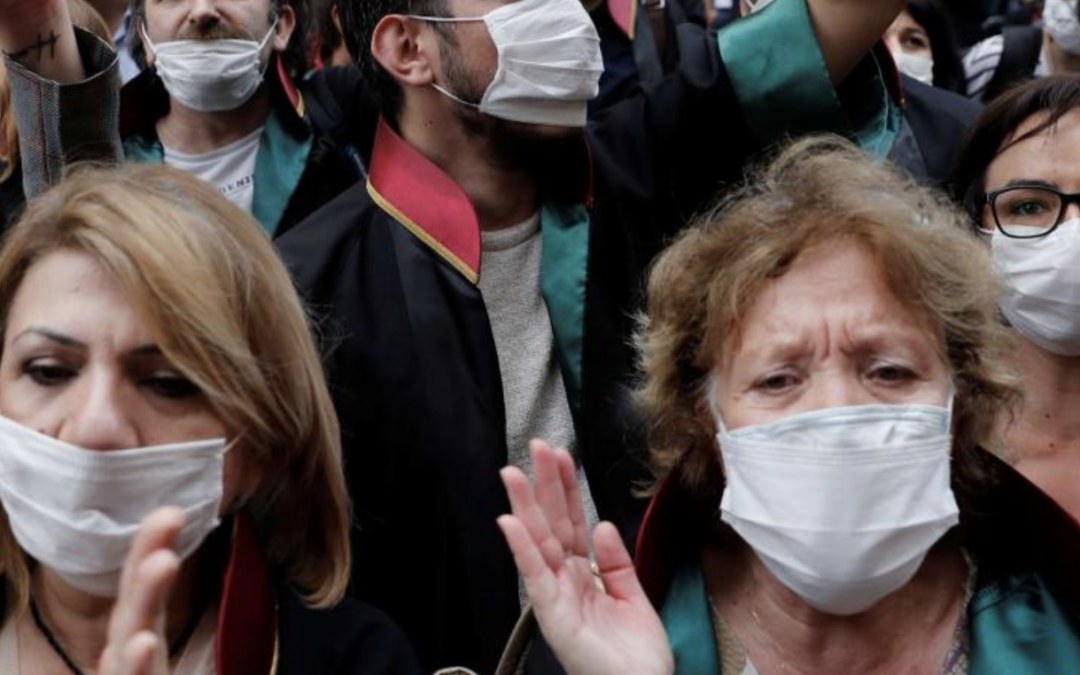
The ICJ called today on the Public Prosecutor Office of Istanbul to drop criminal charges and investigations against the President and Board Members of the Istanbul Bar Association for having publicly displayed a photograph of lawyer Ebru Timtik, who died following a hunger strike while in detention.
“These charges have been brought as a direct result of the lawyers’ exercise of their freedom of expression,” said Massimo Frigo, Senior Legal Adviser with the ICJ Europe and Central Asia Programme. “ They should be dropped immediately.”
On 21 September, the Chief Public Prosecutor’s Office of Istanbul notified to the 11 members of the board of the Istanbul Bar Association, including its President Mehmet Durakoğlu, that they were under criminal investigation.
The charges are not yet known but it is confirmed that the investigation concerns their hanging of a large picture of lawyer Ebru Timtik out of the window of the Istanbul Bar Association’s headquarters.
Lawyer Ebru Timtik died last 27 August on the 238th day of her hunger strike, while in detention on remand. She was a lawyer in the Progressive Lawyers Association and was under trialto answer to the unfounded accusation of being a member of a terrorist organisation. She undertook the hunger strike to protest against these accusations, which are often used in Turkey to silence political opposition and human rights defenders.
Following the bar association’s display of Ebru Timtik’s photograph, Minister of Interior Süleyman Soylu targeted the İstanbul Bar, saying, “I strongly condemn the ones who hung the photograph of a terrorist organization member on the İstanbul Bar Association.” Minister of Justice Abdulhamit Gül also said, “It is unacceptable that the bar association has become a backyard for illegal and marginal structures.” President Erdoğan also stated in the opening speech of the new legal year that “In the next period, we will do what is necessary to cut the bloody road extending from being attorneys to terrorists.”
“It is particularly worrying that these investigations were triggered after statements by the Minister of the Interior and the President, besmirching the legitimate work of lawyers and bar associations as linked to ‘terrorism,” added Massimo Frigo.
International standards
The UN Basic Principles on the Role of Lawyers state:
18. Lawyers shall not be identified with their clients or their clients’ causes as a result of discharging their functions.
23. Lawyers like other citizens are entitled to freedom of expression, belief, association and assembly. In particular, they shall have the right to take part in public discussion of matters concerning the law, the administration of justice and the promotion and protection of human rights and to join or form local, national or international organizations and attend their meetings, without suffering professional restrictions by reason of their lawful action or their membership in a lawful organization. In exercising these rights, lawyers shall always conduct themselves in accordance with the law and the recognized standards and ethics of the legal profession.
24. Lawyers shall be entitled to form and join self-governing professional associations to represent their interests, promote their continuing education and training and protect their professional integrity. The executive body of the professional associations shall be elected by its members and shall exercise its functions without external interference.
Contact
Massimo Frigo, Senior Legal Adviser, e: massimo.frigo(a)icj.org, t: +41797499949; twitter: @maxfrigo
Sep 21, 2020 | News, Op-eds
An opinion piece by Ruth Panjaitan, ICJ National Legal Adviser in Indonesia.
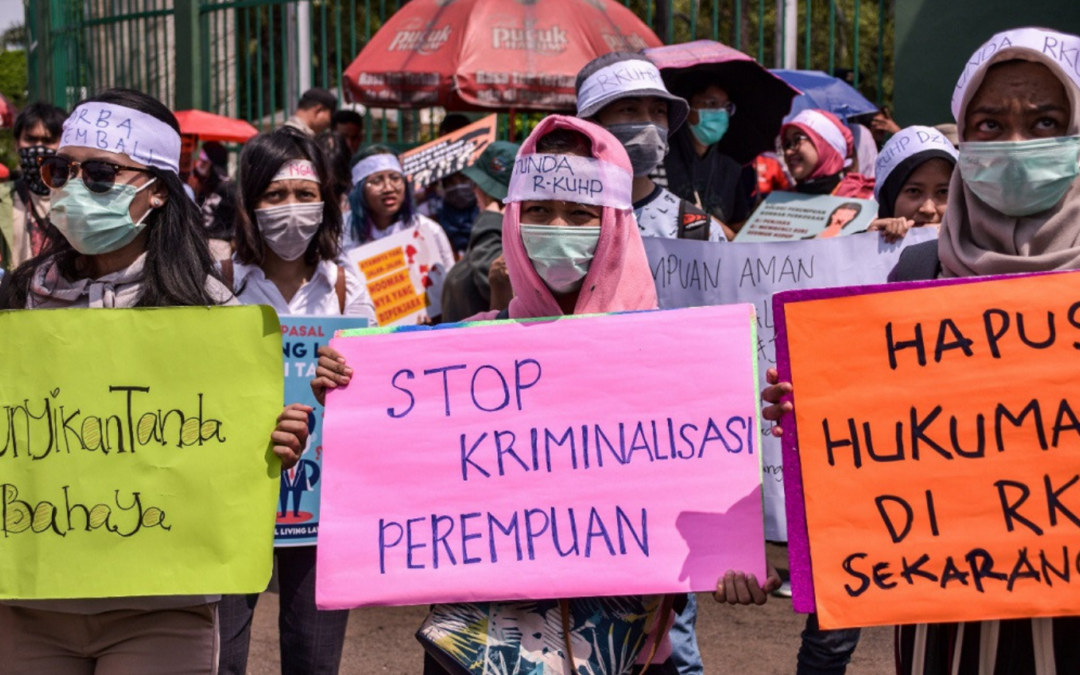
Amid the COVID-19 outbreak in Indonesia, the House Representatives and the Law and Human Rights Ministry have continued their deliberation of the controversial Criminal Code revision as a priority bill.
The International Commission of Jurists has previously expressed concern that a number of provisions in the bill are inconsistent with Indonesia’s obligations under international human rights law. These provisions relate to the right to privacy, freedom of speech and freedom of association.
There are provisions in the draft that would have dire consequences for women’s rights in Indonesia. For instance, if implemented in its current form, the bill would explicitly criminalize cohabitation or the act of two consenting adults living together as heterosexual sexual partners outside of a legal marriage. Persons found guilty of cohabitation would risk up to six months of imprisonment or a fine of approximately Rp 10 million (US$633).
The act of cohabitation is currently not a criminal offence under the existing Criminal Code. However, Indonesian women who live with their partners outside of marriage are often stigmatized as women “of low honor”. In addition, there are some regions in Indonesia that have adopted local ordinances prohibiting cohabitation, such as in Batam and Aceh, as this practice is disfavored by the authorities because of harmful gender stereotypes and their interpretations of religious and cultural norms.
These local ordinances are being used by the local Public Order Agency (Satpol PP) and self-appointed “moral police” to publicly shame cohabiting couples, especially the women.
There have been numerous instances where the neighbors of a cohabiting couple have barged into private homes and publicly chastised the couple. In 2017, a couple’s house in Jakarta’s neighboring city of Tangerang was raided by men from the neighborhood who punched the couple, stripped them naked, paraded them around the community, and forced them to confess that they were living together “illegally”. The perpetrators recorded the incident on video, which unfortunately later went viral on social media.
Local vigilantes account for the biggest percentage of those who invade the privacy of those accused of cohabitation.
The National Commission on Violence Against Women (Komnas Perempuan) noted that gender-based violence of this nature often led women to experience excessive stress, depression, mental health disorder, sometimes even resulting in suicide attempts.
Under the bill, the prosecution of this offense can be initiated by a complaint filed by the spouse, parents and children. With written approval from family members, village heads may also file a complaint.
Consequently, this may serve to legitimize more arbitrary police and vigilante raids based on “mere suspicion” of any family member. This may also potentially empower abusive family members to accuse survivors of domestic violence, of a crime.
Since same-sex marriage is not legal in Indonesia, lesbian, bisexual and transgender women are at risk if they decide to cohabit as couples. Furthermore, this provision will also threaten women in remote areas who could only afford to have religious and/or adat (customary) marriage.
First, the criminalization of cohabitation constitutes an arbitrary and unlawful interference with people’s privacy. The right to privacy is protected under international human rights law, including the International Covenant on Civil and Political Rights (ICCPR) by which Indonesia is bound.
The right to privacy is central to the protection of human dignity and forms the basis of any democratic society. It supports and reinforces other rights, including the right of women to freely choose when or if she will marry.
The UN Human Rights Committee, the supervisory body for the ICCPR, has made clear that states have an obligation to adopt legislative measures to give effect to the prohibition against interferences with and attacks against the right to privacy – and to take measures to ensure the protection of this right.
Second, the criminalization of cohabitation violates other human rights guaranteed by the ICCPR, including the right to family life, a right that, as international human rights law acknowledges, may be exercised and enjoyed by two cohabiting partners without the need for them to be married to one another.
Third, the criminalization of cohabitation would constitute prohibited discrimination and a violation of the right to “equality before the law” and “equal protection of the law without discrimination for all” under international human rights law binding on Indonesia.
The House must therefore reject this bill because of its gender discriminatory nature and arbitrary interference with the right to privacy.
To download in Bahasa Indonesia , click here.
This article was first published in The Jakarta Post, available at: https://www.thejakartapost.com/academia/2020/09/05/consenting-adults-living-together-is-not-a-crime.html